From Surf Wiki (app.surf) — the open knowledge base
Kohs block design test
Psychological test
Psychological test
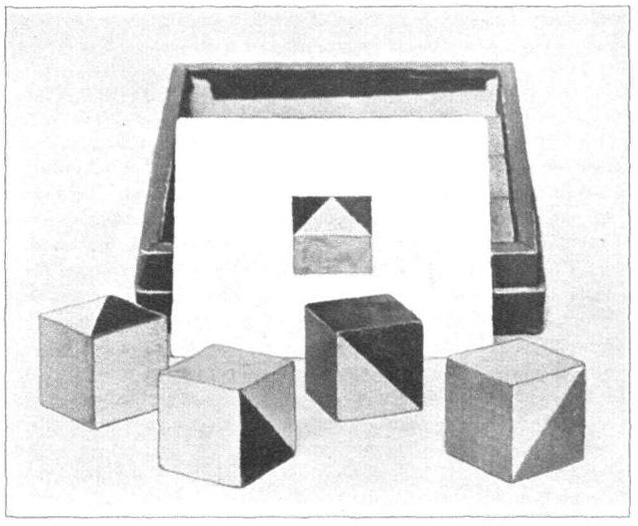
The Kohs Block test, also known as the Kohs Block Design Test, is a performance test designed to be an IQ test. The test taker must, using 16 colored cubes, replicate the patterns displayed on a series of test cards. The design of the test was motivated by a belief that the test could easily be administered to persons with language or hearing disabilities.
History
The test was developed in 1920 by psychologist Samuel C. Kohs (1890–1984), a student of Lewis Terman, building on earlier and similar designs (such as Francis N. Maxfield's Color Cube Test).
Kohs described the 1920s version of the test as a series of 17 cards which increase in complexity as the test progressed. Test takers replicated the designs with painted blocks (each side was a single color or two colors divided by a diagonal line). The initial scores were based on completion time and number of moves. Hutt amended the scoring method to only score completion time. The test was given to both children and adults.
As early as the 1930s, the Kohs Block Test was administered at the Ohio School for the Deaf, and at other schools with special needs students.
The Kohs Block Design Test has been adapted into sections in several current IQ tests. The Kohs Test continues to be used in research extensively to measure executive functioning and learning, consistent with the original design of the test. This has made the Kohs Block Test useful for assessing the effects of aging, drug use, and in brain research, among other areas. In particular, that the Kohs is a relatively non-verbal test lends it to be used effectively in assessment of those with language issues and in multicultural research settings to reduce the impact of language on assessment of functioning.
Patients with damage to the right hemisphere of the brain find successful completion of the task to be extremely difficult, so the test is often used to diagnose right hemisphere damage.
References
References
- (1920). "The Block-Design Tests". Journal of Experimental Psychology.
- Phillips, Leslie. (1966-03-13). "Tests Often a Game For Children Are Signposts For Psychologists". News Journal.
- Terman, Lewis. (1930). "History of Psychology in Autobiography". Clark University Press.
- (2011). "Encyclopedia of Clinical Neuropsychology". Springer.
- (1923). "Intelligence measurement: A psychological and statistical study based upon the block-design tests". MacMillan Co..
- (1932). "The Kohs block-design tests. A revision for clinical practice.". Journal of Applied Psychology.
- (1931-03-15). "Degree of Master of Arts Won by Mis Jean McDonald". The Zanesville Signal.
- American Psychological Association. (2007). "APA Dictionary of Psychology". American Psychological Association.
- (2009). "Learning effects in the block design task: A stimulus parameter-based approach". Psychological Assessment.
- (2001). "Strategy development in a block design task". Intelligence.
- (2002). "Anxiety, Cognitive Performance, and Cognitive Decline in Normal Aging". The Journals of Gerontology Series B: Psychological Sciences and Social Sciences.
- (2015). "T2 relaxation time alterations underlying neurocognitive deficits in alcohol-use disorders (AUD) in an Indian population: A combined conventional ROI and voxel-based relaxometry analysis". Alcohol.
- (2010). "Changes in fMRI magnitude data and phase data observed in block-design and event-related tasks". NeuroImage.
- Jaynes, Julian. (1976). "The Origin of Consciousness in the Breakdown of the Bicameral Mind". First Mariner Books.
This article was imported from Wikipedia and is available under the Creative Commons Attribution-ShareAlike 4.0 License. Content has been adapted to SurfDoc format. Original contributors can be found on the article history page.
Ask Mako anything about Kohs block design test — get instant answers, deeper analysis, and related topics.
Research with MakoFree with your Surf account
Create a free account to save articles, ask Mako questions, and organize your research.
Sign up freeThis content may have been generated or modified by AI. CloudSurf Software LLC is not responsible for the accuracy, completeness, or reliability of AI-generated content. Always verify important information from primary sources.
Report