From Surf Wiki (app.surf) — the open knowledge base
Knafeh
Middle Eastern dessert made of filo pastry

Middle Eastern dessert made of filo pastry
| Field | Value | |
|---|---|---|
| name | Knafeh | |
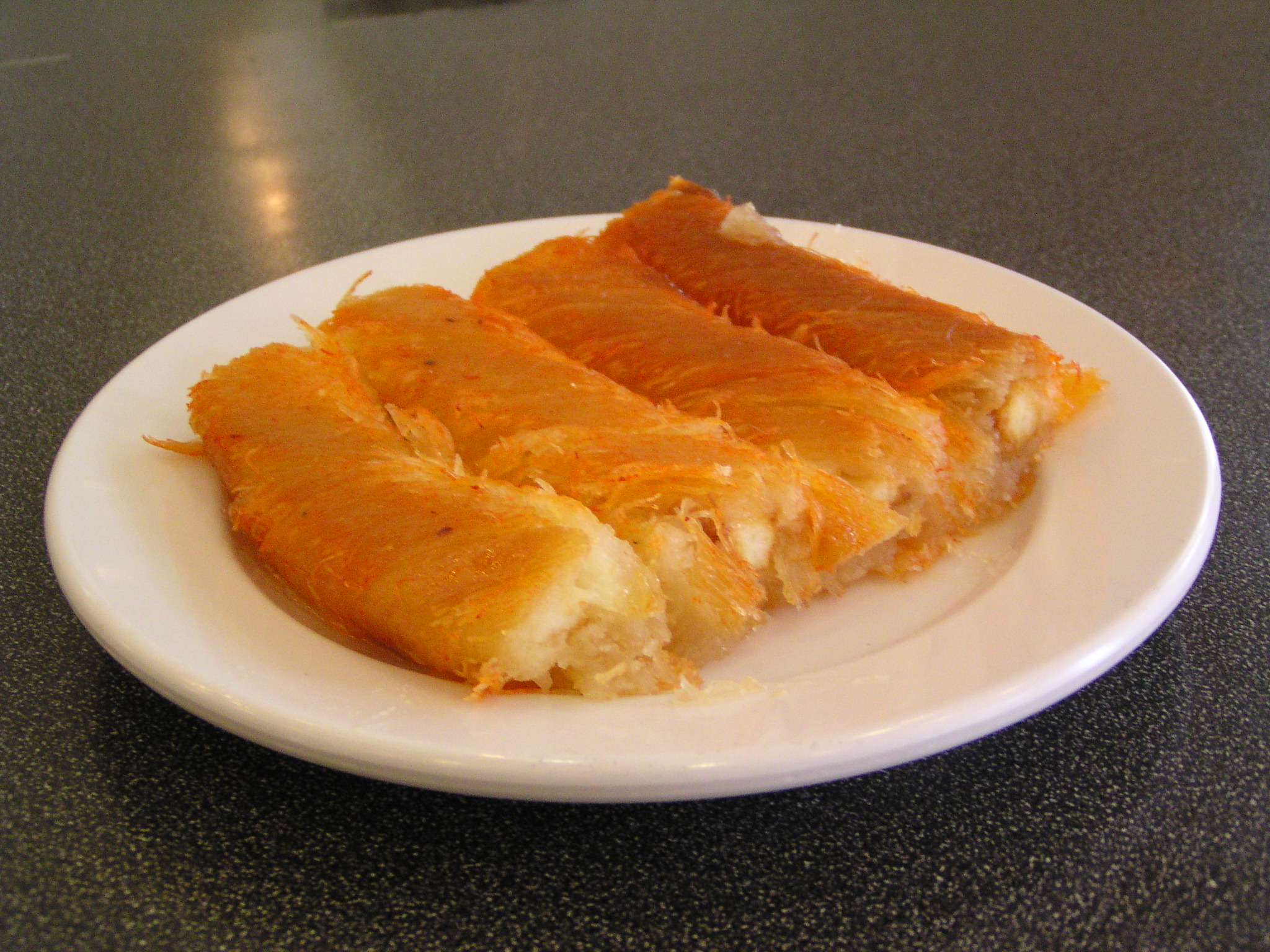
| image | Künefe.jpg | |
| caption | Künefe from Hatay, Turkey | |
| image_size | 250 | |
| alternate_name | {{plainlist | |
| region | Arab world | |
| type | Dessert | |
| served | Warm, room temperature, or cold (qishta variety) | |
| main_ingredient | {{plainlist | |
| variations | Multiple |
- Kunafeh
- Kunafa
- Kanafeh
- Konafi
- Kunaftah
- Künefe
- Kinafa
- Dough
- Sugar
- Cheese
- Almonds
- Pistachios
- Rose water
- Kaymak Knafeh () is a traditional Arab dessert made with kadayif (spun pastry dough) layered with cheese and soaked in a sweet, sugar-based syrup called attar. Knafeh is popular throughout the Arab world, especially in Egypt, and the Levant. Knafeh is often served on special occasions, holidays and celebrating the month of Ramadan. The most common variant of knafeh in Jordan and Palestine, Knafeh Nabulseyeh, originated in the Palestinian city of Nablus.
Etymology
English borrowed the word knafeh from Levantine and Egyptian Arabic, and transliterates it as ar, and similar variations.
The ultimate origin of the word is debated. It may come from the Coptic Egyptian cop, a bread or cake. Or it may come from a Semitic root meaning "side" or "wing", and from the Arabic ar, "to flank or enclose". Early uses appear in One Thousand and One Nights, a collection of Middle Eastern folk Tales.
History
A common story is that the knafeh was created to satisfy the hunger of caliphs during Ramadan. The story, which dates in writing as early as the 10th century, is variously said to have occurred in Fatimid Egypt or in the Umayyad Caliphate in Damascus, Syria, where Levantine dessert makers preparing it for Mu'awiya I.
Ibn Sayyar al-Warraq's tenth century Arabic cookbook, ar (Book of Dishes), which documented many recipes from Abbasid courts, does not mention or describe knafeh. However, it does feature a chapter on qatayif, an Arabic pancake dumpling dessert that originated in the Fatamid Empire. The 13th century cookbook, ar (Book of Dishes from Maghreb and Al-Andalus), of unknown author, gives a number of recipes for knafeh, which it describes as a pancake dumpling thinner than qatayif prepared on a flat pan. Some of the knafeh recipes in the cookbook call for layering the thin pancake with fresh cheese, baking it, and topping it with honey and rose syrup.
Ibn al-Jazari gives an account of a 13th-century Mamluk period market inspector who rode through Damascus at night ensuring the quality of knafeh, qatayif, and other foods associated with Ramadan. Over time, new knafeh preparation methods were developed, including a technique of dripping thin batter onto a metal sheet from a perforated container, creating hair-like strings. A mid-15th century Ottoman Turkish translation of Muhammad bin Hasan al-Baghdadi's ar added several new contemporary knafeh recipes, though it does not specify where they originated from.
According to historian , cheese-filled knafeh does not appear in any historical records prior to the 19th century, Turkish and Arabic Damascene recipes from the 18th century always used different nuts as filling. An 1844 dictionary for Syrian and Egyptian Arabic by Swedish Orientalist mentions a knafeh made of string dough and qaymaq, a sort of cooked cream. |trans-title=A French-Arabic guide for travelers and Franks in Syria and Egypt: with a physical and geographical map of Syria and a geometric plan of ancient and modern Jerusalem, as a supplement to travels in the Orient
The book "Comparative Encyclopedia of Aleppo" by Syrian author Khayr al-Din al-Asadi, completed in 1971 and published posthumously in 1981, described 10 different kinds of knafeh.
Common variants

Knafeh Nabulseyeh (Nablus, Palestine)
Knafeh has been described as a "Palestinian Institution." Knafeh Nabulseyeh is a popular version of knafeh originated in the Palestinian city of Nablus, hence the name Nabulseyeh (also spelled as Nabilsiyeh). Nablus is still renowned in for its knafeh, which "is filled with the city’s trademark firm, white, salty nabulsi cheese" and covered with a sweet syrup called qatir, it has 1 layer of either rough (kadayif) or soft (semolina) knafeh pastry atop the cheese, typically prepared upside down then flipped, with soft dough being more popular than kadayif for Nabulsi knafeh.
Today, knafeh Nabulseyeh is the most common variant of knafeh in Jordan and Palestine. As a result, academics have described Nablus as the modern-day knafeh capital.
Associations between Nablus and knafeh date back to at least 1950; ar's 1950 book ar noted that "Nablus is famous for its knafeh".
Knafeh Ghazawiya (Gaza Strip, Palestine)
Knafeh Ghazawiya is a Palestinian variant of knafeh unique to the Gaza Strip. It is made with a variety of Gazan nuts and spices, with "nutmeg and cinnamon replacing the cheese.", the pastry used is made from semolina and bulgur.
Künefe (Hatay, Turkey)
Künefe is a variant of knafeh believed to have originated in Hatay Province, Turkey. It is filled with a mozzarella-like local Hatay cheese and coated in "a syrup made of water, sugar and lemon juice." In 2012, the EU Commission approved Antakya Künefesi, a variant of both kadayif and künefe, as a Protected Geographical Indication (PGI). It also received a geographic indication by the Turkish Patent and Trademark Office, both geographic indications specify that Hatay kunefe is made with 2 separately heated layers of pastry around the cheese.
Dubai chocolate
Dubai chocolate is a chocolate bar with a kadayif and pistachio filling, It was first produced by Fix Dessert in Dubai, but versions are now sold worldwide. While originally inspired by knafeh and first sold under the name "Can't Get Knafeh Of It", the bar does not contain any cheese.
Sandwiched knafeh

In Lebanon, kaak knafeh is a popular street food, its made of a knafeh sandwiched in sesame-coated bread.
In Nablus, knafeh is sandwiched in pita bread and eaten for breakfast.
Knafeh madlouqa

Knafeh madlouqa () is a Levantine dessert made of a layer of finely-shredded knafeh dough that is cooked in samneh and topped with qishta or kaymak. The knafeh pastry in the bottom layer is sometimes replaced with semolina.
Preparation
There are several types of knafeh pastry:
- khishnah (, rough): a crust made from long thin noodle threads.
- nāʿimah (, fine): a semolina dough.
- muhayara (, mixed): a mixture of khishnah and na'ama.
- mabruma (, twined): a noodle pastry
The knafeh pastry is heated in butter, margarine, palm oil, or traditional semneh, spread with soft sweet cheese, such as Nabulsi cheese, and topped with additional pastry. In khishnah knafeh the cheese is rolled in the pastry. During the final minutes of cooking, thick sweet sugar syrup, water, and a few drops of rose water or orange blossom water are poured on the pastry. The top layer of pastry is sometimes tinted red or orange, and crushed pistachios are often sprinkled as a garnish.
Besides cheese, common fillings include nuts or cream, such as qishta which is used in othmalliyya.
Politics
Israel-Palestine
Main article: Politics of food in the Arab–Israeli conflict
Today, knafeh is served throughout the Middle East, although it is "particularly associated with Nablus" and considered to be a "cultural touchstone for Palestinian identity".
Knafeh is popular in Israel, and it is prepared by many Israeli eateries and chefs. Some Palestinians have criticized the presentation of knafeh as an Israeli food without reference to its Arab origins, describing this as cultural appropriation.
Gallery
File:Jerusalem Kanafeh (3783936961).jpg|Knafeh served in Jerusalem File:Kanafeh.jpg|Knafeh shop, old city of Jerusalem File:Cheese Soft Konafah.jpg|Soft Knafeh filled with Nabulsi cheese File:Pistachio Kadayif (Unsplash).jpg|Knafeh coated with pistachio and cream File:Turkish künefe and tea.jpg|Turkish künefe File:Knafeh.jpg|Knafeh served with ice cream File:The Kunafa Maker.jpg|A traditional knafeh maker in Cairo File:Dubai chocolate on a plate 02.jpg|A bar of Dubai chocolate, filled with knafeh and ground pistachios
References
References
- (3 July 2020). "Othmaliye". [[Middle East Monitor]].
- "knafeh".
- Nissenbaum, Dion. (2023-01-04). "A Trendy Dessert Stirs Up a Sticky Debate". Wall Street Journal.
- (2007). "The World Religions Cookbook". Greenwood Press.
- (2014). "The Oxford Companion to Food". [[Oxford University Press]].
- "Will Egypt’s years-long kunafa trend survive the economic dip?".
- (2010). "Food, Cuisine, and Cultural Competency for Culinary, Hospitality, and Nutrition Professionals". Jones & Bartlett Publishers.
- "Knafeh".
- (2013). "Classic Palestinian Cuisine". Saqi.
- (2024-10-08). "Sami Tamimi and Tara Wigley's knafeh nabulseyeh". The Guardian.
- (2012). "Mediterranean Cuisine". AuthorHouse.
- "Etymological Dictionary of Arabic". [[University of Oslo]].
- (17 November 2010). "Encyclopedia of Jewish Food". Houghton Mifflin Harcourt.
- (26 May 1999). "The Dribble With Pastry". [[Los Angeles Times]].
- Youssef, Aḥmad Abdel-Hamid. (2003). "From Pharaoh's Lips : Ancient Egyptian Language in the Arabic of Today". [[American University in Cairo Press]].
- (2015). "The Oxford Companion to Sugar and Sweets". [[Oxford University Press]].
- ((The Editors of the American Heritage Dictionaries)). "Appendix II - Semitic Roots". Houghton Mifflin Harcourt.
- "Definition and meaning of Kanafeh in Arabic in the dictionary of the meanings of the whole, the lexicon of the mediator, the contemporary Arabic language - Arabic Arabic dictionary - Page 1".
- (2014). "Sweet Treats around the World: An Encyclopedia of Food and Culture". ABC-CLIO.
- Wright, Clifford A.. (1999). "A Mediterranean Feast: The Story of the Birth of the Celebrated Cuisines of the Mediterranean from the Merchants of Venice to the Barbary Corsairs, with More than 500 Recipes". William Morrow Cookbooks.
- (4 October 2007). "The Ramadan Experience in Egypt - ASHARQ AL-AWSAT English Archive". ASHARQ AL-AWSAT English Archive.
- (6 July 2015). "Kunafa, Qatayef: Ramadan's most favorite desserts". [[Cairo Post]].
- (2021-04-14). "20 places to get amazing kunafa and Arabic sweets in the UAE".
- Nasrallah, Nawal. (2007). "Annals of the caliphs' kitchens : Ibn Sayyār al-Warrāq's tenth-century Baghdadi cookbook". [[Brill Publishers.
- "An Anonymous Andalusian Cookbook of the 13th Century".
- (31 October 2014). "Sugar in the Social Life of Medieval Islam". BRILL.
- (8 January 2013). "Sherbet and Spice: The Complete Story of Turkish Sweets and Desserts". I.B.Tauris.
- (4 Apr 2025). "The TikTok-Famous Dubai Chocolate Traces Its Origins to the 13th-Century Middle East". [[Smithsonian (magazine).
- (1885). "كتاب تذكرة الخواتين واستاذ الطباخين". المطبعة الادبية.
- (1891). "Actes du huitième congrès international des orientalistes tenu en 1889 à Stockholm et à Christiania". Brill.
- (5 October 2025). ""موسوعة حلب المقارنة".. الأسدي يرسم هوية المدينة بسبعة مجلدات". [[Enab Baladi]].
- [http://imeu.net/news/article00258.shtml Cuisine] {{webarchive. link. (2007-08-04 Institute for Middle East Understanding)
- (2 Oct 2019). "This sweet Palestinian food finally taught Israelis how to wait in line". Haaretz.
- (29 May 2017). "The Palestinian pride behind the sweet journey of knafeh". The New Arab.
- (24 Nov 2018). "بالفيديو: الكنافة النابلسية.. أصل الحكاية". Al Jazeera.
- (1950). "Riḥlāt ʻAbd al-Wahhāb ʻAzzām".
- Berger, Miriam. "The Palestinian dessert few can enjoy".
- (2 April 2023). "In Ramadan, Gazans sweeten the nights with kunafa". Arab News.
- Tokyol, Gonca. (18 April 2023). "Künefe: The beloved dessert rebuilding Turkey".
- {{CELEX. 52022XC1115(02)
- (23 September 2008). "Hatay künefesi patent aldı". [[Hurriyet]].
- "ANTAKYA KÜNEFESİ".
- (15 March 2023). "Antakya’s künefe receives protected status - Türkiye News". Hürriyet Daily News.
- (23 January 2025). "How Dubai Chocolate Took over the World". The New York Times.
- (Dec 15, 2021). "The Sticky and Sweet Lebanese Dessert in Pretzel Has Made It to Israel". Haaretz.
- (22 Feb 2023). "An odyssey of Palestinian dishes in the West Bank". Al-Araby Al-Jadeed.
- (24 August 2015). "A Trip to the West Bank's Cheesy Dessert Capital". VICE.
- (1981). "موسوعة حلب المقارنة".
- (1997). "معجم فصاح العامية". [[:ar:مكتبة لبنان ناشرون.
- (8 May 2021). "Madlouqa". Middle East Monitor.
- (23 April 2022). "طريقة عمل المدلوقة بالسميد والقشطة الطازة". [[Sada El-Balad]].
- (9 October 2013). "Kunafa".
- (4 Mar 2025). "خيوط عجين بالسمن والسكر.. «الكنافة» أشهر الحلويات في شهر رمضان". [[Al-Masry Al-Youm]].
- (22 March 2018). "A New Book of Middle Eastern Food: The Essential Guide to Middle Eastern Cooking. As Heard on BBC Radio 4". Penguin Books Limited.
- (25 September 2019). "Sweet And Cheesy Knafeh Is An Ancient Dessert Going Big In Modern LA". LAist.
- (4 March 2020). "Cultural appropriation fail: Palestinians mock Israeli chef’s ’beef knafeh’". The New Arab.
- (4 June 2014). "Is knafeh Israeli or Palestinian?". Haaretz.
- (19 August 2014). "Can a Classic Dessert Bring World Peace, Uniting Arabs and Jews?". [[Tablet Magazine]].
This article was imported from Wikipedia and is available under the Creative Commons Attribution-ShareAlike 4.0 License. Content has been adapted to SurfDoc format. Original contributors can be found on the article history page.
Ask Mako anything about Knafeh — get instant answers, deeper analysis, and related topics.
Research with MakoFree with your Surf account
Create a free account to save articles, ask Mako questions, and organize your research.
Sign up freeThis content may have been generated or modified by AI. CloudSurf Software LLC is not responsible for the accuracy, completeness, or reliability of AI-generated content. Always verify important information from primary sources.
Report