From Surf Wiki (app.surf) — the open knowledge base
Kiyotake Kawaguchi
Japanese general in World War II
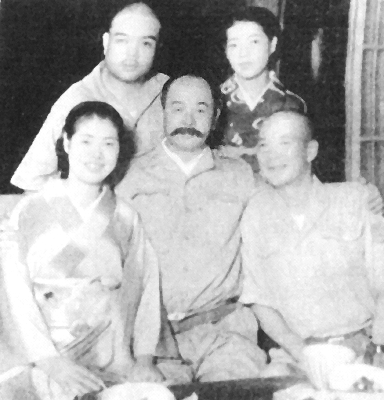
Japanese general in World War II
| Field | Value |
|---|---|
| name | Kiyotake Kawaguchi |
| native_name | 川口 清健 |
| native_name_lang | jpn |
| birth_date | |
| death_date | |
| birth_place | Kōchi City, Kōchi Prefecture, Japan |
| image | Kawaguchi Kiyotake.jpg |
| image_size | 180 |
| caption | Japanese General Kiyotake Kawaguchi |
| allegiance | Empire of Japan |
| branch | |
| serviceyears | 1914–1945 |
| rank | Major General |
- Second Sino-Japanese War
- World War II
- Battle of the Philippines
- Guadalcanal campaign
- Battle of Edson's Ridge
- Battle for Henderson Field Kiyotake Kawaguchi was a general in the Imperial Japanese Army during World War II.
Biography
A native of Kōchi Prefecture, Kiyotake graduated from the 26th class of the Imperial Japanese Army Academy in 1914, and from the 34th class of the Army Staff College in 1922. He spent much of the 1920s and 1930s in a series of staff positions in the North China Area Army and in Japan, before his promotion to major general in 1940.
In 1940, Kawaguchi was appointed commander of the IJA 35th Infantry Brigade. This was under the direct command of the Southern Army and was formed from units from the IJA 18th Division. Kawaguchi's reinforced brigade made a series of landings in British Borneo in December 1941 and January 1942: at Miri, Kuching, Brunei, Jesselton, Beaufort, Labuan Island and Sandakan.
Kawaguchi and his 35th Infantry Brigade, along with other attached units, were landed as reinforcements on Guadalcanal in August and September 1942 in response to the Allied landings on the island. In the resulting Battle of Edson's Ridge on 13 September 1942, Kawaguchi's forces were defeated with heavy losses and forced to retreat from the battlefield. Kawaguchi was subsequently relieved of command during the Japanese preparations for another attack in October 1942 and evacuated from the island and back to Japan.
Kawaguchi was relegated to the reserve list in 1943. After recovering from a long illness, he was placed in command of the defenses of Tsushima Island in March 1945.
After the surrender of Japan, Kawaguchi was transferred to the Philippines to face the military tribunal of the Philippine Army for war crimes committed in Lanao province. He pleaded guilty and was sentenced to six years imprisonment on November 14, 1949. On July 4, 1953, President Elpidio Quirino pardoned all the remaining Japanese war criminals under Philippine jurisdiction.
Kawaguchi died in Japan in 1961.
References
Books
- {{cite book
- {{cite book
- {{cite book
- {{cite book
- {{cite book
Web
- {{cite web
- {{cite encyclopedia
- {{cite web
- {{cite web
- {{cite web
References
- Ammenthorp, The Generals of World War II
- L, Klemen. (1999–2000). "Major-General Kiyotake Kawaguchi". Forgotten Campaign: The Dutch East Indies Campaign 1941-1942 }}{{Dead link.
- L, Klemen. (1999–2000). "The Invasion of British Borneo in 1942". Forgotten Campaign: The Dutch East Indies Campaign 1941-1942.
- During the later stages of the Japanese occupation of the Philippines, it landed at [[Cebu]] in March 1942 and [[Mindanao]] the following month. As commander of Army forces on Cebu after the [[Battle of the Philippines (1941-42). invasion of the Philippines]] in 1942, Kawaguchi objected strenuously to the "revenge killings" of senior Philippine government officials and supreme court justices by Japanese authorities, most notably Japanese Army [[Colonel]] [[Masanobu Tsuji]]. He argued that, "shooting defeated opponents in cold blood was a violation of the true [[Bushido]]." His protests earned him the enmity of Tsuji, who used every opportunity to get Kawaguchi reassigned to combat zones from which he was not likely to return.Harries, ''Soldiers of the Sun'', p. 338.
- Frank, ''Guadalcanal: The Definitive Account of the Landmark Battle''
- "Justice and Reconciliation: Postwar Philippine Trials Against Japanese War Criminals in History and Memory". George Washington University.
This article was imported from Wikipedia and is available under the Creative Commons Attribution-ShareAlike 4.0 License. Content has been adapted to SurfDoc format. Original contributors can be found on the article history page.
Ask Mako anything about Kiyotake Kawaguchi — get instant answers, deeper analysis, and related topics.
Research with MakoFree with your Surf account
Create a free account to save articles, ask Mako questions, and organize your research.
Sign up freeThis content may have been generated or modified by AI. CloudSurf Software LLC is not responsible for the accuracy, completeness, or reliability of AI-generated content. Always verify important information from primary sources.
Report