From Surf Wiki (app.surf) — the open knowledge base
Kivu
Region in the Democratic Republic of the Congo
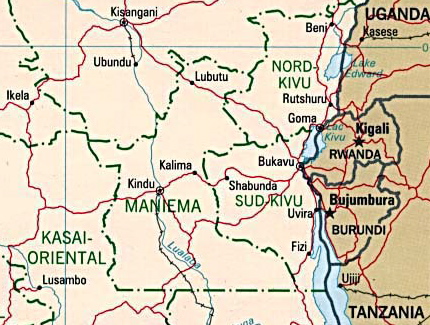
Region in the Democratic Republic of the Congo

Kivu is the name for a large region in the eastern Democratic Republic of the Congo that borders Lake Kivu. It was a Région (read 'province') of the country under the rule of Mobutu Sese Seko from 1966 to 1988. As an official Région in 1986 it was divided into the three "Sub-Regions" (Sous-Régions in French) of: Nord-Kivu, Sud-Kivu and Maniema, Those three became the current provinces in the reorganization of 1988.{{Cite journal |url=https://journals.openedition.org/espacepolitique/1296 |accessdate=7 March 2025 |last=Bruneau |first=Jean-Claude |title=Les nouvelles provinces de la République Démocratique du Congo : construction territoriale et ethnicités |language=fr
History
Kivu has been repeatedly subjected to major conflicts since the early 20th century. Under Belgian colonial rule, it was the site of several religious revolts such as the 1944 Kivu uprising. Following independence, it was a battleground of the Simba rebellion, First Congo War, and Second Congo War, and has been the site of an ongoing military conflict since the early 2000s. In 2025 substantial parts of the area came under the control of the March 23 Movement.
From August 2018 to June 2020, an Ebola epidemic affected the region.
Geography
Kivu is also the name for the entire region surrounding Lake Kivu, including the portions in Rwanda which contain the vast majority of the lake area's population (the contiguous towns of Goma in the Democratic Republic of Congo and Gisenyi in Rwanda, with a combined population approaching 1,000,000, form the largest urbanised area in the Lake Kivu area). The area is characterized by lush vegetation and an extended growing season due in part to its high elevation (1500 m or 4900 ft at the lakeshore) and the volcanic nature of its soil. The Kivu region represents the high point of the East African Rift Valley.
The lake itself contains a massive amount of carbon dioxide in its depths, and there is some concern that tectonic activity (rifting) and/or volcanic activity might cause a limnic eruption, a sudden release of this captured carbon dioxide. If this were to happen it would devastate the population around the lake; however, the likelihood of this occurring is in dispute.
Approximate correspondence between historical and current provinces
| Belgian Congo | Republic of the Congo | Zaire | Democratic Republic of the Congo | 1908 | 1919 | 1932 | 1947 | 1963 | 1966 | 1971 | 1988 | 1997 | 2015 | 22 districts | 4 provinces | 6 provinces | 6 provinces | 21 provinces + capital | 8 provinces + capital | 8 provinces + capital | 11 provinces | 11 provinces | 26 provinces |
|---|---|---|---|---|---|---|---|---|---|---|---|---|---|---|---|---|---|---|---|---|---|---|---|
| Bas-Uele | Orientale | Stanleyville | Orientale | Uele | Orientale | Haut-Zaïre | Orientale | Bas-Uele | |||||||||||||||
| Haut-Uele | Haut-Uele | ||||||||||||||||||||||
| Ituri | Kibali-Ituri | Ituri | |||||||||||||||||||||
| Stanleyville | Haut-Congo | Tshopo | |||||||||||||||||||||
| Aruwimi | |||||||||||||||||||||||
| Maniema | Costermansville | Kivu | Maniema | Kivu | Maniema | ||||||||||||||||||
| Lowa | |||||||||||||||||||||||
| Kivu | Nord-Kivu | Nord-Kivu | |||||||||||||||||||||
| Kivu-Central | Sud-Kivu |
References
References
- [[International Crisis Group]]. (9 July 2009). "Congo: A Comprehensive Strategy to Disarm the FDLR".
- (18 April 2012). "Democratic Republic of Congo: Mobility and Methods of Transportation between Grand Kivu and Kinshasa". [[Immigration and Refugee Board of Canada]].
- Stearns, Jason. (2012). "North Kivu: The background to conflict in north Kivu province in eastern Congo.".
- "Lake Kivu Home Page".
This article was imported from Wikipedia and is available under the Creative Commons Attribution-ShareAlike 4.0 License. Content has been adapted to SurfDoc format. Original contributors can be found on the article history page.
Ask Mako anything about Kivu — get instant answers, deeper analysis, and related topics.
Research with MakoFree with your Surf account
Create a free account to save articles, ask Mako questions, and organize your research.
Sign up freeThis content may have been generated or modified by AI. CloudSurf Software LLC is not responsible for the accuracy, completeness, or reliability of AI-generated content. Always verify important information from primary sources.
Report