From Surf Wiki (app.surf) — the open knowledge base
Kitt Peak National Observatory
United States astronomical observatory

United States astronomical observatory
| Field | Value |
|---|---|
| image | Kitt Peak National Observatory in the Quinlan Mountains, 2023.jpg |
| image_size | 315 |
| caption | Various telescopes at the Kitt Peak National Observatory (KPNO) in the Quinlan Mountains |
| website | |
| telescope1_name | KPNO Nicholas U. Mayall Telescope |
| telescope1_type | 4.0 m Ritchey–Chrétien reflector |
| telescope2_name | WIYN Telescope |
| telescope2_type | 3.5 m Ritchey–Chrétien reflector |
| telescope3_name | McMath–Pierce solar telescope |
| telescope3_type | Unobstructed solar reflector |
| telescope4_name | KPNO 2.1 m Telescope |
| telescope4_type | Fourth largest on the mountain |
| telescope5_name | Coudé Feed Tower |
| telescope5_type | Coudé spectrograph |
| telescope6_name | NEID Solar Telescope |
| telescope6_type | Obtains disk-integrated light for a spectrograph |
| telescope7_name | Coronado Array |
| telescope7_type | Three commercially produced Meade/Coronado solar instruments used for public education |
| telescope8_name | RCT Consortium Telescope |
| telescope8_type | Robotically controlled |
| telescope9_name | WIYN 0.9 m Telescope |
| telescope9_type | Galactic studies |
| telescope10_name | SOLARIO remote telescope |
| telescope10_type | Astrophotography |
| telescope11_name | CWRU Burrell Schmidt |
| telescope11_type | Galactic studies |
| telescope12_name | SARA Observatory 0.9m telescope |
| telescope12_type | Variable stars, undergraduate training |
| telescope13_name | Visitor Center telescopes |
| telescope13_type | Three instruments used for nightly public programs |
| telescope14_name | Spacewatch 1.8 m Telescope |
| telescope14_type | 72 in mirror scavenged from the Mount Hopkins MMT |
| telescope15_name | Spacewatch 0.9 m Telescope |
| telescope15_type | Spacewatch |
| telescope16_name | Super-LOTIS |
| telescope16_type | Designed to look for visible signatures of GRBs |
| telescope17_name | Auxiliary solar telescopes |
| telescope17_type | Two 0.9 m instruments |
| telescope18_name | Bok Telescope |
| telescope18_type | Versatile |
| telescope19_name | MDM Observatory 1.3 m McGraw-Hill Telescope |
| telescope19_type | Originally at Ann Arbor |
| telescope20_name | MDM Observatory 2.4 m Hiltner Telescope |
| telescope20_type | Galactic surveys |
| telescope21_name | ARO 12m Radio Telescope |
| telescope21_type | One of two telescopes operated by the Arizona Radio Observatory, part of Steward Observatory |
| telescope22_name | VLBA |
| telescope22_type | One of ten radio-telescopes forming the VLBA |
| telescope23_name | DIMM all-sky camera |
| telescope23_type | monitors seeing |
| location | Kitt Peak, Arizona, US |
The Kitt Peak National Observatory (KPNO) is a United States astronomical observatory located on Kitt Peak of the Quinlan Mountains in the Arizona-Sonoran Desert on the Tohono Oʼodham Nation, 88 km west-southwest of Tucson, Arizona. With more than twenty optical and two radio telescopes, it is one of the largest gatherings of astronomical instruments in the Earth's northern hemisphere.{{cite web | access-date = February 18, 2012
Kitt Peak National Observatory was founded in 1958. It is home to what was the largest solar telescope in the world, and many large astronomical telescopes of the late 20th century in the United States.
The observatory was administered by the National Optical Astronomy Observatory (NOAO) from the early 1980s until 2019, after which it was overseen by NOIRLab.
In June 2022, the Contreras Fire led to the evacuation of Kitt Peak. The fire reached the summit at 2 a.m. on Friday, June 17. Four non-scientific buildings, including a dormitory, were lost in the fire. 15 months later in September 2023, the observatory reopened to the public.
General information
Kitt Peak was selected by its first director, Aden B. Meinel, in 1958 as the site for a national observatory under contract with the National Science Foundation (NSF) and was administered by the Association of Universities for Research in Astronomy. The land was leased from the Tohono Oʼodham under a perpetual agreement. The second director (1960 to 1971) was Nicholas U. Mayall. In 1982, NOAO was formed to consolidate the management of three optical observatories — Kitt Peak; the National Solar Observatory facilities at Kitt Peak and Sacramento Peak, New Mexico; and the Cerro Tololo Inter-American Observatory in Chile. The observatory sites are under lease from the Tohono O'odham Nation at the amount of a quarter dollar per acre yearly, which was overwhelmingly approved by the Council in the 1950s. In 2005, the Tohono O'odham Nation brought suit against the National Science Foundation to stop further construction of gamma ray detectors in the Gardens of the Sacred Tohono O'odham Spirit I'itoi, which are just below the summit.{{cite web |access-date=February 16, 2009 |archive-url=https://web.archive.org/web/20080820093309/http://www.mauna-a-wakea.info/maunakea/H4_astrodev.html |archive-date=August 20, 2008 |url-status=dead
The largest optical instruments at KPNO are the Mayall 4 meter telescope and the WIYN 3.5-meter telescope; there are also several two- and one-meter class telescopes. The McMath–Pierce solar telescope was for many decades the largest solar telescope in the world and the largest unobstructed reflector (no secondary mirror in the path of incoming light). The ARO 12m Radio Telescope is also at the location.
Kitt Peak is famous for hosting the first telescope (an old 91 cm reflector) used to search for near-Earth asteroids, and calculating the probability of an impact with planet Earth.{{cite web |access-date = December 13, 2017
Kitt Peak hosts an array of programs for the public to take part in, including:
- Daytime tours, speaking about the history of the observatory as well as touring a major research telescope.
- The Nightly Observing Program (NOP), which allows visitors to arrive in the late afternoon, watch the sunset, and use binoculars and telescopes to view the cosmos.
- Additionally, there is the Overnight Telescope Observing Program (OTOP). This program allows for a one-on-one, full night of observing using any of the visitor center's telescopes. Guests may choose to do DSLR imaging, CCD imaging, or simply take in the sights with their eye to the telescope.
Kitt Peak's Southeastern Association for Research and Astronomy (SARA) Telescope was featured in the WIPB-PBS documentary, "Seeing Stars in Indiana". The project followed SARA astronomers from Ball State University to the observatory and featured time-lapse images from various points around Kitt Peak.{{cite video | access-date = February 17, 2012
A major project started in the 2010s is the Dark Energy Spectroscopic Instrument (DESI) for the 4-meter Mayall telescope, for conducting spectrographic astronomical surveys of distant galaxies probing the expansion history of the universe and the mysterious physics of dark energy.
History
.jpg)
The Kitt Peak National Observatory of the United States was dedicated on March 16, 1960. At the dedication a 36-inch telescope and various facilities were ready. Construction was underway for the then planned 84 inch telescope. (i.e. the KPNO 2.1 meter)
The 84 inch (2.1 m) had its first light in September 1964.
Over the decades the mountaintop hosted many telescopes, and achieved a variety of discoveries. Some examples of astronomical research KPNO contributed to include the study of dark matter, cosmic distances, high-redshift galaxies, and the Boötes Void. In addition, the observatory has engaged in variety of public outreach and education programs.
In 2018, KPNO established plans for its Windows on the Universe Center for Astronomy Outreach.
Notable discoveries
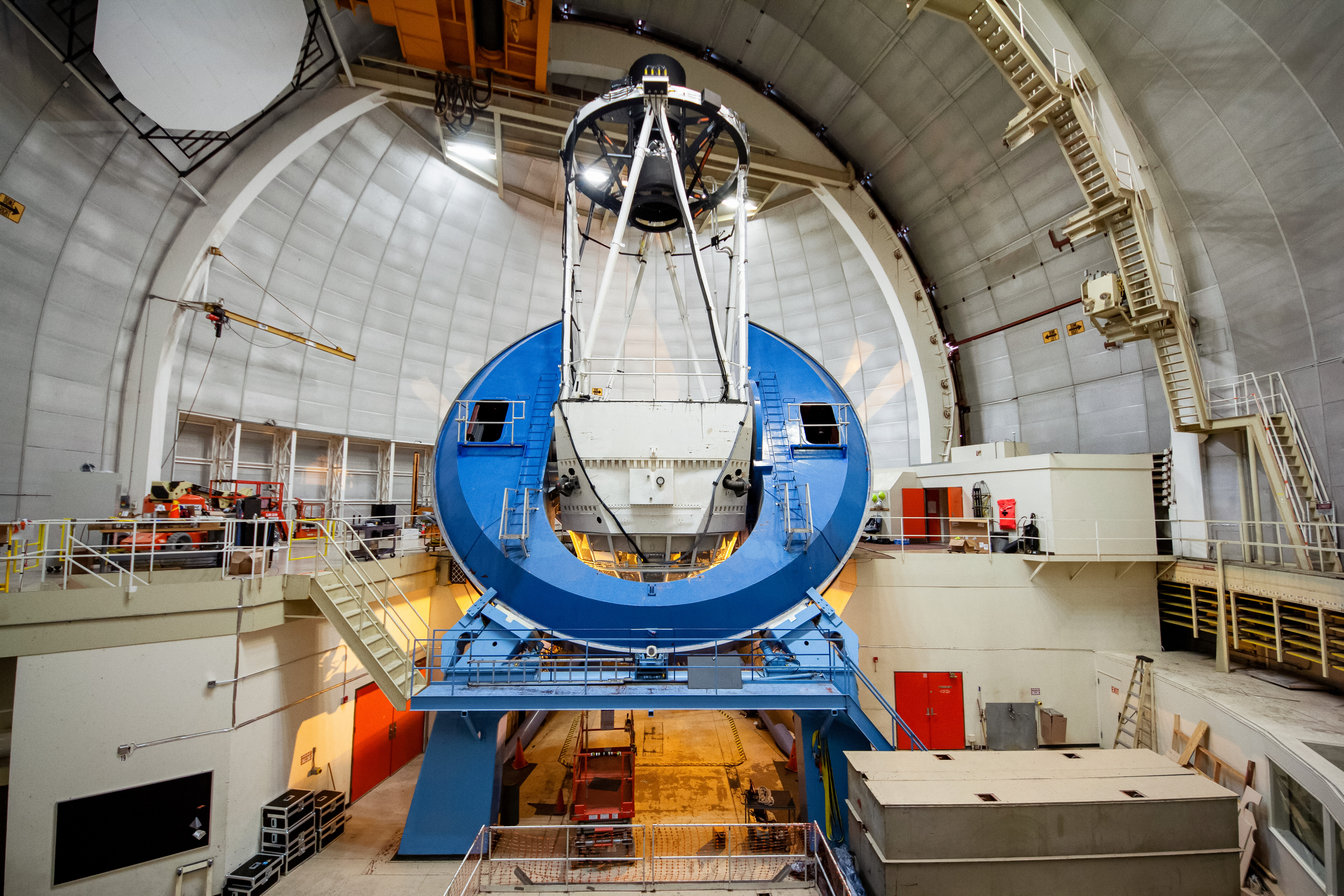
In 1976 the Mayall Telescope was used to discover methane ice on Pluto.
The 90 cm Spacewatch telescope was used to discover the Kuiper belt body, 20000 Varuna in the year 2000. This was discovered by an astronomer noticing the slow moving object in a blink comparison.
Climate
Due to its high elevation, the observatory experiences a subtropical highland climate (Cfb) with a much cooler and wetter climate throughout the year than most of the Sonoran Desert.
Facilities

Image:Kitt Peak National Observatory - 380° panorama taken from behind the Warner & Swasey Observatory.jpg|380° panorama of Kitt Peak from the Warner and Swasey Observatory Image:Kitt Peak National Observatory - 400° panorama taken from the Mayall 4-meter observatory.jpg|400° panorama from Kitt Peak's Mayall 4-meter Observatory
|Jan record high F = 71 |Feb record high F = 75 |Mar record high F = 78 |Apr record high F = 88 |May record high F = 90 |Jun record high F = 98 |Jul record high F = 98 |Aug record high F = 94 |Sep record high F = 91 |Oct record high F = 89 |Nov record high F = 87 |Dec record high F = 72 |year record high F = 98 |Jan record low F = -3 |Feb record low F = -2 |Mar record low F = 9 |Apr record low F = 15 |May record low F = 24 |Jun record low F = 33 |Jul record low F = 40 |Aug record low F = 42 |Sep record low F = 35 |Oct record low F = 20 |Nov record low F = 12 |Dec record low F = 6 |year record low F= -3
References
References
- "ABOUT".
- Lang, Kenneth R.. (2007-01-15). "A Companion to Astronomy and Astrophysics: Chronology and Glossary with Data Tables". Springer Science & Business Media.
- (2019-10-31). "U.S. telescopes get a new overseer".
- (20 June 2022). "Arizona Wildfire Destroys Observatory Buildings". New York Times.
- Borla, Charles. (2023-09-23). "Kitt Peak National Observatory reopens after COVID, wildfire". tucson.com.
- The [[Daniel K. Inouye Solar Telescope]] is now the largest.
- "Kitt Peak Visitor Center Tours, Stargazing, Programs, and Exhibits".
- (2015-06-15). "DESI Design Report".
- Pultarova, Tereza. (February 16, 2018). "How 5,000 Pencil-Size Robots May Solve the Mysteries of the universe". Live Science.
- (1960). "General Notes". Publications of the Astronomical Society of the Pacific.
- "2.1-Meter Telescope".
- (August 21, 2014). "Kitt Peak National Observatory: Discoveries & Programs".
- (September 26, 2018). "NSF Funds New Center for Astronomy Outreach at Kitt Peak".
- Leverington, David. (2003-05-29). "Babylon to Voyager and Beyond: A History of Planetary Astronomy". Cambridge University Press.
- "Spacewatch Discovery of Minor Planet 2000 WR106 {{!}} SPACEWATCH®".
This article was imported from Wikipedia and is available under the Creative Commons Attribution-ShareAlike 4.0 License. Content has been adapted to SurfDoc format. Original contributors can be found on the article history page.
Ask Mako anything about Kitt Peak National Observatory — get instant answers, deeper analysis, and related topics.
Research with MakoFree with your Surf account
Create a free account to save articles, ask Mako questions, and organize your research.
Sign up freeThis content may have been generated or modified by AI. CloudSurf Software LLC is not responsible for the accuracy, completeness, or reliability of AI-generated content. Always verify important information from primary sources.
Report