From Surf Wiki (app.surf) — the open knowledge base
Kitsune
Fox spirits in Japanese folklore
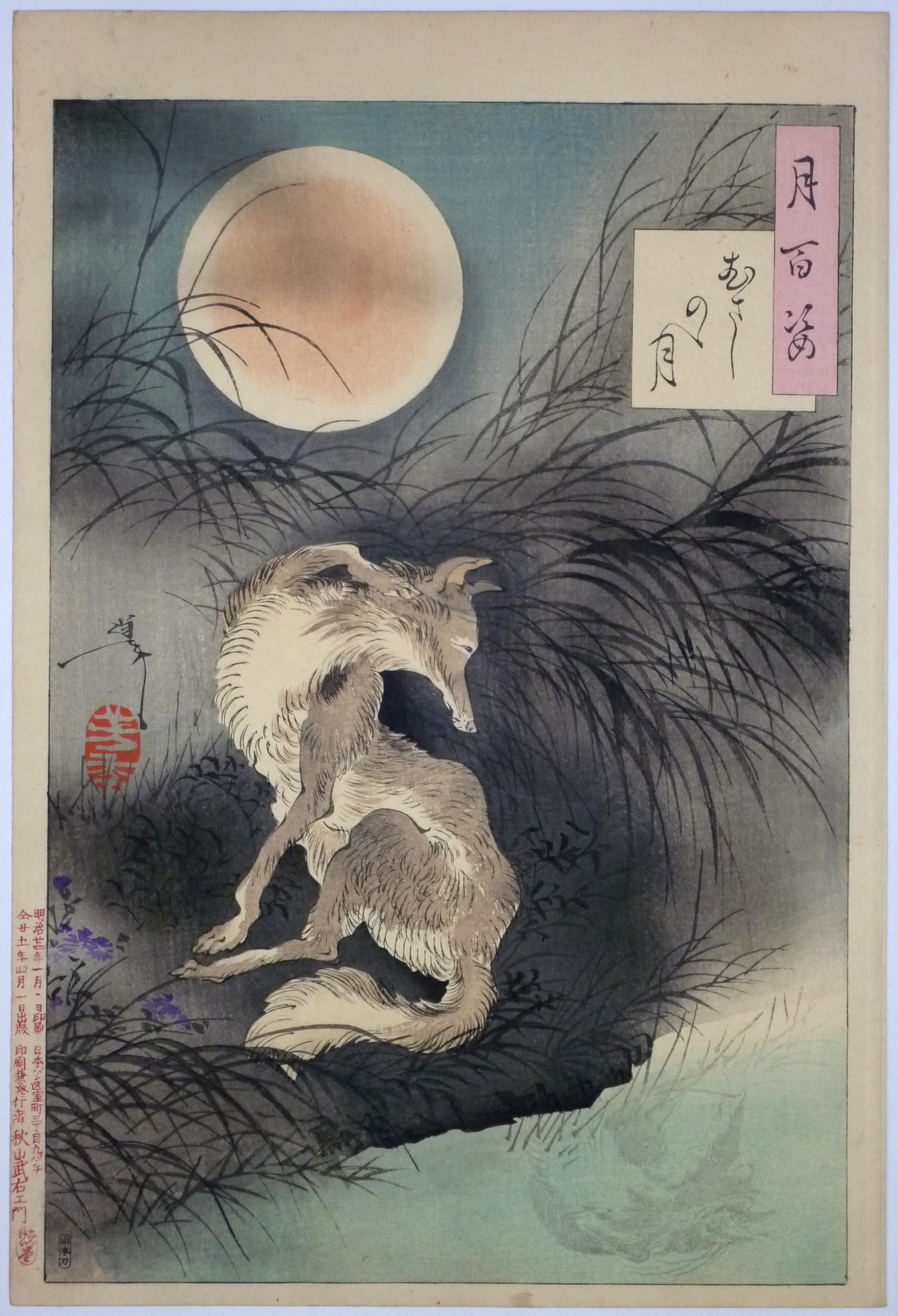
Fox spirits in Japanese folklore
The kitsune, in popular Japanese folklore, is a fox or fox spirit which possesses the supernatural ability to shapeshift or bewitch other life forms.
General overview
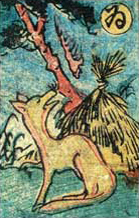
Kitsune, though literally a 'fox', becomes in folklore a 'fox spirit', and a type of yōkai. They are ascribed with intelligence and magical or supernatural powers, especially so with long-living foxes.
The kitsune exhibit the ability of bakeru, or transforming its shape and appearance, like the tanuki as well as the ability to bakasu, i.e. beguile or bewitch; these terms are related to the generic term bakemono meaning "spectre" or "goblin". Another scholar describes the kitsune as being a "disorienting deity" (that makes the traveler lose his way) and such capabilities were also ascribed to badgers (actually tanuki or raccoon dog) and occasionally to cats (cf. bakeneko).
The archetypal method by which the kitsune tricks (bakasu) humans is to lead them astray, or make them lose their way. The experiences of people losing their way (usually in the mountain after dark) and blaming the kitsune fox has been recounted first or secondhand to folklorists well into the present times.
Other typical standard tricks occur as folktale types: people are tricked into taking a "bath in a night-soil pot" (i.e., manure pit), or eating "horse-dung dumpling", or accepting "leaf money" (cf. ).
The "fox wife" theme occurs in a number of noted medieval works (e.g. Nihon ryōiki), but on that theme, the story of nine-tailed vixen Tamamo-no-mae ('Jewel-algae ladyship') and sessho-seki ("murder stone") deserve special attention, as well as the story of a vixen Kuzunoha giving birth to the astrologist-magician Abe no Seimei.
The "Fox wife" is also a folktale type category. There is a weather myth that associates sunshine rain with the kitsune's wedding (Cf. ), and the folktale type for it.
The fox jewel or tama (cf. ) sometimes occur in folktale tradition as something held important by the fox, sometimes as the item necessary for it to transform or conduct other magic. This and the kitsunebi ('fox-fire') which the creature is reputed capable of firing off (cf. ) are standard parts of the pictorial depictions of kitsune, especially on a white kitsune or byakko ().
The kitsune came to be associated with Inari, a Shinto kami or spirit, and serve as its messengers (). The fox also figures in Buddhist as the mount of the deva Dakini, and there is some conflation between the two deities ().
Another dimension is that the kitsune was thought capable of spiritual possession or kitsunetsuki (q.v.), which was a superstition widespread throughout Japan. This is multi-faceted: the illness causing possession might be sought to be exorcized by hiring some shaman, but the fox can turn into a benevolent guardian spirit also, or both, as in the case of an 11th century tale (cf. Kitsunetsuki#Hungry fox).
For an unwanted possession to be exorcised, a professional miko priestess (as in the foregoing tale) or a shugendō priest would be consulted, well into the 20th century as the superstition persisted. A miko or itako purports to be capable of forcing a controlled possession of herself by a fox spirit, and engage in , a sort of séance to speak on behalf of the spirit.
The concept of certain families being "fox owners" (kitsune-mochi) due to having tamed a jinko or ninko were written about in the Edo Period and Meiji era, but appear to be localized around Izumo Province (also further described under kitsunetsuki) which was the backdrop of Lafcadio Hearn's folkloristics. In Izumo, the "owner" families were feared as being able to unleash the fox spirits on normal people.
In other regions, it is only the yamabushi or lay priests trained in shugendō who have the reputation of using kiko. In some cases, the fox or fox-spirit summoned is called the osaki. The familiar may also be known as the kuda-gitsune because they were believed to be so small, or become so small as to fit inside a tube.
The kitsune appears in numerous Japanese works. Noh (), kyogen (), or bunraku and kabuki (, Yoshitsune Senbon Zakura) plays derived from folk tales feature them, as do contemporary works such as native animations, comic books and video games.
Etymology
The full etymology of kitsune is unknown. The oldest known usage of the word is in the text Shin'yaku Kegonkyō Ongi Shiki, dating to 794.
Other old sources include the aforementioned story in the Nihon ryōiki (810–824) and Wamyō Ruijushō (c. 934). These old sources are written in Man'yōgana, which clearly identifies the historical form of the word (when rendered into a Latin-alphabet transliteration) as ki1tune. Following several diachronic phonological changes, this became kitsune.
The fox-wife narrative in Nihon ryōiki gives the folk etymology kitsu-ne as 'come and sleep', while in a double-entendre, the phrase can also be parsed differently as ki-tsune to mean 'always comes'.
Many etymological suggestions have been made, though there is no general agreement:
- Myōgoki (1268) suggests that it is so called because it is "always (tsune) yellow (ki)". perfective aspect particle tsu] to bedroom (ne)", from a legend that a kitsune could take a human woman form, marry a man, and bear children.--
- Arai Hakuseki in Tōga (1717) suggests that ki means 'stench', tsu is a possessive particle, and ne is related to inu, the word for 'dog'.
- Tanikawa Kotosuga in Wakun no Shiori (1777–1887) suggests that ki means 'yellow', tsu is a possessive particle, and ne is related to neko, the word for 'cat'.
- Ōtsuki Fumihiko in Daigenkai (1932–1935) proposes that the word comes from kitsu, which is an onomatopoeia for the bark of a fox, and ne, which may be an honorific referring to a servant of an Inari shrine.
- Nozaki also suggests that the word was originally onomatopoetic: kitsu represented a fox's yelp and came to be the general word for 'fox'; -ne signified an affectionate mood.
Kitsu is now archaic; in modern Japanese, a fox's cry is transcribed as kon kon or gon gon.
Nihongi chronicle
In the Nihon Shoki (or Nihongi, compiled 720), the fox is mentioned twice, as omens. In the year 657 a byakko or "white fox" was reported to have been witnessed in Iwami Province, possibly a sign of good omen. And in 659, a fox bit off the end of a creeping vine plant held by the laborer (shrine construction worker), interpreted as an inauspicious omen foreshadowing the death of Empress Saimei the following year.
For pre-historic considerations before the chronicles, Cf.
{{Anchor|Kyūbi}} Anciently-aged foxes

(1850) argued that there were three classes of foxes, gradable by age, the sky or celestial tenko, the white fox byakko and black fox, of which the tenko was the most ancient, but had no corporeal form and was strictly a spirit(cf. ).
In Japanese folklore, Kitsune have as many as nine tails (but this is derived straight from Chinese classics, as explained below). Generally, a greater number of tails indicates an older and more powerful Kitsune; in fact, some folktales say that a fox will only grow additional tails after it has lived 100 years. One, five, seven, and nine tails are the most common numbers in folktales.
The story was later introduced or invented (established by the 14th century), that the queen-consort Daji (Japanese pronunciation: Dakki) was really a nine-tailed fox that led to the destruction of Yin/Shang dynasty, and the same vixen some 2,000 years later appeared as Tamamo-no-mae in Japan (q.v., also and Hokusai's painting of Tamamo previously as Lady Kayō of India). Tamamo clearly draws from Chinese myth and literature, so her being depicted as a golden-furred and kyūbi no kitsune matches precisely what the Chinese classics writes about the celestial fox (tian hu 天狐) which a 1,000 year old fox turns into.
(Cf. also )
Inari Shinto deity

According to Hiroshi Moriyama, a professor at the Tokyo University of Agriculture, foxes have come to be regarded as sacred by the Japanese because they are the natural enemies of rats that eat up rice or burrow into rice paddies. Because fox urine has a rat-repelling effect, Japanese people placed a stone with fox urine on a hokora of a Shinto shrine set up near a rice field. In this way, it is assumed that people in Japan acquired the culture of respecting kitsune as messengers of Inari Okami.
Inari's kitsune are white, a color of a good omen. They possess the power to ward off evil, and they sometimes serve as guardian spirits. In addition to protecting Inari shrines, they are petitioned to intervene on behalf of the locals and particularly to aid against troublesome nogitsune, those spirit foxes who do not serve Inari. Black foxes and nine-tailed foxes are likewise considered good omens.
There can also be attendant or servant foxes associated with Inari, the Shinto deity of rice. Originally, kitsune were Inari's messengers, but the line between the two is now blurred so that Inari Ōkami may be depicted as a fox. Likewise, entire shrines are dedicated to kitsune, where devotees can leave offerings.
According to beliefs derived from fūsui (feng shui), the fox's power over evil is such that a mere statue of a fox can dispel the evil kimon, or energy, that flows from the northeast. Many Inari shrines, such as the famous Fushimi Inari shrine in Kyoto, feature such statues, sometimes large numbers of them.
Swordsmith deity

Aburage
-p141-kitsunetsuri-foxtrap.png)
The fact that Japanese soup noodles garnished with fried slice of tofu called aburage or abura-age are called kitsune udon and kitsune soba (in Eastern Japan) stems from the popular belief the Inari deity (and its fox minions) prefer to be offered the abura-age (or sushi-rice stuffed in aburage pouches, called inarizushi).
However, the custom of offering abura-age must have arisen rather late (in the Edo Period). In comparison, the notion that the fox's favorite food being nezumi no abura-age dates farther back, since it is attested in 's Matsunoya hikki (c. 1845), which also cites a Muromachi period work Sekyō shō (where there is a metaphor of "springing up like a fox at a yaki-nezumi [roasted rat]").
Watchers of the kyōgen-play know full well that part of the theatrics involves the fox character being driven crazy by the presence of its favorite food, the "oil-fried young mice", While this freak food bait might be thought of as the stuff of popular belief, the oil-fried mouse was an effective bait for trapping foxes, and actually used into the modern era (see fig. right).
Some commentators have extrapolated (on websites, etc.) that people used to offer deep-fried mice to Inari Jinja but was switched to vegetarian substitute, but this has already been rejected by scholar who offers an alternate origin, where in the esoteric rites of Dakini buddhism (associated with foxes, cf. ) dumpling coated with soy flour was offered, which was people colloquially called something like "oil [dump]ling", which hints at this actually being an oil-fried dough treat as found in Chinese cuisine.
Buddhist context
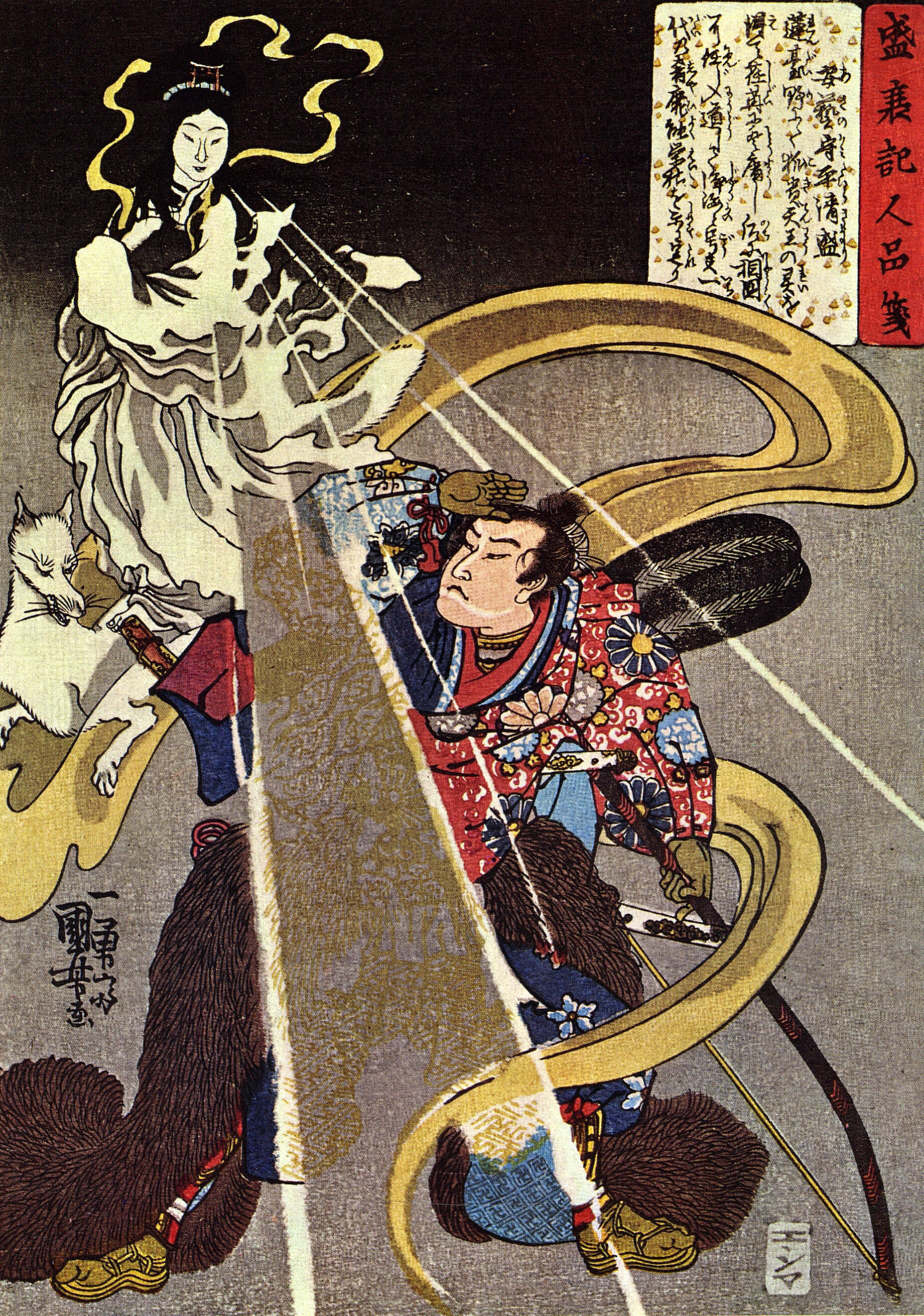
Smyers (1999) notes that the idea of the fox as seductress and the connection of the fox myths to Buddhism were introduced into Japanese folklore through similar Chinese stories, but she maintains that some fox stories contain elements unique to Japan.
Foxes were blamed as a cause for illness, and the Buddhist liturgy called rokujikyōhō were being performed to exorcize it since those times (cf. kitsunetsuki).
Kitsune are connected to the Buddhist religion through the Dakiniten, goddesses conflated with Inari's female aspect. Dakiniten is depicted as a female boddhisattva wielding a sword and riding a flying white fox.
Classifications
A number of authors tried to classify and sub-classify the foxes in different ways, starting from the Heian Period, intensifying in the Edo Period. A sample of it is given as anonymously undated opinions by Lafcadio Hearn.
The Inari Shinto liturgical text Inari no hiden (1780 colophon) lists five types of foxes to be revered, mainly the three: tenko (celestial), kūko, chiko (earth), plus byakko (white), and kūko. 's Yūhisai sakki ( 1781) appeared, which ranks the yako as the most obtuse, followed by the newly created kiko, kūko (sky), then tenko (celestial). 's essay Zen'an zuihitsu, Book 2 (1850) gives his own conclusion that there are tenko, byakko, genko, graded by age, of which the celestial is the most ancient.
Hearn was of the opinion that these precise and intricate stratifications of fox kind according to learned opinion could not be reconciled with the more down-to-earth picture of the kitsune held by the common peasantry.
(Cf. also )
Good vs. evil, or
Hearn's observation was that the Izumo Province during the time of his residence there did conform to the idea that kitsune divided into the good, which are Inari foxes, and the bad. The worst of the bad are called ninko (associated with spiritual possession), and there are other bad, called the yako/nogitsune.
However, Hearn also doubts that such a stark differentiation between the Inari fox and possession fox (good vs. evil) had always been made by the populace in bygone times, and opines this was something imposed upon by the literati. A similar verdict is rendered by , that "practitioners of religion and the intelligentsia were the ones who made commonplace the divide between the good fox vs bad fox". And it was in that milieu that Miyagawa Masakazu in Book 3 of his essay work (1858) set apart zenko and yako ('wild foxes') as the bad. According to Miyagawa, the good fox breaks down further into five subtypes: gold, silver, white, black, and celestial.
Eye for eye, favor for favor
One analysis is that the kitsune will avenge malice with malice, but generally does not repay goodwill with malice, and is loyal to its debt.
An example of revenge is found in a tale set in Kai Province from the 11th century Uji shūi monogatari, where the fox sets fire to a man's home.
An example tale of gratitude involving the dainagon (major counselor) Yasumichi occurs in the Kokon Chomonjū of the mid-13th century, , who was pestered by a family of foxes that took up lair at his mansion, and their bake or mischief escalated to a level of intolerance. But the nobleman halted his plan to eradicate them after a fox appeared in his dream to beg mercy. The foxes after that rarely made rowdy noises, except to cry out loud to announce some good fortune about to happen.
Ninko
Main article: Kitsunetsuki#Ninko
A ninko ("man-fox") according to Lafcadio Hearn is a fox spirit, apparently smaller than the usual fox (no larger than a weasel) except its tail being like a normal full-sized fox's. It is invisible so cannot be detected until it takes possession of some human. Actually the ninko is considered to be kept by the kitsune-mochi, i.e., families gossiped to own and control a fox that can possess, gaining success via that power. As Inoue Enryō noted, the ninko held by kitsune-mochi is just a localized version in Izumo (of the lore of "Animal Spirit Families"), which occurs as the lore of the inkgami or dohyō in neighboring Iwami Province.
Tricksters
Kitsune are often presented as tricksters, preferring to victimize laymen over monks according to one anthologist, though this is not always the case, such as with the fictionalized Hakuzōsu, which in one version (Hyaku monogatari) kills the priest and assumes his place. In the theatrical comedy (kyōgen) version, the hunter realizes the hoax and makes the fox behave ridiculously using a bait of deep-fried mouse, and then captures the fox.
A common trick is to transform into a beautiful woman to beguile men. (cf. ) The kitsune that initiates sexual contact may also manifest the ability to suck the life force or spirit from human beings, reminiscent of vampires or succubi.
Besides the ability to transform, the kitsune is credited with kitsune other supernatural abilities such as spiritual possession (), generating fox-fire (cf. kitsunebi and ).
Another favorite trick of the fox is to give human fake money. Paper currency turns into a leaf once inside the wallet in modern versions, or gold coinage (koban) turns to leaf in older tales.
The fox in fable is also famed for tricking humans into eating dumpling (dango) actually made of horse dung. This is alluded to in the novel Tōkaidōchū Hizakurige (1822) colloquially known as Yaji-Kita after the characters making the journey. In one scene, Yajirobē who "imagines that the fox has taken the shape of [Kitahachi]" refuses the mochi offered him on suspicion of it being inedible horse dung. Foxes are also accused of tricking people into taking a bath in a night soil pot (human manure pit) or a "cesspool" as Hearn puts it politely.
Tales distinguish kitsune gifts from kitsune payments. If a kitsune offers a payment or reward that includes money or material wealth, part or all of the sum will consist of old paper, leaves, twigs, stones, or similar valueless items under a magical illusion. True kitsune gifts are usually intangibles, such as protection, knowledge, or long life.
Shape-shifters
A kitsune may take on human form, an ability learned when it reaches a certain age—usually 100 years, although some tales say 50.
As a common prerequisite for the transformation, the fox must place a leaf (or reeds, weeds) or a skull over its head (cf. Kitsune zōshi picture scroll). The fox's use of skull to transform derives from China, as it is attested in Youyang zazu (9th century). It may have to run a circle around a tree three times to transform. The imagery held by present-day Japanese is that the fox will place a leaf on its head and do a flip in the air to turn into someone or some thing. The use of leaf is hard to explain, but when one examines the corpus of mukashibanashi folktales, the fox frequently stand by water (to look at the reflection of itself) transforms by placing waterweeds on its head, the weed being a sort to ersatz wig.。
Common forms assumed by kitsune include beautiful women, young girls, elderly men, and less often young boys. These shapes are not limited by the fox's own age or gender, and a kitsune can duplicate the appearance of a specific person. Kitsune are particularly renowned for impersonating beautiful women. Common belief in feudal Japan was that any woman encountered alone, especially at dusk or night, could be a kitsune. Kitsune-gao ('fox-faced') refers to human females who have a narrow face with close-set eyes, thin eyebrows, and high cheekbones. Traditionally, this facial structure is considered attractive, and some tales ascribe it to foxes in human form. Variants on the theme have the kitsune retain other foxy traits, such as a coating of fine hair, a fox-shaped shadow, or a reflection that shows its true form.
A medieval tale describes an old fox that transformed into an enormously tall sugi ("cedar") tree, but this raised the suspicion of a man who was searching for his horse; he and his minions shot the tree with arrows, and later a fox was found lying dead.
In some stories, kitsune retain—and have difficulty hiding—their tails when they take human form; looking for the tail, perhaps when the fox gets drunk or careless, is a common method of discerning the creature's true nature. A particularly devout individual may even be able to see through a fox's disguise merely by perceiving them. Kitsune can also be exposed while in human form by their fear and hatred of dogs, and some become so rattled by their presence that they revert to the form of a fox and flee.
Yoshitsune story
Main article: Yoshitsune Senbon Zakura
In the fictional kabuki and puppet play material Yoshitsune Senbon Zakura, the premises is that a 1,000 year old mother and father foxes are hunted for their skin to span the special set of tsuzumi drum, known as the Hatsune ("first sound"). The fox kit assumes the shape of Yoshitsune's retainer Tadanobu in order to be with the drum made from its parents, or possibly to take possession of it.
Kitsunebi control

Main article: Kitsunebi
The kitsune was purportedly capable of firing off the kitsunebi ("fox fire") flame from their tail by stroking it, as portrayed in the Chōjū-jinbutsu-giga (fig. right), or by striking the tail against the ground. Or it might have been the kitsunes fiery breath, according to regional tradition.
The kitsune were also said to employ their kitsunebi to lead travelers astray in the manner of a will-o'-the-wisp.
Spiritual possession {{anchor|Kitsunetsuki}}
Main article: Kitsunetsuki
Kitsunetsuki, also written kitsune-tsuki, literally means 'the state of being possessed by a fox'. Stories of fox possession (kitsunetsuki) are widespread throughout Japan.
Stories of kitsunetsuki s have already been attested during the Heian period, and the setsuwa narrative blaming illness on a fox spirit in Nihon ryōiki can be taken as an early attestation of kitsunetsuki.
From a clinical standpoint, those possessed by a fox are thought to suffer from a mental illness or similar condition. Such illness explanations were already being published by the 19th century, but the superstition was difficult to eradicate (cf. ).
The patient struck ill by the kitsunetsuki syndrome is evidently unable to speak on the kitsune spirit's mind, so that a (hired) miko exorcist temporarily takes over the possession and explains what the fox wants, as in the case of the narrative in the 11th century Uji shūi monogatari, where the fox discloses it merely craved human food.
The idea of fox possession arguably became more widespread in the fifteenth century. Various learned men argued fox possession as superstition or an illness during the Edo period to no avail, the superstition persisted. Lafcadio Hearn picked up on the kitsunetsuki lore during the Meiji Era current near his adoptive home province of Izumo, even while Medical science continued to tried to debunk the myth, and the belief in fox and other animal spirit owning families regionally persisted even in the studies conducted c. 1960.
Familiar spirits
There are families that tell of protective fox spirits, and in certain regions, possession by a kuda-gitsune, osaki, yako, and hito-gitsune are also called kitsunetsuki. These families are said to have been able to use their fox to gain fortune, but marriage into such a family was considered forbidden as it would enlarge the family. They were also said to be able to bring about illness and curse the possessions, crops, and livestock of enemies. This caused them to be considered taboo by the other families, which led to societal problems.
The great amount of faith given to foxes can be seen in how, as a result of the Inari belief where foxes were believed to be Inari no Kami or its servant, they were employed in practices of dakini-ten by mikkyō and shugendō practitioners and in the oracles of miko; the customs related to kitsunetsuki can be seen as having developed in such a religious background.
Wives and lovers
Kitsune are commonly portrayed as lovers, usually in stories involving a young human male and a kitsune who takes the form of a human woman. The kitsune may be a seductress, but these stories are more often romantic in nature. Typically, the young man unknowingly marries the fox, who proves a devoted wife. The man eventually discovers the fox's true nature, and the fox-wife is forced to leave him. In some cases, the husband wakes as if from a dream, filthy, disoriented, and far from home. He must then return to confront his abandoned family in shame.
''Nihon Ryōiki''
The earliest "fox wife" (kitsune nyōbo) tale type, concerning a wife whose identity as fox is revealed after being frightened by the house pet dog, occurs in Nihon Ryōiki, an anthology of Buddhist tales compiled around 822. The plotline involves a man who takes a wife, whose identity is later revealed to be a fox pretending to be a woman.
In this story, a man from , Mino Province --{{Refn|group="lower-alpha" | The archaic place-name is read Ōno-no-kōri in medieval geography. Although translated as "Ōno district", it probably should be clarified that the modern day Ōno District, Gifu (Ōno-gun) lies in the north central part of the prefecture, whereas the actual setting of the tale occurs in Ibi District, at the southwest end of the prefecture, a completely different location. Hamel's book mistook "Ono (Ōno)" to be the man's name (surname).}} -- found and married a fox-wife, who bore a child by him. But the household dog born the same time as the baby always harassed the wife, until one day frightened her so much she transformed back into a yakan, construed to mean "wild fox". Although the husband and wife become separated (during the day), she fulfills the promises to come sleep with him every night, hence the Japanese name of the creature, meaning "come and sleep" or "come always", according to the folk etymology presented in the tale.
Alternate versions of the fox-wife tale appeared later during the Kamakura-period in the works Mizukagami and Fusō Ryakuki of the 12th century.
The fox-wife's descendants were also depicted as doing evil things by taking advantage of their power. According to the foregoing story, the fox-wife's child became the first ancestor of the surname Kitsune-no-atae. However, in another tale from the Nihon Ryōiki, a story was told about a ruffian female descendant; the tale was also placed in the repertoire of the later work Konjaku monogatari. Here, the woman nicknamed "Mino kitsune" (Mino fox), was tall and powerful and engaged in open banditry seizing goods from merchants.
Abe no Seimei

A well-known example of the fox woman motif involves the astrologer-magician Abe no Seimei, to whom was attached a legend that he was born from a fox-woman (named Kuzunoha), and taken up in a number of works during the early modern period, commonly referred to as "Shinoda no mori" ("Shinoda Forest") material (cf. below).
The historical Abe no Seimei later developed a fictional reputation of being the scion of fox-kind, and his extraordinary powers became associated with that mixed bloodline. Seimei was purported to have been born a hybrid between the (non-historical) Abe no Yasuna, and a white fox rescued by him that gratefully assumed the shape of the widower's sister-in-law, Kuzunoha to become his wife, a piece of fantasy with the earliest known example being the Abe no Seimei monogatari printed 1662, and later adapted into puppet plays (and kabuki) bearing such titles as Shinodazuma ("The Shinoda Wife", 1678) and ("A Courtly Mirror of Ashiya Dōman", 1734).
Konjaku monogatari
Another medieval "fox wife" tale is found in the Konjaku monogatarishū (c. 11–12th century), Book 16, tale number 17, concerning the marriage of a man named Kaya Yoshifuji, but the same narrative about this man and the fox had already been written down by Miyoshi Kiyotsura (d. 919) in Zenka hiki and quoted in the Fusō ryakki entry for the 9th month of Kanpyō 8 (Oct./Nov. 896), so it is in fact quite old.
Otogi zōshi
Later the medieval novella Kitsune zōshi (or Kitsune no sōshi) appeared, which may be included in the Otogi-zōshi genre under the broader definition, and the Kobata-gitsune include in the 23 titles of the Otogi-zōshi "library" proper. It has also been noted that the context in Kitsune zōshi, which is no longer a fox-wife tale strictly speaking, since the man is a Buddhist monk, and though he and the bewitching fox-woman spend a night of sensuality together, he is not taking on a spouse, and he merely suffers humiliation.
One scene in Kitsune zōshi reveals the foxes caught in the act of performing transformation by placing as skull or human hair on its head (cf. image right).
Tamamo-no-mae
Main article: Tamamo-no-mae
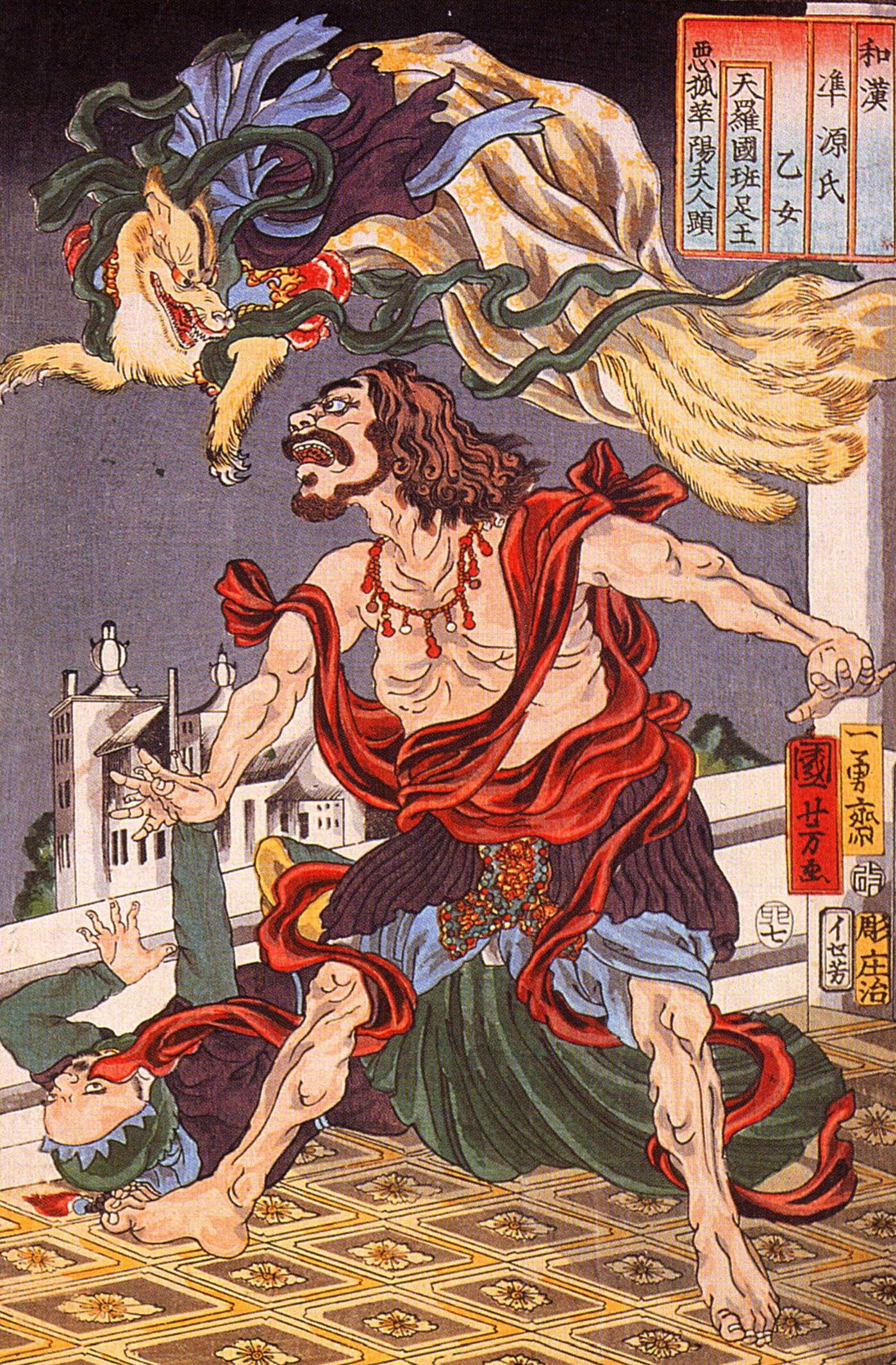
The story about the Lady Tamamo-no-Mae developed in the 14th century, claiming that the vixen captivated the Emperor Konoe (reigned 1141–1155). This was a truly ancient nine-tailed fox, since two thousand years before that, she had been queen-consort Daji to King Zhou of Yin/Shang (Japanese: In no Chū-ō), bringing about the downfall of the dynasty. allowing the Western Zhou dynasty to come into being, only to cause its fall too by assuming the persona of the concubine Bao Si and seducing its last emperor.
After fleeing from Shang dynasty China, she was 花陽婦人 consort named serving King Hanzoku (Kalmashapada of India (cf. figure right below).
Takeda Shingen
Stephen Turnbull, in Nagashino 1575, relates the tale of the Takeda clan's involvement with a fox-woman. The warlord Takeda Shingen, in 1544, defeated in battle a lesser local warlord named Suwa Yorishige and drove him to suicide after a "humiliating and spurious" peace conference, after which Shingen forced marriage on Suwa Yorishige's beautiful 14-year-old daughter Lady Koi—Shingen's own niece. Shingen, Turnbull writes, "was so obsessed with the girl that his superstitious followers became alarmed and believed her to be an incarnation of the white fox-spirit of the Suwa Shrine, who had bewitched him in order to gain revenge." When their son Takeda Katsuyori proved to be a disastrous leader and led the clan to their devastating defeat at the battle of Nagashino, Turnbull writes, "wise old heads nodded, remembering the unhappy circumstances of his birth and his magical mother".
Edo Period
Edo Period scholar Hayashi Razan's ("Study of the Shrines of our Country", 1645) records the lore concerning a man from the Tarui clan, who wedded a fox and begot the historical .
Ancestral lines
A number of stories of this type tell of fox-wives bearing children. When such progeny are human, they possess special physical or supernatural qualities that often pass to their own children.
As aforementioned, the fox wife in the Nihon ryōiki tale gave rise to the ancestral line of the Kitsune-no-atae clan, and a woman of great strength named "Mino kitsune" belonged to that heritage.
''Kitsune no yomeiri''
.jpg)
Other stories tell of kitsune marrying one another. Rain falling from a clear sky—a sunshower—is called kitsune no yomeiri or the kitsune's wedding, in reference to a folktale describing a wedding ceremony between the creatures being held during such conditions. The event is considered a good omen, but the kitsune will seek revenge on any uninvited guests, as is depicted in the 1990 Akira Kurosawa film Dreams.
Fox jewel

There is the notion that the kitsune is in possession of a supernatural luminous jewel or tama lodged in their tail (or possibly kept externally), while in the Chinese version the mythical fox has a special jewel or pearl embedded inside its heart. The jewel on the tail tip is also depicted in Buddhist temple art.
A fox's jewel is described as a round white object the size of a small mandarin orange in a tale from the Konjaku monogatarishū compilation (12th century). The miko (female "exorcist") acting as spiritual medium for the fox is playing with it, and a samurai snatches it away.
It is held that the fox jewel is necessary for the fox to change shape, or use its magical power. Another tradition is that the pearl represents the kitsune's soul; the kitsune will die if separated from it for too long.
An anecdote is recorded in the 18th century, which purports that an actual fox jewel was stolen from the creatures by several temple samurai, causing the temple's high priest (, "bishop") distress, prompting its return to the foxes. The stone flashed kitsunebi fire according to the account.
The fox jewel was frequently discussed under the name of 宝珠の玉 in the post-medieval period, and stories about hōshi no tama is common in the popular telling (recorded oral literature), which often speaks of such stone or tufty object being found or acquired and given over to the custody of a temple, etc., to be enshrined.
(Cf. ).
Iconography
In traditional art, the white fox or byakko has been a favorite theme into the Meiji era.
And the phosphorescent fox is not only depicted with the kitsune-bi fire floating above their heads, but with a luminous jewel (tama) at its tail tip, which Lafcadio Hearn surmises is the same from Buddhism (cf. Mani Jewel and ).
Fox Jewels are a common symbol of Inari and representations of sacred Inari foxes without them are rare.
In the Buddhist context, the fox is standardly depicted as the creature on which the goddess Dakini rides. The luminous jewel is depicted on the fox's tail.
Chinese parallels
Folktales from China tell of fox spirits called húli jīng () also known as nine-tailed fox () that may have up to nine tails. These fox spirits were adopted into Japanese culture through merchants as kyūbi no kitsune.
The earliest "fox wife" (kitsune nyōbo) tale type in Japan in Nihon Ryōiki (Cf. ) bears close resemblance to the Tang dynasty Chinese story Renshi zhuan ("The Story of Lady Ren", c. 800), and the possibility has been suggested that this is a remake of the Chinese version. A composite fashioned from the confluence of Tang dynasty wonder tales (chuanqi genre, as exemplified by the Renshi zhuan) and earlier wonder tales (Zhiguai genre) has also been proposed.
The trope of the fox as femme fatale in Japanese literature also originates from China. Ōe no Masafusa (d. 1111) in Kobiki or Kobi no ki The femme fatale vixen was the mult-millenarian Tamamo-no-mae who was queen-consort during the Yin/Shang dynasty of China according to the fantastic tale.
Foxes in Japanese archaeology
Foxes and humans lived close together in ancient Japan; this companionship gave rise to legends about the creatures.
The oldest relationship between the Japanese people and the fox dates back to the Jomon period necklace made by piercing the canine teeth and jawbone of the fox.
In popular culture

A traditional game called kitsune-ken ('fox-fist') references the kitsune's powers over human beings. The game is similar to rock paper scissors, but the three hand positions signify a fox, a hunter, and a village headman. The headman beats the hunter, whom he outranks; the hunter beats the fox, whom he shoots; the fox beats the headman, whom he bewitches.
The kitsune figures in animations, comic books and video games, such as Yae Miko in the video game Genshin Impact.
Japanese metal idol band Babymetal refer to the kitsune myth in their lyrics and include the use of fox masks, hand signs, and animation interludes during live shows.
Western authors of fiction have also made use of the kitsune legends although not in extensive detail.
Notes
References
Works cited
-
-
-
{{cite journal|last=Lomi |first=Benedetta |author-link= |title= Dharanis, Talismans, and Straw-Dolls: Ritual Choreographies and Healing Strategies of the Rokujikyōhō in Medieval Japan |journal=Japanese Journal of Religious Studies |volume=41 |number=2 |date=2014 |url=https://research-information.bris.ac.uk/files/185939250/JJRS_41_2_Lomi_.pdf
-
]
References
- Yoshitori, Tsukioka. "from the series ''One hundred aspects of the moon''". National Gallery of Victoria, Australia.
- {{harvnb. Bathgate. 2004. Chapter 2. "Foxes, Wives and Spirits: Shapeshifting and the Language of Marriage", pp. 33–70
- {{harvnb. Bathgate. 2004. Chapter 1. "The Jewel Maiden and the Murder Stone: Orientations to Shapeshifting and Signification", pp. 1–32
- {{harvnb. Bathgate. 2004. Chapter 5.
- {{URL. kitsune nyōbō. 「狐女房」
- {{harvnb. Foster. 2015. Foster. 2024
- {{harvnb. Fairchild. 1962. Fairchild. 1962. Fairchild. 1962
- {{harvnb. Hearn. 1910
- Nakamura, Miri. (2014). "The Ashgate Encyclopedia of Literary and Cinematic Monsters". Ashgate Publishing, Ltd..
- (2003-04-28). "Kitsune, Kumiho, Huli Jing, Fox".
- Hiroshi Moriyama. (2007) ''「ごんぎつね」がいたころ――作品の背景となる農村空間と心象世界''. pp.80–84. Rural Culture Association Japan.
- {{illm. Oyamada Tomokiyo. ja. 小山田与清 {{URL
- Hearn's ''Gimpses''; translated by [[:ja:平井呈一. Teiichi Hirai]]. (1964) {{URL. Hearn. 1910
- {{harvnb. Hearn. 1910
- {{harvnb. Hearn. 1910
- {{harvnb. Nakamura. 2003. ja. 善狐と悪狐の分離実体化を一般化したのは、宗教者と知識人"
- {{harvnb. Seki. 1966
- Mayer, Fanny Hagin 1984 {{URL
- {{harvnb. Seki. 1966
- {{harvnb. Seki. 1966
- {{harvnb. Hearn. 1910
- Komatsu 1990, pp. 49, 53, 56 ''apud'' {{harvnb. Smyers. 1999
- Mayer, Fanny Hagin 1984 {{URL. Smyers. 1999
- {{harvnb. Ashkenazy. 2003
- Heine, Steven. (1999). "Shifting Shape, Shaping Text: Philosophy and Folklore in the Fox Koan". University of Hawaii Press.
- {{harvnb. Hearn. 1910
- {{harvnb. Fairchild. 1962
- {{harvnb. Bathgate. 2004
- Yoshihiko Sasama. (1998) ''Kaii ・ kitsune hyaku monogatari'' 怪異・きつね百物語. pp. 1, 7, 12. Yuzankaku. {{ISBN. 978-4639015444
- {{harvnb. Watson
- {{harvnb. Ashkenazy. 2003
- Turnbull, Stephen. (2000). "Nagashino 1575". Osprey.
- Vaux, Bert. (December 1998). "Sunshower summary". Linguist.
- Blust, Robert. (1999). "The Fox's Wedding". Anthropos.
- {{harvnb. Nozaki. 1961
- {{harvnb. Tyler. 1987
- Nichibunken. (2002). "Shirogitsune no hōju no tama".
- (2006). "Fox". [[Reaktion Books]].
- Kaneko, Hiromasa (1984) ''Kaizuka no jūkotsu no chishiki: hito to dōbutsu no kakawari'' 貝塚の獣骨の知識―人と動物とのかかわり. pp. 127–128. Tokyo bijutsu. {{ISBN. 978-4808702298
- Seino, Takayuki (2009) ''Hakkutsu sareta Nihon retto 2009'' 発掘された日本列島2009. p. 27. [[Agency for Cultural Affairs]]. {{ISBN. 978-4022505224
- https://www.gamesradar.com/yae-miko-stars-in-genshin-impacts-best-character-trailer-yet/
- Nakamura, Miri. (2014). "The Ashgate Encyclopedia of Literary and Cinematic Monsters". Ashgate Publishing, Ltd..
- (2015-07-21). "Metal Hammer UK issue 273". Metal Hammer.
- Johnson, Kij. (2001). "The Fox Woman". Tom Doherty.
- (2001). "Spirits White as Lightning". Baen Books.
- (1999). "In the Empire of Dreams". Soho Press.
- Chamberlain, Basil Hall. (1908). "Things Japanese: Being Notes on Various Subjects Connected with Japan for the Use of Travellers and Others". John Murray.
- Davisson, Zack. (2024). "Ultimate Guide to Japanese Yokai: Ghosts, Demons, Monsters and other Creepy Creatures from Japan(with Over 250 Images)". Tuttle Publishing.
- Lloyd, Arthur. (1912). "Encyclopaedia of Religion and Ethics". Scribner.
- Foster, Michael Dylan. (2009). "Pandemonium and Parade: Japanese Monsters and the Culture of Yokai". University of California Press.
- Saitō, Ryūzō. (1925). "Gadai jiten". Hakubunkan.
- Asakawa, Zen'an. (1891). "Hyakka setsurin". Yoshikawa Hanshichi.
- Iikura, Yoshiyuki. (March 2006). "Nazuke to chisiki no yōkai genshō: kesaranpasaran arui wa tensara pasara no 1970 nen-dai". .
- Inoue, Enryō. (2024). "Yōkaigaku kōgi: Rigaku". Tetsugakkan.
- Itō, Ryōhei. (March 1999). "Madowashigami-gata kitsubakatan no kōsatsu". .
- Kenny, Don. (1968). "A Guide to Kyogen". Hinoki Shoten.
- (1896). "Koji ruien". Jingū shichō.
- Komatsu, Kazuhiko. (1992). "Monogatari bungei no hyōgenshi". Yuzankaku.
- Komatsu, Kazuhiko. (2003). "Ikai to nihonjin: e-monogatari no sōzōryoku". Kadokawa gakugei shuppan.
- (1929). "Kokushi taikei". Yoshikawa kobunkan.
- Koyama, Hiroshi. (1990). "Iwanami kōza: kyōgen: kyōgen kanshō annai". Iwanami shoten.
- Miyamoto, Kesao. (1980). "Minkan shinkō jiten". Tōkyōdō shuppan.
- (1951). "Minzokugaku jiten". Tōkyōdō shuppan.
- Miyao, Yoshio. (2009). "Taiyaku nihon mukashibanashishū". Sairyūsha.
- Mizusawa, Tatsuki. (August 2010). "Hyōhaku suru tami no zankono (dai 20 kai) Kijo to Tennō". Rekishi Tokuhon.
- Sato, Yoneshi. (1977). "Nihon mukashibanashi jiten". Kōbundō.
- Kyōkai. (1975). "Nihon ryōiki". Shogakukan.
- (1924). "Nihongi: Chronicles of Japan from the Earliest Times to A.D. 697". Kegan Paul, Trench, Trübner.
- (1986). "Nihon shoki: zenyaku gendaibun". Sōgei shuppan.
- Seki, Keigo . (1955). "Nihon mukashibanashi shūsei II.iii (honkaku mukashibanashi)". Kadokawa.
- (1982). "Nihon mukashibanashi tsūgan: Miyagi". Dohosha.
- Ministry of Agriculture and Commerce. (1892). "Shuryō zusetsu". Tokyo hakubunkan.
- (1984). "Oki・Tōgo minwashū". Shimane daigaku mukashi banashi kenkyūkai .
- Okimoto, Katsumi. (1993). "Zenkiga: Expressing the Spirit of Zen". Chanoyu Quarterly.
- Ōmori. Keiko. Akira Fukuda]] as supervising editor. "". Miyai shoten. (2003)
- Sakurai, Hide. (1929). "Shinkō to fūzoku". Yuzankaku .
- Takahashi, Tōru. (1987). "Mongatari bungei no hyōgenshi". Nagoya daigaku shuppankai.
- Tanaka, Takako. (1997). "Seiai no nihon chūsei". Yosen sha.
- Yamada, Itsuko. (1985-02-28). "Seken banashi no bunrui: Yamanashi ken Fujishi no jirei wo chūshin ni". Bulletin of the Graduate School, Toyo University.
- Yamauchi, Yasuko. (1980). "国文学年次別論文集: 国文学一般".
This article was imported from Wikipedia and is available under the Creative Commons Attribution-ShareAlike 4.0 License. Content has been adapted to SurfDoc format. Original contributors can be found on the article history page.
Ask Mako anything about Kitsune — get instant answers, deeper analysis, and related topics.
Research with MakoFree with your Surf account
Create a free account to save articles, ask Mako questions, and organize your research.
Sign up freeThis content may have been generated or modified by AI. CloudSurf Software LLC is not responsible for the accuracy, completeness, or reliability of AI-generated content. Always verify important information from primary sources.
Report