From Surf Wiki (app.surf) — the open knowledge base
Kingdome
Multi-purpose stadium in Seattle, Washington (1976–2000)

Multi-purpose stadium in Seattle, Washington (1976–2000)
| Field | Value |
|---|---|
| name | Kingdome |
| fullname | King County Stadium |
| nickname | King County Stadium |
| logo_image | Kingdome logo transparent 1981.svg |
| image | Kingdome across parking lot in 1996.jpg |
| image_size | 250px |
| caption | Exterior of the Kingdome from the north parking lot in 1996 |
| address | 201 South King Street |
| location | Seattle, Washington, U.S. |
| coordinates | |
| public_transit | King Street Station |
| parking | ~1,100 spaces |
| broke_ground | November 2, 1972 |
| opened | March 27, 1976 |
| closed | January 9, 2000 |
| demolished | March 26, 2000 |
| owner | King County |
| operator | King County Department of Stadium Administration |
| suites | 46 |
| surface | AstroTurf |
| scoreboard | Diamond Vision |
| construction_cost | $67 million |
| ($ in dollars) | |
| architect | Naramore, Skilling & Praeger |
| structural_engineer | Skilling, Helle, Christiansen & Robertson, Inc. |
| general_contractor | Donald M. Drake Company (1972–74) |
| Peter Kiewit Sons Construction Company (1974–76) | |
| tenants | Seattle Seahawks (NFL) (1976–1999) |
| Seattle Sounders (NASL) (1976–1983) | |
| Seattle Mariners (MLB) (1977–1999) | |
| Seattle SuperSonics (NBA) (1978–1985) | |
| seating_capacity | Baseball: 59,166 |
| Football: 66,000 | |
| Basketball: 40,000 |
the stadium in Seattle
($ in dollars) Peter Kiewit Sons Construction Company (1974–76) Seattle Sounders (NASL) (1976–1983) Seattle Mariners (MLB) (1977–1999) Seattle SuperSonics (NBA) (1978–1985) Football: 66,000 Basketball: 40,000

The Kingdome (officially the King County Stadium) was a multi-purpose stadium located in the Industrial District (later SoDo) neighborhood of Seattle, Washington, United States. Owned and operated by King County, it was the home stadium of the Seattle Seahawks of the National Football League (NFL) and the Seattle Mariners of Major League Baseball (MLB); it was also home to the Seattle SuperSonics of the National Basketball Association (NBA) from 1978 to 1985 and additionally served as both the home outdoor and indoor venue for the Seattle Sounders of the North American Soccer League (NASL). The Kingdome measured 660 ft wide from its inside walls.
The idea of constructing a covered stadium for a major league football or baseball team was first proposed to Seattle officials in 1959. Voters rejected separate measures to approve public funding for such a stadium in 1960 and 1966, but the outcome was different in 1968; King County voters approved the issue of $40 million in municipal bonds to construct the stadium. Construction began in 1972 and the stadium opened in 1976 as the home of the Sounders and Seahawks. The Mariners moved in the following year, and the SuperSonics moved in the year after that, only to move back to the Seattle Center Coliseum in 1985. The stadium hosted several major sports events, including the Soccer Bowl in August 1976, the Pro Bowl in January 1977, the Major League Baseball All-Star Game in July 1979, the NBA All-Star Game in 1987, and the NCAA Final Four in 1984, 1989, and 1995.
During the 1990s, the Seahawks' and Mariners' respective ownership groups began to question the suitability of the Kingdome as a venue for each team, threatening to relocate unless new, publicly funded stadiums were built. An issue was that neither team saw their shared tenancy as profitable; both teams also questioned the integrity of the stadium's roof as highlighted by the collapse of ceiling tiles onto the seating area before a scheduled Mariners game in 1994. As a result, public funding packages for new, purpose-built stadiums for the Mariners and Seahawks were respectively approved in 1995 and 1997.
The Mariners moved to Safeco Field, now known as T-Mobile Park, midway through the 1999 season, and the Seahawks temporarily moved to Husky Stadium after the 1999 season. On March 26, 2000, the Kingdome was demolished by implosion. The Seahawks' new stadium, now known as Lumen Field, was built on the site and opened in 2002. King County finally paid off the bonds used to build and repair the Kingdome in 2015, fifteen years after its demolition.
Concept and construction
First covered stadium proposals
In 1959, Seattle restaurateur David L. Cohn wrote a letter to the Seattle City Council suggesting the city needed a covered stadium for a major professional sports franchise. A domed stadium was thought to be a must because of Seattle's frequent rain. At the time, the city had Husky Stadium and Sick's Stadium for college football and minor league baseball, respectively, but both were deemed inadequate for a major league team.

In 1960, King County commissioners placed a $15 million bond issue measure on the ballot to fund construction of a stadium, but voters on November 8 defeated it with only 48 percent approval because of doubt the stadium could be built within that budget, and lack of a guarantee the city would have a team to play in the stadium. By 1966, the National Football League and the American League were both considering granting the city an expansion franchise, and as a result, the King County Council placed another bond issue measure on the ballot for a September vote. While it received 51.5 percent approval, it did not reach the 60 percent required to proceed; the requirement was due to a 1932 initiative that mandated a supermajority for tax levies over 40 mills.
Seattle Pilots stadium conditions
In 1967, the American League granted Seattle an expansion franchise that would be known as the Seattle Pilots. The league clearly stated Sick's Stadium was not adequate as a major-league stadium, and stipulated that as a condition of being awarded the franchise, bonds had to be issued to fund construction of a domed stadium that had to be completed by 1970; additionally, the capacity at Sick's Stadium had to be expanded from 11,000 to 30,000 by Opening Day 1969, when the team was scheduled to begin playing. The Pilots were supposed to begin play in 1971 along with the Kansas City Royals. However, when Senator Stuart Symington of Missouri got wind of those plans, he demanded both teams begin play in 1969. The American League had birthed the Royals and Pilots as a result of the Kansas City Athletics moving to Oakland, and Symington would not accept the prospect of Kansas City waiting three years for baseball's return.
On February 13, 1968, King County voters approved the issue of $40 million in bonds to fund construction of the "King County Multipurpose Domed Stadium" with 62 percent in favor; it was part of the Forward Thrust group of bond propositions that, among other items, had a regional rapid transit system rejected. That year, a committee considered over 100 sites throughout Seattle and King County for the stadium; they unanimously decided the best site would be on the grounds of Seattle Center, site of the 1962 World's Fair. Community members decried the idea, claiming the committee was influenced by special interest groups.
The Pilots began play as planned in 1969, but Sick's Stadium proved to be a problematic venue for fans, media, and visiting players alike. The Pilots only drew 677,000 fans that season, not nearly enough to break even. It soon became apparent that the Pilots would not survive long enough to move to their new stadium without new ownership. It was also obvious that the timetable for a new stadium would have to be significantly advanced, as Sick's Stadium was unsuitable even for temporary use. However, a petition by stadium opponents brought the dome project to a halt. The Pilots' ownership group had run out of money by the end of the season, and with the stadium plans in limbo, the team was forced to declare bankruptcy. Despite efforts by Seattle-area businessmen to buy the team, as well as an attempt to keep the team in Seattle through the court system, the Pilots were sold to Milwaukee businessman Bud Selig, who relocated the team to Milwaukee and renamed it the Milwaukee Brewers a week before the start of the 1970 season.
Stadium construction and opposition

Despite the lack of a major league sports team to occupy it, the push to build the domed stadium continued. In May 1970, voters rejected the proposal to build the stadium at Seattle Center. From 1970 to 1972, the commission studied the feasibility and economic impact of building the stadium on King Street adjacent to Pioneer Square and the International District—a site that ranked at the bottom when the commission originally narrowed the field of possible sites in 1968.
The King Street site was approved 8–1 by the county council in late 1971, and the groundbreaking ceremony in 1972 was held on November 2. A multiracial coalition of dozens of protesters, led by Bob Santos, attended the ceremony. These included University of Washington students, construction workers of color, and Chinatown-International District residents including many Manongs. They disrupted the speakers, and when some threw mud balls at King County Executive John Spellman and Councilman John O'Brien, the event ended early. Protests continued as a means to pressure the government into funding services for the neighborhood to offset stadium impacts. Activists eventually pushed Spellman into funding a health clinic in their neighborhood, followed by further services for the district.
In bidding for construction of the stadium, which had separate offers for the dome and the rest of the stadium, Donald M. Drake Construction Company of Portland, Oregon, was the winning contractor for both with respective bids of $28.9 million and $5.9 million. Peter Kiewit Sons Construction Company was the only other bidder, offering $30.57 million for the stadium and $5.8 million for the roof; the latter came with the caveat of the company using its own design consultant. To help alleviate tension between the International District community and county officials, Drake emphasized the hiring of minorities, with minorities eventually representing 13 percent of the workers at the site; a community center and a shelter were also built in the neighborhood. However, the stadium's construction encountered numerous issues; in January 1973, six support beams for the roof were toppled as one or two of them buckled, bringing down the others in a domino effect. By January 1974, the stadium reached 50 percent completion; only reaching 60 percent completion in July, it was clear that Drake would not reach the December deadline at that point. It was also apparent that Drake was ill-prepared to work on a project with such scale, with numerous errors, delays, and short-staffing slowing down construction. Efforts to renegotiate the contract failed, and on November 22, Drake stopped work on the Kingdome. The county fired Drake on December 10, bringing in Kiewit to finish construction on the stadium.
Stadium completion and Seahawks arrival

After Ralph Wilson's threats to move the Buffalo Bills to Seattle came to naught with the construction of Rich Stadium, on December 5, 1974, the NFL awarded Seattle an expansion franchise to occupy the new stadium; the team was later named the Seattle Seahawks. Construction lasted another two years, and the stadium held an opening ceremony on March 27, 1976. It hosted its first professional sporting event two weeks later on April 9, an exhibition soccer game between the Seattle Sounders and New York Cosmos of the NASL. It set a record for the largest soccer audience in North America at 58,120. The stadium was finished at $20 million over budget, with part of the cost overrun covered by a $12.8 million out-of-court settlement in 1980 between the county and Drake's liability insurers.
Surface
Like virtually all other multi-purpose stadiums, the Kingdome featured AstroTurf artificial turf for its playing surface, with its baseball configuration featuring dirt sliding pits around each base. When it was constructed, artificial turf was considered a must because the roof was likely to inhibit the growth of natural grass, like the Astrodome's roof.
The AstroTurf surface was first replaced in July 1983 during the MLB All-Star break; Monsanto, the then-owner of AstroTurf, won the turf replacement contract over SuperTurf (then used by the Metrodome) with a bid of $1.2 million. By request of the Mariners and Seahawks, it was replaced again in October and December 1990 at a cost of $2.56 million; the previous surface was sold off thereafter, with 25 rolls of it sold to the Tacoma Dome for $108,200. A strip 40 feet by 4 inches was ripped off left field near second base during a field invasion by celebrating fans after the Mariners won the AL West tiebreaker game in 1995; it was replaced before the first Mariners home game in the ALDS.
Before the 1990 replacement, the AstroTurf surface was converted from baseball to football configuration via the covering of the infield with turf strips; a one-piece surface was placed over the infield after the conclusion of the Mariners season. The surface was attached together via both Velcro and Ziploc fasteners. After the 1990 replacement, separate surfaces were installed for each team; the Seahawks specifically wanted a stiffer variation of AstroTurf. The replacement surfaces were attached together via zippers.
The underlying base of the surface was asphalt, with the AstroTurf essentially consisting of a carpet on top of a pad with respective thicknesses of one-half inch and five-eights inch. Lumps, holes, and ridges were also present in the surface along with gaps within its seams. These factors combined to create a playing surface that was despised by both football and baseball players alike; after the 1998 season, a survey by the NFL Players Association found that 56.7 percent of Seahawks players rated the surface as "poor" or "fair", and was the worst-rated one in the AFC West.
Injuries from playing at the Kingdome and its contemporaries occurred more often compared to stadiums with natural grass. Of note, Seahawks running backs Sherman Smith and Curt Warner respectively suffered season-ending knee injuries in 1980 and 1984 during games at the Kingdome; additionally, the Kingdome's surface is partly blamed for Ken Griffey Jr.'s subsequent injuries and decline in performance after the Mariners traded him to the Cincinnati Reds at the end of the 1999 season.
Football
Seahawks
The expansion Seattle Seahawks of the National Football League (NFL) played their first game ever on August 1, 1976, a preseason game against the San Francisco 49ers at the Kingdome in which they lost 27–20 before a crowd of 60,825. The Seahawks' first regular season game was against the St. Louis Cardinals at the Kingdome on September 12. The Cardinals defeated the Seahawks, 30–24, with 58,441 fans in attendance. At the end of that season, the venue hosted the Pro Bowl, the NFL's all-star game, on January 17, 1977.
The Seahawks hosted Monday Night Football games at the Kingdome twelve times in their history and were 9–3 in those games. The Seahawks and the Oakland/Los Angeles Raiders played five Monday Night games in the Kingdome in the 1980s with Seattle holding a 3–2 edge including a 37–0 blowout victory in 1986. The next year, in 1987, Bo Jackson of the Los Angeles Raiders rushed for 221 yards, the most ever on MNF, and scored 2 touchdowns. One of his scores was a 91-yard touchdown and the other was a historic plowing into Seahawks high-profile rookie linebacker Brian "The Boz" Bosworth.
The Seahawks regularly sold out games at the Kingdome from its inception and throughout the 1980s; 117 consecutive regular-season home games were sold out between 1979 and 1993. However, after Ken Behring took over ownership of the team from the Nordstrom family in 1988, the team began to decline in performance; after winning the AFC West that year, it suffered a franchise-worst 2–14 record in 1992. Season ticket sales, which had reached 62,000 that year with a waiting list of 30,000, gradually decreased to 46,000 in 1995, with the team averaging 46,218 in attendance over five games at the Kingdome in 1994; as a result, the Seahawks began failing to sell out games, resulting in their blackout in the Seattle market. After the blackout of the October 24, 1993 game versus the New England Patriots, one more game was blacked out that year, with five games blacked out the following year; KING-TV, which as Seattle's NBC affiliate was the Seahawks' local broadcast home at the time, prevented further blackouts by purchasing all remaining unsold tickets for three games in 1993 and two games in 1994.
In the Seahawks' heyday, the Kingdome was known as one of the loudest stadiums in the league. Opposing teams were known to practice with jet engine sounds blaring at full blast to prepare for the painfully high decibel levels typical of Seahawks games. It was where Seahawks fans, who were long called "the 12th Man" and led the Seahawks to retire the number 12 in honor of them in 1984, made their reputation as one of the most ravenous fan bases in the NFL, a reputation that has carried over to what is now Lumen Field. The Kingdome's reputation contributed to the NFL's 1989 vote in favor of enacting a rule penalizing home teams for excessive crowd noise; it was especially loathed by Seahawks fans during preseason games, with fan displeasure throughout the league leading commissioner Pete Rozelle to soften enforcement of the rule before the start of the regular season. Raucous Seahawks fans at the Kingdome were also some of the earliest performers of The Wave.
The city of Seattle made numerous bids to host the Super Bowl during the Seahawks' tenure at the Kingdome. However, despite five bids over 12 years, the Kingdome was never awarded the opportunity to host a Super Bowl; its closest chance was in 1989 for Super Bowl XXVI, which was awarded to the Hubert H. Humphrey Metrodome in Minneapolis, Minnesota. In its 1982 bid for Super Bowl XIX, the Seattle City Council voted to give tax exemptions to the NFL if the league selected the Kingdome to host the game.
The Seahawks played their final game at the Kingdome on January 9, 2000, suffering a first-round playoff loss to the Miami Dolphins in their first playoff appearance since the 1988 season. The Dolphins scored a fourth-quarter touchdown to win 20–17; it marked the first home playoff loss for the Seahawks as well as the first road playoff win in 28 years for the Dolphins. It was the last NFL victory for Hall of Fame quarterback Dan Marino and head coach Jimmy Johnson, and it was also the last event the Kingdome ever hosted before its implosion. The Seahawks had an overall record of in the Kingdome, and were 2–1 in the postseason.
Amateur
College
The first football (and college football by extension) game played in the Kingdome occurred just after it opened in 1976, when the Washington Huskies varsity team won 10–7 against a team of Husky alumni on May 1 before 20,470 fans. The Huskies looked into temporarily renting the Kingdome for the 1987 season when the north grandstand of Husky Stadium collapsed during construction on February 25; however, the Kingdome was ultimately not needed as the grandstand was completed in time for the team's first home game against the Stanford Cardinal on September 5. (Seven years later, the Seattle Seahawks would use Husky Stadium as their home field during the first half of the 1994 season while the Kingdome's ceiling was under repair.)
The Kingdome also hosted a game between the Washington State Cougars and USC Trojans on October 9, 1976. With 37,268 in attendance, USC running back Ricky Bell rushed for 346 yards and set the Pac-8 single-game rushing record; the Trojans won by nine points, 23–14. In 1994, under then-new athletic director Rick Dickson, the Cougars flirted with the idea of hosting an additional home game at the Kingdome starting in 1997; however, the plan never came to fruition.
Challenge BowlIn the late 1970s, the Kingdome hosted both instances of a Pacific-10 Conference all-star game called the Challenge Bowl; the bowl, sponsored by the Olympia Brewing Company, pitted an all-star team of Pac-10 players against a similar team from another conference. The Pac-10 went undefeated with a 27–20 victory (as the Pac-8) over the Big Ten on January 15, 1978, and a 36–23 victory over the Big Eight on January 13, 1979.
During the same period, the University of Puget Sound Loggers and Pacific Lutheran University Lutes also faced off at the Kingdome twice; the Loggers won both contests, defeating the Lutes 23–21 on September 17, 1977, with 13,167 in attendance, and then defeating them again 27–14 on September 23, 1978, before a crowd of 8,329. The 1977 game set a series attendance record at the time.
Other levels
The stadium also hosted the annual WIAA high school football state championships in an event called the Kingbowl from 1977 through 1994; the title games were moved to the Tacoma Dome in nearby Tacoma in 1995.
The Seattle and Tacoma Police Departments played a yearly game named the Bacon Bowl to raise money for charity from 1980 to 2005; the Kingdome hosted it from the beginning until 1982, then had a one-off in 1985 during a nine-year span in which the Tacoma Dome hosted the rest of the games. The Kingdome hosted the game again from 1992 to 1994 before it returned to the Tacoma Dome; the game came back for one final time in 1999 before the stadium was demolished.
Baseball
Shortly after the Pilots' departure for Milwaukee, the city of Seattle, King County, and the state of Washington sued the American League, claiming a breach of contract. The league agreed to grant Seattle another franchise in exchange for dropping the lawsuit, and the team that would later be known as the Seattle Mariners was born.
The Mariners held their first game in franchise history at the Kingdome on April 6, 1977, against the California Angels. The Angels shut out the Mariners 7–0 in front of a sellout crowd of 57,762. The first pitch was a strike thrown by the Mariners' Diego Seguí to Jerry Remy. In the top of the first inning, Don Baylor registered the first hit at the stadium with a double that scored Remy, who had stolen second and third base after drawing a walk from Seguí. The Mariners' first batter, Dave Collins, struck out; however, the next batter, José Báez, singled for the franchise's first ever hit. The first home run at the venue was hit in the top of the third inning by Joe Rudi; designated hitter Juan Bernhardt scored the Mariners' first home run in their fifth game at the Kingdome on April 10. The Mariners had their first win at the Kingdome and team history two games after the opener (they were also shut out in their second game 2–0), defeating the Angels 7–6 on April 8 via a walk-off double from Larry Milbourne. The venue hosted the All-Star Game on July 17, 1979.
The Kingdome was somewhat problematic as a baseball venue. Foul territory was quite large, and seats in the upper deck as far as 617 ft from home plate. Part of the problem was that the Kingdome was not a multipurpose stadium in the truest sense. Instead, it was built as a football stadium that could convert into a baseball stadium. For instance, most fans in the outfield seats on the 300 level were unable to see parts of right and center field; these areas were not part of the football playing field.
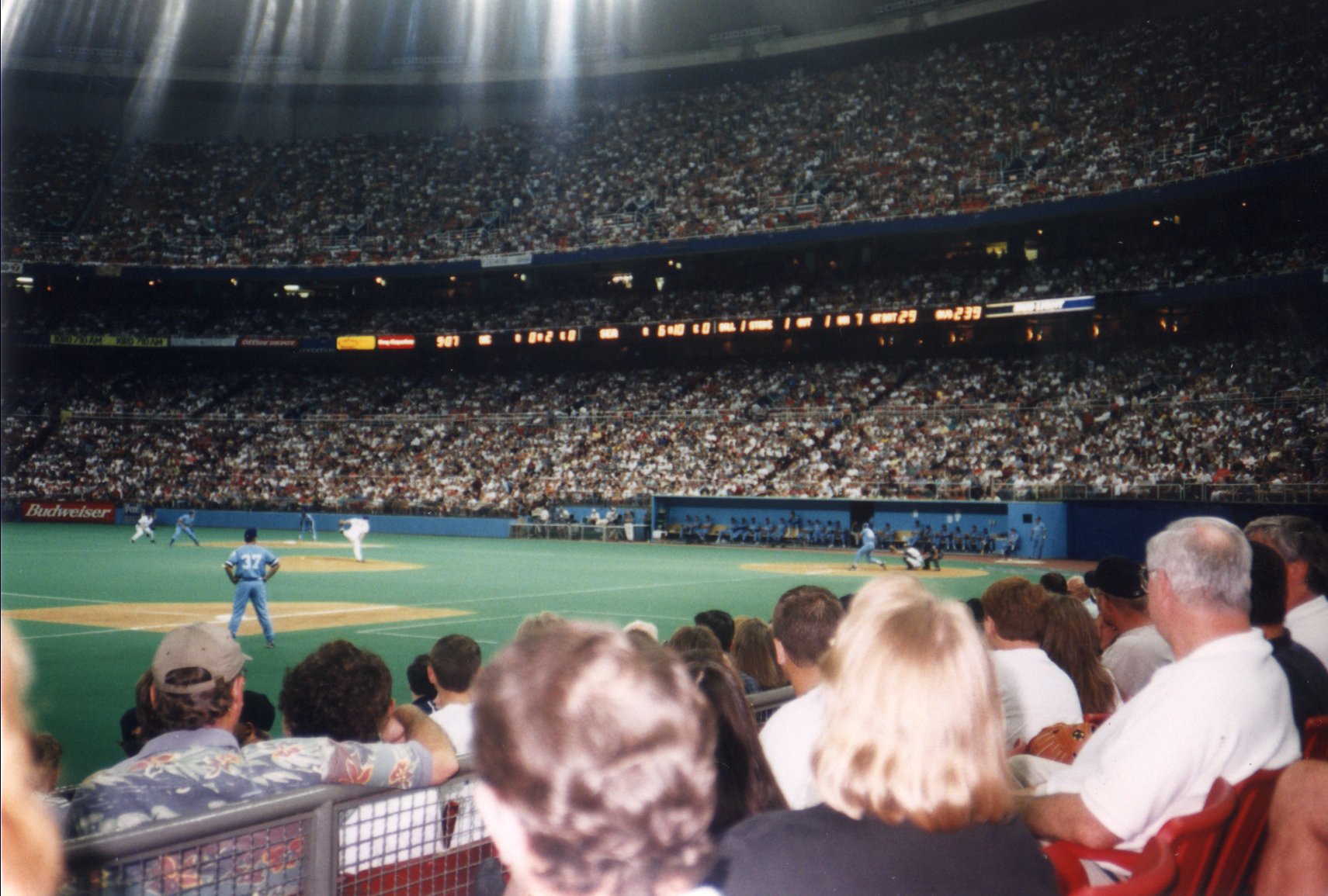
For most of the Mariners' first 18 years, their poor play (they did not have a winning season until 1991) combined with the Kingdome's design, led to poor attendance. Some writers and fans called it "the Tomb" (because of its gray concrete and lack of noise) and "Puget Puke." After their inaugural home opener, the Mariners didn't have another sellout for the next 1,018 home games until their 1990 home opener on April 13. At one point the Mariners covered seats in the upper decks in right and right-center with a tarp in order to make the stadium feel "less empty". Additionally, the Kingdome's acoustics created problems for stadium announcers, who had to deal with significant echo issues. However, when the team's fortunes began to change in the mid-1990s and they began drawing larger crowds, especially in the post-season, the noise created an electric atmosphere and gave the home team a distinct advantage similar to the effect on football games. The average attendance of 22,064 in 1995 was the lowest in three years with the removal of nine home games for the season, but when put in perspective, it was still higher compared to any of the Mariners' first 14 seasons.
Despite its cavernous interior, the Kingdome's field dimensions were relatively small. It had a reputation as a hitter's park, especially in the 1990s when Ken Griffey Jr., Edgar Martínez, Jay Buhner, Alex Rodriguez, and other sluggers played there.
The large number of in-play objects—speakers, roof support wires and streamers—contributed to an "arena baseball" feel.
In its early years, the outfield was symmetrical with a uniform wall height: deep in center, and short elsewhere. For the All-Star Game in 1979, center field was 410 ft, power alleys were 357 ft, and the foul lines were 316 ft; Down the lines, the distance was also listed in fathoms (52.7 fm), presumably to maintain a nautical theme in line with the team name; however, this practice was ditched after the 1980 season. Like the Kingdome's contemporaries, the bullpens were located in foul territory adjacent to the baselines and the stands.
The Kingdome was somewhat improved in 1982 with the addition of a 23 ft wall in right field nicknamed the "Walla Walla" (after the city in southeastern Washington); a nearly $100,000 Daktronics out-of-town scoreboard was later installed on it in 1990. In 1990 and 1991, the moving of home plate closer to the backstop, the addition of box seats down the third base line and the removal of a few rows of seats in left field reduced foul territory and made the outfield dimensions longer and asymmetrical.
The longest game in the Kingdome took place on July 30, 1998, when the Cleveland Indians defeated the Mariners 9–8 in 17 innings via a three-run homer from Manny Ramirez off Bob Wells; Paul Shuey staved off a comeback by the Mariners in the bottom of the inning to end the game the next morning after five hours and 23 minutes.
The most noteworthy baseball game in the Kingdome's history took place on October 8, 1995; in the rubber game of the ALDS, the Mariners defeated the New York Yankees 6–5 in 11 innings in front of 57,411 raucous fans. In the bottom of the 11th, Martinez doubled to left, sending Joey Cora and Griffey home with the winning runs and vaulting the Mariners into the ALCS for the first time in franchise history.
On May 2, 1996, a minor earthquake caused a game at the Kingdome between the Mariners and the Cleveland Indians to be suspended with the Mariners trailing the Indians 6–3 in the bottom of the seventh inning. The earthquake, estimated at a magnitude of 5.3 to 5.4, occurred during a pitching change as Indians' pitcher Orel Hershiser was walking off the mound following a home run by Edgar Martínez. After an inspection by engineers, the game was continued the next evening; Paul Sorrento hit a solo home run in the ninth inning for Seattle after the game resumed, but the Mariners ultimately lost 6–4 to the Indians.
Seguí, who retired from professional baseball after the 1977 season, was invited by the Mariners to throw the ceremonial last pitch after the final Mariners game at the Kingdome in 1999. However, while they were able to make the tickets and reservations for Seguí, a payment mix-up prevented him from boarding the flight out of Kansas City International Airport on the day of the game; the incident made him irate such that he refused to visit Seattle again until 2012, when he was invited as part of the Mariners' 35th anniversary celebration. Despite the disappointment from Seguí's son, then-Mariners first baseman David Segui, the ceremony went on as planned; David's son, then-seven-year-old Cory Segui, threw the last pitch to Bob Stinson, who was the Mariners' catcher in their first game.
In 1989, Griffey Jr. hit a home run in his first-ever plate appearance at the Kingdome on April 10. On June 27, 1999, Griffey Jr. hit the last home run ever at the Kingdome against the Texas Rangers. The Mariners played 1,755 games at the Kingdome, compiling an overall home record of during their 22½-season tenure there.
Basketball
SuperSonics
.jpg)
Besides the Mariners and Seahawks, the stadium also hosted the Seattle SuperSonics of the National Basketball Association (NBA) for seven seasons. The SuperSonics, having previously played at the Seattle Center Coliseum, announced on July 29, 1977, that they intended to move into the Kingdome for the 1978–79 season after the expiration of their contract with the city of Seattle, the owner of the Coliseum; the team pushed for a move to the Kingdome after the city balked at a $30 million plan to expand the Coliseum to 20,000 seats the previous year. On August 22, the King County Council voted 7–2 to approve a 17-year lease with the SuperSonics, with the agreement signed the following day. The following week, the council unanimously voted on August 29 to spend $1.5 million on improvements to the Kingdome in preparation for the team; the team would pay the same amount over the first seven years as part of the agreement. Additional terms of the agreement had the SuperSonics pay the county 10 percent of ticket sale proceeds (not including admissions taxes) and $2,539 in personnel costs per game; the county additionally kept all game concession and parking revenue. On the same day as the agreement signing, longtime Kingdome critic Frank Ruano filed a referendum petition in an attempt to halt the move, but he announced on September 17 that he would withdraw support from the petition for lack of support.
While the SuperSonics had played a few games at the Kingdome over the previous two seasons, their full-time tenancy required the addition of 5,000 portable stadium seats added onto the floor of the arena as well as additional scoreboards and a new basketball court. The center circle of the court was positioned over first base, with the court itself laid parallel and adjacent to the right-field seats; the portable seats were positioned across the court with one end hovering over home plate.
The first SuperSonics game in the Kingdome under the agreement was an exhibition game versus the Portland Trail Blazers on September 22, 1978. A few weeks later, a crowd of 15,219 watched as the SuperSonics defeated the Chicago Bulls, 104–86, on October 14 in their first regular-season game as a tenant. Captain Fred Brown and leading scorer Gus Williams helped lead the team to their first and only championship that season, defeating the Washington Bullets in the Finals and avenging their Finals loss to them the previous season. At the time, the Kingdome was known in the NBA for being the noisiest arena for basketball and for having the largest crowds, with stadium vendor Bill Scott ( Bill the Beerman) taking the duties as cheerleader.
In the 1979–80 season, the SuperSonics set an NBA record average attendance of 21,725 fans per game (since broken). The SuperSonics set the NBA single-game playoff attendance record at 39,457 during Game 4 of the 1978 NBA Finals; they set it again on April 15, 1980, during a conference semifinal game against the Milwaukee Bucks with an attendance record of 40,172 (also since broken). The Kingdome regular season, single-game attendance record of 38,067 was set on November 22, 1991, when the SuperSonics faced the Chicago Bulls.
While leaving a SuperSonics game on February 16, 1983, a 21-year-old man from Olympia fell off a ramp and plunged 47 feet to his death; this was despite the installation of signs warning about the chest-level barriers the previous year.
Logistics would be a problem throughout the team's tenure at the Kingdome because the Seahawks and Mariners had scheduling priority over them, especially during the playoffs when the Mariners were playing there at the same time in the spring. As part of the 1977 agreement, King County agreed to pay the SuperSonics $15,000 for each game (up to five) that was moved elsewhere because of booking issues. Even then, the scheduling priority meant that the SuperSonics would only play home playoff games at the Kingdome while the Mariners were on the road, with most of the games played at the Coliseum; the team even had to use Hec Edmundson Pavilion at the University of Washington for a few games when both the Kingdome and the Coliseum were unavailable.
Along with the scheduling issues, as with other multipurpose stadiums used by the NBA the Kingdome proved itself to be a less-than-ideal venue for basketball. Although the Kingdome's capacity allowed the SuperSonics to set attendance records, the vast space it afforded meant that it did not have the intimate environment of a dedicated arena; furthermore, fans were displeased about the poor sight lines and cold temperatures in the Kingdome. All these factors, plus dwindling attendance due to poor team performance towards the end of their tenancy at the Kingdome, led SuperSonics general manager Zollie Volchok to sign a 10-year contract with the city of Seattle in 1983, agreeing to have the team move back to the Coliseum after the 1984–85 season in exchange for upgrades there.
The SuperSonics faced the Phoenix Suns at the Kingdome on April 7, 1985, in their final game as a regular tenant, losing 110–125 with 5,672 in attendance. However, exemplifying the scheduling issues, it was not their final home game of the season; the SuperSonics were forced to play at the Tacoma Dome on April 11 because the Mariners hosted the Oakland Athletics at the Kingdome that day. By that point, the SuperSonics had an average attendance of 7,399, failing to surpass 10,000 seats sold in 29 of 37 games held at the Kingdome in their final season there.
Despite calling the Coliseum home again, the SuperSonics still played occasionally at the Kingdome over the next few years when large crowds were anticipated; as such, the SuperSonics hosted the 1987 NBA All-Star Game there, having previously hosted the 1974 game at the Coliseum before the Kingdome opened. However, SuperSonics owner Barry Ackerley, who had bought the team from Sam Schulman in October 1983 after the Coliseum deal was signed, started seeking a new arena for them in 1989; team president Bob Whitsitt claimed that the Coliseum was outdated and leaking. Ackerley proposed to build a new arena south of the Kingdome (where T-Mobile Park stands today), but the plan was initially rejected by King County because of objections from the Seahawks and Mariners over inadequate parking. The plan was eventually approved by the Seattle City Council 7–1 on May 30, 1990, but it was ultimately scrapped the following year on June 26 because of issues in financing it; as a compromise measure, the Coliseum was rebuilt as KeyArena during the 1994–95 season, with the SuperSonics playing home games at the Tacoma Dome instead of the closer Kingdome in the meantime. The SuperSonics played at KeyArena until they were controversially relocated to Oklahoma City by owner Clay Bennett after the 2007–08 season.
The SuperSonics played 303 games at the Kingdome in total, including 14 playoff games; they held an overall record of and a playoff record of at the stadium. Of those games, 20 of them had attendances of 30,000 or more.
College
The first men's college basketball game at the Kingdome was held on January 9, 1984, when the Washington Huskies defeated the Notre Dame Fighting Irish, 63–61, in the second overtime in front of 7,466 fans. The Huskies held their only other basketball game at the Kingdome more than a decade later, defeating the Old Dominion Monarchs 71–61 on December 22, 1994, with 4,187 in attendance.
The only women's basketball game at the Kingdome was held on December 6, 1979, when the Soviet national team beat Seattle University 135-45, before 7,239 spectators.
Final Four
The NCAA Final Four of men's college basketball was held three times at the Kingdome, with the stadium hosting the 1984, 1989, and 1995 editions. The 1984 championship game saw the Georgetown Hoyas defeat the Houston Cougars, 84–75. Meanwhile, the 1989 championship game had the Michigan Wolverines beat the Seton Hall Pirates, 80–79, in overtime because of a controversial last-second foul call against the Pirates. Finally, with the 1995 championship game, the UCLA Bruins defeated the Arkansas Razorbacks, 89–78, to win their first championship since the retirement of coach John Wooden twenty years earlier in 1975.
The Kingdome was not the first venue in Seattle to host the Final Four; Hec Edmundson Pavilion had previously hosted it in 1949 and 1952. However, the Kingdome is credited with helping shape the Final Four into an event with a stature comparable to that of the Super Bowl because of its large capacity. It was the only such capable venue on the West Coast of the United States; the last time a non-Seattle West Coast site hosted the game was when the Los Angeles Memorial Sports Arena hosted it in 1972. The 1995 edition was the last time that Seattle hosted a Final Four, and it will likely remain that way for the foreseeable future since the Kingdome's successors were not designed with a controlled environment in mind; it also remains the last time that the Final Four was held on the West Coast. The Final Four was not held again in the Western United States until 2017, when University of Phoenix Stadium in Glendale, Arizona, hosted it for the Phoenix area.
Other
On February 18, 1979, the Harlem Globetrotters held an exhibition game at the Kingdome with close to 23,000 in attendance, of which around 3,500 were under 12 years old.
As a result of the boycott of the 1980 Summer Olympics by the United States, the U.S. Olympic team faced off against a squad of NBA players in a six-game exhibition tournament called the "Gold Medal Series" that June. On June 20, the NBA All-Stars defeated the U.S. Olympic team, 78–76, before a crowd of 10,902; it was the only victory by the NBA squad in the tournament.
The Washington Interscholastic Activities Association (WIAA) held their 3A and 4A high school basketball state tournament five times at the Kingdome between 1993 and 1999. The boys' and girls' games were held simultaneously until the championship, at which point they took turns playing on a single court.
Soccer
Sounders
The Seattle Sounders of the North American Soccer League (NASL) were the first tenant to move into the Kingdome upon its opening, having played at Memorial Stadium for their first two seasons. As a result, they held the honor of hosting the first sporting event at the Kingdome with an exhibition game versus the New York Cosmos on April 9, 1976; the Cosmos defeated them 3–1 with 58,128 fans in attendance. Highlighting the secondary treatment of the Sounders, about 5,000 seats were not yet installed when the game occurred. Just weeks later, they hosted their first regular-season game in the Kingdome on April 26, defeating the Portland Timbers 1–0 via a Geoff Hurst penalty kick in the second overtime before 24,983 spectators.
The largest crowd to attend a Sounders match, regular or postseason, occurred on August 25, 1977, when 56,256 spectators watched as they defeated the Los Angeles Aztecs 1–0 in the second game of the Pacific Conference Final to advance to their first Soccer Bowl. The Sounders' regular-season attendance record was set on August 9, 1980, when the Cosmos defeated them 1–0 in front of 49,606 fans. Overall, the team drew an average attendance of 20,183 from 1975 to 1982, peaking in the 1980 season with an average attendance of 24,247.
Along with traditional soccer, the Sounders participated in NASL indoor soccer for the 1980–81 and 1981–82 seasons. However, the 1983 outdoor season proved to be a dire one for the Sounders; with the team's front office heavily cutting costly foreign players from the roster, the team suffered their worst season ever performance-wise, resulting in a record low average attendance of 8,181. That season additionally saw the smallest crowd to attend a Sounders game, with only 4,270 spectators on hand to witness their 3–1 victory over the Tulsa Roughnecks on July 27. With the cuts not enough to keep the team afloat, the owners ultimately elected to fold it that year on September 6; their final home game was a 3–2 victory over the San Diego Sockers on August 25 with 7,331 fans in attendance.
College
The Kingdome hosted the NCAA Division I Men's Soccer Championship Finals twice in consecutive years. The final on December 17, 1984, featured the Clemson Tigers, coached by Dr. I. M. Ibrahim, and defending national champion Indiana Hoosiers, headed by coach Jerry Yeagley; 7,926 spectators watched as the Tigers won 2–1 in regulation to bring home their first national championship in soccer and deny the Hoosiers a third straight title. A year later, on December 14, 1985, a crowd of 5,986 watched as the UCLA Bruins defeated the American Eagles 1–0 after eight overtime periods to win their first national soccer championship; Bruin coach Sigi Schmid went on to coach the Seattle Sounders FC of Major League Soccer (MLS), a phoenix club of the NASL Sounders, from its inaugural season in 2009 to 2016.
Other professional games
A game of the 1976 U.S.A. Bicentennial Cup tournament was held at the Kingdome on May 28, with Brazil defeating Team America 2–0 before 20,245 spectators.
The Kingdome also hosted the NASL's championship game, the Soccer Bowl, between the Minnesota Kicks and the Toronto Metros-Croatia on August 28, 1976; the Metros-Croatia defeated the Kicks 3–0 before a crowd of 25,765, setting an NASL championship attendance record at the time.
A CONCACAF Championship qualifier for the 1978 FIFA World Cup was hosted at the Kingdome on October 20, 1976; the game, which saw the United States defeat Canada 2–0 before a crowd of 17,675, was the first instance of a World Cup qualifier that was held indoors.
A doubleheader featuring both the U.S. Olympic and national squads was held at the Kingdome on February 3, 1979. The U.S. Olympic team defeated the Canadian Olympic team 2–0 in the first game, while the Soviet national team defeated the U.S. national team 3–1 in the second game; 13,317 spectators were present for both games.
The Kingdome was additionally considered in Seattle's bid to be a host city for the 1994 FIFA World Cup, but it was rejected in favor of Husky Stadium because of concerns over its indoor environment and its turf; the bid ultimately failed in part because of apprehension from the University of Washington.
Other events
Upon its opening, the Kingdome served as one of the main convention centers in Seattle alongside the Seattle Center Coliseum. During preliminary studies for the then-proposed Washington State Convention Center (now the Seattle Convention Center) in the early 1980s, a proposal to build it on the stadium's northern parking lot was floated, but it was never seriously considered and ultimately rejected by the convention center board in favor of building it in the Downtown area.
The largest crowd to attend a single event in the Kingdome came early, during an eight-day Billy Graham crusade in 1976. The Friday night edition on May 14 drew 74,000 and featured singer Johnny Cash; 5,000 were turned away. The stadium was also part of Seattle's bid to host the 1988 Republican National Convention, but it ultimately failed because of a scheduling conflict with the Mariners.
Country singer CW McCall performed 8 shows during the 4-day Custom Van, Truck, 4-Wheel Drive and Motorcycle Show, March 17–20, 1977.
The Kingdome hosted a round of the AMA Supercross Championship from 1978 to 1999.
Concerts
Numerous rock concerts were held in the venue, despite significant echo and sound delay problems attributable to the structure's cavernous size.
| Date | Artist | Opening act(s) | Tour / Concert name | Attendance | Revenue | Notes | |||||||||
|---|---|---|---|---|---|---|---|---|---|---|---|---|---|---|---|
| June 10, 1976 | Wings | – | Wings Over America Tour | 67,053 | $536,424 | The concert set the national indoor attendance record for a single act. It also marked the first time Paul McCartney had toured America since The Beatles stopped touring in 1966. The performance was filmed and included in the concert movie Rockshow. | |||||||||
| August 6, 1976 | Eagles | Linda Ronstadt | |||||||||||||
| JD Souther | – | 48,843 | $398,744 | ||||||||||||
| September 3, 1976 | Aerosmith | Jeff Beck | |||||||||||||
| Rick Derringer | Rocks Tour | 51,091 | $422,698 | ||||||||||||
| June 27, 1977 | Peter Frampton | Foghat | |||||||||||||
| J. Geils Band | |||||||||||||||
| Blondie Chaplin | [-]() | 39,549 | – | ||||||||||||
| July 17, 1977 | Led Zeppelin | – | North American Tour 1977 | 68,954 | – | last=McNerthney | first=Casey | date=June 1, 2011 | title=The Kingdome's Biggest Events | url=https://blog.seattlepi.com/thebigblog/2011/06/01/seattle-history-the-kingdomes-biggest-events/ | url-status=dead | archive-url=https://web.archive.org/web/20210310134002/https://blog.seattlepi.com/thebigblog/2011/06/01/seattle-history-the-kingdomes-biggest-events/ | archive-date=March 10, 2021 | access-date=November 14, 2019 | work=Seattle Post-Intelligencer}} |
| October 14, 1981 | The Rolling Stones | Greg Kihn Band | |||||||||||||
| J. Geils Band | American Tour 1981 | 69,132 | – | last=Morlin | first=Bill | date=October 15, 1981 | title=Rolling Stone give fans 'satisfaction' | url=https://news.google.com/newspapers?id=2upWAAAAIBAJ&sjid=dvkDAAAAIBAJ&pg=7192%2C4366223 | work=Spokane Daily Chronicle | page=52}} | |||||
| October 15, 1981 | 68,028 | Before the concert, a 16-year-old girl from Renton fell backward from a concrete guard rail at the outside 200-level ramp and plunged 50 ft onto a loading area; she died at Harborview Medical Center despite medics immediately rushing her there. | |||||||||||||
| July 23, 1982 | Bryan Adams | ||||||||||||||
| Joan Jett and the Blackhearts | |||||||||||||||
| Blue Öyster Cult | |||||||||||||||
| Loverboy | |||||||||||||||
| Foreigner | – | The Rock and Roll Grand Slam 1982 | 38,201 / 70,000 | $635,352 | |||||||||||
| October 20, 1982 | The Who | The Clash | |||||||||||||
| T Bone Burnett | The Who Tour 1982 | 55,217 | – | last=Cartwright | first=Jane | date=October 21, 1982 | title=For Who the bell tolls: 55,000 fans say goodbye | url=https://infoweb.newsbank.com/apps/news/document-view?p=WORLDNEWS&docref=image/v2%3A127D718D1E33F961%40EANX-NB-12F3887C59B50041%402445264-12F37D521ADED322%4051-12F37D521ADED322%40 | url-access=registration | access-date=May 1, 2021 | work=The Seattle Times | page=D1 | via=NewsBank}} | ||
| May 22, 1983 | The Beach Boys | – | – | 37,807 | $320,000 | The concert followed a Mariners game. | |||||||||
| July 15, 1987 | Madonna | Level 42 | |||||||||||||
| Bhundu Boys | |||||||||||||||
| Hue and Cry | Who's That Girl World Tour | 30,000 | – | last=MacDonald | first=Patrick | date=July 16, 1987 | title=Live video - Madonna's Kingdome concert might as well have been on TV | url=https://infoweb.newsbank.com/apps/news/openurl?ctx_ver=z39.88-2004&rft_id=info%3Asid/infoweb.newsbank.com&svc_dat=AWNB&req_dat=A2FB36B0D8714A7C9BA0382F4B401AE2&rft_val_format=info%3Aofi/fmt%3Akev%3Amtx%3Actx&rft_dat=document_id%3Anews%252F0EB53268ACCE5C60 | url-access=registration | access-date=April 5, 2021 | work=The Seattle Times | page=D1 | via=NewsBank}} | ||
| December 8, 1987 | Pink Floyd | – | A Momentary Lapse of Reason Tour | 33,700 / 40,000 | $710,382 | ||||||||||
| July 27, 1988 | Van Halen | ||||||||||||||
| Scorpions | Metallica | ||||||||||||||
| Dokken | |||||||||||||||
| Kingdom Come | Monsters of Rock | 37,000 | – | last=Lacitis | first=Erik | date=July 28, 1988 | title=What's behind those skull-emblazoned t-shirts? You'd be surprised | url=https://infoweb.newsbank.com/apps/news/openurl?ctx_ver=z39.88-2004&rft_id=info%3Asid/infoweb.newsbank.com&svc_dat=AWNB&req_dat=A2FB36B0D8714A7C9BA0382F4B401AE2&rft_val_format=info%3Aofi/fmt%3Akev%3Amtx%3Actx&rft_dat=document_id%3Anews%252F0EB532EF82FE3BB8 | url-access=registration | access-date=April 5, 2021 | work=The Seattle Times | page=E1 | via=NewsBank}} | ||
| March 29, 1990 | Paul McCartney | – | The Paul McCartney World Tour | 50,000 | – | last=MacDonald | first=Patrick | date=March 30, 1990 | title=Paul McCartney - 'Yesterday' is back and 50,000 fans enjoy a special intimacy with this dynamic performer | url=https://infoweb.newsbank.com/apps/news/openurl?ctx_ver=z39.88-2004&rft_id=info%3Asid/infoweb.newsbank.com&svc_dat=AWNB&req_dat=A2FB36B0D8714A7C9BA0382F4B401AE2&rft_val_format=info%3Aofi/fmt%3Akev%3Amtx%3Actx&rft_dat=document_id%3Anews%252F0EB533E5D37BB8D8 | url-access=registration | access-date=April 5, 2021 | work=The Seattle Times | page=E1 | via=NewsBank}} |
| September 6, 1990 | New Kids on The Block | Perfect Gentlemen | |||||||||||||
| Rick Wes | The Magic Summer Tour | 42,929 / 52,619 | $1,015,300 | ||||||||||||
| October 6, 1992 | Guns N' Roses | ||||||||||||||
| Metallica | Motörhead | Guns N' Roses/Metallica Stadium Tour | 37,226 / 40,000 | $1,023,715 | |||||||||||
| December 15, 1994 | The Rolling Stones | Spin Doctors | Voodoo Lounge Tour | 49,303 / 49,303 | $2,311,900 | ||||||||||
| November 28, 1997 | The Rolling Stones | Third Eye Blind | Bridges to Babylon Tour | 42,258 / 42,258 | $2,411,261 | date=December 27, 1997 | title=Amusement Business Boxscore: Top 10 Concert Grosses | url=https://books.google.com/books?id=0g0EAAAAMBAJ&pg=PA24 | access-date=March 31, 2021 | magazine=Billboard | page=24 | via=Google Books | volume=109 | issue=52 | issn=0006-2510}} |
| December 12, 1997 | U2 | Smash Mouth | PopMart Tour | 30,260 / 35,000 | $1,539,105 |
Final years
The loss of the Sounders and Sonics in the mid-1980s caused financial constraints as the Kingdome was left with 59 unfilled days in their annual schedule. By the 1990s, multi-purpose stadiums fell out of favor with the public, and the Kingdome's suitability as an NFL and MLB venue came into doubt as a result. Neither the Seahawks' nor the Mariners' respective ownership groups saw the shared stadium arrangement as economically feasible because the Kingdome was unable to meet the needs of both tenants; they also noted the lack of revenue-generating luxury suites prominent in newer stadiums. Almost immediately, the new ownership group began campaigning with local and state governments to secure public funding for a new baseball-only stadium. In March 1994, King County Executive Gary Locke appointed a task force to study the need for a baseball-only stadium.
1994 ceiling collapse
The Kingdome's roof had been problematic from the beginning because of a design flaw. With the stadium's limited budget compared to its contemporaries, its architects had the roof's acoustic ceiling tiles serve a dual purpose as forms to pour concrete over for the roof sections. They were firmly placed via six metal clips on their edges, but the effectiveness of the clips was weakened as moisture from the polyurethane insulation accumulated in the tiles because it lacked proper water vapor management. As a result, leaks were discovered in the roof three months before the stadium opened, and several attempts at repairs made the situation worse or were quickly undone.
In 1993, the county decided to strip off the outer roof coating and replace it with a special coating. Sandblasting failed to strip the old roof material off, and the contractor changed its method to pressure washing. This pressure-washing resulted in water seepage through the roof, and on July 19, 1994, four 26 lb, waterlogged acoustic ceiling tiles fell into the seating area. The tiles fell while the Mariners were on the field preparing for a scheduled game against the Baltimore Orioles, a half-hour before the gates were to open for fans to enter the stadium. As a result, the Kingdome was closed for repairs.
The Mariners were forced to play the last 20 games of the 1994 season on the road after the players' union vetoed playing the "home" games at Cheney Stadium in Tacoma, BC Place Stadium in Vancouver, British Columbia, or a neutral site because the union believed that its members should play only in major-league venues. The extended road trip could have lasted over two months, but it was shortened because of the 1994–95 Major League Baseball strike, which began on August 12 and ended up canceling the remainder of the 1994 MLB season; the strike also resulted in a delay to the start of the 1995 season. The Seahawks had to play both their two preseason home games and their first three regular-season home games of the 1994 season at nearby Husky Stadium.
The Kingdome held a reopening ceremony the weekend of November 4–6, 1994, which culminated with the Seahawks returning to the stadium for a regular-season game against the Cincinnati Bengals. Repairing the roof ultimately cost US$51 million, and two construction workers lost their lives in a crane accident on August 17 during the repair. The incident also motivated plans to replace the stadium.
Replacement

On September 19, 1995, King County voters defeated a ballot measure that would have funded the construction of a new baseball-only stadium for the Mariners. However, the following month, the Mariners made it to the MLB postseason for the first time and, on October 8, defeated the New York Yankees in the decisive fifth game of the 1995 ALDS on the heels of a walk-off game-winning double hit by Edgar Martínez. The Mariners' postseason run demonstrated that there was a fan base in Seattle that wanted the team to stay in town, and as a result, the Washington State Legislature approved a separate funding package for a new stadium on October 14.
In January 1996, Seahawks owner Ken Behring announced he was moving the team to Los Angeles and the team would play at Anaheim Stadium, which had recently been vacated as a football venue when the Los Angeles Rams moved to St. Louis (at the same time, the Los Angeles Raiders returned to Oakland, after 13 years away). His rationale for the decision included unfounded safety concerns surrounding the seismic stability of the Kingdome. Behring went so far as to relocate team headquarters to Anaheim, California, but his plans were defeated when lawyers found out that the Seahawks could not break their lease on the Kingdome until 2005. As a result, Behring tried to sell the team. He found a potential buyer in Microsoft co-founder Paul Allen, who stipulated that a new publicly funded stadium had to be built as a condition of his purchase of the team. Allen funded a special election held on June 17, 1997, that featured a measure that would allocate public funding for a new stadium for the Seahawks on the Kingdome site. The measure passed, Allen officially purchased the team, and the Kingdome's fate was sealed.
Despite the intention of the Mariners to start playing at their new home at the beginning of the 1999 season, construction delays meant that installation of its retractable roof would not occur on time, leading to another sale threat by the team's owners. However, the team eventually agreed to play at the Kingdome from the start of the season until after the All-Star Game, with construction on the new home starting on March 8, 1997. Two years later, a sold-out crowd of 56,530 watched as the Mariners defeated the Texas Rangers 5–2 in their final game at the Kingdome on June 27, 1999; they played their first game at their new home, Safeco Field, nearly three weeks later on July 15.
Meanwhile, the Seahawks temporarily relocated to Husky Stadium for two seasons following the 1999 season. To make way for construction of their new stadium, the Kingdome was stripped down and prepared for demolition. During the process, a security incident occurred on February 21, 2000, when a skateboarder disguised himself as a construction worker, climbed up onto the roof, and skated on it with two friends filming him on the nearby Alaskan Way Viaduct; demolition crews were unimpressed by the incident and implemented tighter security measures in response. On the morning of March 26, 2000 at 8:30 AM, the Kingdome was demolished by Controlled Demolition, Inc. via implosion, just one day short of 24 years after the stadium's opening; it set a record recognized by Guinness World Records for the largest building, by volume, ever demolished by implosion. The Kingdome was the first large, domed stadium to be demolished in the United States; its demolition was also the first live event covered by ESPN Classic. The new stadium, Seahawks Stadium, eventually opened on July 20, 2002, in time for the beginning of the NFL season that year.
The Kingdome was demolished before the debt issued to finance its construction was fully paid, and as of September 2010, residents of King County were still responsible for more than $80 million in debt on the demolished stadium. The debt was retired in March 2015, nine months ahead of the original bond maturity and 15 years after the stadium's demolition. The 2% of the 15.6% hotel/motel tax earmarked for the Kingdome debt no longer needed went instead to the county's 4Culture program for arts, heritage, and preservation.
Seating capacity
| Seattle Mariners}};" | Years | Seattle Mariners}};" | Capacity | Seattle Mariners}};" | 1976–1980 | Seattle Mariners}};" | 1981–1987 | Seattle Mariners}};" | 1988–1990 | Seattle Mariners}};" | 1991–1993 | Seattle Mariners}};" | 1994–1999 | |
|---|---|---|---|---|---|---|---|---|---|---|---|---|---|---|
| last=Lowry | first=Phil | url=https://archive.org/details/greencathedralsu0000lowr_u1c9 | title=Green Cathedrals: The Ultimate Celebrations of All 273 Major League and Negro League Ballparks Past and Present | publisher=Addison Wesley Publishing Company | year=2006 | isbn=0-201-62229-7 | location=New York City | url-access=registration}} | ||||||
| 59,438 | ||||||||||||||
| 58,850 | ||||||||||||||
| 57,748 | ||||||||||||||
| 59,166 |
| Seattle Seahawks 76thru01}};" | Years | Seattle Seahawks 76thru01}};" | Capacity | Seattle Seahawks 76thru01}};" | 1976–1979 | Seattle Seahawks 76thru01}};" | 1980–1983 | Seattle Seahawks 76thru01}};" | 1984–1992 | Seattle Seahawks 76thru01}};" | 1993–2000 |
|---|---|---|---|---|---|---|---|---|---|---|---|
| 64,759 | |||||||||||
| 64,984 | |||||||||||
| 66,400 |
| Seattle SuperSonics | border=2}}" | Capacity |
|---|---|---|
| 40,192 |
In popular culture
Because of its versatility and its prominent position in the Seattle skyline for close to a quarter-century, the Kingdome was featured in numerous forms of media during and after its existence. On television, it served as the backdrop for a rescue in the 1978 TV movie "Most Deadly Passage" of NBC's Emergency! series, which featured the work of Seattle Medic One paramedics. It was also mentioned in 1992 with the airing of "Crushed", the sixteenth episode of the fifth season of ABC sitcom Full House; in the episode, guest star Tommy Page boasted to Jesse Katsopolis about playing there. The Kingdome was mentioned again in 1998 during the sixth season of NBC sitcom Frasier, which was set in Seattle. In the sixth episode, "Secret Admirer", Martin describes Daphne's frustrating driving that repeatedly takes them right into various traffic delays, ending with them encountering traffic from the Kingdome. Furthermore, the Kingdome's demolition was featured on The History Channel's Modern Marvels series with their "Concrete" episode that first aired on May 31, 2000.
The Kingdome was not limited to just television mentions; numerous songs mentioned it in their lyrics. While playing with the Mariners, Lenny Randle recorded a song titled "Kingdome" with some of his teammates and family members in order to raise money to buy a speech synthesizer for a young fan with cerebral palsy. Rock band Foo Fighters mentioned the stadium in the refrain of "New Way Home", which was featured on their 1997 album, The Colour and the Shape. Rapper Macklemore also mentioned the Kingdome in "My Oh My", a 2011 song that paid tribute to Dave Niehaus, the longtime play-by-play announcer of the Mariners who had recently died; in it, he talks about growing up in Seattle and going to the Kingdome. The song mentions the Double in the Mariners–Yankees 1995 ALDS, and its accompanying music video also contains footage of the Kingdome's demolition.
With the rise of 3D computer graphics, video games started to depict the Kingdome as well. The Gran Turismo series of racing games on the PlayStation line of consoles featured the Kingdome in the Seattle Circuit race track, a street circuit based on the roads of Seattle. Seattle Circuit is featured in Gran Turismo 2, Gran Turismo 3: A-Spec, Gran Turismo 4, Tourist Trophy, and Gran Turismo PSP. Despite the Kingdome's demolition occurring before the game was released, Gran Turismo 3: A-Spec still featured it in the track. The Kingdome also made an appearance in the 2007 RTS game World in Conflict, in which it was destroyed by Soviet artillery during a Soviet invasion of Seattle in an alternate timeline.
Notes
References
Bibliography
References
- "King County, Department of Stadium Administration, Domed Stadium, Pioneer Square, Seattle, WA". [[University of Washington]].
- Ledbetter, Les. (December 5, 1977). "Seattle Stadium Suit a Legal Test on Cost Overruns". [[The New York Times]].
- (August 25, 1975). "AN ORDINANCE relating to the multi-purpose public stadium specified in King County Resolution No. 34567; providing a name therefore.".
- (March 26, 2012). "Name".
- Macintosh, Heather. (January 1, 2001). "Kingdome opens to a crowd of 54,000 on March 27, 1976".
- Upchurch, Michael. (July 22, 2010). "Seattle's slightly amphibious Sodo subject of new photo-history". [[The Seattle Times]].
- (March 27, 2000). "24 years of Kingdome facts & figures".
- Baker, Tony. (December 10, 1976). "Seattle's own Cardiac Hill?". [[Lewiston Morning Tribune]].
- Baker, Geoff. (March 26, 2015). "Kingdome debt to be retired 15 years after implosion". The Seattle Times.
- Crowley, Walt. (February 2, 2006). "National Football League awards Seattle a franchise for future Seahawks on December 5, 1974". HistoryLink.org.
- Kaiman, Beth. (September 10, 2003). "David Cohn, 85; top restaurateur, major booster of UW athletics". The Seattle Times.
- {{Harvard citation no brackets. Mullins. 2013
- Mullins, William H.. (2009). "Not Quite Big League: The Pilots and Seattle in the 1960s". Pacific Northwest Quarterly.
- {{Harvard citation no brackets. Mullins. 2013
- {{Harvard citation no brackets. Mullins. 2013
- Mullins. 2013
- {{Harvard citation no brackets. Mullins. 2013
- MacIntosh, Heather. (March 1, 2000). "Kingdome: The Controversial Birth of a Seattle Icon (1959–1976)". HistoryLink.org.
- {{Harvard citation no brackets. Mullins. 2013
- (May 20, 1970). "Voters in Seattle reject proposals". Spokesman-Review.
- (December 1, 1971). "Stadium okehed inside Seattle". Lewiston Morning Tribune.
- (November 3, 1972). "Protesters halt groundbreaking at Seattle domed stadium site". Lewiston Morning Tribune.
- Tsutakawa, Mayumi. (July 8, 1999). "How The Kingdome Spurred The Asian-American Community's Coming Of Age".
- {{Harvard citation no brackets. Mullins. 2013
- {{Harvard citation no brackets. Mullins. 2013
- (January 15, 1971). "Memphis, Tampa express interest in Buffalo Bills". Spartanburg (SC) Herald.
- (April 10, 1976). "Huge crowd views Pele". Spokane Daily Chronicle.
- {{Harvard citation no brackets. Mullins. 2013
- Divish, Ryan. (March 17, 2019). "'The slowest surface I've ever seen': Tokyo Dome turf yet another adjustment for Mariners in Japan". The Seattle Times.
- Moore, Jack. (July 2, 2015). "Throwback Thursday: Cincinnati's Riverfront Stadium And The Era Of Multipurpose Mistakes".
- Farrey, Tom. (November 14, 1991). "A Return To Football's Grass Roots? -- Artificial Turf May Not Make Sense, Even Here". The Seattle Times.
- Finnigan, Bob. (March 31, 1983). "Kingdome to get new rug during M's season". The Seattle Times.
- Smith, Craig. (July 13, 1983). "Sounder psych: ironing board and rock". The Seattle Times.
- Farrey, Tom. (October 14, 1990). "Boz poster still a hit with fans". The Seattle Times.
- (January 26, 1991). "Rocket's agent says $13.2 million is NFL price tag". The Seattle Times.
- (October 3, 1995). "Fans Tear Turf From Kingdome". Tacoma News Tribune.
- Farrey, Tom. (September 6, 1990). "Hawks, M's may get separate Dome turf". The Seattle Times.
- Withers, Bud. (January 15, 1990). "Baseball players bugged the most by Kingdome's hard rug". Seattle Post-Intelligencer.
- Kelley, Steve. (September 8, 1984). "Necessary evil: Kingdome's 'chamber of horrors' artificial surface needs improving". The Seattle Times.
- (January 30, 1999). "Kingdome turf rated worst in AFC West, but if the money's right ...". Kitsap Sun.
- Underwood, John. (August 12, 1985). "Just An Awful Toll". Time Inc..
- Lyons, Gil. (September 5, 1984). "Knox says Curt's skills, not Astroturf, caused injury". The Seattle Times.
- Lyons, Gil. (September 23, 1980). "Hawks' Smith out for season with knee injury". The Seattle Times.
- (June 3, 2008). "Skip the what-ifs, and celebrate what Ken Griffey Jr. is on the verge of doing". The Seattle Times.
- Baker, Tony. (August 2, 1976). "Seahawks lose opening game". Spokane Daily Chronicle.
- (January 17, 1977). "Pro battle of pride set in Dome tonight". Spokane Daily Chronicle.
- "All Matchups, Seattle Seahawks vs. Las Vegas/LA/Oakland Raiders". [[Sports Reference]].
- Newberry, Ron. (August 18, 1995). "In Search Of An Audience Seahawks' Ticket Sales Hit All-Time Low; One Longtime Fan Couldn't Give Seats Away". The Spokesman-Review.
- Arnold, Kirby. (December 27, 1999). "Noisy farewell bid the Dome". Kitsap Sun.
- Jenks, Jayson. (December 11, 2019). "Remembering the time the NFL tried to silence its fans".
- Barber, Michael A.. (December 19, 1983). "First-rate reason to party: Seahawks in the playoffs". Seattle Post-Intelligencer.
- Krawczynski, Jon. (February 3, 2018). "How the 1992 Super Bowl came to be, and paved the way for another big game in the Twin Cities".
- Hill, Craig. (January 25, 2014). "Don't rule out possibility of Super Bowl in Seattle just yet". The News Tribune.
- (June 2, 1982). "Sports Briefs". United Press International.
- King, Peter. (January 17, 2000). "Like Old Times Playing as if he were still in his prime, Dan Marino led Miami over Seattle with a vintage fourth-quarter drive".
- Nobles, Charlie. (January 9, 2000). "N.F.L. WILD-CARD PLAYOFFS; Whistling Past The Graveyard In the Kingdome". The New York Times.
- Murray, Ken. (January 16, 2000). "Jaguars flay Dolphins, 62-7; 2nd-worst playoff loss; Marino: sad farewell?". The Baltimore Sun.
- "The Ballparks: Seattle Kingdome". This Great Game.
- "Seattle Kingdome History". Sports Reference.
- Taylor, Phil. (May 2, 1976). "Varsity Wins; No Fireworks". Seattle Post-Intelligencer.
- Rockne, Dick. (May 2, 1976). "Varsity tops Alumni, 10–7". The Seattle Times.
- Rockne, Dick. (February 26, 1987). "After The Fall - The collapse at Husky Stadium leaves answered questions for the university, the project coordinator and UW football fans". The Seattle Times.
- Lange, Greg. (January 18, 2001). "Husky Stadium collapses on February 25, 1987.".
- Missildine, Harry. (October 9, 1976). "Thompson's key in 'Dome Bowl'". The Spokesman-Review.
- (October 10, 1976). "Bell runs for 346 yards as USC clips Cougars". Eugene Register-Guard.
- Missildine, Harry. (October 10, 1976). "Ricky Bell leads SC's 23–14 win". The Spokesman-Review.
- Perry, Jim. "Ricky Bell: 'The Bulldog'".
- Rockne, Dick. (September 7, 1994). "Cougar Notebook -- WSU Football In Kingdome? Ad Studies Possibility". The Seattle Times.
- Hill, Craig. (September 12, 2016). "Remembering Kingdome football, 40 years after first Seahawks game". The News Tribune.
- O'Keefe, Vince. (September 18, 1977). "U.P.S. nips Lutes before 13,167 in Kingdome". The Seattle Times.
- Rudman, Steve. (September 24, 1978). "Small Crowd Sees UPS Win". Seattle Post-Intelligencer.
- (1984). "University of Puget Sound vs. Pacific Lutheran University Official Program, 1984". Tacoma Athletic Commission.
- (November 29, 1977). "Kingbowl forecast is 30,000". Spokesman-Review.
- Derrick, Merle. (December 5, 1977). "What a show!". Spokane Daily Chronicle.
- (May 25, 1995). "Washington moves games to Tacoma". Eugene Register-Guard.
- Trimmer, Dave. (June 15, 1995). "Tacoma Dome plan brings up questions about sites of semis". Spokesman-Review.
- "WIAA - Washington Interscholastic Activities Association".
- (1998). "1998 Seattle vs Tacoma Police Football Bacon Bowl". Bacon Bowl Association.
- (October 21, 1999). "Seattle Vs. Tacoma In Charity Bacon Bowl". The Seattle Times.
- Castro, Hector. (October 10, 2003). "Police play for charity in Bacon Bowl". Seattle Post-Intelligencer.
- Verducci, Tom. (February 5, 1996). "Marinermania: How A Tottering Team's Bid For A Wild-Card Berth Turned Into A Late-Season Frenzy-- And Saved Baseball In Seattle". Time Warner.
- "California Angels at Seattle Mariners Box Score, April 6, 1977". Sports Reference.
- Finnigan, Bob. (June 27, 1999). "The Fun House -- The Kingdome Holds Many Memories - Good, Bad And Zany - For The Mariners And Their Fans". The Seattle Times.
- Brock, Corey. (April 6, 2020). "'The one game they didn't have': The tale of the lost Mariners tapes".
- Stein, Alan J. (April 8, 1999). "Seattle Pilots play their first game on April 8, 1969.".
- Wilma, David. (July 2, 2001). "Seattle Mariners play their first baseball game in Seattle on April 6, 1977.".
- "Club Firsts".
- (July 17, 1999). "M's 1st HR And Win At Safeco". CBS News.
- "California Angels at Seattle Mariners Box Score, April 8, 1977". Sports Reference.
- Feeney, Charley. (July 17, 1979). "50th All-Star Game tonight". Pittsburgh Post-Gazette.
- Smith, Curt. (2001). "Storied Stadiums". Carroll & Graf.
- Sherwin, Bob. (April 14, 1990). "My Oh My, Just Like Old Times -- First M's Sellout Witnesses A 15- 7 Drubbing In Opener". The Seattle Times.
- "A Conversation With Mariners Announcer Tom Hutyler".
- Sullivan, Paul. (October 17, 1995). "MARINERS COUNT ON EAR-SPLITTING, DOME-FIELD EDGE". Chicago Tribune.
- (October 1, 1995). "Despite Huge Crowds Late, M'S Attendance Hits Three-Year Low". The Spokesman-Review.
- Swift, E.M.. (May 18, 1981). "At Home In The Dome".
- (April 15, 1981). "They're called 'Domeruns,' in acknowledgment that a home run...". [[United Press International.
- Anderson, Dave. (April 8, 1982). "Sports of The Times; Domeball: It's Not Baseball". The New York Times.
- (July 12, 2017). "1979 MLB All-Star Game (Seattle)". NBC.
- Pennington, Bill. (2019). "Chumps to Champs: How the Worst Teams in Yankees History Led to the '90s Dynasty". Houghton Mifflin Harcourt.
- Bernstein, Dan. (August 27, 2019). "Behind the demise of on-field bullpens in MLB and their lasting imprint on the game". DAZN Group.
- Green, Tom. (January 6, 1982). "Left-handed power hitters should find home runs a little...". United Press International.
- Sherwin, Bob. (March 12, 1990). "Scoreboard To Put Mariner Fans On-Line". The Seattle Times.
- LaRue, Larry. (November 12, 1989). "Kingdome, Like Mariners, May Get a Facelift". Los Angeles Times.
- (December 5, 1990). "THE SIDELINES : Kingdome Stretching Its Left". Los Angeles Times.
- Wittenmyer, Gordon. (July 31, 1998). "M's endure a long night's journey to defeat". Kitsap Sun.
- (July 31, 1998). "Griffey Hits 41st But Loses In 17th". CBS News.
- Saperstein, Aliya. (March 27, 2000). "Not even a quake could crack the Dome". Seattle Post-Intelligencer.
- Condotta, Bob. (March 26, 2020). "Take a trip down memory lane with the best — and worst — memories of the Kingdome". The Seattle Times.
- (May 4, 1996). "Kingdome Not Damaged By Quake, Experts Say". The Washington Post.
- Mosher, Terry. (September 10, 2013). "Segui forever linked to Seattle". Kitsap Sun.
- Cour, Jim. (June 27, 1999). "Diego Segui Misses Kingdome Farewell". Associated Press.
- (July 22, 2016). "24 for No. 24: Ken Griffey Jr.'s most memorable moments". The News Tribune.
- Andriesen, David. (April 20, 2002). "Rangers DL lineup impressive - back spasms force Pudge to stay behind". Seattle Post-Intelligencer.
- Heberlein, Greg. (July 30, 1977). "Kingdome gets new tenant". The Seattle Times.
- MacLeod, Alex. (August 23, 1977). "Ruano seeks referendum on Sonics' move". The Seattle Times.
- Katz, Dean. (August 30, 1977). "Fund OK'd for Sonics shift". The Seattle Times.
- Heberlein, Greg. (September 18, 1977). "Ruano quits fighting Sonics' move". The Seattle Times.
- Attner, Paul. (October 25, 1978). "Bullets, Sonics Meet Again". The Washington Post.
- Meyers, Georg N.. (February 19, 1978). "11 'last' chances for Sonics in old home". The Seattle Times.
- (February 19, 1978). "The 'cozy Kingdome'". The Seattle Times.
- Heberlein, Greg. (September 22, 1978). "Sonics debut tonight in Dome". The Seattle Times.
- Heberlein, Greg. (October 14, 1978). "Whoosh! Sonics fly past Bulls, 104–86". The Seattle Times.
- Rosen, Jeff. (March 26, 2004). "Sonics pay homage to past". Kitsap Sun.
- O'Neil, Danny. (March 27, 2007). "Voice that filled Kingdome came straight from heart". The Seattle Times.
- Moore, Jim. (March 26, 2007). "Bill Scott, 1949-2007: 'Beerman' lifted everyone's spirits". Seattle Post-Intelligencer.
- Richardson, Kenneth. (January 27, 1989). "Sonics Going Dome Tonight: Hawks in Rare Kingdome Visit". [[Seattle Post-Intelligencer]].
- Frandsen, Mike. (February 1, 2014). "Seattle's Last Title: SuperSonics' 1979 NBA Finals Win over Washington Bullets". Turner Broadcasting System.
- Katz, Fred. (October 25, 2019). "From a poor start to the Finals: How the 1978 SuperSonics made a run similar to the Nationals".
- (April 17, 1980). "Bucks Beat Sonics for 3-2 Lead". The Washington Post.
- (November 24, 1991). "Jordan Finds a Groove In Time to Edge Sonics". [[The New York Times]].
- (February 18, 1983). "Fan Dies in Fall". The New York Times.
- McCready, Eldredge. (April 6, 1985). "So Long, Kingdome - Tomorrow Marks The End Of 'Dome Era' For Sonics". The Seattle Times.
- DuPree, David. (April 22, 1980). "Weary Sonics Open Series With Fresh, Favored Lakers". The Washington Post.
- Sakamoto, Bob. (November 3, 1985). "Sonics Roll Past Bulls". Chicago Tribune.
- (April 28, 1985). "SuperSonics Aren't Returning to Tacoma". Los Angeles Times.
- "Phoenix Suns at Seattle SuperSonics Box Score, April 7, 1985". Sports Reference.
- Farrey, Tom. (July 28, 1991). "The Bottom Line -- Television Pays The Bills -- Sonics: Lost Money Until New NBC Contract". The Seattle Times.
- (October 10, 1985). "Seattle chosen for 1987 NBA All-Star Game". United Press International.
- Cotton, Anthony. (February 9, 1987). "Fill-In Chambers Is All-Star MVP As West Prevails". The Washington Post.
- (October 15, 1983). "SuperSonics Sold". The New York Times.
- Granberry, Michael. (February 4, 1989). "Arena Official Cautious About Sonics' Interest". Los Angeles Times.
- (April 30, 1996). "Mariners Favor Site South of Kingdome". Associated Press.
- (February 15, 1990). "Kingdome or Tacoma Dome interim home for Sonics?". United Press International.
- Nelson, Robert T.. (May 30, 1990). "City's OK Merely First Step In Ackerley's Arena Quest". The Seattle Times.
- Lilly, Dick. (June 26, 1991). "New Sonics Arena Dead - Financing Troubles Sideline Ackerley". The Seattle Times.
- Atkin, Ross. (August 2, 1994). "Seattle Supersonics Will Play 'Out of Town' All Next Season". The Christian Science Monitor.
- Martin, Genna. (October 11, 2018). "The day the Sonics came to Seattle". Seattle Post-Intelligencer.
- Raley, Dan. (March 27, 2000). "Basketball had its Dome moments, too". Seattle Post-Intelligencer.
- Schwarzmann, Bob. (January 10, 1984). "Huskies' Germans conquer the Irish - Schrempf, Welp star in win". The Seattle Times.
- Peoples, John. (December 23, 1994). "NCAA, Huskies winners in Dome - UW rehearsal proves venue set for Final 4". The Seattle Times.
- Schwarzmann, Bob. (December 7, 1979). "Soviets run, pass, shoot, - and win". The Seattle Times.
- Asher, Mark. (April 4, 1984). "1984 NCAA Basketball Championship". The Washington Post.
- Markus, Don. (April 9, 1989). "They're Still Talking About the Call Against the Hall". Los Angeles Times.
- Helfand, Zach. (March 16, 2015). "Twenty years ago, Tyus Edney saved UCLA's last NCAA title run". Los Angeles Times.
- Newnham, Blaine. (March 27, 1998). "Without A Venue Like Kingdome, Seattle Has Seen Last Final Four". The Seattle Times.
- Stevens, Patrick. (March 26, 2017). "2017 March Madness: The Final Four from A to Z". The Washington Post.
- Goodman, Jeff. (November 14, 2014). "Phoenix ('17) among cities to land Final Four". ESPN.
- Anderson, Lenny. (February 18, 1979). "Trotters a Smash Hit". Seattle Post-Intelligencer.
- Herberlein, Greg. (June 21, 1980). "Westphal leads pros past Olympians". The Seattle Times.
- (June 10, 2010). "Games of the XXIInd Olympiad -- 1980".
- Jares, Joe. (April 19, 1976). "In a Kingdome by the Sea". [[Time Inc.]].
- Pentz, Matt. (April 9, 2016). "Sounders, Pele and the huge crowd at the Kingdome". The Seattle Times.
- O'Keefe, Vincent. (April 10, 1976). "The King (Pele) stars in Kingdome". The Seattle Times.
- Drosendahl, Glenn. (December 20, 2014). "Kingdome's first sporting event, an exhibition soccer match between the Seattle Sounders and New York Cosmos, draws crowd of 58,128 on April 9, 1976.".
- O'Keefe, Vince. (April 26, 1976). "Sounders wipe out frustration". The Seattle Times.
- Meyers, Georg N.. (August 26, 1977). "If ever the Kingdome was going to crumble...". The Seattle Times.
- Parietti, Walt. (August 10, 1980). "Cosmos give Sounders the boot, 1–0". The Seattle Times.
- Massey, Matt. (May 6, 2004). "Seattle loved the Sounders of '74". The Seattle Times.
- Smith, Craig. (September 14, 1983). "SOUNDERS: 1974-83". The Seattle Times.
- Yannis, Alex. (December 6, 1981). "N.A.S.L. Is Going Indoors in Big Way". The New York Times.
- (December 3, 1981). "Timbers-Sounders Game Opens NASL Indoor Season". Sarasota Herald-Tribune.
- Johnson, Heather. (July 20, 2003). "Original Seattle Sounders (1974-1983)". HistoryLink.
- Smith, Craig. (August 25, 1983). "Close shave: Sounders win by whisker". The Seattle Times.
- Smith, Craig. (December 17, 1984). "Will Seattle get another shot at soccer final?". The Seattle Times.
- Edes, Gordon. (December 15, 1985). "UCLA Wins Longest NCAA Soccer Final in 8th Overtime, 1-0". Los Angeles Times.
- Baker, Geoff. (December 26, 2018). "Sigi Schmid, Sounders' first MLS coach, dies at 65". The Seattle Times.
- O'Keefe, Vince. (May 29, 1976). "Brazilians beat Team America, 2-0". The Seattle Times.
- Lewis, Michael. (February 11, 2015). "How Eusébio and a team of Canadian Croatians took North American soccer by storm". [[The Guardian]].
- (August 29, 1976). "Toronto Records Soccer Bowl Win". The Spokesman-Review.
- O'Keefe, Vince. (October 21, 1976). "Speedy U. S. booters win". The Seattle Times.
- Lisi, Clemente Angelo. (March 28, 2011). "A History of the World Cup, 1930–2010". Scarecrow Press.
- Yannis, Alex. (January 21, 1979). "U.S. Soccer Squads Regrouping". The New York Times.
- Reed, J. D.. (February 12, 1979). "Coming of age in Seattle". Time Inc..
- Pentz, Matt. (March 17, 2021). "'Seattle deserves this': Inside their second bid to be a World Cup host city".
- Robinson, Herb. (October 6, 1985). "Too many domes?". The Seattle Times.
- Mahoney, Sally Gene. (February 3, 1983). "Designs for state convention center unveiled". The Seattle Times.
- Schaefer, David. (April 1, 1983). "Convention center to be at freeway site". The Seattle Times.
- (May 15, 1976). "Graham packs 'em in". Ellensburg Daily Record.
- (May 17, 1976). "Billy Graham crusade drew". Ellensburg Daily Record.
- Balter, Joni. (August 22, 1986). "Mariner schedule throws curve at GOP". The Seattle Times.
- (March 19, 1977). "Advertisement". Seattle Times.
- Dougherty, Gary. (January 29, 1999). "Supercross – Big bikes will run at Kingdome for last time". The Seattle Times.
- "2015 AMA Supercross media guide".
- (March 26, 2000). "Kingdome looms large in Seattle's concert history". The Seattle Times.
- (June 11, 1976). "Helluva show, whatever you saw". The Seattle Times.
- MacDonald, Patrick. (November 1, 2005). "Paul's always been fab to us". The Seattle Times.
- (August 21, 1976). "Top Boxoffice".
- (September 18, 1976). "Boxscore".
- Arthur, George. (July 10, 1977). "Reflections on Frampton's Kingdome Extravaganza". Seattle Post-Intelligencer.
- McNerthney, Casey. (June 1, 2011). "The Kingdome's Biggest Events". Seattle Post-Intelligencer.
- Morlin, Bill. (October 15, 1981). "Rolling Stone give fans 'satisfaction'". Spokane Daily Chronicle.
- Eals, Clay. (August 16, 2019). "The Stones roll from the covered Kingdome to the open air of CenturyLink Field". The Seattle Times.
- (October 16, 1981). "Girl's fatal mishap mars Stones' second concert". Spokane Daily Chronicle.
- (October 16, 1981). "A 16-year-old girl waiting to get into a Rolling...". United Press International.
- (August 7, 1982). "Boxscore".
- Cartwright, Jane. (October 21, 1982). "For Who the bell tolls: 55,000 fans say goodbye". The Seattle Times.
- Finnigan, Bob. (May 23, 1983). "Mariners cash in on Beach Boys". The Seattle Times.
- (May 18, 1983). "The Hits Don't Stop When The Game Is Over". Ballard News-Tribune.
- MacDonald, Patrick. (July 16, 1987). "Live video - Madonna's Kingdome concert might as well have been on TV". The Seattle Times.
- (January 9, 1988). "Amusement Business Boxscore: Top Concert Grosses".
- Lacitis, Erik. (July 28, 1988). "What's behind those skull-emblazoned t-shirts? You'd be surprised". The Seattle Times.
- MacDonald, Patrick. (March 30, 1990). "Paul McCartney - 'Yesterday' is back and 50,000 fans enjoy a special intimacy with this dynamic performer". The Seattle Times.
- (October 6, 1990). "Amusement Business Boxscore: Top Concert Grosses".
- (October 24, 1992). "Amusement Business Boxscore: Top 10 Concert Grosses".
- (January 7, 1995). "Amusement Business Boxscore: Top 10 Concert Grosses".
- (December 27, 1997). "Amusement Business Boxscore: Top 10 Concert Grosses".
- Gordon, Bill. (October 23, 1983). "Million-dollar woes for Kingdome". Seattle Post-Intelligencer.
- Lewis, Mike. (February 16, 2001). "Taxpayers Off Hook For Safeco Field - Mariners Drop Attempt To Recoup Cost Overruns From The Public". Seattle Post-Intelligencer.
- Nalder, Eric. (August 28, 1994). "Years Of Fixes Turned Leaky Kingdome Roof Into Sodden Disaster". The Seattle Times.
- Condotta, Bob. (July 19, 2004). "Ten years after the Kingdome tiles fell". The Seattle Times.
- Schaefer, David. (November 3, 1994). "Dome To Reopen With Repair Budget In Red". The Seattle Times.
- Drosendahl, Glenn. (September 11, 2010). "Safeco Field, the Seattle Mariners' long-sought stadium, opens on July 15, 1999.". HistoryLink.
- Postman, David. (October 15, 1995). "Legislature OKs plan for stadium - but county must pass taxes; Dome repairs not covered". The Seattle Times.
- Wright, Bart. (April 21, 1996). "Allen goes long to purchase Seahawks". Gannett.
- Crowley, Walt. (September 22, 2001). "Washington voters approve funding for new Seahawks Stadium on June 17, 1997.". HistoryLink.
- (June 19, 1997). "Paul Allen Ventures into Seattle Election". Condé Nast.
- (February 14, 1997). "Seattle Mariners may use Kingdome for an extra year". Ellensburg Daily Record.
- Cour, Jim. (July 17, 1997). "Final piles driven for Mariners' new $414 million stadium". Associated Press.
- (March 9, 1997). "Mariners Break Ground On Their Future". The Spokesman-Review.
- Cour, Jim. (June 27, 1999). "No Love Lost for Kingdome". Los Angeles Times.
- Maebori, Jay. (June 28, 1999). "END OF AN ERA: Griffey turns off Dome lights". Kitsap Sun.
- Tov, Yom. (October 9, 2006). "I did the Dome: Skateboarder tells all". Sound Publishing.
- (February 25, 2000). "Dome pranksters may be charged". The Seattle Times.
- Satchell, Michael. (June 22, 2003). "Bringing Down The House".
- Reader, Bill. (January 26, 2004). "Great moments in dome history". The Seattle Times.
- (March 20, 2000). "ESPN Classic to air Kingdome retrospective, implosion". Seattle Post-Intelligencer.
- Brunner, Jim. (January 4, 2005). "Q&A: Stadium tax proposal". The Seattle Times.
- Belson, Ken. (September 7, 2010). "As Stadiums Vanish, Their Debt Lives On". The New York Times.
- Lowry, Phil. (2006). "Green Cathedrals: The Ultimate Celebrations of All 273 Major League and Negro League Ballparks Past and Present". Addison Wesley Publishing Company.
- Jim Cour. (July 15, 1981). "Seattle Natives Aren't Restless About the Kingdome Anymore". Los Angeles Times.
- John Powers. (December 16, 1984). "Ease On Down the Road. NFL Clubs Are Packing It in for New Cities and Sweetheart Deals". Boston Globe.
- (November 27, 1993). "Elway's Super Year May Lead to Super Year". The Gazette (Colorado Springs).
- Hancock, Hec. (October 19, 1980). "Thanks Be to Paul". Tri-City Herald.
- Yokley, Richard C.. (2008). "Emergency!: Behind the Scene". Jones and Bartlett Publishers.
- (January 14, 1992). "Crushed".
- (November 5, 1998). "Secret Admirer".
- (May 31, 2000). "Concrete".
- Patrin, Nate. (22 May 2015). "Straight Off The Dome: Lenny Randle's Hip-Hop Crusade Against Mariners Malaise".
- Epstein, Dan. "Bloop Hits: Lenny Randle Gets Down".
- Foo Fighters. (January 25, 2017). "New Way Home". Roswell Records.
- Matson, Andrew. (January 4, 2011). "Thinking about Macklemore and Ryan Lewis' rap tribute to Dave Niehaus, "My Oh My"". The Seattle Times.
- McGarvey, Sean. (April 28, 2011). "Seattle Mariners: My Oh My; Seattle Rapper's Tribute to Dave Niehaus". Turner Broadcasting System.
- Macklemore LLC. (2011-01-12). "Macklemore and Ryan Lewis - My Oh My (Official Video)". YouTube.
- (December 9, 1999). "All Tracks Gran Turismo 2". IGN.
- Perry, Douglass C.. (May 11, 2000). "E3 2000: Gran Turismo 2000 Impressions". IGN.
- Howarth, Robert. (April 11, 2007). "World in Conflict Single Player Previews".
This article was imported from Wikipedia and is available under the Creative Commons Attribution-ShareAlike 4.0 License. Content has been adapted to SurfDoc format. Original contributors can be found on the article history page.
Ask Mako anything about Kingdome — get instant answers, deeper analysis, and related topics.
Research with MakoFree with your Surf account
Create a free account to save articles, ask Mako questions, and organize your research.
Sign up freeThis content may have been generated or modified by AI. CloudSurf Software LLC is not responsible for the accuracy, completeness, or reliability of AI-generated content. Always verify important information from primary sources.
Report