From Surf Wiki (app.surf) — the open knowledge base
Kingdom of Sikkim
Kingdom in South Asia (1642–1975)
Kingdom in South Asia (1642–1975)
| Field | Value | |
|---|---|---|
| conventional_long_name | Kingdom of Sikkim | |
| common_name | Sikkim | |
| native_name | ||
| Drenjong | ||
| Dremoshong | ||
| Mayel Lyang | ||
| status | Protectorate | |
| status_text | {{plainlist | |
| government_type | Absolute monarchy (until 1973) | |
| Parliamentary constitutional monarchy (1973–1975) | ||
| leader1 | Phuntsog Namgyal | |
| leader2 | Palden Thondup Namgyal | |
| title_representative | Prime Minister | |
| year_representative1 | 1949 (first) | |
| representative1 | Tashi Tshering | |
| year_representative2 | 1974–1975 (last) | |
| representative2 | Kazi Lhendup Dorji | |
| year_leader1 | 1642–1670 (first) | |
| year_leader2 | 1963–1975 (last) | |
| title_leader | Chogyal | |
| event_start | Established | |
| year_start | 1642 | |
| event_end | Merger with India | |
| date_end | 16 May | |
| year_end | 1975 | |
| event1 | Bhutanese 1st Invasion | |
| date_event1 | 1680 | |
| event2 | Bhutanese 2nd Invasion | |
| date_event2 | 1700 | |
| event3 | Nepalese Invasion | |
| date_event3 | 1776 | |
| event4 | Treaty of Titalia signed | |
| date_event4 | 1817 | |
| event5 | Darjeeling given to British India | |
| date_event5 | 1835 | |
| event6 | Palden Thondup Namgyal forced to abdicate | |
| date_event6 | 1975 | |
| image_flag | [[File:Flag of Sikkim (1967-1975).svg | 100px]] |
| image_flag2 | [[File:Royal_flag_of_Sikkim.svg | 100px]] |
| flag_type | Flag of Sikkim | |
| (1967–1975) | ||
| flag_caption | Flag | |
| Top: (1967–1975) | ||
| Bottom: (1877–1975) | ||
| image_coat | Achievement of Sikkim.jpg | |
| image_map | [[File:Kingdom_of_Sikkim_map.png | 250px]] |
| [[File:Sikkim_area_map.svg | 200px]] | |
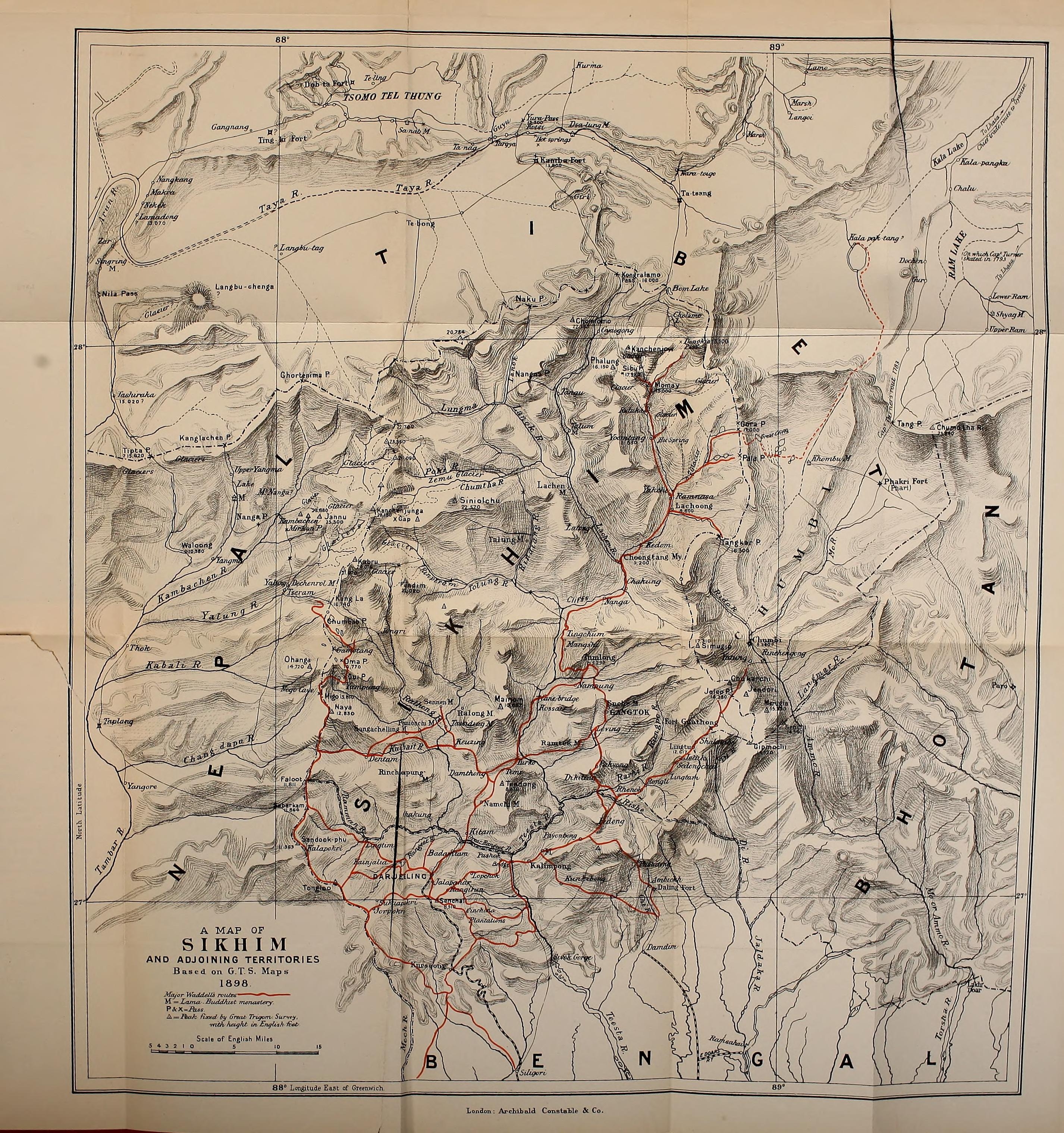
| image_map_caption | Location and administrative map of the Kingdom of Sikkim before incorporation into India | |
| capital | {{plainlist | |
| motto | "Oh, the jewel of creation is in the Lotus" | |
| national_anthem | Drenjong Silé Yang Chhagpa Chilo | |
| "Why is Sikkim Blooming So Fresh and Beautiful?" | ||
| official_languages | Chöke, Sikkimese | |
| common_languages | Lepcha (early period), Dzongkha, Nepali (late period) | |
| religion | Tibetan Buddhism | |
| Nepali Hinduism | ||
| demonym | Drenjop, Sikkimese | |
| currency | Rupee | |
| legislature | State Council of Sikkim | |
| today | India | |
| iso3166code | SK |
Drenjong
Dremoshong
Mayel Lyang
-
Protectorate of Tibet of Qing China (until 1890)
- Bhutanese domination (1680/1700–1792)
- Nepalese domination (1776–1792)
- Nepalo-Bhutanese presence (1792–1816)
- East India Company presence (1816–1890)
-
Princely state of British Raj (1890–1947)
-
Protectorate of India (1950–1975)}} Parliamentary constitutional monarchy (1973–1975) (1967–1975)](flag-of-sikkim) Top: (1967–1975) Bottom: (1877–1975)
-
Yuksom (1642–1670)
-
Rabdentse (1670–1793)
-
Tumlong (1793–1894)
-
Gangtok (1894–1975) "Why is Sikkim Blooming So Fresh and Beautiful?" Nepali Hinduism|
The Kingdom of Sikkim (Classical Tibetan and , Drenjong, , Sikimr Gyalkhab) officially Dremoshong (Classical Tibetan and ) until the 1800s, was a hereditary monarchy in the Eastern Himalayas that existed from 1642 to 16 May 1975, when it joined India after a referendum and constitutional process. It was ruled by Chogyals of the Namgyal dynasty.
History
Foundation of the Monarchy
According to legend, Khye Bumsa, a 14th-century prince from the Minyak House in Kham in eastern Tibet, received a divine revelation instructing him to travel south to seek his fortunes. A fifth-generation descendant of Khye Bumsa, Phuntsog Namgyal, became the founder of Sikkim's monarchy in 1642, when he was consecrated as the first Chogyal, or priest-king, of Sikkim by the three venerated lamas at Yuksom. Phuntsog Namgyal was succeeded in 1670 by his son, Tensung Namgyal, who moved the capital from Yuksom to Rabdentse (near modern Pelling). By the time of its foundation, Sikkim became a protectorate of Tibet (which at the time was part of The Khoshut Khanate until 1717 when it became part of the Dzungar Khanate and later to The Qing Dynasty in 1720.)
Nepalo-Bhutanese domination
In the mid-18th century, Sikkim was invaded by both Nepal (then the Gorkha Kingdom) and Bhutan (then ruled by Gyalsey Tenzin Rabgye) and was under both the Gorkha and the Bhutanese rule for more than 40 years. Between 1775 and 1815, almost 180,000 ethnic Nepalis from Eastern and Central Nepal migrated to Sikkim. After the British colonisation of India, however, Sikkim allied itself with the British India in order to fight Nepal, their common enemy at the time. The Nepalese then attacked Sikkim, overrunning most of the region including the Terai. This prompted the British East India Company to attack Nepal in 1814, resulting in the Anglo-Nepalese War. The Sugauli Treaty between Britain and Nepal and the Treaty of Titalia between Sikkim and British India resulted in territorial concessions by Nepal, which ceded Sikkim to British India.
British and Indian protectorate
Under the 1861 Treaty of Tumlong, Sikkim became a British protectorate.
Thutob Namgyal, the 9th Chogyal of Sikkim, looked to the Dalai Lama for spiritual leadership and during his reign the Tibetan government started to regain political influence over Sikkim. In 1888 the British sent a military expedition to expel Tibetan forces from Sikkim.
Sikkim became an Indian protectorate in 1950.
Accession to India
In 1975, allegations of discrimination against Nepali Hindus in Sikkim led to resentment against the Chogyal. According to some accounts, these developments contributed to the movement of Indian Army personnel into Gangtok. According to journalist Sunanda K. Datta-Ray of The Statesman, in April 1975 the Indian Army carried out a surprise operation during which the palace was surrounded and palace guards were killed.
Following the disarming of the palace, a referendum on the monarchy was held, which some sources describe as having taken place under questionable circumstances. Official results indicated that an overwhelming majority voted to abolish the monarchy. Subsequently, the newly formed parliament of Sikkim, led by Kazi Lhendup Dorjee, passed a resolution requesting that Sikkim become an Indian state, which was accepted by the Government of India under Prime Minister Indira Gandhi.
Culture and religion
In culture and religion, Sikkim was linked closely with Tibet, from which its first king migrated, and Bhutan, with which it shares borders. The presence of a large ethnic Nepali population, mainly from eastern and central Nepal, also leads to cultural linkages with Nepal.
References
Sources
References
- ''The Encyclopaedia Britannica: A Dictionary of Arts, Sciences ...'', Volume 25, page 89.
- [https://www.nytimes.com/1975/04/16/archives/sikkim-votes-to-end-monarchy-merge-with-india.html Sikkim votes to end monarchy & merge with India], nytimes.com. Accessed 11 April 2024.
- "Sikkim / Dämojong".
- "Nepali speakers of Sikkim reflect on 'foreigners' label".
- . (16 May 2018). ["16th May 1975: The Kingdom of Sikkim and its Annexation with India"](https://eurasiantimes.com/sikkim-history-india-annexed/).
- "Did India have a right to annex Sikkim in 1975?".
- Abrahams, Pema. (2023-06-01). "The Forgotten Kingdom".
- Marathe, Om. (2019-08-20). "Explained: Sikkim, from Chogyal rule to Indian state".
- Chettri, Mona. (2013). "Ethnic politics in the Nepali public sphere three casesfrom the eastern Himalaya.".
- "History of Nepal: A Sovereign Kingdom". Official website of Nepal Army.
- (21 February 2016). "Indian hegemonism drags Himalayan kingdom into oblivion". Nikkei Asian Review.
- Larmer, Brook. (March 2008). "Bhutan's Enlightened Experiment". National Geographic.
- (23–29 March 2001). "25 years after Sikkim". Nepali Times.
- Sethi, Sunil. (18 February 2015). "Treaties: Annexation of Sikkim". India Today.
This article was imported from Wikipedia and is available under the Creative Commons Attribution-ShareAlike 4.0 License. Content has been adapted to SurfDoc format. Original contributors can be found on the article history page.
Ask Mako anything about Kingdom of Sikkim — get instant answers, deeper analysis, and related topics.
Research with MakoFree with your Surf account
Create a free account to save articles, ask Mako questions, and organize your research.
Sign up freeThis content may have been generated or modified by AI. CloudSurf Software LLC is not responsible for the accuracy, completeness, or reliability of AI-generated content. Always verify important information from primary sources.
Report