From Surf Wiki (app.surf) — the open knowledge base
Kingdom of Romania
Kingdom in Europe between 1881 and 1947
Kingdom in Europe between 1881 and 1947
| Field | Value | |
|---|---|---|
| conventional_long_name | Kingdom of Romania | |
| native_name | Regatul României | |
| common_name | Romania | |
| iso3166code | omit | |
| era | ||
| event_start | Kingdom proclaimed | |
| year_start | 1881 | |
| event_end | Republic proclaimed | |
| year_end | 1947 | |
| date_end | 30 December | |
| p1 | United Principalities of Moldavia and Wallachia1881: | |
| United Principalities | ||
| flag_p1 | Flag of Romania.svg | |
| p2 | Kingdom of Bulgaria1913: | |
| Kingdom of Bulgaria | ||
| flag_p2 | Flag of Bulgaria.svg | |
| p3 | Moldavian Democratic Republic1918: | |
| Moldavian Democratic Republic | ||
| flag_p3 | National flag of the Moldavian Democratic Republic.svg | |
| p4 | Duchy of Bukovina | |
| flag_p4 | Flag of Bukowina.svg | |
| p5 | Kingdom of Hungary (1920–46)Kingdom of Hungary | |
| flag_p5 | Flag of Hungary (1920–1946).svg | |
| s1 | Romanian People's Republic1947: | |
| Romanian People's Republic | ||
| flag_s1 | Flag of Romania.svg | |
| s2 | Moldavian Soviet Socialist Republic1940/1944: | |
| Moldavian SSR | ||
| flag_s2 | Flag of the Moldavian Soviet Socialist Republic (1941-1952).svg | |
| s3 | Ukrainian Soviet Socialist RepublicUkrainian SSR | |
| flag_s3 | Flag of the Ukrainian Soviet Socialist Republic (1937–1949).svg | |
| s4 | Kingdom of Bulgaria1940: | |
| Kingdom of Bulgaria | ||
| flag_s4 | Flag of Bulgaria.svg | |
| today | ||
| image_flag | Flag of Romania.svg | |
| image_coat | Kingdom of Romania - Big CoA.svg | |
| image_map | Kingdom of Romania (1939).svg | |
| map_caption | The Kingdom of Romania in 1939 | |
| image_map2 | Kingdom of Romania (1914).svg | |
| map_caption2 | The Kingdom of Romania in 1914 | |
| national_motto | Nihil Sine Deo | |
| "Nothing without God" | ||
| national_anthem | Marș triumfal | |
| "Triumphant March" | ||
| (1881–1884) | ||
| official_languages | Romanian | |
| common_languages | ||
| religion | Romanian Orthodox (State Religion) | |
| capital | {{plainlist | |
| government_type | Constitutional monarchy | |
| title_leader | King | |
| leader1 | Carol I | |
| year_leader1 | 1881–1914 | |
| leader2 | Ferdinand I | |
| year_leader2 | 1914–1927 | |
| leader3 | Michael I | |
| year_leader3 | 1927–1930 (1st reign) | |
| leader4 | Carol II | |
| year_leader4 | 1930–1940 | |
| leader5 | Michael I | |
| year_leader5 | 1940–1947 (2nd reign) | |
| deputy1 | Ion Brătianu | |
| deputy2 | Ion Antonescuinfoa[a] | |
| deputy3 | Petru Groza | |
| year_deputy1 | 1881 (first) | |
| year_deputy2 | 1940–1944 | |
| year_deputy3 | 1945–1947 (last) | |
| title_deputy | Prime Minister | |
| legislature | Parliament | |
| (1881–1937; 1939–1940) | ||
| None (rule by decree) | ||
| (1937–1939; 1940–1946) | ||
| Assembly of Deputies | ||
| (1946–1947) | ||
| upper_house | Senate | |
| (1881–1937; 1939–1940) | ||
| lower_house | Assembly of Deputies | |
| (1881–1937; 1939–1940) | ||
| stat_year1 | 1915 | |
| stat_area1 | 137903 | |
| ref_area1 | infob[b] | |
| stat_pop1 | 7,900,000 | |
| ref_pop1 | infob[b] | |
| stat_year2 | 1940 | |
| stat_area2 | 295049 | |
| ref_area2 | infob[b]infoc[c] | |
| stat_pop2 | 20,058,378 | |
| ref_pop2 | infob[b]infoc[c] | |
| GDP_nominal | $2.834 billion | |
| GDP_nominal_year | 1938infod[d] | |
| currency | Romanian Leu | |
| demonym | Romanian | |
| footnotes | {{plainlist | |
| * b. ^ Area and population according to Ioan Suciu, Istoria contemporana a României (1918–2005).<ref name | "AreaPop" | |
| * c. ^ The indicator for the localities of Romania (1941).<ref name | "Indicator41" | |
| * d. ^ 1938 GDP in lei amounting to 387.204 billion (20,487 lei per capita at an estimated population of 18.9 million<ref name | "books.google.ro") at the 1938 average exchange rate of 1 leu for $0.00732. |
United Principalities Kingdom of Bulgaria Moldavian Democratic Republic Romanian People's Republic Moldavian SSR Kingdom of Bulgaria "Nothing without God" "Triumphant March" (1881–1884) Trăiască Regele "Long Live the King" (1884–1948)
- Bucharest (1881–1916, 1918–1947)
- Iași (1916–1918)}} (1881–1937; 1939–1940) None (rule by decree) (1937–1939; 1940–1946) Assembly of Deputies (1946–1947) (1881–1937; 1939–1940) (1881–1937; 1939–1940)
- inforefaa. ^ Was formally declared Conducător (literally, "Leader") of the state on 6 September 1940, by a royal decree which consecrated a ceremonial role for the monarch.
- inforefbb. ^ Area and population according to Ioan Suciu, Istoria contemporana a României (1918–2005).
- inforefcc. ^ The indicator for the localities of Romania (1941).
- inforefdd. ^ 1938 GDP in lei amounting to 387.204 billion (20,487 lei per capita at an estimated population of 18.9 million) at the 1938 average exchange rate of 1 leu for $0.00732. The Kingdom of Romania () was a constitutional monarchy that existed from with the crowning of prince Karl of Hohenzollern-Sigmaringen as King Carol I (thus beginning the Romanian royal family), until 1947 with the abdication of King Michael I and the Romanian Parliament proclamation of the Romanian People's Republic.
From 1859 to 1877, Romania evolved from a personal union of two principalities: (Moldavia and Wallachia) called the Unification of Moldavia and Wallachia also known as "The Little Union" under a single prince to an autonomous principality with a Hohenzollern monarchy. The country gained its independence from the Ottoman Empire during the 1877–1878 Russo-Turkish War (known locally as the Romanian War of Independence), after which it was forced to cede the southern part of Bessarabia in exchange for Northern Dobruja. The kingdom's territory during the reign of King Carol I, between 13 (O.S.) / 25 March 1881 and 27 September (O.S.) / 10 October 1914 is sometimes referred to as the Romanian Old Kingdom, to distinguish it from "Greater Romania", which included the provinces that became part of the state after World War I (Bessarabia, Banat, Bukovina, and Transylvania).
With the exception of the southern halves of Bukovina and Transylvania, these territories were ceded to neighboring countries in 1940, under the pressure of Nazi Germany or the Soviet Union. Following the abolishment of the 1923 constitution by King Carol II in 1938, the Kingdom of Romania became an absolute monarchy, only to become a military dictatorship under Ion Antonescu in 1940 after the forced abdication of King Carol II, with his successor, King Michael I being a figurehead with no effective political power. The country's name was changed to Legionary Romania.
The disastrous World War II campaign on the side of the Axis powers led to King Michael's Coup against Ion Antonescu in 1944, as a result of which the Kingdom of Romania became a constitutional monarchy again and switched sides to the Allies, recovering Northern Transylvania. The influence of the neighbouring Soviet Union and the policies followed by Communist-dominated coalition governments ultimately led to the abolition of the monarchy, with Romania becoming a Soviet satellite state as the People's Republic of Romania on the last day of 1947.
History
Unification and monarchy
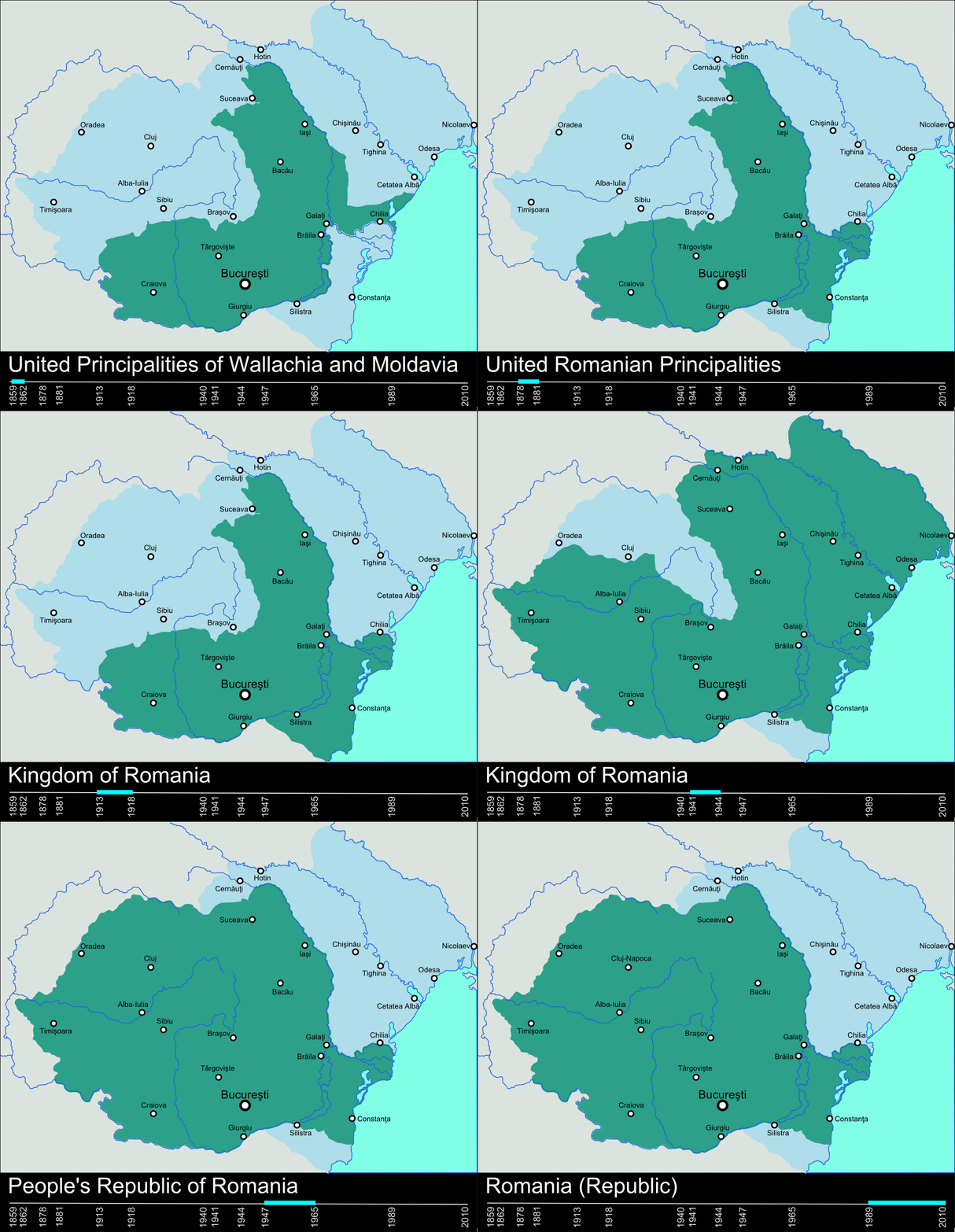
The 1859 ascendancy of Alexandru Ioan Cuza as prince of both Moldavia and Wallachia under the nominal suzerainty of the Ottoman Empire united an identifiably Romanian nation under a single ruler. On 24 January (O.S.) / 5 February 1862, the two principalities were formally united to form the Principality of Romania, with Bucharest as its capital.
On 11 (O.S.) / 23 February 1866 a so-called "monstrous coalition", composed of Conservatives and radical Liberals, forced Cuza to abdicate. The German prince Charles of Hohenzollern-Sigmaringen was appointed as Prince of Romania, in a move to assure German backing to unity and future independence. He immediately adopted the Romanian spelling of his name, Carol, and his cognatic descendants would rule Romania until the overthrow of the monarchy in 1947.
For more than a decade after the formal union of the two principalities, Romania was still nominally a vassal of the Ottoman Empire. However, this was increasingly a legal fiction. Romania had its own flag and anthem, and from 1867 had its own currency as well. Following the Russo-Turkish War of 1877–1878, Romania was recognized as an independent state by the Treaty of Berlin, 1878 and acquired Dobruja, although it was forced to surrender southern Bessarabia (Budjak) to Russia. On 15 March 1881, as an assertion of full sovereignty, the Romanian parliament raised the country to the status of a kingdom, and Carol was crowned king on 10 May.
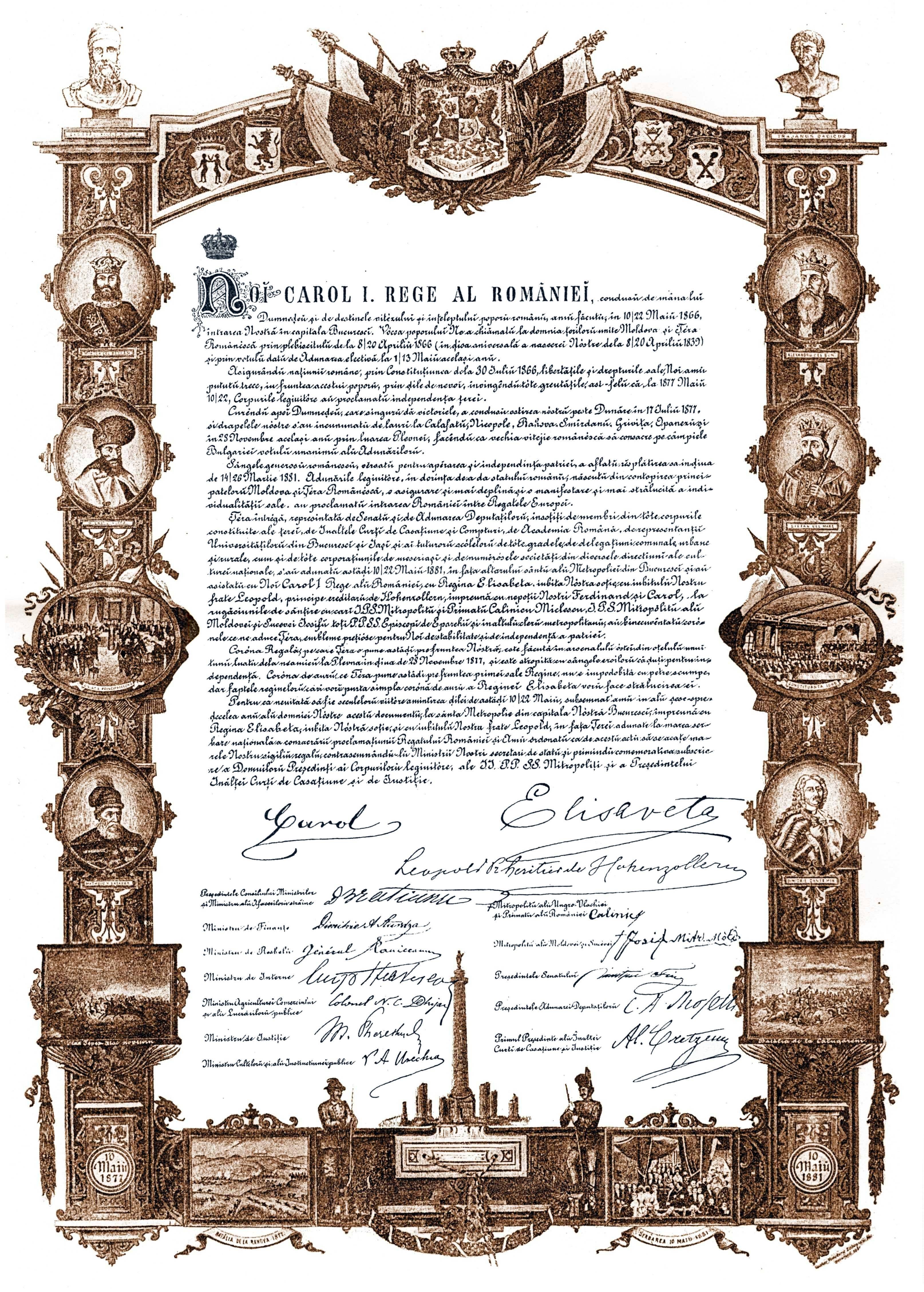
The new state, squeezed between the Ottoman, Austro-Hungarian, and Russian Empires, with Slavic populations on its southwestern, southern, and northeastern borders, the Black Sea due east, and Hungarian neighbours on its western and northwestern borders, looked to the West, particularly France, for its cultural, educational, and administrative models.
Abstaining from the Initial Balkan War against the Ottoman Empire, the Kingdom of Romania entered the Second Balkan War in June 1913 against the Tsardom of Bulgaria. 330,000 Romanian troops moved across the Danube and into Bulgaria. One army occupied Southern Dobruja and another moved into northern Bulgaria to threaten Sofia, helping to bring an end to the war. Romania thus acquired the ethnically mixed territory of Southern Dobruja, which it had desired for years.
In 1916 Romania entered World War I on the Entente side. Romania engaged in a conflict against Bulgaria but as a result Bulgarian forces, after a series of successful battles, regained Dobruja, which had been previously ceded from Bulgaria by the treaty of Bucharest and the Berlin congress. Although the Romanian forces did not fare well militarily, by the end of the war the Austrian and Russian empires were gone; various assemblies proclaimed as representative bodies in Transylvania, Bessarabia and Bukovina decided on union with Romania. In 1919 by the Treaty of Saint-Germain and in 1920 by the Treaty of Trianon most of the territories claimed were assigned to Romania.
Old Kingdom (1881–1918)
Main article: Romanian Old Kingdom, Romania during World War I
The Romanian Old Kingdom ( or just Regat; or Altreich) is a colloquial term referring to the territory covered by the first independent Romanian nation state, which was composed of the Danubian Principalities – Wallachia and Moldavia. It was achieved when, under the auspices of the Treaty of Paris (1856), the ad hoc Divans of both countries – which were under Imperial Ottoman suzerainty at the time – voted for Alexander Ioan Cuza as their prince, thus achieving a de facto unification. The region itself is defined by the result of that political act, followed by the inclusion of Northern Dobruja in 1878, the proclamation of the Kingdom of Romania in 1881, and the annexation of Southern Dobruja in 1913.

The term came into use after World War I, when the Old Kingdom was opposed to Greater Romania, which included Transylvania, Banat, Bessarabia, and Bukovina. Nowadays, the term is mainly of historical relevance, and is otherwise used as a common term for all regions in Romania included in both the Old Kingdom and present-day borders (namely: Wallachia, Moldavia, and Northern Dobruja).
World War I
Main article: Romania in World War I
Romania delayed in entering World War I, but ultimately declared war on the Central Powers in 1916. The Romanian military campaign ended in stalemate when the Central Powers quickly crushed the country's offensive into Transylvania and occupied Wallachia and Dobruja, including Bucharest and the strategically important oil fields, by the end of 1916. In 1917, despite fierce Romanian resistance, especially at the Battle of Mărășești, due to Russia's withdrawal from the war following the October Revolution, Romania, being almost completely surrounded by the Central Powers, was forced to also drop from the war, signing the Armistice of Focșani and next year, in May 1918, the Treaty of Bucharest. But after the successful offensive on the Thessaloniki front which put Bulgaria out of the war, Romania's government quickly reasserted control and put an army back into the field on 10 November 1918, a day before the war ended in Western Europe. Following the proclamation of the union of Transylvania with the Kingdom of Romania on 1 December 1918 by the representatives of Transylvanian Romanians gathered at Alba Iulia, Transylvania was soon united with the Kingdom, as was Bessarabia earlier in 1918, since the power vacuum in Russia caused by the civil war there allowed the Sfatul Țării, or National Council, to proclaim the union of Bessarabia with Romania. War with the Hungarian Soviet Republic in 1919 resulted in the occupation of Budapest by Romanian troops and the end of Béla Kun's Bolshevik regime.
Greater Romania
Union with Bessarabia, Bukovina and Transylvania
Main article: Union of Transylvania with Romania, Union of Bessarabia with Romania, Union of Bukovina with Romania
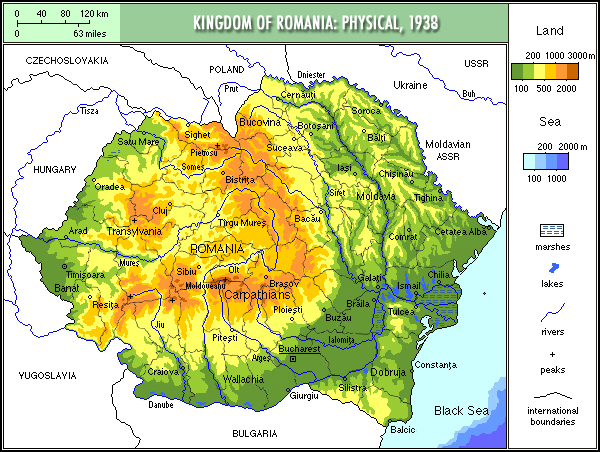
At the Paris Peace Conference, Romania received the territories of Transylvania, part of Banat and other territories from Hungary, as well as Bessarabia (Eastern Moldavia between Prut and Dniester rivers) and Bukovina. In the Treaty of Trianon, Hungary renounced in favor of Romania all the claims of the Austro-Hungarian Monarchy over Transylvania. The union of Romania with Bukovina was ratified in 1919 in the Treaty of Saint Germain, and in 1920 some of the Western powers recognized Romanian rule over Bessarabia by the Treaty of Paris. Thus, Romania in 1920 was more than twice the size it had been in 1914. The last territorial change during this period came in 1923, when a few border settlements were exchanged between Romania and Kingdom of Serbs, Croats and Slovenes. The most notable Romanian acquisition was the town of Jimbolia, while the most notable Yugoslav acquisition was the town of Jaša Tomić.
Romania made no further territorial claims; nonetheless the kingdom's expansion aroused enmity from several of its neighbors, including Bulgaria, the Soviet Union, and especially Hungary. Greater Romania now had a significant minority population, especially of Hungarians, and faced the difficulty of assimilation. Transylvania had significant Hungarian and German population who were accustomed to being the power structure; with a historically contemptuous attitude towards Romanians, they now feared reprisals. Both groups were effectively excluded from politics as the postwar regime passed an edict stating that all personnel employed by the state had to speak Romanian. The new state was also a highly centralized one, so it was unlikely that the Hungarian or German minorities would exercise political influence without personal connections in the government in Bucharest. Despite these policies, the Romanian government permitted both Germans and Hungarians the freedom to have separate schools, publications and judicial hearings in their respective languages. These rights were not extended to other minorities, Jews in particular.

The ''interbellum'' years
The resulting Great Union did not survive World War II. Until 1938, Romania's governments maintained the form, if not always the substance, of a liberal constitutional monarchy. The National Liberal Party, dominant in the years immediately after World War I, became increasingly clientelist and nationalist, and in 1927 was supplanted in power by the National Peasants' Party. Between 1930 and 1940 there were over 25 separate governments; on several occasions in the last few years before World War II, the rivalry between the fascist Iron Guard and other political groupings approached the level of a civil war.
Upon the death of King Ferdinand in 1927, his son, Prince Carol, was prevented from succeeding him because of previous marital scandals that had resulted in his renunciation of rights to the throne. After living three years in exile, with his brother Nicolae serving as regent and his young son Michael as king, Carol changed his mind and with the support of the ruling National Peasants' Party he returned and proclaimed himself king.
Iuliu Maniu, leader of the National Peasants' Party, engineered Carol's return on the basis of a promise that he would forsake his mistress Magda Lupescu, and Lupescu herself had agreed to the arrangement. However, it became clear upon Carol's first re-encounter with his former wife, Elena, that he had no interest in a reconciliation with her, and Carol soon arranged for Magda Lupescu's return to his side. Her unpopularity was a millstone around Carol's neck for the rest of his reign, particularly because she was widely viewed as his closest advisor and confidante. Maniu and his National Peasant Party shared the same general political aims as the Iron Guard: both fought against the corruption and dictatorial policies of King Carol II and the National Liberal Party.
The worldwide Great Depression that started in 1929 and was also present in Romania destabilised the country. The early 1930s were marked by social unrest, high unemployment, and strikes. In several instances, the Romanian government violently repressed strikes and riots, notably the 1929 miners' strike in Valea Jiului and the strike in the Grivița railroad workshops. In the mid-1930s, the Romanian economy recovered and the industry grew significantly, although about 80% of Romanians were still employed in agriculture. French economic and political influence was predominant in the early 1920s but then Germany became more dominant, especially in the 1930s.

As the 1930s progressed, Romania's already shaky democracy slowly deteriorated toward fascist dictatorship. The constitution of 1923 gave the king free rein to dissolve parliament and call elections at will; as a result, Romania experienced over 25 governments in a single decade.
Increasingly, these governments were dominated by a number of anti-Semitic, ultra-nationalist, and mostly at least quasi-fascist parties. The National Liberal Party steadily became more nationalistic than liberal, but nonetheless lost its dominance over Romanian politics. It was eclipsed by parties like the (relatively moderate) National Peasants' Party and its more radical Romanian Front offshoot, the National-Christian Defense League (LANC) and the Iron Guard. In 1935, LANC merged with the National Agrarian Party to form the National Christian Party (NCP). The quasi-mystical fascist Iron Guard was an earlier LANC offshoot that, even more than these other parties, exploited nationalist feelings, fear of communism, and resentment of alleged foreign and Jewish domination of the economy.
Already the Iron Guard had embraced the politics of assassination, and various governments had reacted more or less in kind. On 10 December 1933, Liberal prime minister Ion Duca "dissolved" the Iron Guard, arresting thousands; consequently, 19 days later he was assassinated by Iron Guard legionnaires.
Throughout the 1930s, these nationalist parties had a mutually distrustful relationship with King Carol II. Nonetheless, in December 1937, the king appointed National Christian Party leader, the poet Octavian Goga, as prime minister of Romania's first Fascist government. Around this time, Carol met with Adolf Hitler, who expressed his wish to see a Romanian government headed by the pro-Nazi Iron Guard. Instead, on 10 February 1938 King Carol II used the occasion of a public insult by Goga toward Lupescu as a reason to dismiss the government and institute a short-lived royal dictatorship, sanctioned 17 days later by a new constitution under which the king named personally not only the prime minister but all the ministers.
In April 1938, King Carol had Iron Guard leader Corneliu Zelea Codreanu (aka "The Captain") arrested and imprisoned. On the night of 29–30 November 1938, Codreanu and several other legionnaires were killed while purportedly attempting to escape from prison. It is generally agreed that there was no such escape attempt, but that they were murdered in retaliation for a series of assassinations by Iron Guard commandos.
The royal dictatorship was brief. On 7 March 1939, a new government was formed with Armand Călinescu as prime minister; on 21 September 1939, three weeks after the start of World War II, Călinescu, in turn, was also assassinated by legionnaires avenging Codreanu's murder.
In 1939, Germany and the Soviet Union signed the Molotov–Ribbentrop Pact, which stipulated, among other things, the Soviet "interest" in Bessarabia. After the 1940 territorial losses and growing increasingly unpopular, Carol was compelled to abdicate and name general Ion Antonescu as the new Prime-Minister with full powers in ruling the state by royal decree.
World War II
Main article: Romania in World War II, Kingdom of Romania under Fascism
Post-war Kingdom (1945–1947)
Economy
Pre-Kingdom Era to World War I
At the time of the proclamation of the Kingdom, there were already several industrial facilities in the country: The Assan and Olamazu steam mills, built in 1853 and 1862 respectively, a brick factory built in 1865, and two sugar factories built in 1873, among others. In 1857, the first oil refinery in the world was built at Ploiești. In 1880, after several railways were built, the CFR was founded. After proclamation of the Kingdom, the pre-established industrial facilities began to be highly developed: 6 more, larger, sugar factories were built and the railway network was expanded more. Another, more modern brick factory was built in 1891.
Agriculture
Despite all of these industrial achievements, the overwhelming majority of Romania's economy remained agricultural. In 1919, a staggering 72% of Romanians were engaged in agriculture. The Romanian peasantry was among the poorest in the region, a situation aggravated by one of Europe's highest birth rates. Farming was primitive and machinery and chemical fertilizers almost unheard of. The Regat (prewar Romania) was traditionally a land of large estates worked by peasants who either had little or no land of their own. The situation in Transylvania and Bessarabia was marginally better. After peasant calls for land reform snowballed into an avalanche, King Ferdinand had to oblige, especially once the Russian Revolution had encouraged peasants to take the matter in their own hands. The land reform passed in 1921 accomplished little however. Large landowners still controlled up to 30% of Romania's land, including the forests peasants depended on for fuel. The redistributed plots were invariably too small to feed their owners and most peasants could not overcome their tradition of growing grain over cash crops. Nothing was done to remedy basic problems such as rural overpopulation and technological backwardness. Draft animals were rare, to say nothing of machinery, actual productivity was worse than before. Romanian agriculture struggled in the international market, and with the onset of the Great Depression, collapsed completely.
Expansion and growth
Romania's 1913 GDP at the 1990 exchange rate amounted to $11.7 billion. However, the 1990 dollar was 9.27 times weaker than the 1938 dollar. Thus, Romania's 1913 GDP at the 1938 exchange rate amounted to $1.262 billion.
The 1938 Romanian GDP amounted to 387.204 billion lei, with a GDP per capita of 20,487 lei at an estimated population of 18.9 million. The 1938 average exchange rate was of 1 leu for US$0.00732. Romania's 1938 GDP thus amounted to $2.834 billion.
Romania's public debt as of 1 April 1938 amounted to 112,267,290,144 lei, of which 78,398,078,964 lei consisted of external debt. Total public debt thus amounted to 29% of Romania's 1938 GDP, while public external debt amounted to just over 20%.
Industrial development
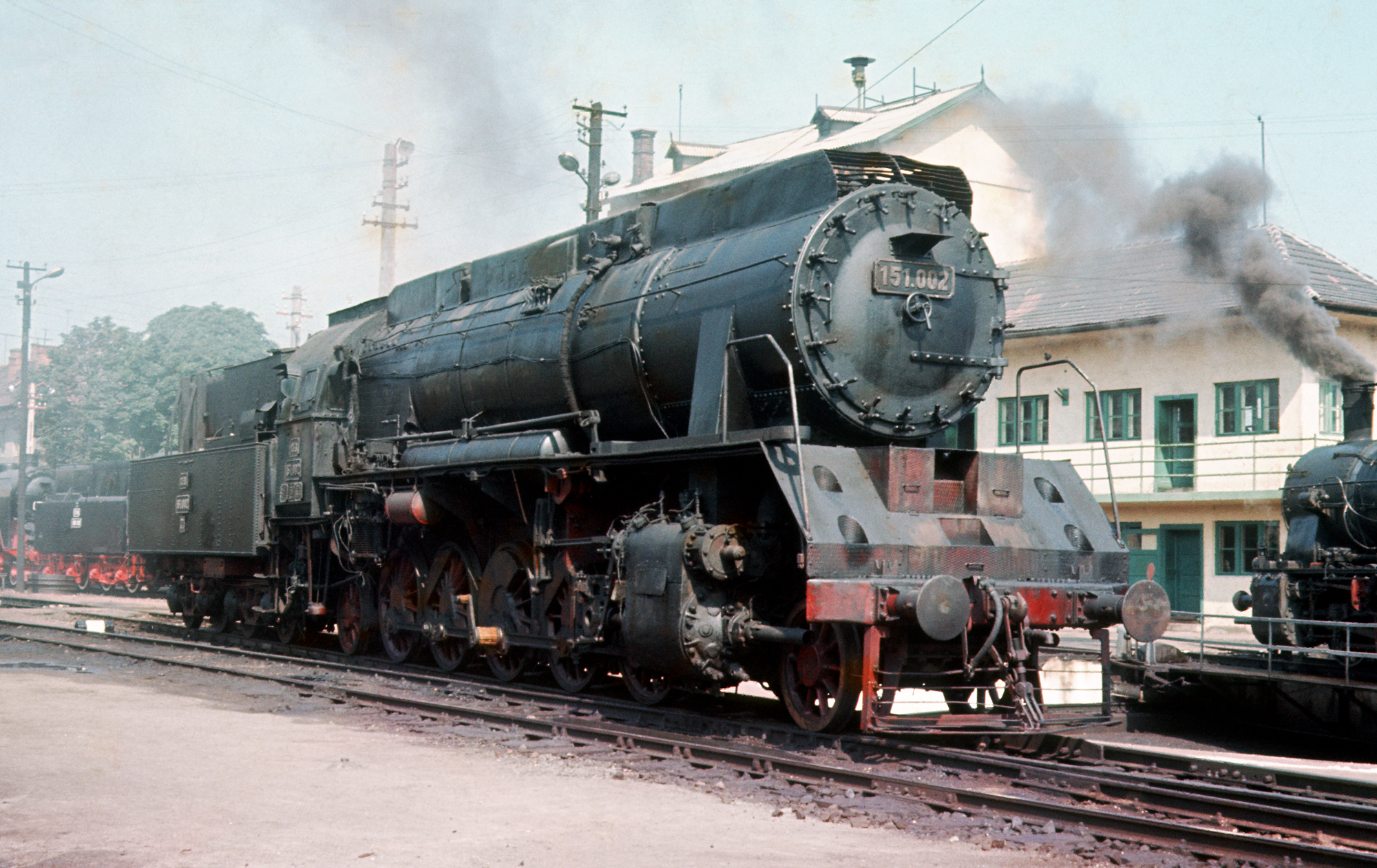
Despite the destruction provoked by the First World War, Romanian industry managed significant growth, as a result of new establishments and development of the older ones. The MALAXA industrial engineering and manufacturing company was established in 1921 by Romanian industrialist Nicolae Malaxa and dealt especially with rolling stock maintenance and manufacturing. It developed rapidly, and by 1930 Romania had managed to cease importing locomotives altogether, all required rolling stock being supplied by the local industry. Industrial facilities acquired along with the new provinces, such as the Reșița works, also contributed to the rapid development of Romanian heavy industry. Other important establishments were the Copșa Mică works, producing non-ferrous metals and the Romanian Optical Enterprise. Construction also developed, as great monuments like the Caraiman Cross (1928), Arcul de Triumf (1936), and the Mausoleum of Mărășești (1938) were erected. The oil industry was also greatly expanded, making Romania one of the top oil exporters by the late 1930s, which also attracted German and Italian interest.
In 1938, Romania produced 6.6 million tons of crude oil, 284,000 tons of crude steel, 133,000 tons of pig iron, 510,000 tons of cement, and 289,000 tons of rolled steel.
Armament industry

Romanian military industry during World War I was mainly focused on converting various fortification guns into field and anti-aircraft artillery. Up to 334 German 53 mm Fahrpanzer guns, 93 French 57 mm Hotchkiss guns, 66 Krupp 150 mm guns and dozens more 210 mm guns were mounted on Romanian-built carriages and transformed into mobile field artillery, with 45 Krupp 75 mm guns and 132 Hotchkiss 57 mm guns being transformed into anti-aircraft artillery. The Romanians also upgraded 120 German Krupp 105 mm howitzers, the result being the most effective field howitzer in Europe at that time. Romania even managed to design and build from scratch its own model of mortar, the 250 mm Negrei Model 1916. Other Romanian technological assets include the building of Vlaicu III, the world's first aircraft made of metal. The Romanian Navy possessed the largest warships on the Danube. They were a class of 4 river monitors, built locally at the Galați shipyard using parts manufactured in Austria-Hungary, and the first one launched was Lascăr Catargiu, in 1907. The Romanian monitors displaced almost 700 tons, were armed with three 120 mm naval guns in 3 turrets, two 120 mm naval howitzers, four 47 mm anti-aircraft guns and two 6.5 machine guns. The monitors took part in the Battle of Turtucaia and the First Battle of Cobadin. The Romanian-designed Schneider 150 mm Model 1912 howitzer was considered one of the most modern field guns on the Western Front.
.jpg)
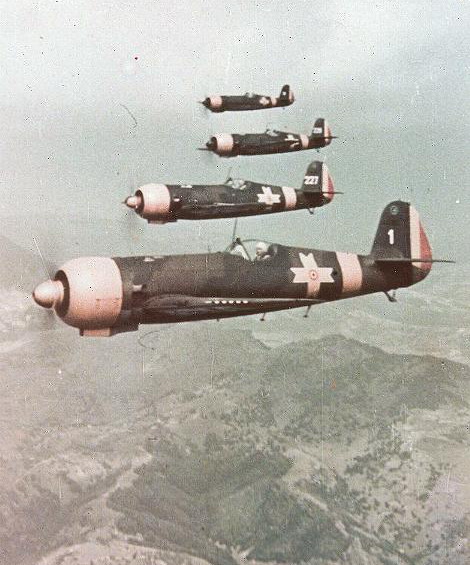
The Romanian armament industry was expanded greatly during the Interwar period and World War II. New factories were constructed, such as the Industria Aeronautică Română and Societatea Pentru Exploatări Tehnice aircraft factories, which produced hundreds of indigenous aircraft, such as IAR 37, IAR 80, and SET 7. Before the war, Romania acquired from France the licence to produce hundreds of Brandt Mle 27/31 and Brandt Mle 1935 mortars, with hundreds more produced during the war, and also the licence to produce 140 French 47 mm Schneider anti-tank guns at the Concordia factory, with 118 produced between 26 May 1939 and 1 August 1940 and hundreds more produced during the war; these guns were to be towed by Malaxa Tip UE armored carriers, built since late 1939 at the Malaxa factory under French licence, eventually 126 being built until March 1941. Czechoslovak licence was acquired in 1938 to produce the ZB vz. 30 machine gun, with 5,000 being built at the Cugir gun factory until the start of Operation Barbarossa in June 1941. Romania also acquired the licence to produce the R-1 tankette, but ultimately only one prototype was built locally. German licence was acquired in 1938 to produce 360 37 mm Rheinmetall anti-aircraft guns, but only 102 were produced until May 1941. British licence was acquired to produce 100 Vickers Model 1931 75 mm anti-aircraft guns at the Reșița works, with the first battery of 6 guns entering service on 1 August 1939, and 100 more guns were built during the war for a total production of 200. On 14 June, Romania launched the first locally-built warship, the minelayer .
During the war, Romania copied and produced hundreds of Soviet M1938 mortars, as well as designing and producing up to 400 75 mm Reșița Model 1943 anti-tank guns. Infantry weapons designed and produced by Romania during the war include the Orița M1941 sub-machinegun and the Argeș flamethrower. Romania also built 30 Vănătorul de care R-35, 34 TACAM T-60, 21 TACAM R-2 tank destroyers and rebuilt 34 captured Soviet Komsomolets armored tractors. A few prototype vehicles were also built, such as the Mareșal tank destroyer, which is credited with being the inspiration for the German Hetzer, a Renault R-35 tank with a T-26 turret and an artillery tractor known as T-1. Warships built include the submarines and , a class of 4 minesweepers, 6 Dutch-designed torpedo boats and 2 gunboats.
Demographics
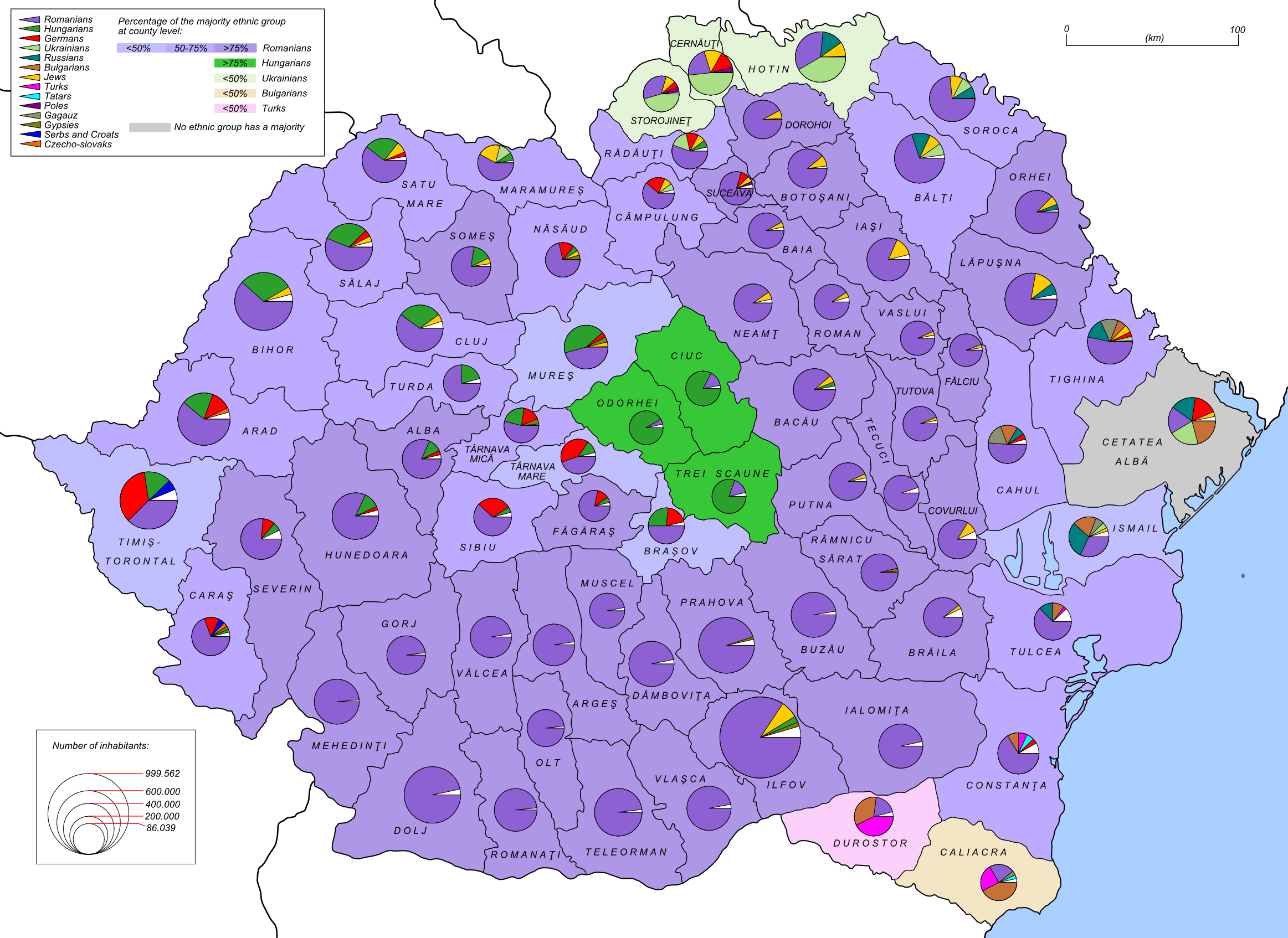
According to the 1930 Romanian Census, Romania had a population of 18,057,028. Romanians made up 71.9% of the population and 28.1% of the population were ethnic minorities.
| Ethnicity | number | % |
|---|---|---|
| Romanians | 12,981,324 | 71.9 |
| Hungarians | 1,425,507 | 7.9 |
| Germans | 745,421 | 4.1 |
| Jews | 728,115 | 4 |
| Ruthenians and Ukrainians | 582,115 | 3.2 |
| Russians | 409,150 | 2.3 |
| Bulgarians | 366,384 | 2 |
| Romani | 262,501 | 1.5 |
| Turks | 154,772 | 0.9 |
| Gagauzes | 105,750 | 0.6 |
| Czechs and Slovaks | 51,842 | 0.3 |
| Serbs, Croats and Slovenes | 51,062 | |
| Poles | 48,310 | |
| Greeks | 26,495 | 0.1 |
| Tatars | 22,141 | |
| Armenians | 15,544 | 0.0 |
| Hutsuls | 12,456 | |
| Albanians | 4,670 | |
| Others | 56,355 | 0.3 |
| Undeclared | 7,114 | 0.0 |
| Total | 18,057,028 | 100 |
Cities
Largest cities as per 1930 census:
| Rank | Name | Population | ||
|---|---|---|---|---|
| 1 | ||||
| 2 | ||||
| 3 | ||||
| 4 | ||||
| 5 | ||||
| 6 | ||||
| 7 |
Notes: 1 - including 12 suburban communities.
Two of Romania's seven largest cities in 1930 are currently located outside of Romania as a result of World War II border changes.
Education

While the Romanian nobility had a long tradition of sending their sons to Europe's finest schools, the educated were otherwise a tiny minority. Transylvania had the most educated population in Greater Romania, while Bessarabia fared the worst. While legally all Romanians were required to undergo at least four years of schooling, in practice few actually did and the system was designed to separate those who would go on to higher education from those who would not. While this was partially necessary due to limited resources, it ensured that peasants had almost no chance of becoming educated.
High school and college education in Romania was modeled after the French system. Students undertook a rigid curriculum based around the liberal arts. Romania suffered from the same problem as the rest of Eastern Europe, which was that most students, coming from aristocratic backgrounds, preferred to study subjects such as theology, philosophy, literature and the fine arts over science, business, and engineering.
Administrative division
After Independence, the Romanian Old Kingdom was divided into 33 counties.
After World War I, as a result of the 1925 administrative unification law, the territory was divided into 71 counties, 489 districts (plăși) and 8,879 communes.
In 1938, King Carol II promulgated a new Constitution, and subsequently he had the administrative division of the Romanian territory changed. Ten ținuturi (approximate translation: "lands") were created (by merging the counties) to be ruled by rezidenți regali (approximate translation: "Royal Residents") - appointed directly by the King. This administrative reform did not last and the counties were re-established after the fall of Carol's regime.
Maps
File:Romania Judete Antebelice (RO).svg|Administrative map of Romania in 1881–1913 File:Romania 1930 counties.500px.svg|Administrative map of Romania in 1925–1938 File:Tinuturi Romania.svg|Regions (Ținuturi) of Romania in 1938–1940 File:ROMANIA MAI 1942.png|Romania in 1942 File:Romania 1948.jpg|Kingdom of Romania in 1947
Timeline (1859–1940)

| • 1940 – | 6 September. After the forced abdication of King Carol II, his 19-year-old son Michael I assumes the throne, being obliged to grant dictatorial powers to Prime Minister and Conducător Ion Antonescu. |
|---|---|
| 14 September. The Kingdom of Romania is supplanted by a short-lived dictatorship called the National Legionary State. |
File:Alegătorul liber 1875-01-23, nr. 001.pdf|Alegătorul liber, January 23, 1875 File:Bukarester Tagblatt 1880-08-10, nr. 001.pdf|Bukarester Tagblatt, August 10, 1880 (in German) File:Voința naționala 1884-11-01.pdf|Voința naționala, November 1, 1884 File:Opinia 1913-08-22, nr. 01966.pdf|Opinia, August 22, 1913
Monarchs
File:Carol I King of Romania.jpg|King Carol I (1881–1914) File:King Ferdinand of Romania.jpg|King Ferdinand I (1914–1927) File:1903Nicholas-09.jpg|Prince Nicholas (Regent) (1927–1930) File:Carol al II-lea.jpg|King Carol II (1930–1940) File:Mihai.jpg|King Michael I (1927–1930; 1940–1947)
Kings of Romania (1881–1947)
(1st reign)
(2nd reign)
Queens-consort of Romania
Queen Mother on Michael I's 2nd accession
Timeline
This is a graphical lifespan timeline of Kings
Define $width = 1100 Define $warning = 1290 # $width - 110 Define $height = 560 # 43x20 + 160
Define $start = 1818 Define $end = 2021
ImageSize = width:$width height:$height PlotArea = right:10 left:1 bottom:80 top:60 Period = from:$start till:$end TimeAxis = orientation:horizontal Legend = orientation:vertical position:bottom columns:1
Colors = id:bg value:white id:lightline value:rgb(0.9, 0.9, 0.9) id:lighttext value:rgb(0.5, 0.5, 0.5) id:BEFORE value:rgb(0.81, 0.73, 0.31) Legend: Life_Before_Heirship/Ruling id:AFTER value:rgb(0.81, 0.73, 0.11) Legend: Life_After_Heirship/Ruling id:PRINCIP value:green Legend: Domnitor_(ruler_of_a_Principality) id:KING value:rgb(0.31, 0.39, 0.81) Legend: King id:HEIR value:yellow Legend: Crown_Heir id:STATUS value:rgb(0.80, 0.80, 0.80) Legend: Country_Status id:NAME value:rgb(0.15, 0.13, 0.05) id:ACTINGNAME value:rgb(0.99, 0.00, 0.00) id:TODAY value:green
BackgroundColors = canvas:bg ScaleMinor = gridcolor:lightline unit:year increment:1 start:$start ScaleMajor = gridcolor:lighttext unit:year increment:10 start:1820
Define $dy = -5 # shift text to button side of bar
LineData= at:2017 color:TODAY width:0.1
PlotData= bar:1 width:18 color:STATUS align:center fontsize:M from:1818 till:1877 shift:(-0,$dy) textcolor:NAME text:Ottoman Dependency
bar:2 width:18 color:STATUS align:center fontsize:M from:1818 till:1861 shift:(-0,$dy) textcolor:NAME text:Two Principalities
bar:3 width:18 color:BEFORE align:left fontsize:M from:1820 till:1859 shift:(-100,$dy) textcolor:NAME text:Alexandru Ioan Cuza color:PRINCIP from:1859 till:1867 color:AFTER from:1867 till:1874
bar:4 width:18 color:STATUS align:center fontsize:M from:1861 till:1881 shift:(-0,$dy) textcolor:NAME text:Principality
bar:6 width:18 color:BEFORE align:left fontsize:M from:1839 till:1866 shift:(-70,$dy) textcolor:NAME text:Carol I color:PRINCIP from:1866 till:1881 color:KING from:1881 till:1915
bar:7 width:18 color:BEFORE align:left fontsize:M from:1835 till:1867 shift:(-105,$dy) textcolor:NAME text:Leopold, Prince of Hohenzollern color:HEIR from:1867 till:1880 color:AFTER from:1880 till:1906
bar:9 width:18 color:STATUS align:center fontsize:M from:1877 till:2017 shift:(-0,$dy) textcolor:NAME text:Independent State
bar:10 width:18 color:BEFORE align:left fontsize:M from:1864 till:1890 shift:(-170,$dy) textcolor:NAME text:William, Prince of Hohenzollern color:HEIR from:1880 till:1889 color:AFTER from:1889 till:1928
bar:11 width:18 color:STATUS align:center fontsize:M from:1881 till:1948 shift:(-0,$dy) textcolor:NAME text:Kingdom
bar:12 width:18 color:BEFORE align:left fontsize:M from:1865 till:1889 shift:(-65,$dy) textcolor:NAME text:Ferdinand I color:HEIR from:1889 till:1915 color:KING from:1915 till:1927
bar:13 width:18 color:BEFORE align:left fontsize:M from:1893 till:1915 shift:(-58,$dy) textcolor:NAME text:Carol II color:HEIR from:1915 till:1918 color:AFTER from:1918 till:1920 color:HEIR from:1920 till:1926 color:AFTER from:1926 till:1930 color:KING from:1930 till:1941 color:AFTER from:1941 till:1954
bar:14 width:18 color:BEFORE align:left fontsize:M from:1903 till:1918 shift:(-50,$dy) textcolor:NAME text:Prince Nicholas color:HEIR from:1918 till:1920 color:AFTER from:1920 till:1927 color:HEIR from:1927 till:1930 color:AFTER from:1930 till:1979
bar:15 width:18 color:BEFORE align:left fontsize:M from:1921 till:1926 shift:(-40,$dy) textcolor:NAME text:Michael I color:HEIR from:1926 till:1927 color:KING from:1927 till:1930 color:HEIR from:1930 till:1941 color:KING from:1941 till:1948 color:AFTER from:1948 till:2017
bar:16 width:18 color:STATUS align:center fontsize:M from:1948 till:2021 shift:(-0,$dy) textcolor:NAME text:Republic
TextData = pos:(480,$height) fontsize:L textcolor:black text:"Lifespan of each kings and heir to the Romanian throne"
Royal standards
File:Royal standard of Romania (King, 1881 model).svg|Royal Standard (1881–1922) File:Royal standard of Romania (King, 1922 model).svg|Royal Standard (1922–1947)
Notes
References
References
- "Constitutiunea din 1923". Legislatie pentru Democratie.
- Bataković, Dušan T.. (2011). "Minorities in the Balkans: State policy and interethnic relations (1804 - 2004): Les minorites dans les Balkans". Balkanološki institut SANU.
- [[Dennis Deletant]], ''Hitler's Forgotten Ally: Ion Antonescu and His Regime, Romania, 1940–1944'', [[Palgrave Macmillan]], London, 2006. {{ISBN. 1-4039-9341-6
- Ioan Scurtu. (2005). "Istoria contemporana a României (1918-2005)".
- Institutul Central de Statistică. (1943). "Indicatorul localităților din România".
- (8 January 2016). "D. Berg-Schlosser, J. Mitchell, Springer, Feb 23, 2000, ''The Conditions of Democracy in Europe 1919-39: Systematic Case Studies'', p. 392". Springer.
- (1943). "United States - Bureau of Mines, Economics and Statistics Branch, December 1944, ''Foreign Minerals Survey - The Mineral Resources of Rumania'', p. 4".
- "Timeline".
- "Romania - The Crimean War and Unification".
- Deju, Elena. (18 November 2018). "Aspecte ale influenţei limbii franceze asupra limbii române". Analele Universităţii "Dunărea de Jos" Din Galaţi. Fascicula XXIV Lexic Comun / Lexic Specializat.
- (2013). "Unele consideraţii privind impactul dreptului francez asupra celui românesc, în contextul formării României moderne". Conferința Internațională de Drept, Studii Europene și Relații Internaționale.
- "Text of the Treaty of Trianon". World War I Document Archive.
- Bernard Anthony Cook. (2001). "Europe Since 1945: An Encyclopedia". Taylor&Francis.
- Malbone W. Graham. (October 1944). "The Legal Status of the Bukovina and Bessarabia". American Society of International Law.
- Dan Petre, ''Hotarele românismului în date'' (Ed. Litera Internațional, București, 2005), pp. 106–107
- Peter Jordan (1989), ''Atlas Ost- und Südosteuropa: aktuelle Karten zu Ökologie, Bevölkerung und Wirtschaft'', Issue 2, Österreichisches Ost- und Südosteuropa-Institut, p. 27
- Takako Ueta, Eric Remacle, Peter Lang (2005), ''Japan and Enlarged Europe: Partners in Global Governance'', p. 81
- link. (21 September 2017)
- Rebecca Ann Haynes, "Reluctant allies? Iuliu Maniu and Corneliu Zelea Codreanu against King Carol II of Romania." ''[[The Slavonic and East European Review]]'' (2007): 105-134. [http://discovery.ucl.ac.uk/2247/1/2247.pdf online] {{Webarchive. link. (2019-07-07)
- William A. Hoisington Jr, "The Struggle for Economic Influence in Southeastern Europe: The French Failure in Romania, 1940." ''Journal of Modern History'' 43.3 (1971): 468-482.
- "Decret regal privind investirea generalului Ion Antonescu cu depline puteri". Istoria românilor între anii 1918–1940.
- "WORLD EVENTS: 1844-1856". [[Public Broadcasting Service.
- (5 December 2014). "industria romana inainte de primul razboi mondial Archives - Romania Military".
- [https://books.google.com/books?id=rpBbX3kdnhgC&pg=PA7 Stephen Broadberry, Mark Harrison, Cambridge University Press, Sep 29, 2005, ''The Economics of World War I'', pp. 7-8]
- "Inflation calculator".
- (23 December 2016). "M. Epstein, Springer, Dec 23, 2016, ''The Statesman's Year-Book: Statistical and Historical Annual of the States of the World for the Year 1939'', p. 1275". Springer.
- "Metallic Welded Constructions. Faur Bucharest Romania".
- link. (2024-09-21 , Ken Jowitt, [[University of California Press]], 8 January 2021)
- Adrian Storea, Gheorghe Băjenaru, ''Artileria română în date și imagini (Romanian artillery in data and pictures)'', pp. 40, 49, 50, 54, 59, 61, 63, 65 and 66 (in Romanian)
- Jozef Wilczynski, ''Technology in Comecon: Acceleration of Technological Progress Through Economic Planning and the Market'', p. 243
- International Naval Research Organization, ''Warship International, Volume 21'', p. 160
- Frederick Thomas Jane, ''Jane's Fighting Ships'', p. 343
- Robert Gardiner, ''Conway's All the World Fighting Ships 1906–1921'', p. 422
- Adrian Storea, Gheorghe Băjenaru, ''Artileria română în date și imagini (Romanian artillery in data and pictures)'', p. 53 (in Romanian)
- ''Third Axis. Fourth Ally. Romanian Armed Forces in the European War, 1941-1945'', pp. 29, 30, 75 and 147
- Dan Ovidiu Pintilie, ''Istoricul societății Concordia 1907-1948'', p. 142 (in Romanian)
- ''Third Axis. Fourth Ally. Romanian Armed Forces in the European War, 1941-1945'', p. 75
- ''Third Axis. Fourth Ally. Romanian Armed Forces in the European War, 1941-1945'', p. 29
- Charles K. Kliment, Vladimir Francev, ''Czechoslovak Armored Fighting Vehicles'', pp. 113-134
- Steven J. Zaloga, ''Tanks of Hitler's Eastern Allies 1941-45'', p. 31
- ''Third Axis. Fourth Ally. Romanian Armed Forces in the European War, 1941-1945'', p. 220
- Spencer C. Tucker, ''World War II at Sea: An Encyclopedia: An Encyclopedia'', p. 633
- Cristian Crăciunoiu, ''Romanian Navy torpedo boats''
- (16 July 2008). "Populaţia pe Neamuri". Institutul Central de Statistică.
- [[Prince Nicholas of Romania. Nicholas]] ruling as [[prince regent]].
- With [[Ion Antonescu]] as ''[[Conducător]]'', from 6 September 1940 to 23 August 1944.

This article was imported from Wikipedia and is available under the Creative Commons Attribution-ShareAlike 4.0 License. Content has been adapted to SurfDoc format. Original contributors can be found on the article history page.
Ask Mako anything about Kingdom of Romania — get instant answers, deeper analysis, and related topics.
Research with MakoFree with your Surf account
Create a free account to save articles, ask Mako questions, and organize your research.
Sign up freeThis content may have been generated or modified by AI. CloudSurf Software LLC is not responsible for the accuracy, completeness, or reliability of AI-generated content. Always verify important information from primary sources.
Report