From Surf Wiki (app.surf) — the open knowledge base
King tide
Especially high spring tide
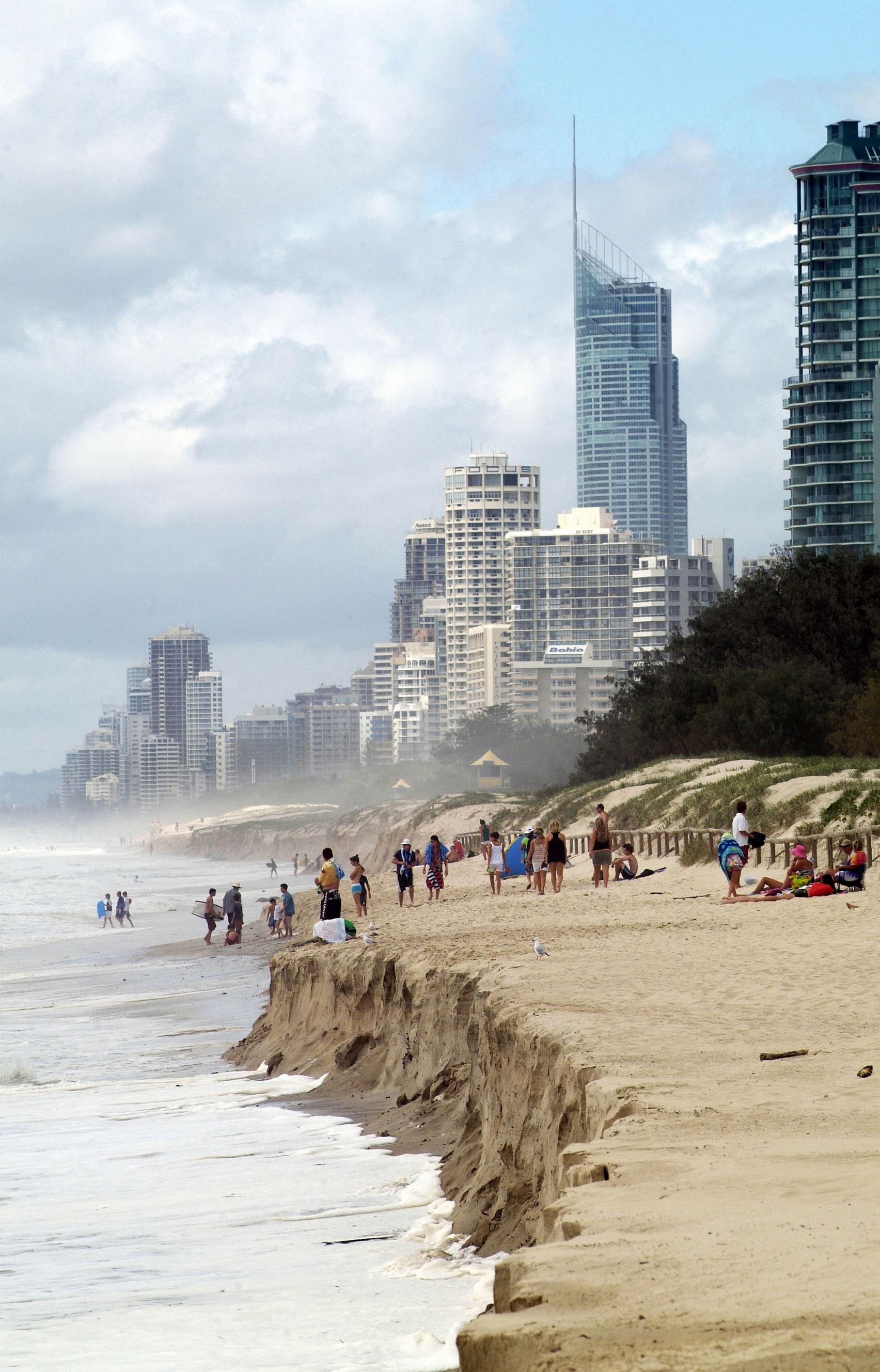
Especially high spring tide
A king tide is an especially high spring tide, especially the perigean spring tides which occur three or four times a year. King tide is not a scientific term, nor is it used in a scientific context.
The expression originated in Pacific countries to describe especially high tides that occur a few times per year. It is now used in North America as well, particularly in low-lying South Florida, where king tides can cause tidal flooding. In Vancouver, Canada, king tides are a growing problem along its seawall.
Definition
King tides are the highest tides. They are naturally occurring, predictable events.
Tides are the movement of water across Earth's surface caused by the combined effects of the gravitational forces exerted by the Moon, Sun, and the rotation of Earth which manifest in the local rise and fall of sea levels. Tides are driven by the relative positions of the Earth, Sun, Moon, land formations, and relative location on Earth. In the lunar month, the highest tides occur roughly every 14 days, at the new and full moons, when the gravitational pull of the Moon and the Sun are in alignment. These highest tides in the lunar cycle are called spring tides.
The proximity of the Moon in relation to Earth and Earth in relation to the Sun also has an effect on tidal ranges. The Moon moves around Earth in an elliptic orbit that takes about 29 days to complete. The gravitational force is greatest when the Moon is at perigee (closest to Earth) and smallest when it is at apogee (farthest from Earth). The Moon has a larger effect on the tides than the Sun, but the Sun's position also has an influence on the tides. Earth moves around the Sun in an elliptic orbit that takes a little over 365 days to complete. Its gravitational force is greatest when the Earth is at perihelionclosest to the Sun in early Januaryand least when the Earth is at aphelionfarthest from the Sun in early July.
The king tides occur at new and full moon when the Earth, Moon and Sun are aligned at perigee and perihelion, resulting in the largest tidal range seen over the course of a year. So, tides are enhanced when the Earth is closest to the Sun around January 2 of each year. They are reduced when it is furthest from the Sun, around July 2.
The predicted heights of a king tide can be further augmented by local weather patterns and ocean conditions.
References
General references
Inline citations
References
- "Explainer: king tides - Social Media Blog - Bureau of Meteorology".
- "Hurricanes leave Florida coasts vulnerable to 'King tides'". The Big Story.
- (9 January 2022). "CityNews".
- [https://oceanservice.noaa.gov/education/tutorial_tides/tides06_variations.html Tidal Variations - The Influence of Position and Distance] NOAA ocean service education
- LaFever, Matt. (2024-12-16). "California king tides flood small town restaurant, which still opens anyway". SFGATE.
This article was imported from Wikipedia and is available under the Creative Commons Attribution-ShareAlike 4.0 License. Content has been adapted to SurfDoc format. Original contributors can be found on the article history page.
Ask Mako anything about King tide — get instant answers, deeper analysis, and related topics.
Research with MakoFree with your Surf account
Create a free account to save articles, ask Mako questions, and organize your research.
Sign up freeThis content may have been generated or modified by AI. CloudSurf Software LLC is not responsible for the accuracy, completeness, or reliability of AI-generated content. Always verify important information from primary sources.
Report