From Surf Wiki (app.surf) — the open knowledge base
King Street, Manchester
Street in Manchester, England

Street in Manchester, England

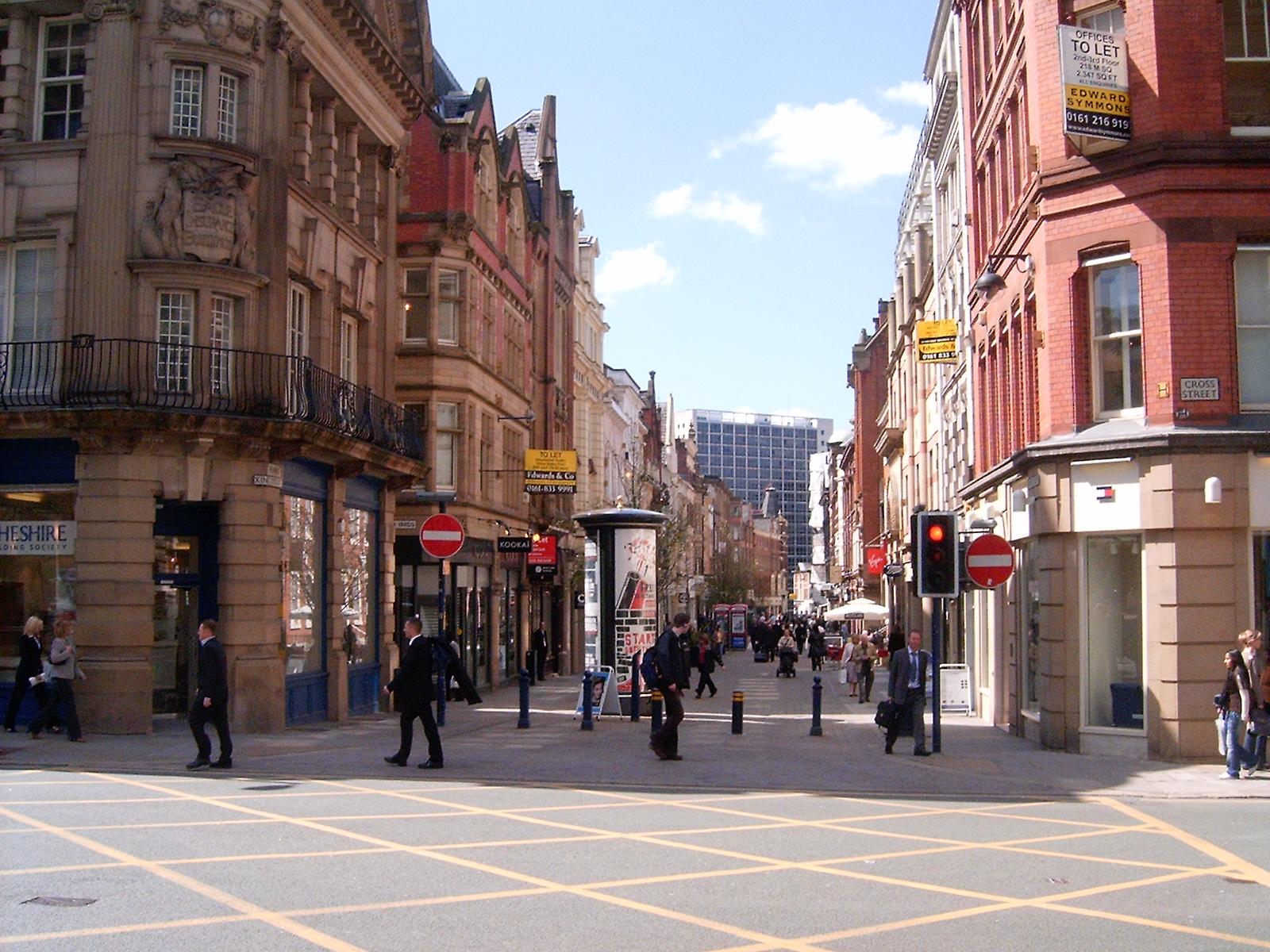
King Street is one of the most important thoroughfares of Manchester city centre, England. For much of the 20th century it was the centre of the north-west banking industry but it has become progressively dominated by upmarket retail instead of large banks.
History
King Street began in the 18th century at the Spring Gardens end when the Jacobite party in the town created James's Square and to the west of it a fine street. Beyond what is now Cross Street it was much narrower and one 18th-century building remains (a former District Bank). Further west beyond Deansgate is King Street West on a different alignment. By the 1970s, there was a clear demarcation between the eastern section of mainly financial and office buildings and the narrower section to the west a mostly upmarket shopping street (later pedestrianised). Subsequently, the eastern section had the monumental National Westminster Bank offices built at no. 55 and some years later further changes increasingly brought more upmarket retail. In 2008, the grand Midland Bank building of Edwin Lutyens was vacated by HSBC Bank.
Old Town Hall
Manchester's original civic administration (a commission of police) was housed in the Police Office on King Street from 1772; it was near the junction with Deansgate and Police Street is so called because of it. It was replaced by the first Town Hall, to accommodate the growing local government and its civic assembly rooms. The Town Hall, also located on King Street at the corner of Cross Street, was designed by Francis Goodwin and constructed during 1822–25, much of it by David Bellhouse. The building was designed in the Grecian style and Goodwin was strongly influenced by his patron John Soane. As the size and wealth of the city grew, largely as a result of the textile industry, its administration outstripped the existing facilities and a new building was proposed. The King Street building was subsequently occupied by a public library and then Lloyds Bank. The façade was removed to Heaton Park in 1912, when the current building was erected on the site (53 King Street).
Notable buildings
Many notable buildings survive and are preserved in a conservation area. On King Street there are 18 buildings listed at Grade II, one at Grade II* and one at Grade I; on King Street West is one at Grade II and on South King Street nearby one more at Grade II.
Alongside its landmark Edwardian and Victorian structures, King Street also contains a series of more modest commercial buildings whose architectural value lies in their collective contribution to the street’s formal character rather than individual distinction.
| Address | Image | Year | Grade | Notes | Ref. | ||
|---|---|---|---|---|---|---|---|
| 15–17 King Street | [[File:15-17 King Street, Manchester.jpg | 100px | centre]] | 1902 | |||
| 19 King Street | [[File:19 King Street, Manchester.jpg | 60px | centre]] | ||||
| 28 King Street | [[File:28 King Street.jpg | 100px | centre]] | ||||
| Old Exchange, | |||||||
| 29–31 King Street | 1897 | ||||||
| 30 King Street | [[File:30 King Street and 19 South King Street.jpg | 100px | centre]] | ||||
| 31–33 King Street West | 1840 | ||||||
| 33 King Street | [[File:33 King Street.jpg | centre | 100px]] | ||||
| 35–37 King Street | [[File:35-37 King Street.jpg | centre | 100px]] | 1736 | Georgian house, became Loyd Entwisle's bank in 1788. | ||
| Continued under various names until incorporated into | |||||||
| the National Westminster Bank; in the 1990s it closed | |||||||
| and was converted into a shop. | |||||||
| 41 South King Street | [[File:41 South King Street, Manchester.jpg | 60px | centre]] | ||||
| 48 King Street | [[File:48 King Street, Manchester, Listed Building.jpg | 100px | centre]] | ||||
| Former Lloyds Bank, | |||||||
| 53 King Street | [[File:Lloyds Bank Manchester.jpg | 100px | centre]] | 1913–15 | Later Lloyds TSB, now a restaurant. | ||
| Designed by Charles Heathcote. | |||||||
| 54–56 King Street | [[File:55 King Street.jpg | 100px | centre]] | ||||
| 62 King Street | [[File:62 King Street, Manchester.jpg | 60px | centre]] | 1874 | |||
| Pall Mall Court, | |||||||
| 67 King Street | [[File:Pall Mall Court, Manchester.jpg | 60px | centre]] | 1969 | |||
| Former Northern Rock | |||||||
| Building Society, | |||||||
| 74 King Street | [[File:Former Northern Rock Building, Manchester.jpg | 100px | centre]] | 1896 | Designed by Heathcote and Rawle. | ||
| Prudential Assurance Office, | |||||||
| 76–80 King Street | [[File:Prudential Assurance Office.jpg | centre | 100px]] | 1888 | Designed by Alfred Waterhouse. | ||
| Manchester Reform Club, | |||||||
| 81 King Street | [[File:Former Reform Club, Spring Gardens, Manchester 4.JPG | 100px | centre]] | 1870 | Designed by Edward Salomons. | ||
| Former Bank of England, | |||||||
| 82 King Street | [[File:Bank of England building, Manchester.jpg | 100px | centre]] | 1846 | Designed by C.R. Cockerell. | ||
| 84–86 King Street | Former National and Provincial Building Society. | ||||||
| Ship Canal House, | |||||||
| 88–96 King Street | [[File:Ship Canal House.jpg | 100px | centre]] | 1927 | Headquarters of the Manchester Ship Canal. | ||
| Designed by Harry S. Fairhurst. | |||||||
| Atlas Chambers, | |||||||
| 98 King Street | [[File:Atlas House, Manchester.jpg | 100px | centre]] | 1929 | Designed by Fairhurst and Michael Waterhouse. | ||
| 100 King Street | [[File:100 King Street Manchester.jpg | 100px | centre]] | 1929 | Formerly the Midland Bank (HSBC). | ||
| Designed by Sir Edwin Lutyens. |
Shopping area
King Street (along with Bridge Street) is considered Manchester's most upmarket shopping area; it has included the Manchester branches of Hermès, Whistles, Gant, Karen Millen, King Street Grooming, Emporio Armani, DKNY, Diesel, Timberland, Calvin Klein Jeans, Polo Ralph Lauren, Max Mara, T. M. Lewin, Jaeger, Cecil Gee, Agent Provocateur, Mulberry, Thomas Pink, Crombie. (However some of these are on Bridge Street to the south of King Street West.)
The part west of Cross Street was already a shopping street in the early 20th century.
Roger Oldham's 1906 Manchester Alphabet booklet includes the following lines: And there's King Street South And also King Street West, They each of them begin with K, I know which I like the best-- The one in which the cake shop is-- Let's go inside and rest.}}
References
References
- Bradshaw, L. D. (1985) ''Origins of Street Names in the City Centre of Manchester''. Radcliffe: Neil Richardson; pp. 39-40
- City Planning Department (1985) ''Manchester's Architectural Heritage''. Manchester: City Council
- {{National Heritage List for England
- {{National Heritage List for England
- {{National Heritage List for England
- {{National Heritage List for England
- {{National Heritage List for England
- {{National Heritage List for England
- {{National Heritage List for England
- Nicholls, Robert (2004) ''Curiosities of Greater Manchester''. Stroud: Sutton; {{ISBN. 0-7509-3661-4; p. 188
- {{National Heritage List for England
- {{National Heritage List for England
- {{National Heritage List for England
- {{National Heritage List for England
- {{National Heritage List for England
- {{National Heritage List for England
- {{National Heritage List for England
- {{National Heritage List for England
- {{National Heritage List for England
- {{National Heritage List for England
- {{National Heritage List for England
- {{National Heritage List for England
- {{National Heritage List for England
- {{National Heritage List for England
- {{National Heritage List for England
- Robinson, Jon. (2021-11-18). "The 25 major North West commercial property deals you shouldn't miss".
- Krieger, Eric (1991) ''Manchester in Early Picture Postcards''. Tottington: Printwise Publications {{ISBN. 1-872226-04-3; p. 11
This article was imported from Wikipedia and is available under the Creative Commons Attribution-ShareAlike 4.0 License. Content has been adapted to SurfDoc format. Original contributors can be found on the article history page.
Ask Mako anything about King Street, Manchester — get instant answers, deeper analysis, and related topics.
Research with MakoFree with your Surf account
Create a free account to save articles, ask Mako questions, and organize your research.
Sign up freeThis content may have been generated or modified by AI. CloudSurf Software LLC is not responsible for the accuracy, completeness, or reliability of AI-generated content. Always verify important information from primary sources.
Report