From Surf Wiki (app.surf) — the open knowledge base
King's Privy Council for Canada
Body of advisers to the monarch of Canada
.jpg)
Body of advisers to the monarch of Canada
| Field | Value |
|---|---|
| name | King's Privy Council for Canada |
| native_name | Conseil privé du Roi pour le Canada |
| native_name_lang | fr |
| image | Langevin Block (2013)(cropped).jpg |
| caption | The Office of the Prime Minister and Privy Council building is the seat of the Privy Council |
| abbreviation | PC |
| formation | 1867 |
| status | Advisory body |
| membership | List of current members |
| leader_title | Monarch |
| leader_name | |
| leader_title2 | President |
| leader_name2 | Dominic LeBlanc |
| leader_title3 | Clerk |
| leader_name3 | Michael Sabia |
| website |
The King's Privy Council for Canada (), sometimes called His Majesty's Privy Council for Canada or simply the Privy Council (PC), is the full group of personal advisors to the monarch of Canada on state and constitutional affairs. Practically, the tenets of responsible government require the sovereign or his viceroy, the governor general, almost always to follow only that advice tendered by the Cabinet: a committee within the Privy Council composed usually of elected members of Parliament. Those summoned to the Privy Council are appointed for life by the governor general on the advice of the prime minister. The group is composed predominantly of former Cabinet ministers, with some others having been inducted as an honorary gesture. Privy counsellors are accorded the use of an honorific style and post-nominal letters, as well as various signifiers of precedence.
{{Canadian monarch, current|title=1}}-in-Council
The Government of Canada, which is formally referred to as His Majesty's Government, is defined by the Canadian constitution as the sovereign acting on the advice of the Privy Council; what is known as the Governor-in-Council, referring to the governor general of Canada as the 's stand-in. The group of people is described as "a Council to aid and advise in the Government of Canada, to be styled the Queen's Privy Council for Canada", though, by convention, the task of giving the sovereign and governor general advice (in the construct of constitutional monarchy and responsible government, this is typically binding) on how to exercise the royal prerogative via orders-in-council rests with the Cabinet—a committee of the Privy Council made up of other ministers of the Crown who are drawn from, and responsible to, the House of Commons in the Parliament. This body is distinct but also entwined within the Privy Council, as the president of the King's Privy Council for Canada customarily serves as one of its members and Cabinet ministers receive assistance in the performance of their duties from the Privy Council Office, headed by the clerk of the Privy Council.
While the Cabinet specifically deals with the regular, day-to-day functions of the King-in-Council, occasions of wider national importance—such as the proclamation of a new Canadian sovereign following a demise of the Crown or conferring on royal marriages—will be attended to by more senior officials in the Privy Council, such as the prime minister, the chief justice of Canada, and other senior statesmen; though all privy councillors are invited to such meetings in theory, in practice, the composition of the gathering is determined by the prime minister of the day. The quorum for Privy Council meetings is four.
Membership
The Constitution Act, 1867, outlines that persons are to be summoned and appointed for life to the King's Privy Council by the governor general, though convention dictates that this be done on the advice of the sitting prime minister. As its function is to provide the vehicle for advising the Crown, the members of the Privy Council are predominantly all living current and former ministers of the Crown. In addition, the chief justices of Canada and former governors general are appointed. From time to time, the leader of His Majesty's Loyal Opposition and heads of other opposition parties will be appointed to the Privy Council, either as an honour or to facilitate the distribution of sensitive information under the Security of Information Act and, similarly, it is required by law that those on the Security Intelligence Review Committee be made privy councillors, if they are not already. To date, only Prime Minister Paul Martin advised that parliamentary secretaries be admitted to the Privy Council.
Appointees to the King's Privy Council must recite the requisite oath:
Provincial premiers are not commonly appointed to the Privy Council, but have been made members on special occasions, such as the centennial of Confederation in 1967 and the patriation of the constitution of Canada in 1982. On Canada Day in 1992, which also marked the 125th anniversary of Canadian Confederation, Governor General Ramon Hnatyshyn appointed 18 prominent Canadians to the Privy Council, including the former Premier of Ontario David Peterson, retired hockey star Maurice Richard, and businessman Conrad Black (who was later expelled from the Privy Council by the Governor General on the advice of Prime Minister Stephen Harper). The use of Privy Council appointments as purely an honour was not employed again until 6 February 2006, when Harper advised the Governor General to appoint former member of Parliament John Reynolds, along with the new Cabinet. Harper, on 15 October 2007, also advised Governor General Michaëlle Jean to appoint Jim Abbott.
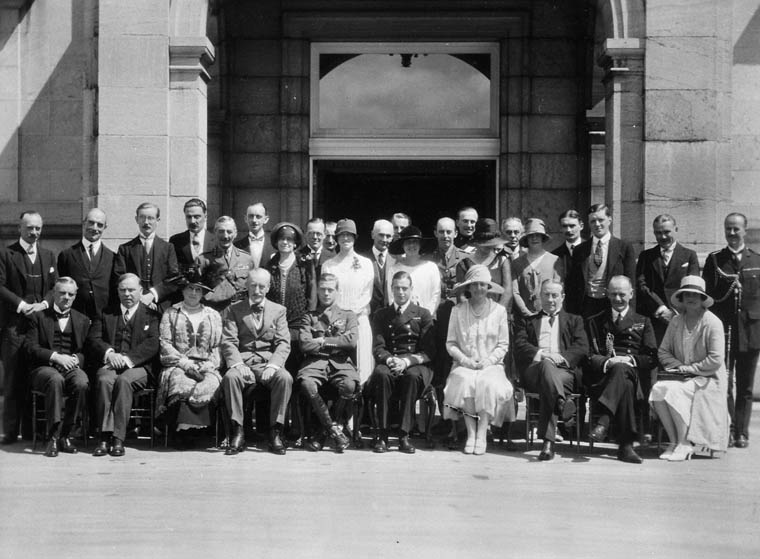
Members of the monarch's family have been appointed to the Privy Council: the Prince of Wales (Edward, later King Edward VIII), appointed during the reign of his father, King George V, on 2 August 1927; Prince Philip, Duke of Edinburgh, appointed during the reign of his wife, Queen Elizabeth II, on 14 October 1957; the Prince of Wales (Charles, now King Charles III), appointed during the reign of his mother, Queen Elizabeth II, on 18 May 2014; and Queen Camilla, appointed during the reign of her husband, King Charles III on 26 May 2025.
On occasion, non-Canadians have been appointed to the Privy Council. The first non-Canadian sworn of the council was Billy Hughes, Prime Minister of Australia, who was inducted on 18 February 1916, at the request of Robert Borden—to honour a visiting head of government, but also so that Hughes could attend Cabinet meetings on wartime policy. Similarly, Winston Churchill, Prime Minister of the United Kingdom, was inducted during a visit to Canada on 29 December 1941.
Privy councillors are entitled to the style the Honourable () or, for the prime minister, chief justice, or certain other eminent individuals, the Right Honourable () and the post-nominal letters PC (in ). Prior to 1967, the style the Right Honourable was only employed in Canada by those appointed to the Imperial Privy Council in London, such persons usually being prime ministers, Supreme Court chief justices, certain senior members of the Canadian Cabinet, and other eminent Canadians. These appointments ended under Lester Pearson, though the traditional style remained in use, limited to only prime ministers and chief justices. In 1992, several eminent privy councillors, most of whom were long-retired from active politics, were granted the style by the Governor General and, in 2002, Jean Chrétien recommended that Herb Gray, a privy councillor of long standing, be given the style the Right Honourable upon his retirement from Parliament.
History
According to Eugene Forsey, Privy Council meetings—primarily meetings of the full Cabinet or the prime minister and senior ministers, held with the governor general presiding—were not infrequent occurrences in the first 15 years following Canadian Confederation in 1867. One example of a Privy Council meeting presided over by the governor general occurred on 15 August 1873, in which Governor General the Earl of Dufferin outlined "the terms on which he would agree to a prorogation of Parliament" during the Pacific Scandal. When he served as viceroy, John Campbell, Marquess of Lorne, put an end to the practice of the governor general presiding over Privy Council meetings, other than for ceremonial occasions.
Prime Minister William Lyon Mackenzie King had the Privy Council convene in 1947 to consent to the marriage of Princess Elizabeth (later Queen Elizabeth II) to Philip Mountbatten, per the Royal Marriages Act 1772. The Princess' father, King George VI, had offered an invitation for Mackenzie King to attend when the Privy Council of the United Kingdom met for the same purpose. But, the Prime Minister declined and held the meeting of the Canadian Privy Council so as to illustrate the separation between Canada's Crown and that of the UK.

The Council has assembled in the presence of the sovereign on two occasions: The first was at 10:00 a.m. on the Thanksgiving Monday of 1957, at the monarch's residence in Ottawa, Rideau Hall. There, Queen Elizabeth II chaired a meeting of 22 of her privy councilors, including her consort, by then titled as Prince Philip, Duke of Edinburgh, who had just been appointed to the Privy Council at that same meeting. The Queen also approved an order-in-council. Two years later, the Privy Council again met before the Queen, this time in Halifax, Nova Scotia, to confirm the appointment of Georges Vanier as governor general. There was originally some speculation that the coming together of the sovereign and her Council was not constitutionally sound. However, the Prime Minister at the time, John Diefenbaker, found no legal impropriety in the idea and desired to create a physical illustration of Elizabeth's position of Queen of Canada being separate to that of Queen of the United Kingdom.
A formal meeting of the Privy Council was held in 1981 to give formal consent to the marriage of Prince Charles, Prince of Wales (now King Charles III), to Lady Diana Spencer.
To mark the occasion of her Ruby Jubilee, Queen Elizabeth II, on Canada Day, 1992, presided over the swearing in of new members of her Privy Council.
The most recent formal meeting of the Privy Council was on 10 September 2022, for the proclamation of the accession of King Charles III.
Notes
References
References
- (1926). "Official Report of Debates, House of Commons". Queen's Printer.
- (2011). "Canadian Symbols of Authority: Maces, Chains, and Rods of Office". Dundurn.
- Privy Council Office. "Queen's Privy Council for Canada – Facts". Queen's Printer for Canada.
- Privy Council Office. "Members of the Queen's Privy Council". Queen's Printer for Canada.
- MacLeod, Kevin S.. (2015). "A Crown of Maples". Queen's Printer for Canada.
- Wrong, Humphrey Hume. (10 November 1952). "Relations With the United States". [[Department of Foreign Affairs and International Trade]].
- Her Majesty the Queen. (1867). "Constitution Act, 1867". Queen's Printer.
- (2000). "House of Commons Procedure and Practice". Queen's Printer for Canada.
- Elizabeth II. (1 April 2005). "Interpretation Act". Queen's Printer for Canada.
- {{Harvnb. Her Majesty the Queen. 1867
- Palango, Paul. (8 May 1981). "Privy Council nod on royal betrothal 'medieval'". Globe and Mail.
- Office of the Governor General of Canada. "Oaths of Office". Queen's Printer for Canada.
- (31 January 2014). "Conrad Black stripped of the Order of Canada". Globe and Mail.
- Government of Canada. (11 December 2017). "King's Privy Council for Canada > Members of the King's Privy Council". King's Printer for Canada.
- Government of Canada. (18 May 2014). "PM announces the appointment of His Royal Highness the Prince of Wales to the Queen's Privy Council for Canada". Queen's Printer for Canada.
- The Times. "Court Circular: May 26, 2025".
- Fitzhardinge, Laurence. (1979). "William Morris Hughes: A Political Biography / Vol. 2: The Little Digger, 1914–1952". [[Angus & Robertson]].
- (30 December 1941). "Becomes Canadian Privy Councillor". Ottawa Citizen.
- Privy Council Office. (June 2023). "Prime Minister Announces New Ministry". Queen's Printer for Canada.
- (November 1966). "Meetings of the Queen's Privy Council for Canada, 1867-1882". The Canadian Journal of Economics and Political Science.
- {{harvnb. Forsey. 1966
- {{harvnb. Forsey. 1966
- King, William L.M.. (10 September 2022). "William Lyon Mackenzie King". National Post.
- Boyce, Peter John. (2008). "The Queen's Other Realms: The Crown and Its Legacy in Australia, Canada and New Zealand". Federation Press.
- Bousfield, Arthur. (2002). "Fifty Years the Queen". Dundurn Press.
- Buckner, Phillip. (2005). "Canada and the End of Empire". UBC Press.
- {{Harvnb. Buckner. 2005
- Valpy, Michael. (2 November 2005). "Scholars scurry to find implications of royal wedding". The Globe and Mail.
- (2002). "Fifty Years the Queen: A Tribute to Her Majesty Queen Elizabeth II on Her Golden Jubilee". Dundurn.
- Secretary to the Governor General of Canada. (9 September 2022). "Ceremony to proclaim the Accession of the Sovereign to take place at Rideau Hall". King's Printer for Canada.
- (10 September 2022). "King Charles III proclaimed Canada's new head of state in ceremony at Rideau Hall". Globe and Mail.
This article was imported from Wikipedia and is available under the Creative Commons Attribution-ShareAlike 4.0 License. Content has been adapted to SurfDoc format. Original contributors can be found on the article history page.
Ask Mako anything about King's Privy Council for Canada — get instant answers, deeper analysis, and related topics.
Research with MakoFree with your Surf account
Create a free account to save articles, ask Mako questions, and organize your research.
Sign up freeThis content may have been generated or modified by AI. CloudSurf Software LLC is not responsible for the accuracy, completeness, or reliability of AI-generated content. Always verify important information from primary sources.
Report