From Surf Wiki (app.surf) — the open knowledge base
King (playing card)
Playing card

Playing card
The king is a playing card with a picture of a king displayed on it. The king is usually the highest-ranking face card. In the French version of playing cards and tarot decks, the king immediately outranks the queen. In Italian and Spanish playing cards, the king immediately outranks the knight. In German and Swiss playing cards, the king immediately outranks the Ober. In some games, the king is the highest-ranked card; in others, the Ace is higher. Aces began outranking kings around 1500 with Trappola being the earliest known game in which the aces were highest in all four suits. In the ace–ten family of games such as pinochle and Schnapsen, both the ace and the 10 rank higher than the king.
History
The king card is the oldest and most universal court card. It most likely originated in Persian Ganjifeh where kings are depicted as seated on thrones and outranking the viceroy cards which are mounted on horses. Playing cards were transmitted to Italy and Spain via the Mamluks and Moors. The best preserved and most complete deck of Mamluk cards, the Topkapı pack, did not display human figures but just listed their rank most likely due to religious prohibition. It is not entirely sure if the Topkapı pack was representative of all Mamluk decks as it was a custom-made luxury item used for display. A fragment of what may be a seated king card was recovered in Egypt which may explain why the poses of court cards in Europe resemble those in Persia and India.
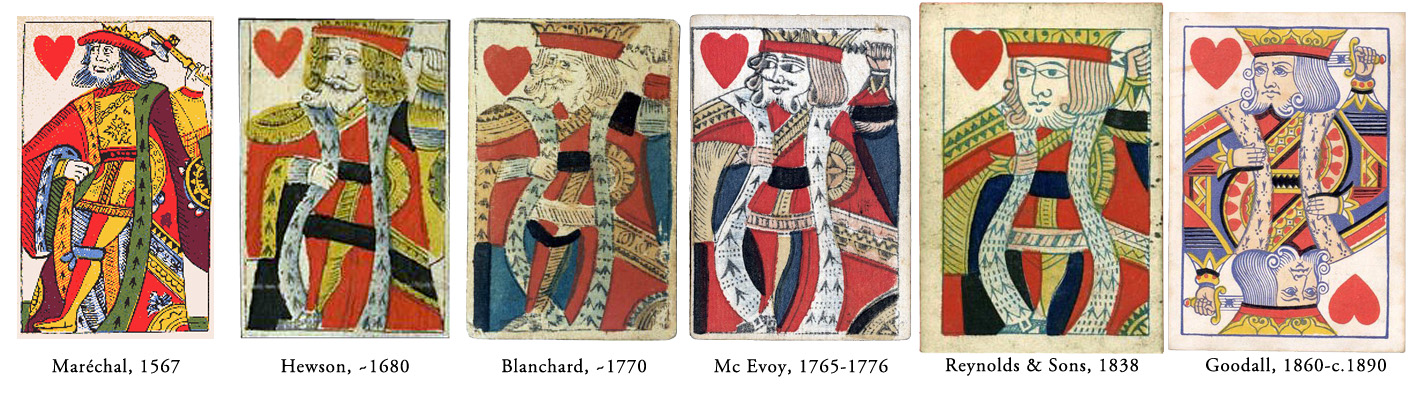
Seated kings were generally common throughout Europe. During the 15th century, the Spanish started producing standing kings. The French originally used Spanish cards before developing their regional deck patterns. Many Spanish court designs were simply reused when the French invented their own suit-system around 1480. The English imported their cards from Rouen until the early 17th century when foreign card imports were banned. The king of hearts is sometimes called the "suicide king" because he appears to be sticking his sword into his head. This is a result of centuries of bad copying by English card makers where the king's axe head has disappeared.
Starting in the 15th century, French manufacturers assigned to each of the court cards names taken from history or mythology. This practice survives only in the Paris pattern which ousted all its rivals, including the Rouen pattern around 1780. The names for the kings in the Paris pattern (portrait officiel) are:
File:King of spades fr.svg|David File:King of hearts fr.svg|Charlemagne File:King of diamonds fr.svg|Julius Caesar File:King of clubs fr.svg|Alexander the Great
Most French-suited continental European patterns are descended from the Paris pattern but they have dropped the names associated with each card.
Example cards
Kings from Russian playing cards: Image:Атласная колода король экстра трефы.jpg|King of Clubs (Russian pattern) Image:Атласная колода экстра король бубни.jpg|King of Diamonds (Russian pattern) Image:Атласная колода экстра король черви.jpg|King of Hearts (Russian pattern) Image:Атласная колода экстра король пики.jpg|King of Spades (Russian pattern) Image:Taroky honery.JPG|Industrie und Glück pattern
Kings from Italian playing cards: Image:Bergamo Deck - Wands - King.jpg|King of clubs (Bergamo pattern) Image:Bergamo Deck - Coins - King.jpg|King of coins (Bergamo pattern) Image:Bergamo Deck - Cups - King.jpg|King of cups (Bergamo pattern) Image:Bergamo Deck - Swords - King.jpg|King of swords (Bergamo pattern)
Kings from Spanish playing cards: Image:Aluette card deck - Grimaud - 1858-1890 - King of Clubs.jpg|King of clubs (Aluette) Image:Aluette card deck - Grimaud - 1858-1890 - King of Coins.jpg|King of coins (Aluette) Image:Aluette card deck - Grimaud - 1858-1890 - King of Cups.jpg|King of cups (Aluette) Image:Aluette card deck - Grimaud - 1858-1890 - King of Swords.jpg|King of swords (Aluette) Image:TuteFourKings.jpg|Catalan / Argentine pattern Image:Reyes Tute.jpg|Castilian pattern
Kings from German playing cards: Image:Saxonian Deck - Acorns - King.jpg|King of acorns (Saxon pattern) Image:Saxonian Deck - Bells - King.jpg|King of bells (Saxon pattern) Image:Saxonian Deck - Hearts - King.jpg|King of hearts (Saxon pattern) Image:Saxonian Deck - Leaves - King.jpg|King of leaves (Saxon pattern)
In Unicode
The kings are included in the Playing Cards:
References
References
- (1990). "The Oxford Guide to Card Games". Oxford University Press.
- McLeod, John. [https://www.pagat.com/aceten/ Ace-Ten Games] at [[pagat.com]]. Retrieved 25 February 2016.
- Tor, Gjerde. "Mamluk cards, ca. 1500". old.no.
- Wintle, Simon. [https://www.wopc.co.uk/spain/moorish/index Moorish playing cards] at World of Playing Cards. Retrieved 25 February 2017.
- (1980). "The Game of Tarot". Duckworth.
- [https://i-p-c-s.org/pattern/ps-48.html English pattern] at the [[International Playing-Card Society]]. Retrieved 25 February 2017.
- "The Rouen Pattern". whiteknucklecards.com.
- Wintle, Simon. [https://www.wopc.co.uk/cards/suicide-king Suicide King] at the World of Playing Cards. Retrieved 25 February 2017.
- [http://www.snopes.com/history/world/cardking.asp "The Four King Truth"] at the [[Urban Legends Reference Pages]]. Retrieved 25 February 2017.
- (1990). "All Cards on the Table". Jonas Verlag.
- Pollett, Andy. [http://a_pollett.tripod.com/cards21.htm France and Belgium] at Andy's Playing Cards. Retrieved 25 February 2017.
- [https://www.i-p-c-s.org/faq/history_14.php Paris and Rouen pattern figures] at the [[International Playing-Card Society]]. Retrieved 25 February 2017.
- (2020). "Playing Cards - The Unicode Standard, Version 13.0". Unicode.
This article was imported from Wikipedia and is available under the Creative Commons Attribution-ShareAlike 4.0 License. Content has been adapted to SurfDoc format. Original contributors can be found on the article history page.
Ask Mako anything about King (playing card) — get instant answers, deeper analysis, and related topics.
Research with MakoFree with your Surf account
Create a free account to save articles, ask Mako questions, and organize your research.
Sign up freeThis content may have been generated or modified by AI. CloudSurf Software LLC is not responsible for the accuracy, completeness, or reliability of AI-generated content. Always verify important information from primary sources.
Report