From Surf Wiki (app.surf) — the open knowledge base
Khmelnytskyi Oblast
Oblast (region) of Ukraine
Oblast (region) of Ukraine
| Field | Value |
|---|---|
| name | Khmelnytskyi Oblast |
| native_name | Хмельницька область |
| native_name_lang | uk |
| official_name | Khmelnytska oblast |
| nickname | Хмельниччина (uk) |
| settlement_type | Oblast |
| image_flag | Flag_of_Khmelnytskyi_Oblast.svg |
| flag_alt | Flag of Khmelnytskyi oblast |
| image_shield | Coat_of_Arms_of_Khmelnytskyi_Oblast.svg |
| shield_alt | Coat of arms of Khmelnytskyi oblast |
| image_map | Khmelnytskyi in Ukraine.svg |
| mapsize | 275px |
| coordinates | |
| subdivision_type | Country |
| subdivision_name | Ukraine |
| established_title | Established |
| established_date | 22 September 1937 |
| seat_type | Administrative center |
| seat | Khmelnytskyi |
| leader_title | Governor |
| leader_name | Serhii Tiurin |
| leader_title1 | Oblast council |
| leader_name1 | 84 seats |
| leader_title2 | Chairperson |
| leader_name2 | Violeta Labazyuk |
| unit_pref | Metric |
| area_total_km2 | 20645 |
| area_rank | Ranked 19th |
| population_footnotes | |
| population_total | 1228829 |
| population_rank | Ranked 14th |
| population_as_of | 2022 |
| population_blank1_title | Annual growth |
| population_density_km2 | auto |
| demographics_type1 | GDP |
| demographics1_footnotes | |
| demographics1_title1 | Total |
| demographics1_info1 | ₴ 120 billion |
| (€3.1 billion) | |
| demographics1_title2 | Per capita |
| demographics1_info2 | ₴ 96,964 |
| (€2,500) | |
| blank5_name_sec1 | HDI (2022) |
| blank5_info_sec1 | 0.722 |
| blank_name_sec1 | Raions |
| blank_info_sec1 | 3 |
| blank1_name_sec1 | Cities |
| blank1_info_sec1 | 13 |
| blank3_name_sec1 | Settlements |
| blank3_info_sec1 | 24 |
| blank4_name_sec1 | Villages |
| blank4_info_sec1 | 1416 |
| timezone1 | EET |
| utc_offset1 | +2 |
| timezone1_DST | EEST |
| utc_offset1_DST | +3 |
| postal_code_type | Postal code |
| postal_code | 29000-31999 |
| area_code_type | Area code |
| area_code | +380-38 |
| iso_code | UA-68 |
| registration_plate_type | Vehicle registration |
| registration_plate | вх, нх |
| blank_name_sec2 | FIPS 10-4 |
| blank_info_sec2 | UP09 |
| blank1_name_sec2 | NUTS statistical regions of Ukraine |
| blank1_info_sec2 | UA53 |
| website | adm-km.gov.ua |
(€3.1 billion) (€2,500)
Khmelnytskyi Oblast (), also known as Khmelnychchyna (), is an oblast (province) in western Ukraine covering portions of the historical regions of western Podolia and southern Volhynia. The administrative center of the oblast is the city of Khmelnytskyi. The current estimated population is around
Created in 1937 out of border okrugs of Vinnytsia Oblast, in 1941–44 it was under Nazi Germany occupation and part of the Reichskommissariat Ukraine (Wolhynien und Podolien general district). Following the Kamenets-Podolsky pocket in spring of 1944 as part of the Proskurov-Chernovtsy operation, Soviet troops removed the German occupation in the region. Until 4 February 1954 it was called Kamianets-Podilskyi Oblast () and was centered in Kamianets-Podilsky until 1941. The region rebranding took place after the official renaming of the region's administrative center to Khmelnytskyi.
Geography
Khmelnytskyi Oblast has a total area of 20600 km² (3.4% of the total area of Ukraine) and is located between 48°27' and 50°37' north latitude and between 26°09' and 27°56' east longitude. It is 220 km long when measured from north to south, and is 120 km in length when measured from east to west. It is associated with a historical region of Podolia, yet in reality its territory is split almost in half, the northern in Volhynia, and the southern in Podolia. Its Volhynian region contains smaller cities like Iziaslav, Starokostiantyniv, Shepetivka, while its Podolian portion more developed cities of Khmelnytskyi and Kamianets-Podilskyi.
The oblast borders the Rivne Oblast to the northwest, the Zhytomyr Oblast to the northeast, the Vinnytsia Oblast to the east, the Chernivtsi Oblast to the south, and the Ternopil Oblast to the west.
Elevations
The Podolian Upland (270–370 meters above sea-level) occupies the central area of the Khmelnytskyi Oblast. The northwestern areas of the oblast are part of the Volyn highland (highest point — 329 m above sea-level), while to the north, the oblast claims a part of the historic region of Polissia (highest point — 200–250 m above sea-level). The southwestern territory of the Khmelnytskyi Oblast is crossed by the Tovtry range (), which includes Mount Velyka Buhaikha (), the highest point of the oblast at 409 m above sea-level. The extreme south of the oblast has a surface with canyon-like river valleys. The Dniester Reservoir located there is the lowest point of the oblast (121 m above sea level).
Rivers and Lakes
There are 120 rivers with a length of 10 km or more in the Khmelnytskyi Oblast. The largest of these are the Dniester River (which flows for 160 km within the oblast), as well as its tributaries: Smotrych, Ushytsia, and the Zbruch — and the Southern Buh River (which flows for 120 km within the oblast), as well as its tributaries: Buzhok, Ikva, and Vovk. The rivers of the Dnieper River's basin — Horyn, Khmora, and Sluch Rivers also run through the oblast. The oblast's lakes are located mostly in basin of the Horyn River. The largest reservoir in the oblast is the Dniester Reservoir.
There are 1858 ponds and/or reservoirs in the oblast. The largest of these include Shchedrivske (with a surface area of 12.58 km2), Novostavske (with a surface area of 11.68 km2), and Kuzmynske (with a surface area of 7.65 km2).
History
Historic administrative affiliation of the area:
- 1937–1941: USSR, Ukrainian SSR
- 1944–1991: USSR, Ukrainian SSR
- since 1991: Ukraine: Khmelnytskyi Oblast
Khmelnytskyi Oblast was created on September 22, 1937, as the Kamianets-Podilskyi Oblast () out of border okruhas (Proskuriv and Kamianets-Podilskyi) of the Vinnytsia Oblast.
In March 1941 the administrative center of the oblast was moved from Kamianets-Podilskyi to the city of Proskuriv. During the World War II the territory was part of another administrative division (General District Wolhynien und Podolien, see Reichskommissariat Ukraine), but after liberation from the Nazi Germany, Khmelnytskyi Oblast was reinstated in its original borders. In 1954, Proskuriv was renamed Khmelnytskyi (in honour of Bohdan Khmelnytskyi), and soon afterward, the oblast was renamed to Khmelnytskyi Oblast ().
Administrative divisions
Main article: Administrative divisions of Khmelnytskyi Oblast
The oblast is subdivided into 3 raions (administrative districts). It consists of 13 cities, 24 towns, and more than 1,417 villages.
The following data incorporates the number of each type of administrative divisions of Khmelnytskyi Oblast:
- Administrative Center – 1 (Khmelnytskyi);
- Raions — 3;
- Hromadas — 60.
The local administration of the oblast is controlled by the Khmelnytskyi Regional Council. The governor of the oblast is the Khmelnytskyi Regional Council speaker, appointed by the President of Ukraine.
Demographics
According to the 2001 Ukrainian census, ethnic Ukrainians accounted for 93.9% of the population of Khmelnytskyi Oblast, ethnic Russians for 3.6%, and ethnic Poles for 1.6%.
Khmelnytskyi Oblast's population is 1,401,140 as of January 1, 2004. As of 2002, the oblast ranks 13th by population in Ukraine. The population density is 69.5/km2.
Pensioners make up 453,800 thousand people or 31,7% of population. The birth rate per 1,000 residents is 8.3, and the death rate — per 1000 residents – 16.1. The urban population, according to the 2001 Ukrainian Census data, accounted for 729,600 people, or 51%, and the rural population — for 701,200 people, or 49%.
According to the data, the number of men accounted for 659,900 people, or 46.1%, that of women — 770,900 people, or 53.9%.
Language

Due to the Russification of Ukraine during the Soviet era, the share of Ukrainian speakers in the population of Khmelnytskyi Oblast gradually decreased between the 1970 and 1989 censuses, while the share of Russian speakers increased. Native language of the population of Khmelnytskyi Oblast according to the results of population censuses:
| 1959 | 1970 | 1979 | 1989 | 2001 | ||||||
|---|---|---|---|---|---|---|---|---|---|---|
| Ukrainian | ||||||||||
| Russian | ||||||||||
| Other |
Native language of the population of the raions and cities of Khmelnytskyi Oblast according to the 2001 Ukrainian census:
| Ukrainian | Russian | |||
|---|---|---|---|---|
| Khmelnytskyi Oblast | ||||
| City of Khmelnytskyi | ||||
| City of Kamianets-Podilskyi | ||||
| City of Netishyn | ||||
| City of Slavuta | ||||
| City of Shepetivka | ||||
| City of Starokostiantyniv | ||||
| Bilohiria Raion | ||||
| Vinkivtsi Raion | ||||
| Volochysk Raion | ||||
| Horodok Raion | ||||
| Derazhnia Raion | ||||
| Dunaivtsi Raion | ||||
| Iziaslav Raion | ||||
| Kamianets-Podilskyi Raion | ||||
| (in pre-2020 borders) | ||||
| Krasyliv Raion | ||||
| Letychiv Raion | ||||
| Nova Ushytsia Raion | ||||
| Polonne Raion | ||||
| Slavuta Raion | ||||
| Starokostiantyniv Raion | ||||
| Stara Syniava Raion | ||||
| Teofipol Raion | ||||
| Khmelnytskyi Raion | ||||
| (in pre-2020 borders) | ||||
| Chemerivtsi Raion | ||||
| Shepetivka Raion | ||||
| (in pre-2020 borders) | ||||
| Yarmolyntsi Raion |
Ukrainian is the only official language on the whole territory of Khmelnytskyi Oblast.
According to a poll conducted by Rating from 16 November to 10 December 2018 as part of the project «Portraits of Regions», 85% of the residents of Khmelnytskyi Oblast believed that the Ukrainian language should be the only state language on the entire territory of Ukraine. 8% believed that Ukrainian should be the only state language, while Russian should be the second official language in some regions of the country. 3% believed that Russian should become the second state language of the country. 4% found it difficult to answer.
On 15 June 2022, a moratorium on the public use of Russian-language cultural products was imposed in Khmelnytskyi Oblast by a decision of the Khmelnytskyi Oblast Council.
In 2023, Khmelnytskyi Oblast Military Administration approved the «Programme of development and functioning of the Ukrainian language as the state language in all spheres of public life in Khmelnytskyi Oblast for 2023—2025», the main purpose of which is to strengthen the position of the Ukrainian language in various spheres of public life in the oblast.
According to the research of the Content Analysis Centre, conducted from 15 August to 15 September 2024, the topic of which was the ratio of Ukrainian and Russian languages in the Ukrainian segment of social media, 88.8% of posts from Khmelnytskyi Oblast were written in Ukrainian (86.0% in 2023, 77.9% in 2022, 41.8% in 2020), while 11.2% were written in Russian (14.0% in 2023, 22.1% in 2022, 58.2% in 2020).
After Ukraine declared independence in 1991, Khmelnytskyi Oblast, as well as Ukraine as a whole, experienced a gradual Ukrainization of the education system, which had been Russified during the Soviet era. Dynamics of the ratio of the languages of instruction in general secondary education institutions in Khmelnytskyi Oblast:
According to the State Statistics Service of Ukraine, in the 2023–2024 school year, of the 135,705 pupils in general secondary education institutions in Khmelnytskyi Oblast, 135,475 (99.83%) were studying in classes where Ukrainian was the language of instruction, while 230 (0.17%) were studying in classes where Polish was the language of instruction.
Age structure
: 0-14 years: 15.1% (male 101,597/female 95,783) : 15-64 years: 68.5% (male 435,464/female 463,058) : 65 years and over: 16.4% (male 69,479/female 145,420) (2013 official)
Median age
: total: 40.4 years : male: 37.1 years : female: 43.6 years (2013 official)
Economy
The economy of the oblast mostly deals with the energy industry, transport and agriculture. The oblast is situated at a historical crossroad of the railway and highway routes connecting Central Europe to Black Sea coast and Russia (with the city of Shepetivka being the most important railway junction). The Khmelnyts’ka nuclear power plant in the city of Netishyn is the most important industrial company of the oblast. Notable machinery, armament and chemical industries are also present.
Attractions
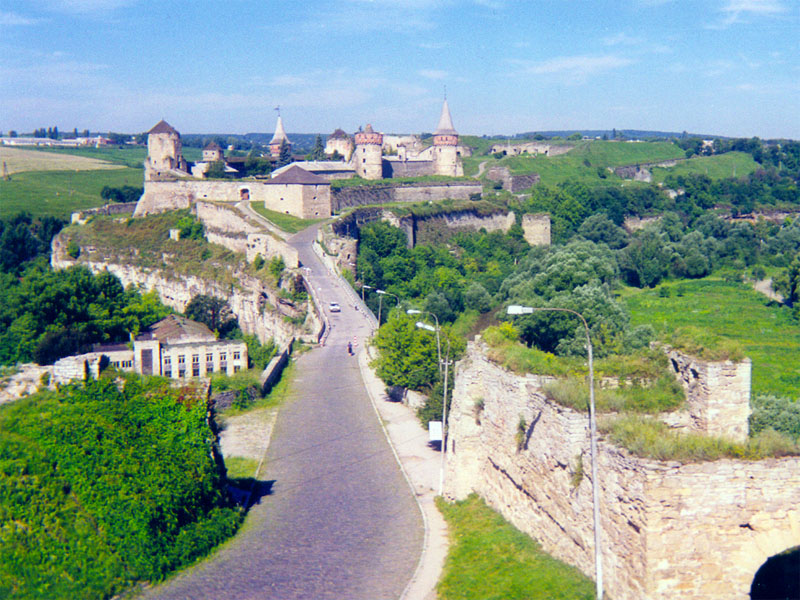
- Kamianets National Historical-Architectural Reserve (including the Old Town and the Castle)
- Medzhybizh National Historical-Cultural Reserve (including the Fortress)
- Samchyky National Historical-Cultural Reserve
Nomenclature
Most of Ukraine's oblasts are named after their administrative center cities, officially referred to as "oblast centers" (, translit. oblasnyi tsentr). The name of each oblast is a relative adjective, formed by adding a feminine suffix to the name of respective center city: Khmelnytskyi is the center of the Khmelnyts’ka oblast’.
Notable people
- Vasyl Sviato (1948–2025), member of the Verkhovna Rada
Gallery
File:Проскурівська каланча.jpg|Proskuriv kalancha File:Стара фортеця.jpg|Kamianets-Podilskyi Castle File:Шепетівка (45).jpg|Shepetivka File:Проспект Незалежності у Нетішині.jpg|Independence Avenue in Netishyn File:Славута. Костел святої Дороти.png|Church of Saint Dorothy in Slavuta File:Старокостянтинів. Івана хрестителя.jpg|John the Baptist Church in Starokostiantyniv File:Starokostyantyniv veja 1.jpg|Defense tower in Starokostiantyniv File:Kamieniec Podolski national university.JPG|National University named after I. Ohiienko File:Хмельницкий областной совет. Фото 4.jpg|Khmelnytskyi Oblast administration building File:Khmelnitsky, Proskurivska St, beginning, 2005 08 10.jpg|Proskurivska street in Khmelnytskyi File:Палац в літній день в с.Самчики.jpg|Chechels' Palace, a part of the Samchyky Estate File:Letichev.jpg|Medieval fortress in Letychiv File:Khmelnytskyi Oblast 059.jpg|Highway H03 File:Заслав зима.jpg|Horyn River in Iziaslav File:Подільські товтри 2.jpg|Dniester panorama
References
:Inline
- Information Card of the Region – Official site of the Cabinet of Ministers of Ukraine
References
- (2011). "Toponymic Guidelines for Map and Other Editors for International Use". DerzhHeoKadastr and Kartographia ([[United Nations Statistics Division]]).
- (3 May 2024). "Zelenskyy appointed new head of Khmelnytskyi Oblast State Administration". [[Ukrainska Pravda]].
- "Голова Хмельницької обласної ради". km-oblrada.gov.ua.
- "Валовии регіональнии продукт".
- "Sub-national HDI - Area Database - Global Data Lab".
- {{in lang. uk [http://pop-stat.mashke.org/ukraine-ethnic2001.htm Етнічний склад населення України, 2001 рік]
- [http://db.ukrcensus.gov.ua/MULT/Database/Census/databasetree_en.asp Банк даних, перепис 2001 року]
- [http://www.kmu.gov.ua/control/en/publish/article?art_id=116766&cat_id=32596/ Cabinet of Ministers of Ukraine – Khmelnytsky Region] URL accessed on November 26, 2006
- [http://www.ukrcensus.gov.ua/eng/regions/region_khmel// Ukrcensus.gov.ua – Khmel'nyts'kyi region region] {{Webarchive. link. (2007-09-30 URL accessed on January 11, 2007)
- "Динамика численности этнических украинцев в УССР: на основе итогов Всесоюзных переписей населения 1959 г., 1970 г. и 1979 г.".
- Итоги Всесоюзной переписи населения 1959 года: Украинская ССР, стр. 168—193
- Численность и состав населения СССР: по данным Всесоюзной переписи населения 1979 года. Центральное статистическое управление СССР, 1984
- ''Чорний С.'' Національний склад населення України в ХХ сторіччі (2001)
- Итоги Всесоюзной переписи населения 1970 года. Том IV — М., Статистика, 1973
- "Всеукраїнський перепис населення 2001. Розподіл населення за національністю та рідною мовою".
- "Перепис 1989. Розподіл населення за національністю та рідною мовою (0,1)".
- "Розподіл населення за національністю та рідною мовою, Хмельницька область".
- "Про забезпечення функціонування української мови як державної".
- (2018-12-26). ""ПОРТРЕТИ РЕГІОНІВ": ПІДСУМКИ. Зведені дані, порівняльний аналіз між областями". [[Rating (sociological group).
- (17 June 2022). "Мораторій на використання російськомовного контенту на Хмельниччині: що загрожує порушникам". [[Suspilne.
- (2023-05-12). "У Хмельницькій області діятиме програма із розвитку української мови". Славута.City.
- (May 2023). "Перелік завдань і заходів Програми розвитку та функціонування української мови як державної в усіх сферах суспільного життя у Хмельницькій області на 2023—2025 роки". Хмельницька обласна військова адміністрація.
- (2024-10-28). "Частка дописів українською мовою в соцмережах зросла до 56 %, — Центр контент-аналізу".
- ""Радикальний прогрес". У соцмережах української стало набагато більше, — дослідження".
- Barbara A. Anderson and Brian D. Silver, "Equality, Efficiency, and Politics in Soviet Bilingual Education Policy, 1934-1980," American Political Science Review 78 (December 1984): 1019-1039.
- "Джерело".
- "Збірник «Статистичний щорічник України» за 2008 рік". [[State Statistics Service of Ukraine.
- "Збірник «Статистичний щорічник України» за 2012 рік". [[State Statistics Service of Ukraine.
- "Збірник «Статистичний щорічник України» за 2018 рік". [[State Statistics Service of Ukraine.
- "Загальна середня освіта в Україні у 2021 році".
- "Загальна середня освіта в Україні у 2022 році".
- "Збірник «Статистичний щорічник України» за 2022 рік". [[State Statistics Service of Ukraine.
- 136 pupils (0.10%) received general secondary education in Polish.
- 256 pupils (0.26%) received general secondary education in Polish.
- "Загальна середня освіта в Україні у 2023 році".
This article was imported from Wikipedia and is available under the Creative Commons Attribution-ShareAlike 4.0 License. Content has been adapted to SurfDoc format. Original contributors can be found on the article history page.
Ask Mako anything about Khmelnytskyi Oblast — get instant answers, deeper analysis, and related topics.
Research with MakoFree with your Surf account
Create a free account to save articles, ask Mako questions, and organize your research.
Sign up freeThis content may have been generated or modified by AI. CloudSurf Software LLC is not responsible for the accuracy, completeness, or reliability of AI-generated content. Always verify important information from primary sources.
Report