From Surf Wiki (app.surf) — the open knowledge base
Kherson Governorate
1803–1920 unit of Russia

1803–1920 unit of Russia
| Field | Value |
|---|---|
| name | Kherson Governorate |
| native_name | Херсонская губерния |
| native_name_lang | ru |
| settlement_type | Governorate |
| image_shield | Coat of Arms of Kherson Governorate 1878.svg |
| image_map | Kherson in Russian Empire (1914).svg |
| mapsize | 225px |
| map_caption | Location in the Russian Empire |
| subdivision_type | Country |
| subdivision_name | Russian Empire |
| established_title | Established |
| established_date | 1803 |
| extinct_title | Abolished |
| extinct_date | 1920 |
| seat_type | Capital |
| seat | Kherson |
| area_total_km2 | 71936 |
| population_as_of | 1897 |
| population_total | 2,733,612 |
| population_density_km2 | auto |
| population_urban | 28.86% |
| population_rural | 71.14% |
| total_type | Total |
Kherson Governorate, known until 1803 as Nikolayev Governorate, was an administrative-territorial unit (guberniya) of the Russian Empire, with its capital in Kherson. It encompassed 71,936 km2 in area and had a population of 2,733,612 inhabitants. At the time of the census in 1897, it bordered Podolia Governorate to the northwest, Kiev Governorate to the north, Poltava Governorate to the northeast, Yekaterinoslav Governorate to the east, Taurida Governorate to the southeast, Black Sea to the south, and Bessarabia Governorate to the west. It roughly corresponds to what is now most of Mykolaiv, Kirovohrad and Odesa Oblasts in Ukraine and some parts of Kherson and Dnipropetrovsk Oblasts.
The economy of the governorate was mainly based on agriculture. During the grain harvest, thousands of agricultural laborers from the parts of the Empire found work in the area. The industrial part of the economy, consisting primarily of flour milling, distilling, metalworking industry, iron mining, beet-sugar processing, and brick industry, was underdeveloped.
Administrative divisions
The governorate bordered Bessarabia Governorate to the west, with Kiev and Poltava Governorates to the north, to the east was Yekaterinoslav Governorate, and southward was Taurida Governorate.
From 1809, the governorate consisted of five uyezds: Khersonsky Uyezd, Aleksandriysky Uyezd, Ovidiopol, Tiraspolsky Uyezd, and Yelisavetgradsky Uyezd. The city of Odessa was separate, as it carried a special status. In 1825, Odessky Uyezd and in 1834, Ananyevsky Uyezd were added into the territorial division of the Kherson Governorate. A seventh uyezd – Bobrynets, existed from 1828 to 1865. The cities of Odessa and Nikolayev (in 1803–1861) and their surrounding vicinity were governed separately: Odessa by a gradonachalnik (), answerable directly to the tsar and (from 1822) the governor-general of Novorossiya and Bessarabia, and Nikolayev by a military governor.
In 1920, while being under Bolshevik rule, the governorate's territory, 70600 km2, was divided to form the newer Odessa Governorate. Kherson Governorate was renamed as Mykolaiv Governorate in 1921, and in 1922 – it was merged with Odessa Governorate. In 1925, Odessa Governorate was abolished, and its territory was divided into six okruhas: Kherson, Kryvyi Rih, Mykolaiv, Odesa, Pershotravneve, and Zinoviivske. In 1932, much of this territory was incorporated into the new Odesa Oblast, now an administrative division o modern Ukrainian nation, which was divided to form Mykolaiv Oblast.
| County | Capital | Arms of capital | Area | Population | ||||
|---|---|---|---|---|---|---|---|---|
| (1897 census) | Transliteration name | Russian Cyrillic | ||||||
| Aleksandriysky | Александрійскій | Aleksandriya | [[File:Oleksnandria.emblem.2.gif | 42px | center]] | 11165 km2 | 327,199 | |
| Ananyevsky | Ананьевскій | Ananev | [[File:Ananyiv coat of arms project (Kene).png | 42px | center]] | 10289.2 km2 | 187,226 | |
| Yelisavetgradsky | Елисаветградскій | Yelisavetgrad | [[File:Coat of Arms of Yelisavetgrad (project).png | 42px | center]] | 15866.8 km2 | 507,660 | |
| Odessky | Одесскій | Odessa | [[File:Odessa COA Kene project.png | 42px | center]] | 10552.1 km2 | 532,729 | |
| Tiraspolsky | Тираспольскій | Tiraspol | [[File:Coat of arms of Tiraspol 1868.svg | 42px | center]] | 7228.9 km2 | 206,568 | |
| Khersonsky | Херсонскій | Kherson | [[File:Coat of arms of Kherson 1878.svg | 42px | center]] | 19553 km2 | 532,956 | |
| Nikolayev War Governorate | Николаевское воѣнное губернаторство | Nikolayev | [[File:Николаев.Герб 1883.jpg | 42px | center]] | 197.3 km2 | 92,000 |
Principal cities
;From the Russian Census of 1897
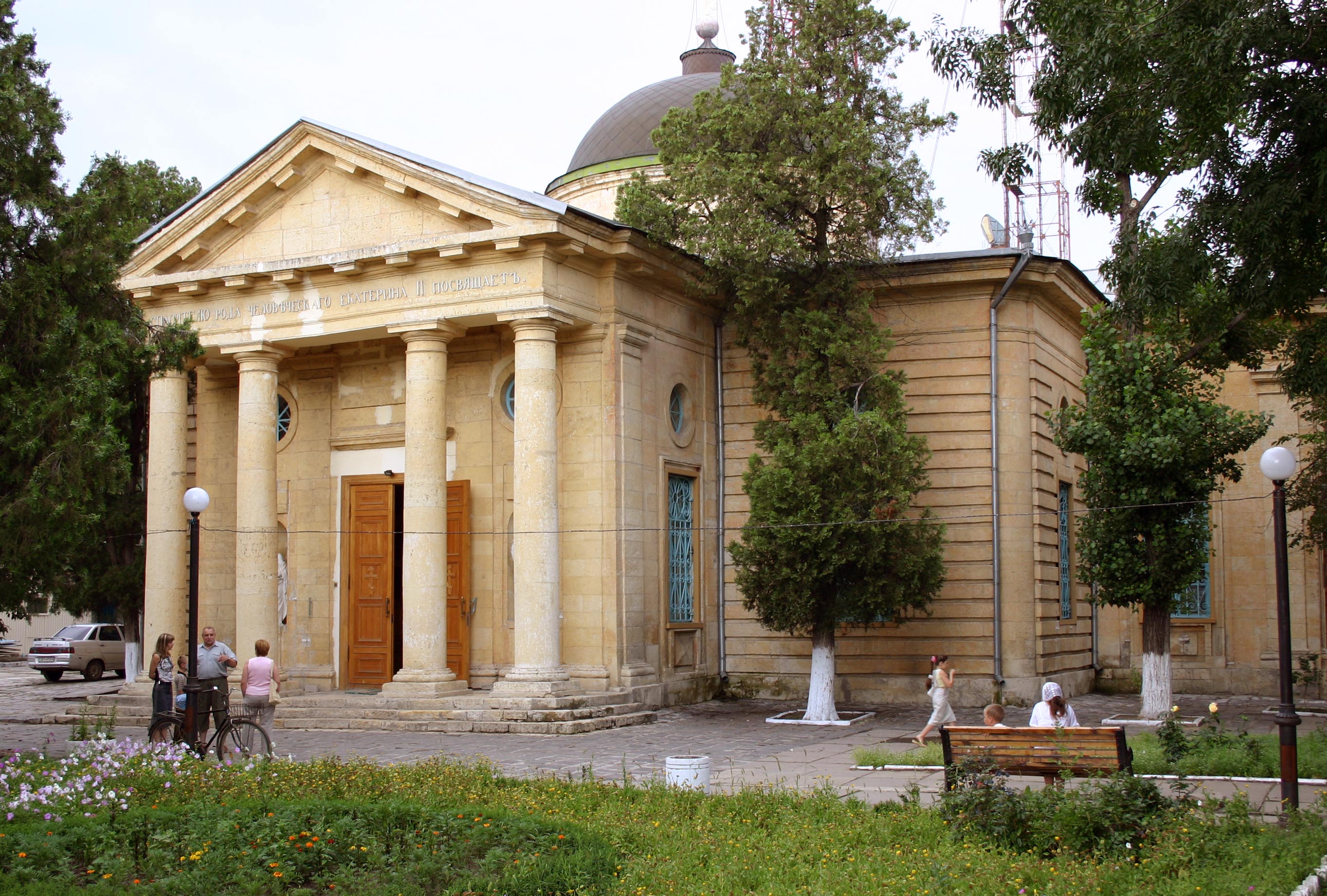
- Odessa – 403,815 (Russian – 198,233, Jewish – 124,511, Ukrainian – 37,925)
- Nikolayev – 92,012 (Russian – 61,023, Jewish – 17,949, Ukrainian – 7,780)
- Yelizavetgrad – 61,488 (Jewish – 23,256, Russian – 21,301, Ukrainian – 14,523)
- Kherson – 59,076 (Russian – 27,902, Jewish – 17,162, Ukrainian – 11,591)
- Tiraspol – 31,616 (Russian – 14,013, Jewish – 8,568, Ukrainian – 3,708)
- Ananiv – 16,684 (Ukrainian – 7,205, Romanian – 4,174, Jewish – 3,514)
- Voznesensk – 15,748 (Jewish – 5,879, Ukrainian – 5,644, Russian – 2,583)
- Bobrinets – 14,281 (Ukrainian – 9,529, Jewish – 3,464, Russian – 837)
- Aleksandriya – 14,007 (Ukrainian – 7,658, Jewish – 3,687, Russian – 2,364)
- Beryslav – 12,149 (Ukrainian – 8,852, Jewish – 2,639, Russian – 524)
- Dubossary – 12,089 (Jewish – 5,326, Romanian – 3,383, Ukrainian – 2,841)
- Novogeorgiyevsk – 11,594 (Russian – 6,631, Ukrainian – 3,372, Jewish – 1,424)
- Ochakov – 10,786 (Ukrainian – 5,204, Russian – 3,508, Jewish – 1,430)
- Novomirgorod – 9,364 (Russian – 7,025, Jewish – 1,617, Ukrainian – 572)
- Grigoriopol – 7,605 (Romanian – 3,740, Russian – 1,832, Jewish – 832)
- Olviopol – 6,884 (Ukrainian – 5,022, Jewish – 1,480, Russian – 271)
- Ovidiopol – 5,187 (Ukrainian – 2,785, Russian – 1,997, Jewish – 387)
- Maiaky – 4,575 (Russian – 2,865, Ukrainian – 944, Jewish – 644)
Demographics
Until 1858, a third of the population (military settlers, admiralty settlements, foreign colonists, etc.) was subject to martial law. The gubernia had a population of about 245,000 in 1812; 893,000 in 1851; 1,330,000 in 1863; 2,027,000 in 1885; 2,733,600 in 1897; and 3,744,600 in 1914. In the 1850s it consisted of Ukrainians (68–75 %), Romanians (8–11 %), Russians (3–7 %), Jews (6 %), Germans (4 %), Bulgarians (2 %), Poles, Greeks, and Gypsies. In 1914, Ukrainians composed only 53% of the population, while Russians made up 22% and Jews – 12%. Urban dwellers made up 10 to 20 percent of the population until the 1850s, after which the proportion of urban dwellers increased, to about 30% in 1897. Migration within the Russian Empire mainly accounted for the area's population growth, with 46% of the population born outside of the governorate in 1897.
Russian Empire Census
According to the Russian Empire Census on , the Kherson Governorate had a population of 2,733,612, including 1,400,981 men and 1,332,631 women. The majority of the population indicated Little Russian to be their mother tongue, with significant Russian, Jewish, Romanian, and German speaking minorities.
| Language | Native speakers | Percentage | TOTAL | 2,733,612 | 100.00 |
|---|---|---|---|---|---|
| Little Russian | 1,462,039 | 53.48 | |||
| Great Russian | 575,375 | 21.05 | |||
| Jewish | 322,537 | 11.80 | |||
| Romanian | 147,218 | 5.39 | |||
| German | 123,453 | 4.52 | |||
| Polish | 30,894 | 1.13 | |||
| Bulgarian | 25,685 | 0.94 | |||
| White Russian | 22,958 | 0.84 | |||
| Greek | 8,257 | 0.30 | |||
| Tatar | 3,152 | 0.12 | |||
| Armenian | 2,070 | 0.08 | |||
| Roma | 1,671 | 0.06 | |||
| French | 1,353 | 0.05 | |||
| Czech | 1,351 | 0.05 | |||
| Italian | 834 | 0.03 | |||
| Swedish | 662 | 0.02 | |||
| Latvian | 619 | 0.02 | |||
| Turkish | 508 | 0.02 | |||
| Lithuanian | 478 | 0.01 | |||
| English | 475 | 0.01 | |||
| Estonian | 303 | 0.01 | |||
| Georgian | 201 | 0.01 | |||
| Mordavian | 170 | 0.01 | |||
| Other languages | 919 | 0.03 |
| Faith | Male | Female | Both | Number | Percentage | Total | 1,400,981 | 1,332,631 | 2,733,612 | 100.00 |
|---|---|---|---|---|---|---|---|---|---|---|
| Eastern Orthodox | 1,123,860 | 1,067,219 | 2,191,079 | 80.15 | ||||||
| Judaism | 168,425 | 171,485 | 339,910 | 12.43 | ||||||
| Roman Catholic | 53,140 | 42,087 | 95,227 | 3.48 | ||||||
| Lutheran | 29,229 | 27,328 | 56,557 | 2.07 | ||||||
| Old Believer | 13,923 | 14,131 | 28,054 | 1.03 | ||||||
| Baptist | 2,719 | 2,696 | 5,415 | 0.20 | ||||||
| Mennonite | 2,734 | 2,652 | 5,386 | 0.20 | ||||||
| Reformed | 2,507 | 2,503 | 5,010 | 0.18 | ||||||
| Muslim | 1,964 | 403 | 2,367 | 0.09 | ||||||
| Armenian Apostolic | 1,307 | 905 | 2,212 | 0.08 | ||||||
| Karaite | 954 | 1,054 | 2,008 | 0.07 | ||||||
| Anglican | 80 | 83 | 163 | 0.01 | ||||||
| Armenian Catholic | 59 | 19 | 78 | 0.00 | ||||||
| Buddhist | 13 | 11 | 24 | 0.00 | ||||||
| Other Christian denomination | 64 | 55 | 119 | 0.00 | ||||||
| Other non-Christian denomination | 3 | 0 | 3 | 0.00 |
Notes
References and notes
References
- "Demoscope Weekly – Annex. Statistical indicators reference".
- Hamm, Michael F.. (2014). "Kiev: A Portrait, 1800–1917". Princeton University Press.
- Fortson IV, Benjamin W.. (2011). "Indo-European Language and Culture: An Introduction". John Wiley & Sons.
- "Демоскоп Weekly - Приложение. Справочник статистических показателей.".
This article was imported from Wikipedia and is available under the Creative Commons Attribution-ShareAlike 4.0 License. Content has been adapted to SurfDoc format. Original contributors can be found on the article history page.
Ask Mako anything about Kherson Governorate — get instant answers, deeper analysis, and related topics.
Research with MakoFree with your Surf account
Create a free account to save articles, ask Mako questions, and organize your research.
Sign up freeThis content may have been generated or modified by AI. CloudSurf Software LLC is not responsible for the accuracy, completeness, or reliability of AI-generated content. Always verify important information from primary sources.
Report