From Surf Wiki (app.surf) — the open knowledge base
Khat
Psychoactive species of plant
Psychoactive species of plant
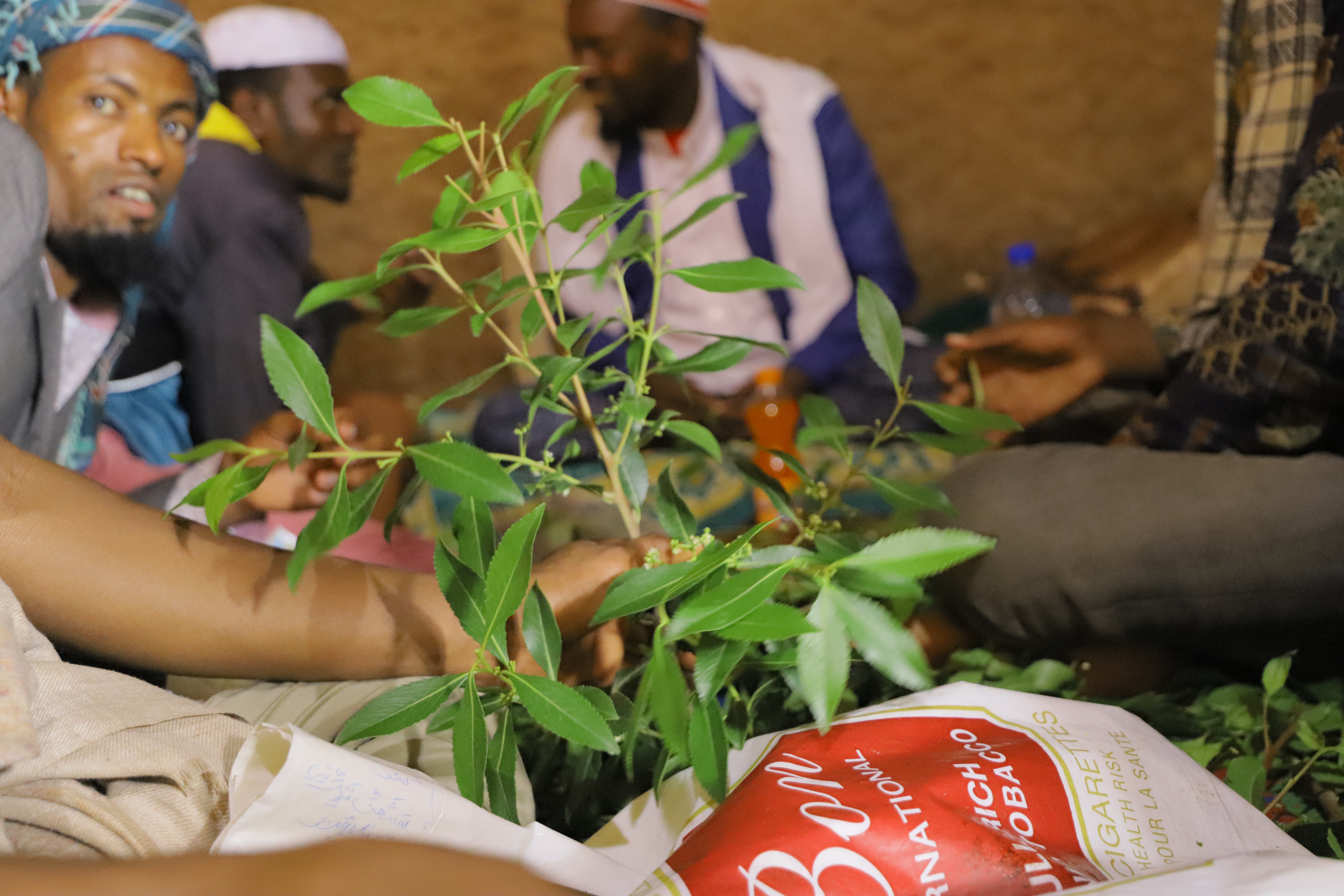
Khat (Catha edulis), also known as Bushman's tea, especially in South Africa, is a flowering plant native to eastern and southeastern Africa. It has a history of cultivation originating in the Harar area (present day eastern Ethiopia) and subsequently introduced at different times to countries nearby in East Africa and Southern Arabia, most notably Yemen. Cultivated by farmers, its leaves are sold on the market to be chewed as a recreational stimulant. The world's largest consumers are Eastern Africans, particularly Somalis, and nearby Yemen, with the largest producers/exporters being Ethiopia and Kenya.
Khat contains the alkaloid cathinone, a stimulant which causes greater sociability, excitement, mild loss of appetite and mild euphoria. Among communities from the areas where the plant is native, khat-chewing has historical relevance (as a social custom, especially among men) dating back thousands of years, analogous—but slightly different—to the use of coca leaves in South America's Andes Mountains or the betel nut preparations in South Asia.
Since 1980, the World Health Organization (WHO) classifies khat as a "drug of abuse" that can produce psychological dependence, although the WHO does not consider khat addiction to be a serious global problem.
The legality of khat varies by region and country; in many territories, khat might pass "under-the-radar" as a botanical species (thus not be a specifically controlled substance), but its recreational use may, nevertheless, be illegal under more general laws.
It is strictly a controlled substance in many regions, often at the highest degree, including in Australia, Canada, the European Union, India, Jordan, New Zealand, Saudi Arabia, the United Arab Emirates (UAE) and the United Kingdom (UK). In the United States (US) and Turkey, the botanical specimen (plant) Catha edulis is not prohibited, but the consumption and distribution of harvested leaves or possession for recreational use is illegal. In the UAE, the punishment for possession, use, or distribution of khat can include life imprisonment.
By contrast, its production, sale, and consumption are all fully legal—or not mentioned in a legal context at all—in the nations where its use is culturally significant, including Djibouti, Ethiopia, Kenya, Somalia, Sudan, Uganda and Yemen. In Israel, which hosts a population of Yemenite Jews, only the consumption of the plant's leaves in its natural state is permitted; "khat extracts" are illegal, after they became a street drug and were popularly abused in the 2000s.
Nomenclature
The genus name Catha is a Latinization of the Arabic name قات, which is regularly romanized as qāt. Other romanizations include kat, quatt, qaad, qhat, ghat, and chat.
The khat plant is known by a variety of names, such as qat and gat in Yemeni Arabic, qaat and jaad in Somali, and chat in Harari and Amharic. It is also known as jimaa in the Oromo language, mayirungi in Luganda, and as miraa and muguka in Swahili. In the African Great Lakes region, where Catha edulis is (in some areas) cultivated, it is known as miraa, muhulo, muguka and muirungi.
It also goes by various descriptive names, such as Abyssinian tea, Arabian tea, kafta, jimaa, and Somalian tea in its endemic regions of the Horn of Africa and the Arabian peninsula. In South Africa, the plant is known as Bushman's tea. The plant is also known as chat tree and flower of paradise.
Vernacular names
In the Indian subcontinent, Catha edulis is sometimes referred to by its Unani name Kat or Qaat in traditional texts.
Description
Khat is a slow-growing shrub or tree that typically attains a height of 1-5 m. However, it can reach heights of up to 10 m in equatorial areas. The plant usually grows in arid environments, at a temperature range of 5 -. It has evergreen leaves, which are 5–10 cm long and 1-4 cm broad.

It takes seven to eight years for the khat plant to reach its full height. Other than access to sun and water, khat requires little maintenance. Ground water is often pumped from deep wells by diesel engines to irrigate the crops, or brought in by water trucks. The plants are watered heavily starting around a month before they are harvested to make the leaves and stems soft and moist. A good khat plant can be harvested four times a year, providing a year-long source of income for the farmer.
The shrub's flowers are produced on short axillary cymes that are 4-8 cm in length. Each flower is small, with five white petals.
The samara fruit is an oblong, three-valved capsule, which contains one to three seeds.
Society and culture
Cultivation

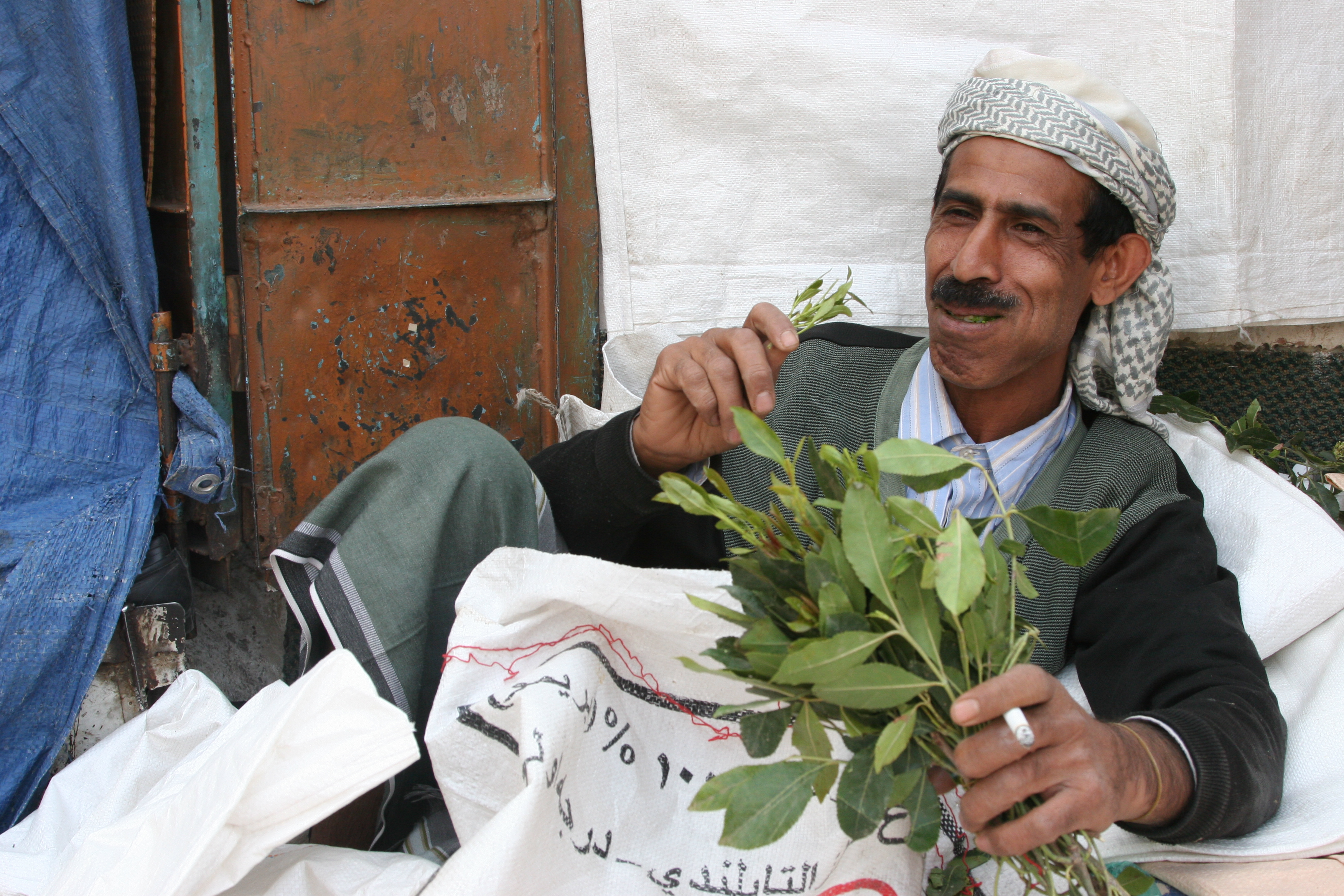
Khat has been grown for use as a stimulant for centuries in the Horn of Africa and the Arabian peninsula. There, chewing khat predates the use of coffee and is used in a similar social context. Its fresh leaves and tops are chewed or, less frequently, dried and consumed as tea, to achieve a state of euphoria and stimulation. The leaves or the soft part of the stem can be chewed with either chewing gum or fried peanuts to make it easier to chew.
In Uganda, it is grown in the central region, especially in Kasenge (Wakiso), Butambala District, Mabira Forest, and in some parts of the western region of the country. In Kenya, it is grown in Meru County and Embu County.
One reason for the widespread cultivation of khat in Yemen is the high income that it provides for farmers. Some studies done in 2001 estimated that the income from cultivating khat was about 2.5 million Yemeni rials per hectare, while fruits brought only 0.57 million rials per hectare. Between 1970 and 2000, the area on which khat was cultivated was estimated to have grown from 8,000 to 103,000 hectares. In 2000, according to a World Bank estimate, khat accounted for 30% of Yemen's economy.
Uses

Although the practice of khat-chewing is still primarily restricted to its original area of cultivation in the Red Sea area, the khat plant is native to the whole of the eastern side of Africa from Kenya southwards to Tanzania, Malawi, Zambia, Zimbabwe, where it grows on rocky outcrops and around the fringes of woodlands. In southern Africa the shrub's range is scattered but still grows in the KwaZulu-Natal, Eastern Cape, Western Cape and Mpumalanga provinces of South Africa, in addition to Eswatini and Mozambique.
Traditionally, khat is used as a socialising drug as in Yemen, where khat-chewing is predominantly a male habit combined with conversation, hookah smoking, and tea drinking. Khat is so popular in Yemen that its cultivation consumes much of the country's agricultural resources. An estimated 40% of Yemen's water supply goes towards irrigating it, with production increasing by about 10% to 15% every year. One "daily bag" of khat requires an estimated 500 L of water to produce. Water consumption is high and groundwater levels in the Sanaa basin are diminishing, so government officials have proposed relocating large portions of the population of the city to the Red Sea coastal areas.
In countries outside the core area of growth and consumption, khat is sometimes chewed at parties or social functions. It may also be used by farmers and labourers for reducing physical fatigue or hunger, and by drivers and students for improving attention.
More recently, in 2019, reports indicate that child soldiers in Yemen have been chewing khat in order to remain alert on the battlefield.
Distribution
.jpg)
In recent years, improved roads, off-road motor vehicles, and air transportation have increased the global distribution of this perishable commodity and, as a result, the plant has been found in places such as Australia, Netherlands, Canada, the United Kingdom, the Levant, Rome (Italy), New Zealand and the United States. In the US, freshly-packed khat leaves are sold in the African and Middle Eastern markets of Boston, Dallas, Los Angeles, and New York City, where the demand is highest.
Effects
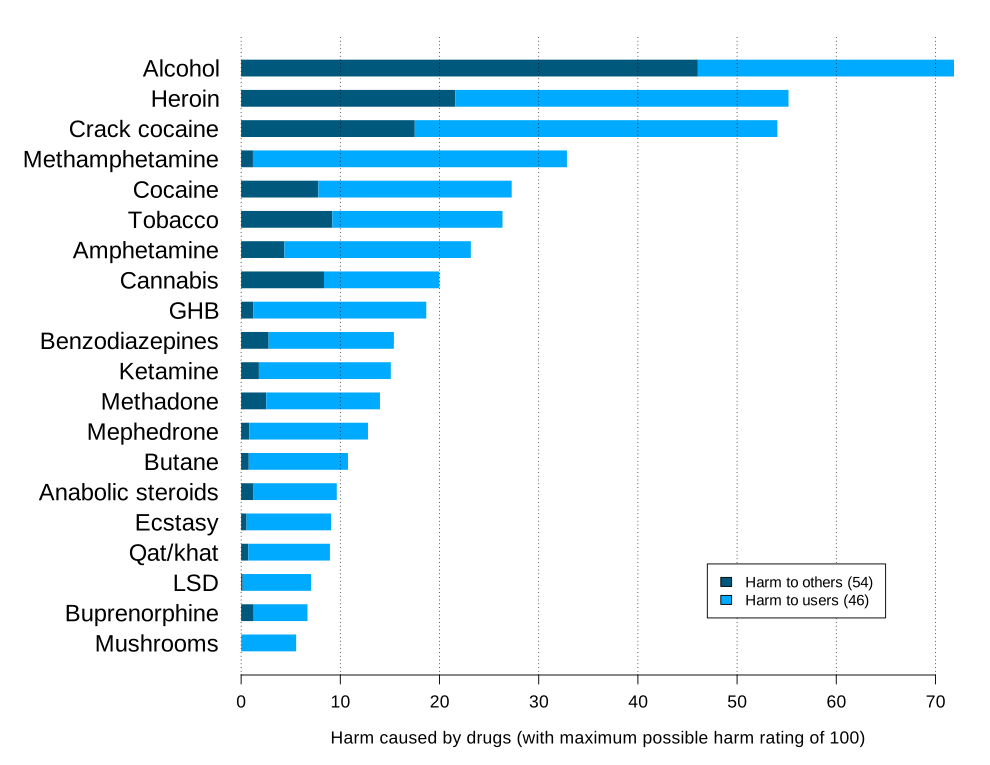

Medieval Mamluk historian al-Maqrizi describing Khat's effects states:
Khat consumption induces mild euphoria and excitement, similar to that conferred by strong coffee. Individuals become very talkative under the influence of the plant. Animal testing has shown that khat causes an increase in motoric activity. The effects of oral administration of cathinone occur more rapidly than the effects of amphetamine pills; roughly 15 minutes as compared to 30 minutes in amphetamine. Khat can induce manic behaviours and hyperactivity, similar in effects to those produced by amphetamine.
The use of khat results in constipation. Dilated pupils (mydriasis) are prominent during khat consumption, reflecting the sympathomimetic effects of the drug, which are also reflected in increased heart rate and blood pressure. Long-term use can precipitate permanent tooth darkening (of a greenish tinge), susceptibility to ulcers, and diminished sex drive. Khat is an effective anorectic, causing loss of appetite.
It is unclear if the consumption of khat directly affects the mental health of the user or not. Occasionally, a psychotic episode can result, resembling a hypomanic state in presentation. In humans, its prolonged consumption creates an uplifted mood and a sense of release from time and space.
Khat is mainly chewed by men, but there are cases of its use by women, and in particular it has been associated with increased likelihood of adverse outcomes during pregnancy.
Effects by timeframe
Immediate
- alertness
- arousal
- concentration
- confidence
- constipation
- dilated pupils
- euphoria
- friendliness
- increased blood pressure
- increased heart rate
- insomnia
- mania
- psychosis
- suppressed appetite
- talkativeness
- thought disorder
- verbosity
Long-term
- depression
- infrequent hallucinations
- impaired inhibition (similar to alcohol)
- increased risk of myocardial infarction (heart attack)
- oral cancer
- psychosis in extreme cases in the genetically predisposed
- weight loss
Indeterminate
- death
- stroke following acute coronary syndrome (clogging of the artery)either from impaired insight into symptoms by the khat chewer, delay to care, or poorly understood pathophysiological mechanisms
Chemistry and pharmacology

The stimulant effect of the plant was originally attributed to "katin", cathine, a phenethylamine-type substance isolated from the plant. However, the attribution was disputed by reports showing the plant extracts from fresh leaves contained another substance more behaviourally active than cathine. In 1975, the related alkaloid cathinone was isolated, and its absolute configuration, (S)-2-Amino-1-phenylpropan-1-one, was established in 1978. Cathinone is not very stable and breaks down to produce cathine and norephedrine. These chemicals belong to the PPA (phenylpropanolamine) family, a subset of the phenethylamines related to amphetamines and the catecholamines epinephrine and norepinephrine. In fact, cathinone and cathine have a very similar molecular structure to amphetamine. Khat is sometimes confused with methcathinone (also known as cat), a Schedule I substance that possesses a similar chemical structure to the khat plant's cathinone active component. However, both the side effects and the addictive properties of methcathinone are much stronger than those associated with khat use.
When khat leaves dry, the more potent chemical, cathinone, decomposes within 48 hours, leaving behind the milder chemical, cathine. Thus, harvesters transport khat by packaging the fresh leaves and stems in plastic bags or wrapping them in banana leaves to preserve their moisture and keep the cathinone potent. It is also common for them to sprinkle the plant with water frequently or use refrigeration during transportation.
When the khat leaves are chewed, cathine and cathinone are released and absorbed through the mucous membranes of the mouth as well as the lining of the stomach. The action of cathine and cathinone on the reuptake of epinephrine and norepinephrine has been demonstrated in lab animals, showing that one or both of these chemicals cause(s) the body to recycle these neurotransmitters more slowly, resulting in the wakefulness and insomnia associated with khat use.
Receptors for serotonin show a high affinity for cathinone, suggesting this chemical is responsible for feelings of euphoria associated with chewing khat. In mice, cathinone produces the same types of nervous pacing or repetitive scratching behaviours associated with amphetamines. The effects of cathinone peak after 15 to 30 minutes, with nearly 98% of the substance metabolised into norephedrine by the liver.
Cathine is somewhat less understood, being believed to act upon the adrenergic receptors causing the release of epinephrine and norepinephrine. It has a half-life of about three hours in humans. The medication bromocriptine can reduce cravings and withdrawal symptoms within 24 hours.
Demographics

An estimated 5 to 10 million people globally use khat on a daily basis. It is grown principally by communities in the Horn of Africa and the Arabian peninsula, where khat-chewing has a long history as a social custom dating back thousands of years.
The traditional form of khat chewing in Yemen involves only male users; khat chewing by females is less formal and less frequent. Researchers estimate about 70–80% of Yemenis between 16 and 50 years old chew khat, at least on occasion. Approximately 60–90% of male and 35% of female Yemenis chew khat daily. Before Yemeni unification in 1990, khat chewing was largely confined to the north-west mountains of the country, where khat grows. Yemenis spend an estimated 14.6 million man-hours per day chewing khat. Researchers have also estimated that families spend about 17% of their income on khat.
In Ethiopia, khat is chewed by 19.5% of the population and is more commonly chewed by men than women.
History
The inhabitants of Ifat Sultanate were the first to be recorded using khat in the 14th century by Arab historian Ibn Fadlallah al-Umari. The khat plant likely originated in the Horn of Africa specifically Ethiopia-Somali area, from there it spread to Kenya and the Arabian Peninsula. According to nineteenth century British explorer Richard Burton, khat originated in the Emirate of Harar.
Muslim Sufis in the surrounding areas also used it to intensify their mystical experience and to facilitate a sense of union with God.
The earliest known documented description of khat is found in the Kitab al-Saidala fi al-Tibb كتاب الصيدلة في الطب, an 11th-century work on pharmacy and materia medica written by Abū Rayhān al-Bīrūnī, a Persian scientist and biologist. Unaware of its origins, al-Bīrūnī wrote that khat is:
It is mentioned again in a 13th-century publication by the physician Naguib Ad-Din.
In 1854, Malay author Abdullah bin Abdul Kadir noted that the custom of chewing khat was prevalent in Al Hudaydah in Yemen:
In 1856, English writer Charles Dickens also described the custom of khat chewing in the Horn region and the adjacent Gulf territories, likening it to drinking strong green tea:

Nowadays khat consumption is limited to East Africa and South Western Arabia. These countries include Djibouti, Ethiopia, Kenya, Somalia (includes Somaliland), Uganda, and Yemen. The author Yousif Al Zarouni writes in his book:
The plant is mostly used by East Africans and South West Arabians, rarely by people from other places.}}
Following a ban on khat in the British-governed Aden Protectorate, the Qāt Commission of Inquiry in Aden concluded: "Qāt does not create an addiction, like opium or hashish, in that those who are suddenly deprived of it, do not suffer physical consequences."
Legal status

.jpg)
In 1965, the World Health Organization (WHO) Expert Committee on Dependence-producing Drugs' Fourteenth Report noted, "The Committee was pleased to note the resolution of the Economic and Social Council with respect to khat, confirming the view that the abuse of this substance is a regional problem and may best be controlled at that level." For this reason, khat was not scheduled under the Single Convention on Narcotic Drugs. In 1980, the WHO classified the plant as a drug of abuse that can produce mild to moderate psychological dependence (less than tobacco or alcohol), although the WHO does not consider khat to be seriously addictive. It is a controlled or illegal substance in some countries, but is legal for sale and production in others.
Africa
Morocco
Khat is illegal in Morocco.
Ethiopia
_(2782041206).jpg)
Khat is legal in Ethiopia.
Somalia
Khat is legal in Somalia.
Djibouti
Khat is legal in Djibouti.
Kenya
Khat is legal in Kenya. However, two of its active components, cathinone and cathine, are classed as Class C substances.
South Africa
In South Africa, Catha edulis is a protected tree.
The use of khat is illegal.
Uganda
Khat is illegal in Uganda as of 2023.
Asia
Bangladesh
Khat is illegal in Bangladesh.
China
Khat is illegal in China.
Hong Kong
Khat is regarded as a dangerous drug in Hong Kong. Traffickers can face a penalty up to HK$5 million as well as life imprisonment.
Taiwan
In Taiwan, khat is illegal. It is classified as a narcotic drug.
Israel
Khat, called "Gat" in Israel, is consumed mainly by Yemenite Jews and Beta Israel. The activity of chewing its leaves is called "lekhazen" (). The process of chewing the Gat can take up to several hours. Some chew the Gat in a gathering which is called "takhazina" (). The Gat is grown traditionally in private gardens, but it may be found in some markets.
Gat is legal in Israel as long as it is consumed in its natural form, but the distillation of its components is illegal. Some use the plant as a hedge since it is an evergreen.
In 2003, Hagigat, a pill based on extracted cathinone, began to be sold in kiosks in Israel. Following several cases of hospitalisation, the Israeli Ministry of Health classified cathinone as a dangerous drug, and Hagigat was outlawed. The plant itself is allowed to be chewed and sold in its natural state, as no harm was found in normal quantities.
As of June 2012, the Israeli anti-drug authority announced that beverages containing Khat are considered illegal as per the dangerous drug ordinance of the state of Israel.
Indonesia
Khat is illegal in Indonesia.
Saudi Arabia
Khat is illegal in Saudi Arabia.
Singapore
Khat is prohibited in Singapore by the Central Narcotics Bureau (CNB).
United Arab Emirates
Khat is illegal in the United Arab Emirates under federal law number 14 of 1995 on the Countermeasures against Narcotic Drugs and Psychotropic Substances. Schedule No. 4, Part 2(5) prohibits the cultivation and possession of khat. The possession and selling of khat may lead to life imprisonment.
Vietnam
Khat is classified as a narcotic drug in Vietnam. The illegal cultivation, possession and distribution of khat are criminally prosecuted. The use of khat may lead to mandatory rehabilitation.
Yemen
.jpg)
Khat is legal in Yemen. However, cultivation of the crop and the selling of its leaves are governed by a series of regulations. In 2007, the Yemeni government passed a law that restricted the cultivation of khat in a number of agricultural flatlands and basins with high water stress. The Law Concerning the General Sales Tax in 2005 also set the tax rate on khat at 20% of its retail price.
The widespread cultivation of khat in Yemen has exacerbated a severe water shortage. Khat is much more water-intensive to grow than other crops. It has also played a major role in a famine in the country.
Europe
Belgium
Khat has been illegal in Belgium since 2006.
Denmark
Khat has been illegal in Denmark since 1993. In 2009, the Danish Health Authority investigated khat use among Somalis in Denmark. A questionnaire with 848 respondents was used. The responses indicated that 48% of Somali males and 16% of females used the narcotic on a monthly basis and that 29% of males and 6% of females used it two times or more a week. Half the respondents had never used khat. The responses indicated that Somalis constituted the great majority of users in Denmark.
The report also investigated attitudes towards khat use among Somalis in Denmark. In total, two out of three respondents stated that khat is a problem for social integration into Danish society, while one in three users stated the same. Responses indicated that two out of three considered khat to be part of Somali culture, although two in three also stated that they agree that khat should be banned in Denmark.
Finland
Khat is classified as an illegal drug in Finland, and possession, use and sale of the substance is prohibited and punishable. As with all illegal drugs, operating a motor vehicle with detectable levels of Khat or its metabolites in one's system can also lead to a conviction for driving under the influence, even if the driver does not appear intoxicated.
France
Khat is prohibited in France as a stimulant since 1957.
Germany
In Germany, cathinone is listed as a "non-trafficable substance", which makes the possession, sale and purchase of fresh khat illegal. The derivative cathine, with "norpseudoephedrine" listed as an alternate name, is only available on prescription.
In 2017, 5815 kg of khat was discovered by customs officials in Frankfurt. In June 2018, 324 kg of khat was discovered in packages from East Africa.
Greece
In the Hellenic Republic, khat is classified as an illegal narcotic under Law 3459/2006 (the Code of Laws on Narcotics).
In August 2025, Greek customs officials at Athens International Airport seized a record 500 kilograms of khat with an estimated street value of €1.5 million, underscoring its continued prohibition and enforcement.
Iceland
In August 2010 the Icelandic police intercepted khat smuggling for the first time. 37 kg were confiscated. The drugs were most likely intended for sale in Canada. Again in May 2011 the police intercepted around 60 kg.
Ireland
Khat is a controlled drug for the purpose of the Misuse of Drugs Act 1977 and Schedule 1 of the Misuse of Drugs Regulations 1988. As such its possession and supply is prohibited.
Italy
Khat is inserted in the Table I of the Italian official list of psychoactive drugs under the name "Catha edulis pianta" (English: "Catha edulis plant") and thus possession is forbidden.
Netherlands
In the Netherlands, the active ingredients of khat, cathine and cathinone, are qualified as hard drugs and forbidden. Use is mostly limited to the Somali community. In 2008 health minister Ab Klink decided against qualifying the unprocessed plant as drugs after consultation with experts. However, on 9 January 2012 the Dutch government announced a ban on khat.
Norway
In Norway, khat is classified as a narcotic drug and is illegal to use, sell and possess. Most users are Somali immigrants and khat is smuggled from the Netherlands and the United Kingdom.
Norwegian Customs seized 10 metric tons of khat in 2010, an increase from less than 4 in 2006.
In 2016, Oslo municipality estimated 50–70% of Somali immigrant males to be habitual users.
Poland
In Poland, khat is a classified narcotic drug, and is illegal to sell and possess.
Slovenia
Khat is classified as an illegal drug in Slovenia.
Sweden
The drug was prohibited in Sweden in 1989, without research. In 2007, it was estimated that 30% of Somali males in Sweden were using khat. Smuggling seizures by police amounted to about 9 tonnes annually.
Switzerland
In Switzerland, khat is illegal and it is classified as a narcotic drug.
United Kingdom
Khat was made illegal in the UK on 24 June 2014. Concerns had been expressed by commentators, health professionals and community members about the use of khat in the UK, particularly by immigrants from Somalia, Yemen and Ethiopia. Studies of the effects of khat use by immigrants on their mental health suggested that there was a need for better research on khat-chewing and its possible link with psychiatric disorders; it also suggested that public discourse on the issue displayed elements of a moral panic. As a result of these concerns, the Home Office commissioned successive research studies to look into the matter, and in 2005, presented the question of khat's legal status before the Advisory Council on the Misuse of Drugs. The study concluded that most of the participants who were using khat were using it moderately in terms of both the quantity used and the frequency and duration of chewing sessions, and that khat use was typically a social activity. Only a small minority of the study participants' khat use was judged to be excessive. After a careful review of the evidence, the Advisory Council on the Misuse of Drugs recommended in January 2006 that the status of khat as a legal substance should remain for the time being.
In 2008, Conservative politician Sayeeda Warsi stated that a future Conservative government would ban khat. The website of the Conservative Party, which in 2010 became the larger party in a UK coalition government, previously stated that a Conservative government would "Tackle unacceptable cultural practices by", amongst other measures, "classifying Khat". In 2009, the Home Office commissioned two new studies in the effects of khat use and in June 2010, a Home Office spokesperson stated: "The Government is committed to addressing any form of substance misuse and will keep the issue of khat use under close scrutiny".
During a parliamentary debate on the legality issue on 11 January 2012, Mark Lancaster, the Conservative Member of Parliament for Milton Keynes, stated that the importation of Khat into the UK stands at 10 tonnes every week.
On 23 January 2013, the Advisory Council on the Misuse of Drugs (ACMD) said there was "insufficient evidence" that khat caused health problems. The ACMD said there was "no evidence" khat was directly linked with serious or organised crime, and was chewed to obtain a "mild stimulant effect much less potent than stimulant drugs, such as amphetamine".
On 3 July 2013, the British Home Secretary Theresa May announced that khat was to be banned in Britain, designating it a Class C substance under the Misuse of Drugs Act 1971.
Alex Miller, a journalist from the Montreal, Canada-based magazine and television channel Vice, looked into the use of the substance and the potential impact of the ban for BBC nightly current affairs programme Newsnight and for a Vice documentary.
Kenyan MPs appealed to the UK not to "condemn people" by banning the herbal stimulant khat
In March 2014, the United Kingdom House of Commons' Home Affairs Select Committee announced that it would continue to lobby for the UK government not to go through with its intended ban on khat. The committee had shortly before also completed an inquiry and a report recommending that the British authorities refrain from banning the plant.
On 12 May 2014, the House of Lords passed a Motion to Approve the Misuse of Drugs Act 1971 (Designation)(Amendment) (No. 2)(England, Wales and Scotland) Order 2014, in order to control Catha edulis as a Class C drug. An amendment was proposed stating that, "this House regrets that Her Majesty's Government's plans for the introduction of the Order do not include provisions for a 12-month review of the impact of the reclassification of khat in view of the highly unusual community focus of its use, for putting a detailed policing strategy in place before a ban takes effect, or for a health strategy to prevent a transfer of addiction to other substances; and do not commit the Department for International Development to do more work with the government of Kenya to alleviate the effect of the reclassification on the Kenyan economy." However, the amendment was defeated by vote. The prohibition came into effect on 24 June 2014.
In January 2015, the Bristol Post reported that most khat houses in the city had closed down, "forcing users to take the drug in their homes instead". The local police had initially not sought to enforce the ban, giving users a grace period, but according to the Bristol Post had recently started to take action against khat use and had issued three warnings and a caution. Additionally, in September 2014 the police had seized 24 bags of dried khat from a property in Easton, but no arrests were made. Additionally, the Somali Resource Centre indicated that the ban seemed to have been effective, and that the prohibition had all but destroyed the import market since the plant has to be fresh in order to be consumed. A consultation with Somalis in Glasgow undertaken by the national voluntary organisation Fast Forward at the request of the Somali Association in Glasgow in October 2014 suggested that khat continues to be used in both fresh and dried forms by some Somalis in the city, and that the ban has also led some users to seek out other substances. The ban has reportedly served to increase the price of khat in the UK. Channel 4 News reported in September 2014 that before the ban, 20 tonnes of khat arrived at Heathrow Airport daily, and it would sell for £3 per bundle. After the ban, it was reportedly selling at £30 per bundle.
North America
Canada
In Canada, khat is a controlled substance under Schedule IV of the Controlled Drugs and Substances Act (CDSA), meaning it is illegal to seek or obtain unless approved by a medical practitioner. Possession of khat for personal use is not an arraignable offence in Canada. The maximum punishment for trafficking or possession with the intent of trafficking is ten years in prison.
In 2008, Canadian authorities reported that khat is the most common illegal drug being smuggled at airports.
However, in 2012 the Ontario Court of Appeal upheld a 2011 absolute discharge of a young woman who brought 34 kilograms of khat into Canada in 2009. According to the defence, the ruling recognises that there is no empirical evidence that khat is harmful. The courts in Quebec and Ontario continued to discharge the accused for bringing khat into Canada for the same reason (no evidence of harmfulness of khat) in 2014 and 2016.
United States

In the United States, cathinone is a Schedule I drug, according to the US Controlled Substances Act. The 1993 DEA rule placing cathinone in Schedule I noted that it was effectively also banning khat:
Catha edulis (khat) is a stimulant similar to that of amphetamine and its congeners, not a drug as categorised by US FDA (United States Food & Drug Administration) and FDA import Alert #66-23 (published date 03/18/2011) states that "Districts may detain, without physical examination, all entries of khat", based on section 801(a) (3) of the Federal Food, Drug, and Cosmetic Act on the grounds that "its labeling fails to bear adequate directions for use."
As federal and local khat raids have often targeted immigrants from countries where khat is legal, issues of cultural misunderstanding have sometimes been raised.
The plant itself is specifically banned in Missouri:
In California, both the plant itself as well as cathinone, its active component, are illegal.
Oceania
Australia
In Australia, the importation of khat is controlled under the Customs (Prohibited Imports) Regulations 1956. It is illegal to import khat into Australia for personal use. Khat can be imported only for medical or scientific use.
Importing khat without a permit is subject to fines or prosecution. In 2003, the total number of khat annual permits was 294 and the total number of individual khat permits was 202; however as of 1 December 2013, permits for the use of khat by individuals for recreational/cultural purposes are no longer issued. There are currently no plans by the Australian Government to amend the regulations to allow the importation of khat for personal use.
Khat is listed as a Schedule 2 dangerous drug in Queensland, in the same category as cannabis. In the states of Victoria, New South Wales and Tasmania, khat does not appear to be regulated through criminal legislation.
The importation of Khat (Catha edulis) material (includes material that is fresh, dried, powdered, capsules or tablets) is prohibited under the Customs (Prohibited Import) Regulations 1956 unless the person importing the material is the holder of both a license to import and a permit to import granted by the Therapeutic Goods Administration (TGA).
New Zealand
In New Zealand, khat is listed as a Class C drug, in the same category as cannabis and codeine.
South America
In South America, there is no legislation regarding khat; the active ingredients in the plant can be found in several weight control compounds sold in the continent.
Biofuel
The possibility of Khat waste has been explored as a biofuel. It may be a possible future fuel, especially in developing countries. Some chemical groups that are essential for biofuel properties, such as alkene groups and O-H bonds have been found in Khat waste.
Research programs
In 2009, the University of Minnesota launched the Khat Research Program (KRP), a multidisciplinary research and training program focusing on the neurobehavioral and health effects of khat, led by Mustafa al'Absi. The program was funded by the National Institutes of Health and the National Institute for Drug Abuse of the United States. The inaugural event for the KRP was held in Sharm El-Sheik, Egypt, in December, 2009 in collaboration with the International Brain Research Organization (IBRO) and its local affiliates.
Notes
References
Bibliography
- Gatter, Peer (2012). Politics of Qat: The Role of a Drug in Ruling Yemen. Wiesbaden: Ludwig Reichert Verlag. . Link to the table of contents and to selected chapters.
References
- Hilton-Taylor, C.. (1998). "''Catha edulis''".
- "Catha edulis (Vahl) Endl. | Plants of the World Online | Kew Science".
- Elmi, A. S.. (August 1983). "The chewing of khat in Somalia". Journal of Ethnopharmacology.
- "Khat is big business in Ethiopia – DW – 07/10/2019".
- (March 2007). "Development of a rational scale to assess the harm of drugs of potential misuse". Lancet.
- (November 2003). "Adverse effects of khat: A review". Advances in Psychiatric Treatment.
- (2009). "Haight-Ashbury Free Medical Clinic". Journal of Psychoactive Drugs.
- ''Sadeh ve'yerek'' – Newspaper of the Vegetable Growers Association, Issue 230, Tel-Aviv (March 2011). [Hebrew]
- ''[[Oxford English Dictionary]]'', 1st edition, 1901 [https://www.oed.com/view/Entry/102615 ''s.v.'']
- Dickens, Charles. (1856). "Household Words: A Weekly Journal, Volume 14". Bradbury & Evans}} {{open access}} {{link note.
- (11 March 1965). "Č̣at (Catha edulis Forsk)". Institute of Ethiopian Studies.
- {{GRIN
- Rätsch, Christian. (2004). "The Encyclopedia of Psychoactive Plants: Ethnopharmacology and Its Applications". Park Street Press, U.S..
- Al Zarouni, Yousif. (2015). "The Effects of Khat (Catha Edulis)". Yousif Al Zarouni.
- "Khat facts". ADF.
- (3 May 2013). "Protected Trees". Department of Water Affairs and Forestry, Republic of South Africa.
- Khan, A.Q.. (2005). "Unani Pharmacopoeia". Central Council for Research in Unani Medicine.
- "Growing Catha edulis". Plot55.
- {{Cite encyclopedia. Alafif Cultural Foundation. (2003). (September 2013)
- "Catha edulis". PlantZAfrica.com.
- Kirby, Alex. (7 April 2007). "Yemen's khat habit soaks up water". BBC News.
- Marshall, Tim. (15 January 2010). "Yemen: Legal High Is 'Fueling Extremism'". [[Sky News]].
- Filkins, Dexter. (11 April 2011). "After the Uprising". [[The New Yorker]].
- (19 April 2015). "Yemen crisis: Meet the child soldiers who have forsaken books for". [[The Independent]].
- (22 February 2019). "For Yemen Child Soldiers, a Refuge Mixes Play with Saudi Propaganda". The New York Times.
- (4 January 2018). "The drug that is starving Yemen".
- Simon, O'Rourke. (13 December 2006). "Concerns over African methamphetamine-like drug in Hamilton". [[The New Zealand Herald]].
- Zecharia Madar, "The Khat Phenomenon in Yemen and the Dangers it Poses", in: ''Ascending the Palm Tree – An Anthology of the Yemenite Jewish Heritage'', Rachel Yedid & Danny Bar-Maoz (ed.), E'ele BeTamar: Rehovot 2018, p. 144 {{OCLC. 1041776317
- (November 2010). "Drug harms in the UK: a multicriteria decision analysis". Lancet.
- (24 March 2007). "Development of a rational scale to assess the harm of drugs of potential misuse.". Lancet.
- (1955). "The Book of the True Knowledge of the History of the Moslem Kings in Abyssinia".
- (2018). "Ascending the Palm Tree: An Anthology of the Yemenite Jewish Heritage". E'ele BeTamar.
- Peter, Kalix. (1983). "The Health and Socioeconomic Aspects of Khat Use". Intl. Council on Drug and Addictions.
- (3 February 2015). "Khat use and appetite: An overview and comparison of amphetamine, khat and cathinone". Journal of Ethnopharmacology.
- (July 1982). "A manic-like psychosis due to khat (Catha edulis Forsk.)". Journal of Toxicology. Clinical Toxicology.
- (2023). "The effects of khat use during pregnancy on perinatal and maternal outcomes: a meta-analysis". Archives of Women's Mental Health.
- (12 January 2011). "Long-term effects of chronic khat use: impaired inhibitory control". Frontiers in cognition.
- (20 September 2006). "Khat – DrugInfo". Alcohol and Drug Foundation.
- "British-Yemeni Society: The impact of khat-chewing on health: a re-evaluation". Al-bab.com.
- [[cathinone]], IUPAC name
- Drugs.com. (1 January 2007). "Complete Khat Info".
- "DF – Khat".
- (August 1993). "Biochemical effects of Catha edulis, cathine and cathinone on adrenocortical functions". J Ethnopharmacol.
- "Behavioral Effects of Cathinone".
- (March 2007). "Cathine, an amphetamine-related compound, acts on mammalian spermatozoa via beta1- and alpha2A-adrenergic receptors in a capacitation state-dependent manner". Hum. Reprod..
- (1992). "Treatment of khat addiction". J Subst Abuse Treat.
- (2009). "Khat: a Controversial Plant". Wiener Klinische Wochenschrift.
- (4 January 2018). "The drug that is starving Yemen". [[The Economist]].
- (January 2024). "Epidemiology of Khat ( Catha edulis ) Chewing in Ethiopia: A Systematic Review and meta-analysis". Journal of Psychoactive Drugs.
- (2002). "Islamic History and Culture in Southern Ethiopia". LitVerlag.
- "Everything about Qat/khat/kat".
- (5 November 2018). "The Khat Conundrum in Ethiopia Socioeconomic Impact and Policy Directions". Forum for Social Studies.
- [http://oceanindien.revues.org/851 "Khat in the Western Indian Ocean – Regional Linkages and Disjunctures"] Neil Carrier et Lisa Gezon, 42–43. 2009 : ''Plantes et Sociétés'', pp. 271–97.
- (2001). "The Cambridge World History of Food". [[Cambridge University Press]].
- (1986). "Khat: another drug of abuse?". Journal of Psychoactive Drugs.
- (2000). "Munshi Abdullah's voyage to Mecca: A preliminary introduction and annotated translation". Indonesia and the Malay World.
- (2012). "Herbal Medicine in Yemen: Traditional Knowledge and Practice, and Their Value for Today's World". Brill.
- "World Health Organization Expert Committee on Dependence-producing Drugs: Fourteenth Report". United Nations Office of Drugs and Crime.
- ''see'' Law Library of Congress (May 2015) [https://www.loc.gov/law/help/legal-status-of-khat/legal-status-khat.pdf ''Legal status of khat in selected jurisdictions'']
- "Khat {{!}} Office of Justice Programs".
- Thomson Gale (Firm), ''Countries of the World and Their Leaders Yearbook 2007'', Volume 1, (Thomson Gale: 2006), p. 545.
- "SAPTA – Khat".
- (28 January 2016). "What is khat?".
- (2024-02-08). "Museveni Signs Law Banning Khat in Uganda".
- (16 July 2019). "Who runs the khat smuggling ring in Bangladesh?".
- (4 May 2014). "Visitors Please Do Not Carry Khat into China".
- "Hong Kong Customs seizes suspected ketamine and khat leaves (with photo)".
- (25 July 2016). "桃園市政府毒品危害防制中心".
- Urquhart, Conal. (4 September 2004). "Drugs and dance as Israelis blot out intifada". [[The Guardian]].
- (2008). "Illicit cathinone ("Hagigat") poisoning". Clinical Toxicology.
- (26 April 2009). "There are many drugs that help people get out of their minds yet stay within the law – they're called 'legal highs'". The Observer.
- "חדשות - בארץ NRG - הסוף למיץ גת: המשקה הפופולרי לא חוקי".
- (27 October 2009). "Undang-undang Republik Indonesia Nomor 35 Tahun 2009 Tentang Narkotika (Laws of the Republic Indonesia Number 35 Year 2009 About Narcotics)".
- "Khat (catha edulis)". Ekhat.
- "Plants that Contain Controlled Drugs".
- "Federal Law No. 14 of 1995 on the Countermeasures against Narcotic Drugs and Psychotropic Substances". The State of the United Arab Emirates.
- (14 July 2010). "65-year-old Emirati serving life for using qat".
- "Nghị định số 57/2022/NĐ-CP của Chính phủ: Quy định các danh mục chất ma túy và tiền chất".
- "Luật số 100/2015/QH13 của Quốc hội: Bộ Luật Hình sự".
- "Luật số 73/2021/QH14 của Quốc hội: Luật Phòng, chống ma túy".
- Gatter, Peer. (2012). "Politics of Qat – The Role of a Drug in Ruling Yemen". Ludwig Reichert Verlag.
- Heffez, Adam. (23 July 2013). "How Yemen Chewed Itself Dry". Foreign Affairs.
- "Druglijn – Wat is khat? Veelgestelde vragen".
- (2009). "Brug af khat blandt dansk-somaliere – undersøgelse af omfang og holdninger". [[Danish Health Authority]].
- "Khat use on the increase in Finland". Helsingin Sanomat.
- "Gesetz über den Verkehr mit Betäubungsmitteln (Betäubungsmittelgesetz - BtMG)".
- "HZA-F: 324 Kilo Khat vom Zoll am Flughafen Frankfurt am Main sichergestellt".
- (2 August 2025). "€1.5 mln of khat, a stimulant drug, seized at Athens airport". Ekathimerini.
- (2010-08-19). "Hald lagt á fíkniefnið Khat í fyrsta sinn".
- (2011-05-18). "60 kíló af fíkniefnum".
- "Tabelle delle sostanze stupefacenti e psicotrope".
- "khat". Infopolitie.nl.
- "Qat niet verboden". DePers.nl.
- (10 January 2012). "Kabinet verbiedt qat". Nu.nl.
- "Khat – Tolletaten".
- "Khat 09-14 – Tolletaten".
- "Khat – Tolletaten".
- (16 March 2007). "NOVA paper 1/06".
- (1 June 2011). "Official statistics from the Norwegian Customs and Excise Authorities".
- "Annenhver somalier tygger khat". Aftenposten.
- (June 2016). "Dz.U. 2009 nr 63 poz. 520 }} {{dead link".
- "Uredba o razvrstitvi prepovedanih drog (Uradni list RS, št. 45/14, 22/16, 14/17 in 4/19)".
- (2016). "Drogsituationen Lägesbild i Sverige 2013–2016 / Dnr ANA 2016- 271". Polismyndigheten / Nationella operativa avdelningen.
- David M. Anderson and Neil C. M. Carrier, University of Oxford. (July 2011). "Khat: Social harms and legislation A literature review". United Kingdom [[Home Office]].
- "Loi fédérale sur les stupéfiants et les substances psychotropes".
- "The Misuse of Drugs (Designation) (Amendment) (No. 2) (England, Wales and Scotland) Order 2014". legislation.gov.uk.
- Klein, Axel. (2007). "Drugs in Society: European Perspectives". Radcliffe Publishing.
- (2007). "Khat use and mental illness: A critical review". Social Science & Medicine.
- Jones, Aidan. (8 May 2009). "More Somali migrants say Britain should ban khat". [[Christian Science Monitor]].
- (2005). "Khat use among Somalis in four English cities". [[Home Office]].
- Warsi, Sayeeda. (15 June 2008). "Conservatives will ban khat". The Guardian.
- "Where we stand: Community relations". Conservative Party.
- (19 June 2010). "Call for new controls on legal drug khat". Sky News.
- (11 January 2012). "Hansard 11 Jan 2012". Hansard.
- (23 January 2013). "Khat: A review of its potential harms to the individual and communities in the UK". Advisory Council on the Misuse of Drugs.
- (3 July 2013). "Written statement to Parliament: Khat". HM Government.
- (3 July 2013). "Herbal stimulant khat to be banned". BBC News.
- "Khat: What impact will UK herb stimulant ban have?". BBC News.
- (24 January 2014). "Khat Power: The Latest War On Drugs".
- (27 November 2013). "Kenya appeals to UK not to ban khat". bbc.co.uk.
- (7 March 2014). "UK legislators to press for lifting ban on Miraa Read". Standard Digital.
- "The Misuse of Drugs (Designation) (Amendment) (No. 2) (England, Wales and Scotland) Order 2014". legislation.gov.uk.
- "Misuse of Drugs Act 1971 (Amendment) (No. 2) Order 2014 – Motion to Approve: 12 May 2014: House of Lords debates". theyworkforyou.com.
- (13 June 2014). "Denied: Kenya won't be allowed to sell khat in the UK".
- (10 January 2015). "Khat in Bristol: Banned drug's still here – it's just moved underground". Bristol Post.
- (19 January 2015). "Consultation on khat use within Glasgow's Somali community". Fast Forward.
- (27 September 2014). "Joining the police crack-down on banned drug khat". Channel 4 News.
- (29 March 2010). "Controlled Drugs and Substances Act". Laws.justice.gc.ca.
- (16 December 2008). "Gangs infiltrate Canada's airports". The Christian Science Monitor.
- Powell, Betsy. (20 April 2012). "Woman who brought khat to Canada wins appeal". The Star.
- (2014-12-10). "R. c. Ali, 2014 QCCQ 671". [[CanLII]].
- {{cite CanLII. (2016). (2016-10-13)
- "Erowid Khat Vault : Law: Federal Register vol 58, no 9". Erowid.org.
- (2011-03-18). "Import Alert 66-23". Food and Drug Administration.
- Verhovek, Sam Howe (2006). [https://www.latimes.com/archives/la-xpm-2006-aug-22-na-khat22-story.html ''DEA's Khat Sting Stirs Up Somali "Cultural Clash"'']. Los Angeles Times. 22 August 2006.
- (28 August 2009). "Section 195-017 Substances, how placed in schedules-li". Moga.mo.gov.
- LawTech Publishing Group. (2016). "2016 California Penal Code Unabridged". LawTech Publishing Group.
- {{cite Legislation AU. Cth. reg. cir1956432. Customs (Prohibited Imports) Regulations 1956 Reuglation 5 and Schedule 4.
- (7 December 2016). "Import restrictions: Kava and Khat {{!}} Office of Drug Control".
- {{cite Legislation AU. Qld. reg. dmr1987256/sch2.html. Drugs misuse Regulation 1987 Schedule 2.
- (2010). "Legal regulation of the drug khat in Australia". Journal of Law and Medicine.
- (July 2014). "Misuse of Drugs Act 1975 No 116". legislation.govt.nz.
- "Khat: Uses, Side Effects, Interactions, Dosage, and Warning".
- (2024). "Pyrolysis of Khat waste vs. Coal: Experimental and Aspen plus analysis". Heliyon.
- "al'Absi Launches the Khat Research Program". Med.umn.edu.
- "KRP". Khatresearch.org.
- "KRP Symposium".
- Al-Mugahed, Leen. (2008). "Khat Chewing in Yemen: Turning over a New Leaf: Khat Chewing Is on the Rise in Yemen, Raising Concerns about the Health and Social Consequences". Bulletin of the World Health Organization.
This article was imported from Wikipedia and is available under the Creative Commons Attribution-ShareAlike 4.0 License. Content has been adapted to SurfDoc format. Original contributors can be found on the article history page.
Ask Mako anything about Khat — get instant answers, deeper analysis, and related topics.
Research with MakoFree with your Surf account
Create a free account to save articles, ask Mako questions, and organize your research.
Sign up freeThis content may have been generated or modified by AI. CloudSurf Software LLC is not responsible for the accuracy, completeness, or reliability of AI-generated content. Always verify important information from primary sources.
Report