From Surf Wiki (app.surf) — the open knowledge base
Khan Yunis
City in Gaza, Palestine
City in Gaza, Palestine
| Field | Value |
|---|---|
| name | Khan Yunis |
| native_name | خان يونس |
| translit_lang1 | Arabic |
| translit_lang1_type | Arabic |
| translit_lang1_info | خان يونس |
| type | City in the Gaza Strip |
| image_skyline | Israeli destruction on al-Seqaly Street in Khan Younis, Gaza War, June 11 2024.jpg |
| image_caption | Al-Seqaly Street in Khan Yunis, June 2024 |
| image_blank_emblem | KhanYounis_Logo.jpg |
| blank_emblem_type | Municipal Seal of Khan Younis |
| pushpin_map | Palestine Gaza Strip#Palestine |
| pushpin_map_caption | Location of Khan Yunis within Palestine |
| mapframe | yes |
| grid_name | Palestine grid |
| grid_position | 83/83 |
| subdivision_type | State |
| subdivision_name | Palestine |
| subdivision_type1 | Governorate |
| subdivision_name1 | Khan Yunis |
| established_title | Founded |
| established_date | 1387 |
| government_footnotes | tags -- |
| government_type | City |
| leader_title1 | Head of Municipality |
| leader_name1 | Muhammad Jawad Abd al-Khaliq al-Farra |
| unit_pref | dunam |
| area_total_km2 | 54.56 |
| area_total_dunam | 54560 |
| population_footnotes | |
| population_total | 205125 |
| population_as_of | 2017 |
| population_density_km2 | auto |
| blank_name_sec1 | Name meaning |
| blank_info_sec1 | "Caravansary [of] Jonah" |
the city
Khan Yunis (), also spelled Khan Younis or Khan Yunus, is a city in the southern Gaza Strip, Palestine, and serves as the capital of the Khan Yunis Governorate. It has been largely destroyed during the Gaza war.
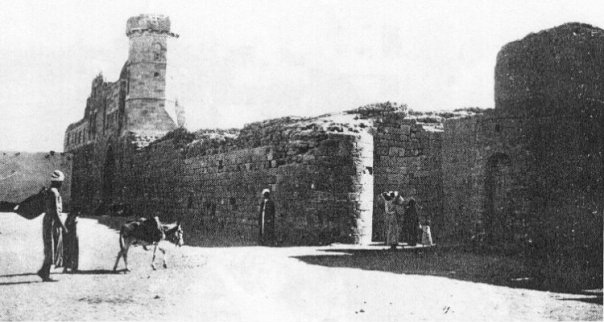
Before the 14th century, Khan Yunis was a village known as "Salqah". A vast caravanserai, today known as Barquq Castle, was constructed there by the emir Yunis al-Nawruzi in 1387–88, an official of the Mamluk Empire to protect caravans, pilgrims, and travellers.
According to the Palestinian Central Bureau of Statistics, Khan Yunis had a population of 205,125 in 2017. Khan Yunis, which lies only 4 km east of the Mediterranean Sea, has a semi-arid climate with temperature of 30 °C maximum in summer and 10 °C minimum in winter, with an annual rainfall of approximately 260 mm.
History
Ancient period
Herodotus describes a city named Ienysos () located between Lake Serbonis and Kadytis (modern Gaza city). He talks about how the Persian military marched through the location on its way to Egypt. He also describes how the coastal area between Kadytis and Ienysos was inhabited by local Arab tribes. Some sources, due to phonological resemblance of the names and due to the general matching of the geographic locations, associate this site with modern Khan Yunis.
Other sources have suggested a further inland location of "Khirbet Ma'in Abu Sitta" (Palestinian village depopulated in 1949, near modern kibbutz of Nir Oz) or the Egyptian town of Arish as possible locations of Ienysos, but there is no clear evidence to support this identification.
Ancient discoveries in Khan Yunis feature a lintel with a Greek inscription, discovered repurposed in the tomb of Sheikh Hamada. The inscription translates to: 'Hilarion - giving thanks to St. Georgius.' Originally housed in the Musée de Notre Dame de France in Jerusalem, the lintel is currently lost.
Establishment by Mamluks
Main article: Barquq Castle
The khan served as resting stop for couriers of the barid, the Mamluk postal network in Palestine and Syria.
Ottoman period
Khan Yunis was the site of a minor battle in late 1516, when the Egypt-based Mamluks were defeated by Ottoman forces under the leadership of Hadim Sinan Pasha. The Ottoman sultan Selim I then arrived in the area where he led the Ottoman army across the Sinai Peninsula to conquer Egypt. During the 17th and 18th centuries the Ottomans assigned an Asappes garrison associated with the Cairo Citadel to guard the fortress at Khan Yunis.
Pierre Jacotin named the village Kan Jounes on his map from 1799, while in 1838, Robinson noted Khan Yunas as a Muslim village located in the Gaza district. In 1863 French explorer Victor Guérin visited Khan Yunis. He found it had about a thousand inhabitants, and that many fruit trees, especially apricots were planted in the vicinity.
During the Ottoman period, the Bedouin tribe of 'Arab al-Wahidat (عرب الوحيدات) were among the residents of Khan Yunis.
At the end of the 19th century, the Ottomans established a municipal council to administer the affairs of Khan Yunis, which had become the second largest town in the Gaza District after Gaza itself.
British Mandate

In the 1938 village statistics, the population is listed as 4,379 (including three Jews) with 3,953 in nearby suburbs. In the 1945 statistics, Khan Yunis had a population of 11,220 (11,180 Muslims and 40 Christians), with 2,302 (urban) and 53,820 (rural) dunams of land, according to an official land and population survey. Of this, 4,172 dunams were plantations and irrigable land, 23,656 used for cereals, while 1,847 dunams were built-up land.
1948–1967

Khan Yunis was one of the towns where Palestinian refugees who were forcibly expelled from areas of Palestine to the east and north of the Gaza Strip gathered, to wait for a resolution that would allow then to return to their ancestral villages and homes.

During the night of 31 August 1955, three Israeli paratroop companies attacked the British-built Tegart fort in Khan Yunis from where attacks had been carried out against Israelis. The police station, a petrol station and several buildings in the village of Abasan were destroyed, as well as railway tracks and telegraph poles. In heavy fighting, 72 Egyptian soldiers were killed. One Israeli soldier was killed and 17 were wounded. The operation led to a ceasefire on September 4, forcing President Gamal Abdel Nasser and the Egyptian government to halt Palestinian fedayeen operations against Israel. One of the mechanized companies was commanded by Rafael Eitan.
Before the Suez War, Khan Yunis was officially administered by the All-Palestine Government, seated in Gaza and later in Cairo. After a fierce firefight, the Sherman tanks of the IDF 37th Armored Brigade broke through the heavily fortified lines outside of Khan Yunis held by the 86th Palestinian Brigade. It was the only site in the Gaza strip where the Egyptian army put up any resistance to the Israeli invasion of Gaza, but it surrendered on 3 November 1956.
There are conflicting reports of what happened. Israel said that Palestinians were killed when Israeli forces were still facing armed resistance, while the Palestinians said all resistance had ceased by then, and that many unarmed civilians were killed as the Israel troops went through the town and camp, seeking men in possession of arms.
The killings, dubbed the Khan Yunis massacre, were reported to the UN General Assembly on 15 December 1956 by the Director of the United Nations Relief and Works Agency, Henry Labouisse. According to the report, the exact number of dead and wounded is not known, but the director received lists of names of persons allegedly killed from a trustworthy source, including 275 people, of which 140 were refugees and 135 local residents.
After 1959, the All-Palestine Government of Gaza Strip was abolished and the city was included in the United Arab Republic, which was shortly disestablished and the Gaza Strip came under the direct Egyptian military occupation rule.
1967 and aftermath

In 1967, during the Six-Day War, Israel occupied Khan Yunis again.
As a result of the 1993-1995 Oslo Accords, Khan Yunis and most of the Gaza Strip (excluding Israeli settlements and military areas) were placed under the control of the Palestinian Authority.
Khan Yunis was the site of Israeli helicopter attacks in August 2001 and October 2002 that left several civilians killed, hundreds wounded and civilian buildings within the vicinity destroyed.
The Palestinian Authority came into control of the entirety of the Strip following the 2005 Israeli disengagement. However, following the Battle of Gaza in 2007, Hamas took over the Gaza Strip and established its own government in the region.
Israel–Gaza war
Main article: Siege of Khan Yunis, July 2024 Khan Yunis incursion, August 2024 Khan Yunis incursion, Battle of Khan Yunis (2025)


Economy
Khan Yunis is the second largest urban area in the Gaza Strip after Gaza City. It serves as the principal market center of the territory's southern half and hosts a weekly Bedouin souk ("open-air market") mostly involving local commodities. Khan Yunis had the highest unemployment rate in the Palestinian territories.
Education
- University College of Science and Technology
- Al Quds Open University
- Palestine College of Nursing
Culture and heritage
Barquq Castle
Barquq Castle was a Mamluk-era fortified mosque and caravanserai. It was very damaged by the Israeli army during the Gaza war. File:Barquq Castle from Thiersch's Pharos, antike, Islam und Occident.png|At the beginning of the 20th century File:Yunus al-Nûrûzi Caravansary, 2016.jpg|Interior remains in 2016 File:Barquq castle exterior (adjusted).jpg|Barquq castle exterior in 2020
Al Qarara Cultural Museum
Located in Al-Qarara, on the outskirts of Khan Yunis, the cultural museum tells the story of the history of Palestine. Key objects included Byzantine mosaics, swords dating to the Crusader period, thobes, as well as jewellery worn by women prior to the Nakba. It also included military items dating to the British Mandate in Palestine.
The museum's structure, display cases, and collection were destroyed in October 2023 by Israeli forces.
Notable people
- Hiba Abu Nada (1991-2023), poet and novelist killed in an Israeli air force bombing of her home in Khan Yunis
- Rouzan al-Najjar, nurse born September 11, 1996 in Khan Younes, killed by a bullet of an Israeli army sniper in June 2018
- Mohammed Assaf, singer who grew up in the Khan Yunis refugee camp, winner of the second season of Arab Idol
- Mohammed Shabir (1946 – 2023), doctor in microbiology and former president of The Islamic University in Gaza killed by an Israeli sniper during Gaza War
- Yahya Sinwar (1962 - 2024), Palestinian militant and politician who served as chairman of the Hamas Political Bureau from August 2024, and as the leader of Hamas in the Gaza Strip from February 2017, until his death in October 2024 File:מוחמד עסאף.jpg|Mohammed Assaf File:Yahya al-Sinwar profile portrait 3x4.jpg|Yahya Sinwar
International relations

Twin towns – sister cities
Khan Yunis is twinned with the following cities:
- NOR Hamar, Norway
- ESP Almuñécar, Spain
- FRA Évry, France
- ITA Bisceglie, Italy
- ITA Alcamo, Italy
References
Bibliography
References
- (February 2018). "Preliminary Results of the Population, Housing and Establishments Census, 2017". [[State of Palestine]].
- "Name Reference - Anera.org".
- al-Natsheh, Yusuf. "Khan of Amir Yunis al-Nawruzi". Museum with No Frontiers.
- Abu Khalaf, Marwan F.. (1983). "Khan Yunus and the Khans of Palestine". Council for British Research in the Levant.
- Retsö, J. (2014). ''The Arabs in antiquity: Their history from the Assyrians to the Umayyads - "Chapter 9: The Age of the Achaemenids - Herodotus of Halicarnassus"''. Routledge.
- Abu-Sitta, S. H. (2017). ''Mapping my return: A Palestinian memoir''. American University in Cairo Press.
- Verreth, Herbert. (2006). "The northern Sinai from the 7th century BC till the 7th century AD. A guide to the sources". Leuven.
- (2014-07-14). "XXXVIII. Khan Yunis". De Gruyter.
- Abu-Khalaf, Marwan. [https://web.archive.org/web/20080201045835/http://www.elagha.net/e/index.htm Khan Younis City]. ''El-Agha''. July 2002.
- Pitcher, p. 105.{{full citation needed. (November 2025)
- Karmon, 1960, p. [http://www.jchp.ucla.edu/Bibliography/Karmon,Y_1960_Jacotin_Map(IEJ_10).pdf 173] {{Webarchive. link. (2019-12-22)
- Robinson and Smith, vol 3, 2nd appendix, p. [https://archive.org/stream/biblicalresearch03robiuoft#page/117/mode/1up 117]
- Guérin, 1869, p.[https://archive.org/stream/descriptiongog02gu#page/226/mode/1up 226] ff, pp. [https://archive.org/stream/descriptiongog02gu#page/249/mode/1up 249]-250, p. [https://archive.org/stream/descriptiongog02gu#page/251/mode/1up 251]
- (2025-01-01). "Vines Among the dunes: sand/dune agriculture in Rimāl Isdūd/Ashdod-Yam during the Late Ottoman and British Mandate periods". Contemporary Levant.
- Feldman, 2008, p. [https://books.google.com/books?id=D0bEoa0a_YsC&pg=PA21 21]
- Barron, 1923, Table V, [[Gaza Subdistrict, Mandatory Palestine. Sub-district of Gaza]], p. [https://archive.org/stream/PalestineCensus1922/Palestine%20Census%20%281922%29#page/n10/mode/1up 8]
- Mills, 1932, p. [https://archive.org/details/CensusOfPalestine1931.PopulationOfVillagesTownsAndAdministrativeAreas 4]
- Mills, 1932, p. [https://archive.org/details/CensusOfPalestine1931.PopulationOfVillagesTownsAndAdministrativeAreas 5]
- (1938). "Village Statistics".
- Department of Statistics, 1945, p. [http://users.cecs.anu.edu.au/~bdm/yabber/census/VSpages/VS1945_p31.jpg 31]
- Government of Palestine, Department of Statistics. ''Village Statistics, April, 1945.'' Quoted in Hadawi, 1970, p. [http://www.palestineremembered.com/download/VillageStatistics/Table%20I/Gaza/Page-046.jpg 46]
- Government of Palestine, Department of Statistics. ''Village Statistics, April, 1945.'' Quoted in Hadawi, 1970, p. [http://www.palestineremembered.com/download/VillageStatistics/Table%20II/Gaza/Page-087.jpg 87]
- Government of Palestine, Department of Statistics. ''Village Statistics, April, 1945.'' Quoted in Hadawi, 1970, p. [http://www.palestineremembered.com/download/VillageStatistics/Table%20III/Gaza/Page-137.jpg 137]
- Derori, 2005, p. 142
- Katz, 1988, p. 10
- Morris, 1993, p. 350
- Varble, 2003, p. [https://books.google.com/books?id=MrP3kgd4sf8C&pg=PA46 46]
- [http://domino.un.org/unispal.nsf/0/6558f61d3db6bd4505256593006b06be?OpenDocument UNRWA Report to the UN General Assembly November 1 – December 14, 1956] {{webarchive. link. (June 29, 2013 .: "The town of Khan Yunis and the Agency's camp adjacent thereto were occupied by Israel troops on the morning of 3 November. A large number of civilians were killed at that time, but there is some conflict in the accounts given as to the causes of the casualties. The Israel authorities state that there was resistance to their occupation and that the Palestinian refugees formed part of the resistance. On the other hand, the refugees state that all resistance had ceased at the time of the incident and that many unarmed civilians were killed as the Israel troops went through the town and camp, seeking men in possession of arms. The exact number of dead and wounded is not known, but the Director has received from sources he considers trustworthy lists of names of persons allegedly killed on 3 November, numbering 275 individuals, of whom 140 were refugees and 135 local residents of Khan Yunis.")
- (Dec 21, 2009). "Graphic novel on IDF 'massacres' in Gaza set to hit bookstores". Haaretz.
- "CNN.com - More violence in Gaza and West Bank - August 21, 2001".
- Anderson, John Ward. (2002-10-08). "Israeli Missile Kills 10 In Crowded Gaza Street". The Washington Post.
- Bulos, Nabih. (2023-12-04). "In Gaza, she sits by her belongings, waiting for her home to be bombed".
- (2 December 2023). "Moment Israeli strikes hit residential complex in Gaza's Khan Yunis {{!}} AFP".
- (2023-12-02). "Israeli strike destroys prestige Qatar-funded Gaza complex".
- (2023-11-19). "Israeli airstrikes in Nusseirat, Khan Yunis claim 15 innocent lives".
- (2023-12-04). "". link
- (2023-12-03). "Israel expands ground invasion in Gaza's Khan Younis".
- (2023-10-18). "خسائر كبيرة في قطاع الثقافة الفلسطينية جراء العدوان الإسرائيلي على غزة".
- (2023-10-18). "استهداف البشر والحجر والكلمة.. قصص تدمير أشهر المؤسسات الثقافية في غزة - البوابة نيوز".
- Picheta, Vasco Cotovio, Rob. (2024-04-07). "Israeli military says it has withdrawn forces from Khan Younis after months of fighting".
- Adler, Edna Mohamed,Nils. "Israel's war on Gaza updates: Israel says troops moved for new operations".
- (2024-04-07). "IDF ends active ground invasion, completely withdraws from southern Gaza".
- Fabian, Emanuel. (7 April 2024). "Five rockets fired from Khan Younis at Gaza border communities, hours after IDF withdraws ground troops". The Times of Israel.
- "IRAN UPDATE, APRIL 7, 2024".
- (30 July 2024). "Israeli forces quit east Khan Younis, Palestinians recover dozens of bodies".
- Clinton, Jane. (2024-08-30). "The Israeli military said on Friday it had wrapped up a month-long operation in southern and central Gaza that it said killed more than 250 Palestinian fighters.". The Guardian.
- (2025-01-19). "Alto el fuego en Gaza: se abre un respiro tras 15 meses de terror y casi 47.000 muertes".
- (19 January 2025). "Gazans cheer as ceasefire between Israel and Hamas takes hold".
- Thomas, p. 382.
- Irving, p. 230.
- [http://www.cst-kh.edu.ps/index.php/2011-03-12-10-49-42 University College of Science and Technology] {{webarchive. link. (2014-02-02)
- (2024-04-24). "Palestinians mourn as Israel destroys Gaza archaeological sites".
- Karajeh, Nagham. "Najla Abu Lahia starts cultural museum in Gaza by collecting more than 3,000 artifacts".
- (2021-04-17). "متحف القرارة... زوجان يحاولان الحفاظ على التراث في غزة".
- Zaki, Saeed. (2023-10-18). "خسائر كبيرة في قطاع الثقافة الفلسطينية جراء العدوان الإسرائيلي على غزة".
- Adams, Geraldine. (2023-11-06). "Global museum community responds to Israel-Hamas war".
- Saber, Indlieb Farazi. "A 'cultural genocide': Which of Gaza's heritage sites have been destroyed?".
- Ramadan, Alsayid. (21 October 2023). "Ḥāṣila ʿalā ǧāʾiza 'š-Šāriqa li-'l-ibdāʿ al-ʿarabī.. Wafa 'l-adība 'l-filasṭīnīa 'š-šābba Hiba Abū Nadā ḍaḥīa qaṣf Ġazza".
- (2018-12-30). "A Day, a Life: When a Medic Was Killed in Gaza, Was It an Accident? (Published 2018)".
- (24 May 2013). "عائلة مشترك Arab Idol محمد عساف:فوزه فخر لفلسطين | مجلة سيدتي".
- (2024-01-26). "Fact Sheet: Scholars Killed".
- "Hamas names Yahya Sinwar as new leader after Ismail Haniyeh's killing". [[Al Jazeera English]].
- "العلاقات الخارجية". Khan Yunis.
This article was imported from Wikipedia and is available under the Creative Commons Attribution-ShareAlike 4.0 License. Content has been adapted to SurfDoc format. Original contributors can be found on the article history page.
Ask Mako anything about Khan Yunis — get instant answers, deeper analysis, and related topics.
Research with MakoFree with your Surf account
Create a free account to save articles, ask Mako questions, and organize your research.
Sign up freeThis content may have been generated or modified by AI. CloudSurf Software LLC is not responsible for the accuracy, completeness, or reliability of AI-generated content. Always verify important information from primary sources.
Report