From Surf Wiki (app.surf) — the open knowledge base
KFC
American fast food restaurant chain

American fast food restaurant chain
| Field | Value | |
|---|---|---|
| name | KFC Corporation | |
| logo | KFC logo-image.svg | |
| logo_size | 160px | |
| type | Subsidiary | |
| foundation | {{unbulleted list | |
| founder | ||
| hq_location | 1441 Gardiner Lane | |
| Louisville, Kentucky, U.S. | ||
| Dallas, Texas, U.S. (global) | ||
| num_locations | 31,981 | |
| num_locations_year | 2025 | |
| key_people | Scott Mezvinsky (CEO) | |
| area_served | Worldwide (145 countries) | |
| industry | Restaurant | |
| genre | Fast food | |
| products | {{flatlist | |
| revenue | US$2.83 billion (2023) | |
| parent | Yum! Brands | |
| homepage |
the fast food chicken restaurant chain
|Sanders Court & Café:
North Corbin, Kentucky, U.S. |First franchise:
South Salt Lake, Utah, U.S.}} Louisville, Kentucky, U.S. Dallas, Texas, U.S. (global)
- Fried chicken
- chicken burgers
- wraps
- french fries
- soft drinks
- milkshakes
- salads
- desserts
- breakfasts
KFC Corporation, doing business as KFC (an abbreviation of Kentucky Fried Chicken), is an American multinational fast food restaurant chain specializing in Southern fried chicken and chicken sandwiches. Headquartered in Louisville, Kentucky, it is the world's second-largest restaurant chain (as measured by sales) after McDonald's, with over 31,980 locations globally in 150 countries, . The chain is a subsidiary of Yum! Brands, a restaurant company that also owns the Pizza Hut and Taco Bell chains.
KFC was founded by Colonel Harland Sanders (1890–1980), an entrepreneur who began selling fried chicken from his roadside restaurant in Corbin, Kentucky, during the Great Depression. Sanders identified the potential of the restaurant-franchising concept, and the first "Kentucky Fried Chicken" franchise opened in South Salt Lake, Utah, in 1952. KFC popularized chicken in the fast-food industry, diversifying the market by challenging the established dominance of the hamburger. By branding himself as "Colonel Sanders", Harland became a prominent figure of American cultural history, and his image remains widely used in KFC advertising to this day. However, the company's rapid expansion overwhelmed the aging Sanders, and he sold it to a group of investors led by John Y. Brown Jr. and Jack C. Massey in 1964.
KFC was one of the first American fast-food chains to expand internationally, opening outlets in Canada, the United Kingdom, Mexico and Jamaica by the mid-1960s. Throughout the 1970s and 1980s, it experienced mixed fortunes domestically, as it went through a series of changes in corporate ownership with little or no experience in the restaurant business. In the early 1970s, KFC was sold to the spirits distributor Heublein, which was taken over by the R. J. Reynolds food and tobacco conglomerate; that company sold the chain to PepsiCo. The chain continued to expand overseas, however, and in 1987 it became the first Western restaurant chain to open in China. It has since expanded rapidly in China, which is now the company's single largest market. PepsiCo spun off its restaurants division as Tricon Global Restaurants, which later changed its name to Yum! Brands.
KFC's original product is pressure-fried chicken pieces, seasoned with Sanders' signature recipe of "11 herbs and spices". The constituents of the recipe are a trade secret. Larger portions of fried chicken are served in a cardboard "bucket", which has become a feature of the chain since it was first introduced by franchisee Pete Harman in 1957. Since the early 1990s, KFC has expanded its menu to offer other chicken products such as chicken fillet sandwiches and wraps, as well as salads and side dishes such as french fries and coleslaw, desserts and soft drinks; the latter often supplied by PepsiCo. KFC is known for its slogans "It's Finger Lickin' Good!", "Nobody does chicken like KFC", "We do chicken right", and "So good".
History
Main article: History of KFC

Sanders Court & Café
Harland Sanders was born in 1890 and raised on a farm outside Henryville, Indiana (near Louisville, Kentucky). When Sanders was five years old, his father died, forcing his mother to work at a canning plant. This left Sanders, as the eldest son, to care for his two younger siblings. After he reached seven years of age, his mother taught him how to cook. After leaving the family home at the age of 13, Sanders passed through several professions with mixed success.
In 1930, Sanders took over a Shell filling station on U.S. Route 25 just outside North Corbin, Kentucky, a small town on the edge of the Appalachian Mountains. It was here that he first served to travelers the recipes that he had learned as a child: fried chicken and other dishes such as steaks and country ham. After four years of serving from his own dining room table, Sanders purchased the larger filling station on the other side of the road and expanded to six tables. By 1936, this had proven successful enough for Sanders to be given the honorary title of Kentucky Colonel by Governor Ruby Laffoon. In 1937 he expanded his restaurant to 142 seats and added a motel he purchased across the street, naming it Sanders Court & Café.
Sanders was unhappy with the 35 minutes it took to prepare his chicken in an iron frying pan, but he refused to deep fry the chicken, which he believed lowered the quality of the product. If he pre-cooked the chicken in advance of orders, there was sometimes wastage at day's end. In 1939, the first commercial pressure cookers were released onto the market, mostly designed for steaming vegetables. Sanders bought one and modified it into a pressure fryer, which he then used to fry chicken. The new method reduced production time to be comparable with deep frying while, in the opinion of Sanders, retaining the quality of pan-fried chicken.
"Original Recipe" and franchising

In 1952, Sanders franchised his recipe to his friend Pete Harman of South Salt Lake, Utah, the operator of one of the city's largest restaurants. The Sanders Court & Café generally served travelers, so when the route planned in 1955 for Interstate 75 bypassed his properties, Sanders sold them and traveled the US to franchise his recipe to restaurant owners. Independent restaurants would pay four (later five) cents on each chicken as a franchise fee in exchange for Sanders' recipe and the right to feature it on their menus and use his name and likeness for promotional purposes.
Don Anderson, a sign painter hired by Harman, coined the name "Kentucky Fried Chicken". For Harman, the addition of KFC was a way of differentiating his restaurant from competitors; a product from Kentucky was exotic and evoked imagery of Southern hospitality. Harman trademarked the phrase "It's finger lickin' good", which eventually became the company slogan. He also introduced the "bucket meal" in 1957 (14 pieces of chicken, five bread rolls and a pint of gravy in a cardboard bucket). Serving their signature meal in a paper bucket was to become an iconic feature of the company.
By 1963, there were 600 KFC restaurants, making the company the largest fast food operation in the United States. KFC popularized chicken in the fast food industry, diversifying the market by challenging the dominance of the hamburger.
With significant growth in tow, the fledgling Kentucky Fried Chicken decided in 1964 that they would begin offering franchise opportunities beyond the Atlantic, and landed on the United Kingdom as its entry point into Europe. As such, the first British KFC eatery opened its doors at 92 Fishergate in Preston, Lancashire, on May 1, 1965, and still operates today.
Pat Grace met with Sanders at his holiday home near Toronto, Canada, and agreed to franchise the brand in Ireland. In 1970 Grace returned to Ireland after a number of years in Canada to open his first Kentucky Fried Chicken restaurants in Phibsboro shopping center in Dublin. Eventually he opened another six restaurants located in Dublin, Limerick and Cork. After disagreements over cost cutting with KFC management in the early 1980s, the Irish restaurants were renamed to Pat Grace's Famous Fried Chicken reportedly retaining the original recipe. These stores were closed in the late 1980s. Pat Grace went on to wholesale the chicken spice blend under the brand Grace's Perfect Blend.
Sale and global expansion

In 1964, Sanders sold KFC to a group of investors led by John Y. Brown Jr. and Jack C. Massey for US$2 million (around US$17 million in 2020). The contract included a lifetime salary for Sanders and the agreement that he would be the company's quality controller and trademark. The chain had reached 3,000 outlets in 48 countries by 1970. In July 1971, Brown sold the company to the Connecticut-based Heublein, a packaged food and drinks corporation, for US$285 million (around US$1.8 billion in 2020). Sanders died in 1980, his promotional work making him a prominent figure in American cultural history. By the time of his death, there were an estimated 6,000 KFC outlets in 48 countries worldwide, with $2 billion worth of sales annually.
In 1982, Heublein was acquired by R. J. Reynolds, the tobacco giant. In July 1986, Reynolds announced the sale of KFC to PepsiCo for $850 million (around US$2.0 billion in 2020). The actual sale took place in early October for $840 million. PepsiCo made the chain a part of its restaurants division alongside Pizza Hut and Taco Bell. KFC entered the Chinese market in November 1987, with an outlet in Beijing.
In 1991, the KFC name was officially adopted, although it had already been widely known by that initialism. Kyle Craig, president of KFC U.S., admitted the change was an attempt to distance the chain from the unhealthy connotations of "fried". The early 1990s saw a number of successful major product launches, including spicy "Hot Wings" (launched in 1990), popcorn chicken (1992) and, internationally, the "Zinger", a spicy chicken fillet sandwich (1993). By 1994 KFC had 5,149 outlets in the US and 9,407 overall, with over 100,000 employees. In August 1997, PepsiCo spun off its restaurants division as a public company valued at US$4.5 billion (around US$7.3 billion in 2020). The new company was named Tricon Global Restaurants and, at the time, had 30,000 outlets and annual sales of US$10 billion (around US$16 billion in 2020), making it second in the world only to McDonald's. Tricon was renamed Yum! Brands in May 2002.

On March 31, 2011, Priszm, who was the largest franchisee of KFC restaurants in Canada at the time, went into bankruptcy protection in Ontario and British Columbia.
By 2015, KFC was struggling, having lost business to other retailers and being surpassed by Chick-fil-A as the leading chicken retailer in the US three years previously. The company launched a new initiative with a plan to revamp its packaging, decor and uniforms and expand its menu. Additionally, beginning in May 2015, a new series of US advertisements was launched featuring Darrell Hammond as Colonel Sanders. In a planned rotation of actors, Norm Macdonald, Jim Gaffigan, George Hamilton and Rob Riggle portrayed Sanders in similar ads through the fall of 2016. In January 2018, country music icon Reba McEntire played the first female Colonel Sanders.
Before leaving as CEO in 2021, Andrea Zahumensky told Ad Age the "brand assets that we're so lucky to have" were the bucket, the three stripes and the full name Kentucky Fried Chicken. All of these were being used more by the chain.
Australia rebranded KFC back to its original name, "Kentucky Fried Chicken" in 2019.
Operations
Main article: Operations of KFC by country

KFC is a subsidiary of Yum! Brands, one of the largest restaurant companies in the world. KFC had sales of $23 billion in 2013. KFC is incorporated under Delaware General Corporation Law, and has its headquarters at 1441 Gardiner Lane, Louisville, Kentucky, in a three-story colonial style building known colloquially as the "White House" due to its resemblance to the US president's home. The headquarters contain executive offices and the company's research and development facilities.
Yum! Brands plans to move the KFC headquarters to Plano, Texas, in 2025.
Products

KFC's core product offering is pressure fried on-the-bone chicken pieces seasoned with Colonel Harland Sanders' "Original Recipe" of 11 herbs and spices. The product is typically available in either two- or three-piece individual servings or in a family size cardboard bucket typically holding between six and 16 chicken pieces. In territories that follow the system handed down by Colonel Sanders, such as Canada and the UK, each chicken is divided into nine different cuts (two drumsticks, two thighs, two wings, two breast pieces and one keel); however, the United States now uses an eight-piece cut.
The chicken is hand-breaded at individual KFC outlets with wheat flour mixed with seasoning in a two- to four-minute process. It is then pressure fried for between seven and 10 minutes (the timing differs between countries) in oil at 185 degrees Celsius. Following this, the chicken is left to stand for 5 minutes in order for it to sufficiently cool before it is placed in the warming oven. A KFC executive stated that the taste of the chicken will vary between regions depending on the oil variety used and whether the chicken has been corn-fed or wheat-fed.

As well as its core chicken on the bone offering, KFC's major products include chicken burgers (including the Zinger and the Tower); wraps ("Twisters" and "Boxmasters"); and a variety of finger foods, including crispy chicken strips and hot wings. Popcorn chicken, which consists of bite-sized pieces of fried chicken, is one of the most widely available KFC products. In some locations, such as in Australia, Belarus, Malaysia and South Africa, chicken nuggets are also sold.
McCormick & Company is KFC's largest supplier of sauces, seasonings and marinades and is a long-term partner in new product development.
Due to the company's previous relationship with PepsiCo, most territories supply PepsiCo products, but exceptional territories include Barbados, Greece, Mexico, New Zealand, the Philippines, Romania, South Africa, Turkey, Indonesia (since 2019), Singapore (since 2022) and Malaysia (since 2022) which stock drinks supplied by The Coca-Cola Company, and Aruba, which stocks RC Cola from the Cott Corporation. In Peru, the locally popular Inca Kola is sold.
Launched in 2009, the Krusher/Krushem range of frozen beverages containing "real bits" such as Kit Kat, Oreo and strawberry shortcake is available in over 2,000 outlets. Egg custard tart is a popular dessert worldwide, but other items include ice cream sundaes and tres leches cake in Peru.
In 2012, the "KFC AM" breakfast menu began to be rolled out internationally, including such items as pancakes, waffles and porridge, as well as fried chicken.
On August 27, 2019, KFC tested meatless boneless wings and nuggets in Atlanta, Georgia.
In February 2023, Kentucky Fried Chicken in Australia announced that several items would no longer be sold in their menu, including wings, popcorn chicken, Nashville hot sauce and strawberry lemonade.
The 11 herbs and spices
Main article: KFC Original Recipe

Sanders' Original Recipe of "11 herbs and spices" is one of the best known trade secrets in the catering industry. The recipe is not patented, because patent law requires public disclosure of an invention and provides protection only for a strictly limited term, whereas trade secrets can remain the intellectual property of their holders in perpetuity.
A copy of the recipe, signed by Sanders, is held inside a safe inside a vault in KFC's Louisville headquarters, along with 11 vials containing the herbs and spices. To maintain the secrecy of the recipe, half of it is produced by Griffith Laboratories before it is given to McCormick, who add the second half.
In 1999, a couple who bought the house formerly occupied by Colonel Sanders found scribbled notes purported to be the secret recipe. Initially, KFC wanted to file a lawsuit against the couple to stop an auction of the notes but, by early 2001, it dropped the lawsuit, claiming the scribbled notes are "nowhere close" to the original recipe.
Joe Ledington of Kentucky, a nephew by marriage of Colonel Sanders, claimed to have found a copy of the original KFC fried chicken recipe on a handwritten piece of paper in an envelope in a scrapbook. In August 2016, Chicago Tribune staffers conducted a cooking test of this recipe and claimed after a few attempts that, with the addition of the MSG flavor-enhancer Ac'cent, they produced fried chicken which tasted "indistinguishable" from the chicken they purchased at KFC.
Regionalized menus
KFC adapts its menu internationally to suit regional tastes and there are over 300 KFC menu items worldwide. Some locations, such as the UK and the US, sell grilled chicken. In predominantly Islamic countries, the chicken served is halal. Some locations in the US sell fried chicken livers and gizzards. A small number of US outlets offer an all-you-can-eat buffet option with a limited menu.
Value menu items are sold under the "Streetwise" name in locations such as Canada, Nigeria, South Africa and Mauritius. Side dishes often include French fries, coleslaw, barbecue baked beans, corn on the cob, mashed potato, bread rolls and American biscuits. Salads include the bean salad, the Caesar salad and the garden salad. In a number of territories, KFC sells onion rings. In most of Asia, several Sub-Saharan Africa and Pacific markets, rice based side dishes are often sold. In Greece and Bulgaria, potato wedges are sold instead of French fries.
In a number of Eastern European locations and Portugal, beer is offered in addition to soft drinks. In 2023 KFC branches in UK and Ireland introduced new 'signature fries' (fries coated in herbs and spice) in an attempt to improve the taste of the fries. File:KFC Hot Wings Fries.jpg|Hot wings and fries served in paper buckets File:16-03-02-Hot-Wings-KFC-Berlin-N3S 3711.jpg|Hot wings menu set sold in Berlin File:KFC Rice Set (Malaysia) and Chicken Nuggets.jpg|Hot & spicy chicken, colonel rice, coleslaw and nuggets in Malaysia File:KFC Spaghetti Philippines.jpg|Spaghetti and gravy as sold in the Philippines File:Pork congee with preserved eggs at KFC Tongzhou Guoyuan (20220711091757).jpg|KFC century eggs and pork congee sold in China in breakfast hours only
Equipment
KFC initially used stove-top covered cooking pots to fry its chicken. In the 1960s, the officially recommended model was the L S Hartzog developed "KFC 20-Head Cooker", a large device that cost $16,000. The Hartzog model had no oil filtration system, meaning that filtering had to be done manually, and the pressure fryers occasionally exploded often harming employees. In 1969, inventor and engineer Winston L. Shelton developed the "Collectramatic" pressurized fryer to overcome the problems KFC faced in quickly frying chicken to meet growing customer demand. The Collectramatic used precision time and temperature controls and self-filtered the cooking oil – all while meeting Colonel Sanders' high standards. Fred Jeffries, then vice president of purchasing at KFC, claimed that the invention helped fuel the company's rapid expansion and success:
There's no way it (KFC) could have grown as it did without the Collectramatic. Stores were doing about $200,000 a year in sales on average with the pots...but they could never have done the $900,000 a year it became without Win's fryer. He (Shelton) helped set the stage for that with true engineering thinking.
Although a number of franchisees bought the Collectramatic, which had the support of Colonel Sanders from 1970 onwards, John Y. Brown Jr. had given tacit approval to franchisees to exclusively use the older L S Hartzog fryer, saying "Though those old pots were damn dangerous, at least we knew they worked! I was mostly afraid these new fryers would break down in the middle of business." Brown warned franchisees that they were in violation of their contract if they used the Collectramatic. Brown held his ground on the issue until he learned that his father, John Y. Brown Sr., who owned multiple KFC franchises, was successfully using the Collectramatic in every franchise he owned. The issue was eventually resolved after Heublein purchased KFC, acquired Hartzog and nullified the contract. The Collectramatic has been an approved pressure fryer for KFC from 1972 onwards.
From 2013 onwards, KFC has been transitioning from using Collectramatic cookers to pressure fryers produced by Henny Penny, which supplies KFC with various equipment. The 'Velocity' series of pressure fryers includes increased load capacity, automatic oil filtration and increased oil longevity.
Advertising
Main article: KFC advertising
.jpg)
Colonel Sanders was a key component of KFC advertising until his death in 1980. Despite his death, Sanders remains a key icon of the company as an "international symbol of hospitality". Early official slogans for the company included "North America's Hospitality Dish" (from 1956) and "We fix Sunday dinner seven nights a week". The "finger lickin' good" slogan was used from 1956 and went on to become one of the best-known slogans of the 20th century. The trademark expired in the US in 2006. The first KFC logo was introduced in 1952 and featured a "Kentucky Fried Chicken" typeface and a logo of the Colonel. In 1962, Dave Thomas took Colonel Sanders' bucket and turned it into a sign that revolved in a circular motion in front of almost every American KFC outlet.
Advertising played a key role at KFC after it was sold by Sanders and the company began to advertise on US television with a budget of US$4 million in 1966. In order to fund nationwide advertising campaigns, the Kentucky Fried Chicken Advertising Co-Op was established, giving franchisees 10 votes and the company three when deciding on budgets and campaigns. In 1969, KFC hired its first national advertising agency, Leo Burnett.
Controversies and criticism
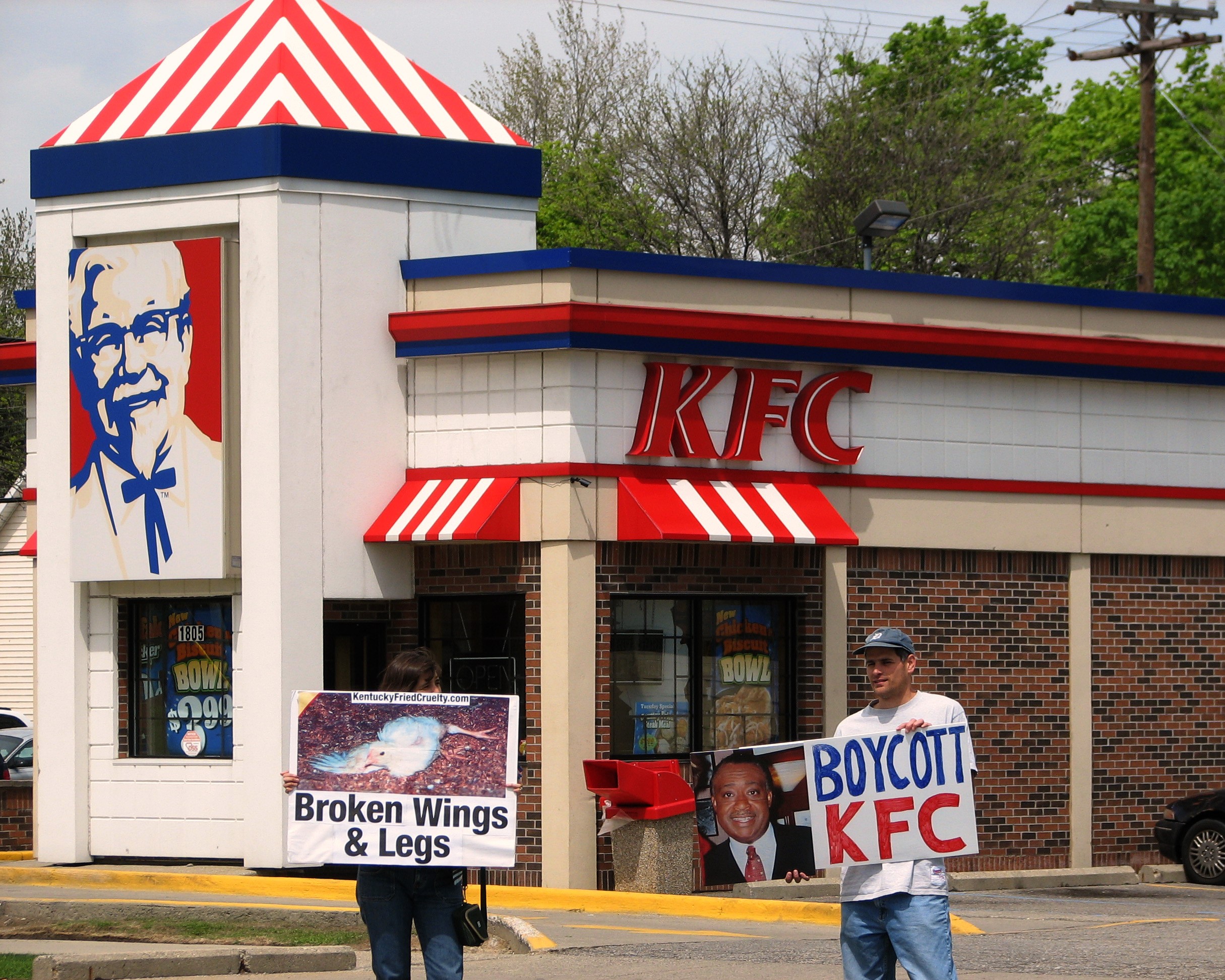
Since the beginning of the 21st century, fast food has been criticized for its animal welfare record, its links to obesity and its environmental impact. Eric Schlosser's book Fast Food Nation (2002) and Morgan Spurlock's film Super Size Me (2004) reflected these concerns. Since 2003, People for the Ethical Treatment of Animals (PETA) has protested KFC's choice of poultry suppliers worldwide. The exception is KFC Canada, which signed an agreement pledging to only use "animal-friendly" suppliers. President of KFC's US division Gregg Dedrick said PETA mischaracterized KFC as a poultry producer rather than a purchaser of chickens. In 2008, Yum! stated: "[As] a major purchaser of food products, [Yum!] has the opportunity and responsibility to influence the way animals supplied to us are treated. We take that responsibility very seriously, and we are monitoring our suppliers on an ongoing basis."
In 2006, Greenpeace accused KFC Europe of sourcing the soya bean for its chicken feed from Cargill, which had been accused of clearing large swathes of the Amazon rainforest in order to grow the crop.
In 2010, according to The Guardian, "in the US where fried chicken remains closely associated with age-old racist stereotypes about black people in the once segregated south", KFC Australia aired the 30-second promotion on television named "KFC's cricket survival guide" which shows a white cricket fan surrounded by black fans from the opposing team. The television announcer asks, "Need a tip when you're stuck in an awkward situation?" The fan passes around his "bucket of KFC", even though the commercial was intended for an Australian audience, which found its way to social media in the United States, prompting sharp disapproval. KFC Australia made a statement to the fact the commercial was "misinterpreted by a segment of people in the US" and it was a "light-hearted reference to the West Indian cricket team" and "The ad was reproduced online in the US without KFC's permission, where we are told a culturally-based stereotype exists, leading to the incorrect assertion of racism...We unequivocally condemn discrimination of any type and have a proud history as one of the world's leading employers for diversity".
In May 2012, Greenpeace accused KFC of sourcing paper pulp for its food packaging from Indonesian rainforest wood. Independent forensic tests showed that some packaging contained more than 50 percent mixed tropical hardwood fiber, sourced from Asia Pulp & Paper (APP). APP said such fiber can be found in recycled paper, or: "It can also come from tree residues that are cleared, after a forest area has become degraded, logged-over or burned, as part of a sustainable development plan. APP has strict policies and practices in place to ensure that only residues from legal plantation development on degraded or logged-over forest areas and sustainable wood fiber enters the production supply chain." KFC said: "From a global perspective, 60 percent of the paper products that Yum! (our parent company) sources are from sustainable sources. Our suppliers are working towards making it 100 percent."
In December 2012, the chain was criticized in China when it was discovered that a number of KFC suppliers had been using growth hormones and an excessive amount of antibiotics on its poultry in ways that violated Chinese law. In February 2013, Yum! CEO David Novak admitted that the scandal had been "longer lasting and more impactful than we ever imagined". The issue is of major concern to Yum!, which earns almost half of its profits from China, largely through the KFC brand. In March 2013, Yum! reported that sales had rebounded in February, but that lower sales in December and January would result in a decline in same-store sales of 20 percent in the first quarter.
In 2017, KFC was fined £950,000 after two workers in the UK were scalded by boiling hot gravy. The company admitted to charges of failing in a duty of care to employees and was ordered by Teesside Crown Court in Middlesbrough to pay fines of £800,000 and £150,000.
In February 2018, logistics mismanagement by DHL, which had been selected by KFC UK as their new delivery partner, caused a chicken shortage in the United Kingdom – KFC's largest market in Europe – forcing the company to temporarily close hundreds of restaurants around the country. KFC apologized by taking out adverts in British newspapers showing the company's initials rearranged to read "FCK", followed by an apology, which was well received.
In November 2021, Finland's first KFC restaurant was opened at the Itis shopping center in Itäkeskus, Helsinki. A few days before the opening day, a tent had appeared in front of the restaurant, where a man who had kept his identity secret for a few days had stayed, and who on the opening day revealed himself to the public as a vegan activist defending animal rights. After trying to give his speech to those present, the security company carried him away. Even before the opening of the restaurant, in October, news of a controversy over the procurement of a broiler for food from Poland; the cause is mainly related to the risk of salmonella in broilers, which is a significant problem in Poland, whereas its prevalence in Finland is low.
Following the 2022 Russian invasion of Ukraine, a number of companies have faced growing pressure to halt operations in Russia but have not yet done so. This includes KFC, which has over 1,000 outlets in Russia, more than any other Western fast food chain.
However, within a few years, all Russian KFC restaurants were rebranded as "Rostic's".
In early 2022 a promotional video was shot with influencer Niko Omilana showing a chicken farm in the KFC supply chain. The video depicted birds with a good quality of life. Animal rights activists entered the same farm months later and found vastly different conditions, with instances of "severe overcrowding" and "lame and dead birds". Paul Roger, a vet and founder member of AWSELVA, said birds in the footage were exhibiting "behavioural signs of stress such as feather pecking and topical skin infection". KFC's actions were branded "misleading".
On November 9, 2022, KFC Germany issued an announcement inviting its German audience to celebrate Kristallnacht with "Cheesy Chicken". An apology was issued shortly afterwards, blaming the original message as an "error in our system".
In May 2024, the closure of the outlet in Malaysia was reported due to the ongoing Israeli–Palestinian conflict. Attacks on two outlets in Baghdad, Iraq were also reported.
In September 2024, KFC announced that it would not meet the Better Chicken Commitment, an animal welfare pledge made in 2019. The commitment includes several welfare standards, such as adopting slower-growing breeds by 2026, but as of 2024, only 1% of KFC's chickens were from such breeds.
In June 2025, KFC temporarily closed all its 11 restaurants in Denmark and dismissed its franchise holder in the country, after a TV show (broadcast on June 23) revealed that in multiple restaurants, employees were systematically falsifying ("extending") use-by dates on raw chicken, and possibly other problems. Before broadcast, the questions by the TV reporter caused the national food authority to launch simultaneous inspection raids on all 11 restaurants. None got an all-clear, seven received strict warnings and four were given punishments (fines/charges or forced instant closure). Among the issues found by the authorities were moldy residue in multiple restaurants; a common procedure of reusing the breading mix continuously instead of using fresh breading mix every three hours, as stated in written procedures that were hastily changed during the raids (some inspections only saw the new procedure, which they found dubious); a common thawing procedure (with no written risk assessment documentation) for raw chicken which would allow chicken to be served up to four days after the start of defrosting and made it difficult to confirm the actual age of the raw chicken; and suspect messages between restaurant bosses and the national franchise holder about deceiving inspectors from both the government and KFC Western Europe. Furthermore, various formal and legal issues were found in multiple restaurants, such as dirty waste buckets too close to fresh food, parts of operations done under the company ID of the parent company instead of the actual restaurant as registered with food safety authorities, and incomplete paperwork on deliveries.
In September 2025, Czech journalist reported that the practices of artificially extending the shelf life of meat that led to the closure of all KFC outlets in Denmark may also be used by some branches in the Czech Republic. He cited the testimony of a former employee from the Jablonec nad Nisou branch. The State Agricultural and Food Inspection Authority later revealed that similar practices were used by the KFC outlet in Liberec. The inspection subsequently decided to carry out mass inspections of KFC restaurants throughout the country. In November the spokesperson of the State Agricultural and Food Inspection Authority revealed that employees of the KFC outlet in Prague-Dejvice defrosted chicken meat in standing water, which increases microbiological risks.
References
References
- (March 12, 2024). "KFC Surpasses 30,000 Restaurants Worldwide".
- (September 28, 2025). "KFC - Company Description". Franchise Times.
- "Scott Mezvinsky". Yum! Brands, Inc..
- "Yum Financial Statement 2023".
- (February 11, 1971). "KFC Corporation".
- "KFC: restaurants worldwide 2019".
- "YUM! Brands, Form 10-K, Annual Report, Filing Date Feb 22, 2018". secdatabase.com.
- Whitworth, William. (February 14, 1970). "Kentucky-Fried". [[The New Yorker]].
- Klotter, James C.. (2005). "The Human Tradition in the New South". [[Rowman & Littlefield]].
- Sanders, Harland. (2012). "The Autobiography of the Original Celebrity Chef". KFC.
- Ozersky, Josh. (April 2012). "Colonel Sanders and the American Dream". [[University of Texas Press]].
- Aaseng, Nathan. (January 2001). "Business Builders in Fast Food". Oliver Press.
- Smith, Andrew F.. (December 2, 2011). "Fast Food and Junk Food: An Encyclopedia of What We Love to Eat". ABC-CLIO.
- Hollis, Tim. (1999). "Dixie Before Disney: 100 Years of Roadside Fun". [[University Press of Mississippi]].
- Sanders, Harland. (1974). "The Incredible Colonel". Creation House.
- Binney, Ruth. (April 1, 2012). "Wise Words and Country Ways for Cooks". David & Charles.
- Schreiner, Bruce. (July 23, 2005). "KFC still guards Colonel's secret".
- Kleber, John E.. (May 18, 1992). "The Kentucky Encyclopedia". [[University Press of Kentucky]].
- Ozersky, Josh. (2012). "Colonel Sanders and the American Dream". [[University of Texas Press]].
- (April 21, 2004). "Colonel's landmark KFC is mashed". [[Deseret Morning News]].
- (1999). "Fast Food: Roadside Restaurants in the Automobile Age". [[JHU Press]].
- Darden, Robert. (January 1, 2004). "Secret Recipe: Why Kfc Is Still Cooking After 50 Years". Tapestry Press.
- Smith, Andrew F.. (May 1, 2007). "The Oxford Companion to American Food and Drink". [[Oxford University Press]].
- "Grace's Perfect Blend History".
- (January 22, 2021). "Glen And Friends Cooking – KFC secret Ingredients revealed".
- Aaseng, Nathan. (January 1, 2001). "Business Builders in Fast Food". The Oliver Press, Inc..
- Smith, J. Y.. (December 17, 1980). "Col. Sanders, the Fried-Chicken Gentleman, Dies". [[The Washington Post]].
- (September 13, 1986). "COMPANY NEWS; Bid by Pepsico". The New York Times.
- (October 2, 1986). "COMPANY NEWS; Kentucky Chicken". The New York Times.
- (February 17, 1991). "And Now, Finger Lickin' Good For Ya?". [[Businessweek]].
- (May 31, 1992). "A feast of bargains". [[Sunday Herald Sun]].
- (1999). "Fast Food: Roadside Restaurants in the Automobile Age". [[JHU Press]].
- (May 16, 2002). "Tricon Global Restaurants Shareholders Approve Company Name Change to Yum! Brands, Inc.". QSR Magazine.
- Peter, Sacha. (April 1, 2011). "Priszm Income Fund Declares Bankruptcy". Divestor.
- Harwell, Drew. (May 25, 2015). "The fried-chicken wars: Inside KFC's weird new fight to dethrone Chick-fil-A". [[The Washington Post]].
- (January 27, 2016). "CMO Q&A: How KFC's Colonel Sanders reboot 'broke the Internet' – twice".
- (August 17, 2015). "KFC has 'Last Comic Standing' judge Norm Macdonald as new Colonel – Business Insider". Business Insider.
- Johnson, Lauren. (February 6, 2016). "KFC Swaps Out Norm Macdonald for Jim Gaffigan as Its Latest 'Real' Colonel". [[Adweek]].
- Moran, Victoria. (June 23, 2016). "KFC Brings in an Extra-Bronzed George Hamilton to Play Extra Crispy Colonel". [[Advertising Age]].
- (September 8, 2016). "KFC Debuts a New Colonel For Football Season".
- (January 26, 2018). "Reba McEntire to play KFC's Colonel Sanders".
- Wohl, Jessica. (April 19, 2021). "KFC U.S. chief marketing officer, Andrea Zahumensky, exits". [[Ad Age]].
- Brook, Benedict. (July 26, 2019). "Fried chicken chain KFC's big branding change in Australia". news.com.au.
- (2014). "Iconic Global Brand". Yum! Brands.
- Thimmesch, Adam B.. (2011–2012). "The Fading Bright Line of Physical Presence: Did ''KFC Corporation v. Iowa Department of Revenue'' Give States the Secret Recipe for Repudiating ''Quill''?". Kentucky Law Journal.
- Wolf, Barney. (May 2012). "David Novak's Global Vision". QSR Magazine.
- "Yum! Brands 10K 31/12/2011". Yum! Brands.
- Partridge, Joanna. (February 19, 2025). "KFC to become Texas fried chicken in HQ move to low-tax state".
- Tian, X.. (2016). "Managing International Business in China". Cambridge University Press.
- "Nutrition Guide". KFC Canada.
- KFC UK and Ireland. (August 21, 2017). "Which pieces of chicken go into your KFC bucket?".
- "Nutrition Calculator". KFC.
- Stephens Balakrishnan, Melodena. (2013). "East Meets West: the World is Round and Time is Cyclic". [[Emerald Group Publishing]].
- (July 2013). "Serving Up Quality". CEO Magazine.
- "Secret of Kentucky Fried Chicken taste". Yum!.
- (October 28, 2014). "This is How KFC Actually Makes its Fried Chicken From Beginning to End". Gizmondo.
- "Burgers". KFC UK.
- "Food". KFC US.
- Horovitz, Bruce. (July 3, 2002). "What's next: Fast-food giants hunt for new products to tempt consumers". [[USA Today]].
- "Chicken". KFC Australia.
- "Drinks". KFC Romania.
- (October 3, 2019). "Suara Kecewa Konsumen KFC saat Pepsi 'Cabut' dan Bakal Diganti". tirto.id.
- (July 25, 2022). "KFC & Pizza Hut now serving Coke instead of Pepsi in Singapore". EconoTimes.
- (August 1, 2022). "Coca-Cola, QSR Brands in multi-year partnership in Malaysia". [[The Star (Malaysia)]].
- "KFC Menu: Drinks". KFC South Africa.
- "Drinks 'n' Chills". KFC Hellas.
- Shaw, Aimee. (November 6, 2015). "KFC ditches Pepsi for Coke". The New Zealand Herald.
- "Extras – Bebidas". KFC.
- "Piezas, snacks, complementos y bebidas". KFC Peru.
- (April 15, 2010). "Q1 2010 Yum! Brands, Inc. Earnings Conference Call — Final". FD (Fair Disclosure) Wire.
- "Postres (Desserts)". KFC Peru.
- Jargon, Julie. (February 21, 2012). "Yum's CEO Serves Up New Taco, Growth Plans". [[The Wall Street Journal]].
- (October 20, 2016). "'Chicken AM': KFC launches a breakfast menu".
- (August 26, 2019). "KFC, Beyond Meat partner to test plant-based nuggets, wings". [[Las Vegas Review-Journal]].
- McKibben, Beth. (August 27, 2019). "The Fate of KFC's Future Faux Fried 'Chicken' Kingdom Lies With Atlantans [Update]". [[Eater (website).
- (November 2023). ["KFC Menu Australia"](https://kfcmenu.com.au/ }}{{Dead link).
- Chartrand, Sandra. (February 5, 2001). "Patents; Many companies will forgo patents in an effort to safeguard their trade secrets". [[The New York Times]].
- Hovey, C.. (2002). "The Patent Process: A Guide to Intellectual Property for the Information Age". Wiley.
- (February 26, 2001). "It pays to understand law on trade secrets". [[Louisville Business First.
- (September 9, 2008). "Colonel's Secret Recipe Gets Bodyguards". [[CNBC]].
- Crossan, Rob. (April 26, 2012). "The A to Z of fried chicken". [[The Times]].
- Sabra Chartrand. (February 5, 2001). "Patents; Many companies will forgo patents in an effort to safeguard their trade secrets.". [[The New York Times]].
- (August 20, 2016). "KFC Secret Recipe Found? Colonel Sanders' Nephew Shares 11 Herbs And Spices Found In Family Scrapbook". [[Inquisitr]].
- (November 2011). "KFC's Radical Approach To China". Harvard Business Review.
- Cave, Andrew. (February 20, 2011). "KFC's Colonel joins the health kick". [[Daily Telegraph]].
- Clark, Andrew. (April 15, 2009). "Kentucky Grilled Chicken". [[The Guardian]].
- "Nutrition Guide". KFC US.
- Bhasin, Kim. (October 25, 2012). "The All-You-Can-Eat KFC Buffet Is The Unicorn Of Fast Food".
- Mattos, Melinda. (August 1, 2010). "Hungry for change". Campaign.
- (2014). "Intercultural Communication: A Peacebuilding Perspective". Waveland Press.
- "Sides". KFC US.
- "Bean Salad". kfc.co.nz.
- "Signature Sides". KFC Arabia.
- Kaiman, Jonathan. (January 4, 2012). "China's fast-food pioneer struggles to keep customers saying 'YUM!'". [[The Guardian]].
- "Seasoned Potato Wedges". KFC US.
- "Drinks". Yum! Brands.
- "Drinks". KFC Ukraine.
- "Drinks". KFC Portugal.
- (October 9, 2023). "KFC unveils exciting revamp to its iconic fries recipe, introduces 'Signature Fries'". The Economic Times.
- Coomes, Steve. (July 17, 2012). "Winston Shelton: The Colonel's Corporal". [[Louisville Magazine]].
- "History". Winston Industries.
- "Henny Penny Wins KFC Equipment Supplier of the Year Award". Henny Penny.
- President and Fellows of Harvard College. (1994). "PepsioCo's Restaurants". [[Harvard Business School]].
- "North America's Hospitality Dish". KFC Corporation.
- Dukes, Terry. (2000). "KFC: The Animated Colonel Campaign". WARC [World Advertising Center].
- Reynolds, John. (April 6, 2011). "Profile: Jennelle Tilling, vice-president of marketing, UK and Ireland at KFC". [[PR Week]].
- Rogers, Ian. (June 9, 2012). "The Mystery of the Colonel". Grey Not Grey.
- Patrick, Colin. (July 1, 2012). "Wendy's Founder Dave Thomas Worked for Colonel Sanders". [[Mental Floss]].
- Carpenter, B. (2004). Dave Thomas. In W. L. O'Neill & K. T. Jackson (Eds.), ''The Scribner Encyclopedia of American Lives'' (2004 ed.). Charles Scribner's Sons.
- Rood, George. (January 5, 1969). "Accidental Competitor in Chicken Game Is Winner". [[The New York Times]].
- Georgescu, Peter. (July 2005). "The Source of Success: Five Enduring Principles at the Heart of Real Leadership". [[John Wiley & Sons]].
- Barnett, Michael. (December 16, 2010). "Colonel Sanders' new modern army of outlets". [[Marketing Week]].
- (2009). "NGOs and Corporations: Conflict and Collaboration". [[Cambridge University Press]].
- (2011). "MGMT". [[Cengage Learning]].
- Swann, Patricia. (April 2010). "Cases in Public Relations Management". [[Routledge]].
- (2008). "Annual Report". Yum! Brands.
- (July 24, 2006). "Food giants to boycott illegal Amazon soya". [[The Guardian]].
- Clark, Andrew. (January 6, 2010). "KFC accused of racism over Australian advertisement". [[The Guardian]].
- (June 13, 2012). "KFC Using Rain-Forest Wood in Boxes, Greenpeace Says". [[Bloomberg News]].
- (June 13, 2012). "KFC Using Rain-Forest Wood in Boxes, Greenpeace Says".
- Badasha, Kamalpreet. (May 24, 2012). "KFC denies Greenpeace sourcing allegations".
- Hsu, Tiffany. (February 5, 2013). "After KFC chicken scare, Yum plans to 'stay the course in China'". [[Los Angeles Times]].
- Cai, Debbie. (March 11, 2013). "Yum's China Sales Fall 20% as It Tries to Win Back KFC Customers". [[The Wall Street Journal]].
- (January 20, 2017). "KFC fined nearly £1m after two workers scalded by boiling hot gravy". ITV News.
- Petroff, Alanna. (February 20, 2018). "KFC chicken shortage will hit UK stores all week". CNN.
- Petroff, Alanna. (February 23, 2018). "KFC apologizes for chicken shortage with a hilarious hidden message". CNN.
- (November 10, 2021). "Joku pystytti teltan pian avattavan KFC-ravintolan eteen Itäkeskuksessa ja värjöttelee sateessa varpaat jäässä jo kolmatta päivää: "Kanoista tykkään"". [[Helsingin Sanomat]].
- (November 11, 2021). "KFC:n telttamies olikin aktivisti: Mielenosoittajat talutettiin ulos – sisällä hurrattiin kanansyönnille". [[Iltalehti]].
- (November 11, 2021). "Vegan "chicken lover" protests KFC launch in Finland". [[Yle News]].
- (March 5, 2022). "Major companies including McDonald's are under fire for failing to boycott Russia".
- (December 13, 2024). "Владелец бренда Rostic's выкупил одного из крупнейших франчайзи KFC".
- (April 12, 2022). "KFC faces backlash over 'misleading' portrayal of UK chicken farming".
- (November 10, 2022). "KFC apologises after German Kristallnacht promotion". BBC News.
- "KFC Malaysia temporarily closes outlets amid Gaza boycott".
- "Two KFC outlets attacked in Baghdad over Gaza war, police sources say". Reuters.
- Ungoed-Thomas, Jon. (November 23, 2024). "KFC drops pledge to stop using 'Frankenchickens' in the UK". The Observer.
- (June 2, 2024). "(inspection) Results". Fødevarestyrelsen.
- Orry, Frederik. (June 23, 2025). "Razzia på KFC-restauranter: Kontant afslører ommærkning af kylling". [[DR (broadcaster).
- Vrabec, Luboš. "Podvody s trvanlivostí masa v jabloneckém KFC? Všechny předpisy dodržujeme, zní od provozovatele".
- Dobiáš, Marek. (September 8, 2025). "Naprostý humus v českém KFC? Prý prodává prošlé maso, které připravují nemocní zaměstnanci".
- Spěvák, Přemysl. (September 5, 2025). "Podvod s prošlým kuřecím masem? Porušení postupů bychom odhalili, odmítá KFC". [[Vltava Labe Media]].
- (September 19, 2025). "Inspekce zkontrolovala KFC v Liberci. Za prošlé maso padla pokuta".
- Tichý, Adam. (September 23, 2025). "Inspekce se chystá na KFC, podezření na prošlé maso bere "velmi vážně"".
- (November 11, 2025). "Další průšvih KFC: Inspekce odhalila rizikové rozmrazování masa". Prima F.T.V..
- Grimes, William. (August 26, 2012). "In Kentucky, Fried Chicken History". New York Times.
- Liddle, Alan. (May 21, 1990). "Pete Harman". Nation's Restaurant News.
- Liddle, Alan. (October 14, 1996). "Leon W. 'Pete' Harman: the operational father of KFC has many goals — and retiring isn't one of them". Nation's Restaurant News.
- Cottreli, Robert. (December 17, 1980). "Obituary: Colonel Sanders". Financial Times.
- Barmash, Isadore. (July 23, 1971). "Chief Expected to Leave Kentucky Fried Chicken". New York Times.
- Stevenson, Richard W.. (July 25, 1986). "Pepsico to Acquire Kentucky Fried: Deal Worth $850 Million". New York Times.
- Brooks, Nancy Rivera. (July 25, 1986). "Pepsico to Buy Kentucky Fried From RJR Nabisco – $850-Million Deal Is Good for Both Firms-Analysts". Los Angeles Times.
- Seth Stevenson. (May 3, 2004). "Alphabet Soup".
- (October 7, 1997). "Pepsico To Tricon". Chicago Tribune.
- (June 28, 1997). "Pepsico Picks Name For Planned Spinoff". New York Times.
- Kleber, John E.. (December 4, 2000). "The Encyclopedia of Louisville". University Press of Kentucky.
- Brady, Diane. (March 29, 2012). "KFC's Big Game of Chicken". Businessweek.
- Chu, Kathy. (February 27, 2012). "Yum Brands CEO takes on the world – a bite at a time". USA Today.
- Momen Putrym, Goldie. (February 21, 2010). "So Good? KFC Drops Famous Catchphrase". Sky News.
- "IT'S FINGER LICKIN' GOOD — Reviews & Brand Information — KFC Corporation Louisville, TX — Serial Number: 72209171". Trademarkia.
- (September 4, 1998). "KFC creates animated Colonel for new ads". Associated Press.
This article was imported from Wikipedia and is available under the Creative Commons Attribution-ShareAlike 4.0 License. Content has been adapted to SurfDoc format. Original contributors can be found on the article history page.
Ask Mako anything about KFC — get instant answers, deeper analysis, and related topics.
Research with MakoFree with your Surf account
Create a free account to save articles, ask Mako questions, and organize your research.
Sign up freeThis content may have been generated or modified by AI. CloudSurf Software LLC is not responsible for the accuracy, completeness, or reliability of AI-generated content. Always verify important information from primary sources.
Report