From Surf Wiki (app.surf) — the open knowledge base
Keystone (architecture)
Wedge-shaped stone at the apex of a masonry arch
Wedge-shaped stone at the apex of a masonry arch
A keystone (or capstone) is the wedge-shaped stone at the apex of a masonry arch or typically round-shaped one at the apex of a vault. In both cases it is the final piece placed during construction and locks all the stones into position, allowing the arch or vault to bear weight. In arches and vaults (such as quasi-domes) keystones are often enlarged beyond the structural requirements and decorated. A variant in domes and crowning vaults is a lantern. A portion of the arch surrounding the keystone is called a crown.
Keystones or their suggested form are sometimes placed for decorative effect in the centre of the flat top of doors, recesses and windows, so as to form an upward projection of a lintel, as a hallmark of strength or good architecture.
Although a masonry arch or vault cannot be self-supporting until the keystone is placed, the keystone experiences the least stress of any of the voussoirs, due to its position at the apex. Old keystones can decay due to weathering and vibration, a condition known as bald arch.
Architecture
In a rib-vaulted ceiling, keystones commonly mark the intersections of any two or more arched ribs. For aesthetics, keystones are often larger than ribs in vaults and many of the voussoirs (arch stones) in arches, or embellished with a boss.
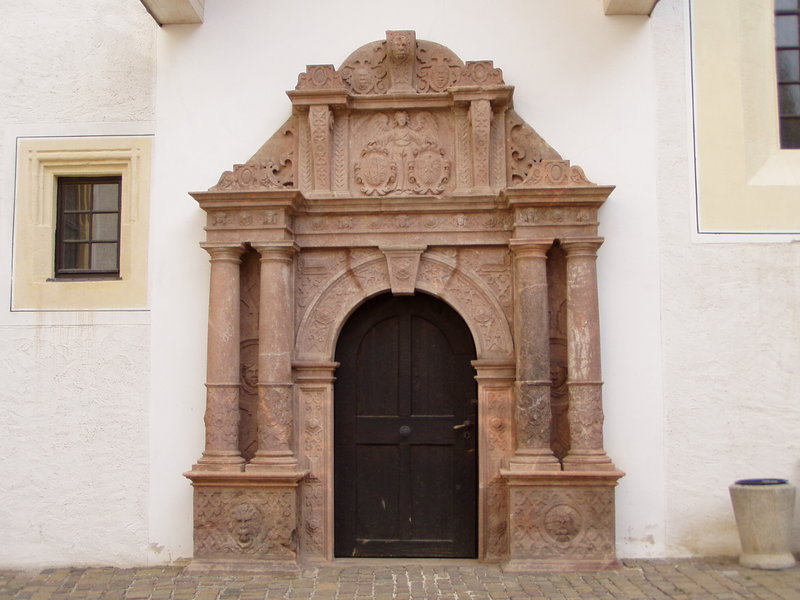
A "dropped keystone" is one where the keystone projects lower than the other voussoirs. Following Giulio Romano, Mannerist architects of the 16th century often designed arches with enlarged and slightly dropped keystones, as in the "church house" entrance portal at Colditz Castle. Numerous examples are found in the work of Sebastiano Serlio, a 16th-century Italian Mannerist architect.
Metaphor
Keystone is often used metaphorically for an essential part on which the whole depends or as an acme of the whole.
In Christianity, Psalms 118:22, translated in the Authorized Version as "The stone which the builders refused is become the head stone of the corner", is taken to refer to Jesus.
The Commonwealth of Pennsylvania calls itself the "Keystone State", because during early American history, it held a crucial central position among the Thirteen Colonies geographically, economically, and politically, like the keystone in an arch. A keystone is a symbol of Pennsylvania, being used in the logos of many Commonwealth government departments, state route signs, and on license plates, and the Shoulder Sleeve Insignia of the Pennsylvania National Guard's 28th Infantry Division (United States), a Red Keystone, first adopted during World War I in October 1918.
Referring to the Book of Mormon, Joseph Smith said that it "was the most correct of any book on earth, and the keystone of our religion, and a man would get nearer to God by abiding by its precepts, than by any other book." Ezra Taft Benson, the 13th president of the Church of Jesus Christ of Latter-day Saints, said it "is my prayer that the Book of Mormon may become the keystone of our lives."
Gallery
Image:8500 - Milano - Palazzo Borgazzi (1829) - Dettaglio - Foto Giovanni Dall'Orto, 31-Aug-2007.jpg|Keystone from the palazzo Borgazzi (Milan, Italy) File:Barcelona. Generalitat Palace. Door to Carrer del Bisbe. C. 1638. Pere Pau Ferrer, architect. (18966422650) (cropped).jpg|Keystone much enlarged for decorative effect, and carrying a coat of arms, Barcelona Image:Chapter House ceiling (crop 1).jpg|The York Minster Chapter House rib-vault ceiling with central and peripheral keystones File:Middle keystone in the Chapel of St. Anne in Malbork showing Jesus Christ.jpg|A boss depicting Jesus Christ decorates the keystone in the rib-vaulting at Chapel of St. Anne in Malbork, 14th century. Image:Toulouse Cathedral - Keystone 1.jpg|Bossed keystone in the ceiling of an apse chapel (Toulouse Cathedral) Image:Spain Andalusia Cordoba BW 2015-10-27 13-54-14.jpg|Horseshoe arches with equal-size voussoirs and keystones, Mosque–Cathedral of Córdoba, Spain 1993-1994-Giardino Giusti (Verona)-testo e photo Paolo Villa-nA2-tesi Accademia Belle Arti Bologna-portone di Palazzo Giusti.jpg|Main entrance Giusti's Palace Keystone, with rustic quoins and face of man File:Bonn-Oberkassel Alte Evangelische Kirche Schlussstein.jpg|Dropped keystone on a German church File:München-Altstadt Rumfordstraße 23 490.jpg|Doors and windows with decorated keystones, Munich File:Tor der Casa di Giulio Romano.JPG|A range of plain but enlarged keystones by Giulio Romano for his house in Mantua File:Mark Master Keystone.gif|The keystone is the symbol of the Order of Mark Master Masons File:Navicular bone12.png|As a metaphor, the navicular bone, shown in green, is known as the keystone of the foot
Notes
Sources
References
- Ching, Francis D.K.. (1995). "A Visual Dictionary of Architecture". John Wiley & Sons, Inc..
- "Glossary of Medieval Art and Architecture – Keystone". [[University of Pittsburgh]].
- "keystone". Merriam Webster.
- {{Bible. Ps. 118:22
- "State Symbols". Commonwealth of Pennsylvania.
- (1908). "[[History of the Church (book)". [[Deseret News]].
- (17 August 2013). "'Keystone of our religion'". [[Church News]].
- "UpToDate".
This article was imported from Wikipedia and is available under the Creative Commons Attribution-ShareAlike 4.0 License. Content has been adapted to SurfDoc format. Original contributors can be found on the article history page.
Ask Mako anything about Keystone (architecture) — get instant answers, deeper analysis, and related topics.
Research with MakoFree with your Surf account
Create a free account to save articles, ask Mako questions, and organize your research.
Sign up freeThis content may have been generated or modified by AI. CloudSurf Software LLC is not responsible for the accuracy, completeness, or reliability of AI-generated content. Always verify important information from primary sources.
Report