From Surf Wiki (app.surf) — the open knowledge base
Key retainer
Key retention and authorized use device
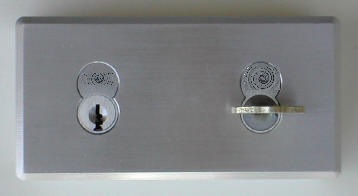
Key retention and authorized use device
Applications
These include janitorial or custodial staff, irregular or temporary users, guests and other authorized users that require access to a certain key but to whom that key is not issued directly. The KRD acts as a "mechanical sign-out sheet", physically controlling access to the key and providing accountability for its eventual return.
Operation
One key (High Level/Special) is retained in a core (at 1/4 turn) until another "release" key is inserted in the other core and rotated 90° (1/4 turn). Then the "retained" key can be removed for use while the "release" key is held (trapped) for visual accountability purposes. This cycle is repeated in reverse when the normally "retained" key is returned and the "release" key is removed "retrieved" by the authorized user.
Padlocks
The term "key retainer" can also refer to a padlock that does not allow the key to be removed when the shackle is in the open position. This prevents accidentally leaving the padlock unlocked, and it also prevents accidentally locking the key inside a locker, shed, etc.
References
"Small Format Interchangeable Cores: Advanced" ©2005 by William M. Lynk; Published by The National Publishing Company, Chicago, Illinois; pp. 212–214.
This article was imported from Wikipedia and is available under the Creative Commons Attribution-ShareAlike 4.0 License. Content has been adapted to SurfDoc format. Original contributors can be found on the article history page.
Ask Mako anything about Key retainer — get instant answers, deeper analysis, and related topics.
Research with MakoFree with your Surf account
Create a free account to save articles, ask Mako questions, and organize your research.
Sign up freeThis content may have been generated or modified by AI. CloudSurf Software LLC is not responsible for the accuracy, completeness, or reliability of AI-generated content. Always verify important information from primary sources.
Report