From Surf Wiki (app.surf) — the open knowledge base
Kerala school of astronomy and mathematics
Hindu astronomy, mathematics, science school in India
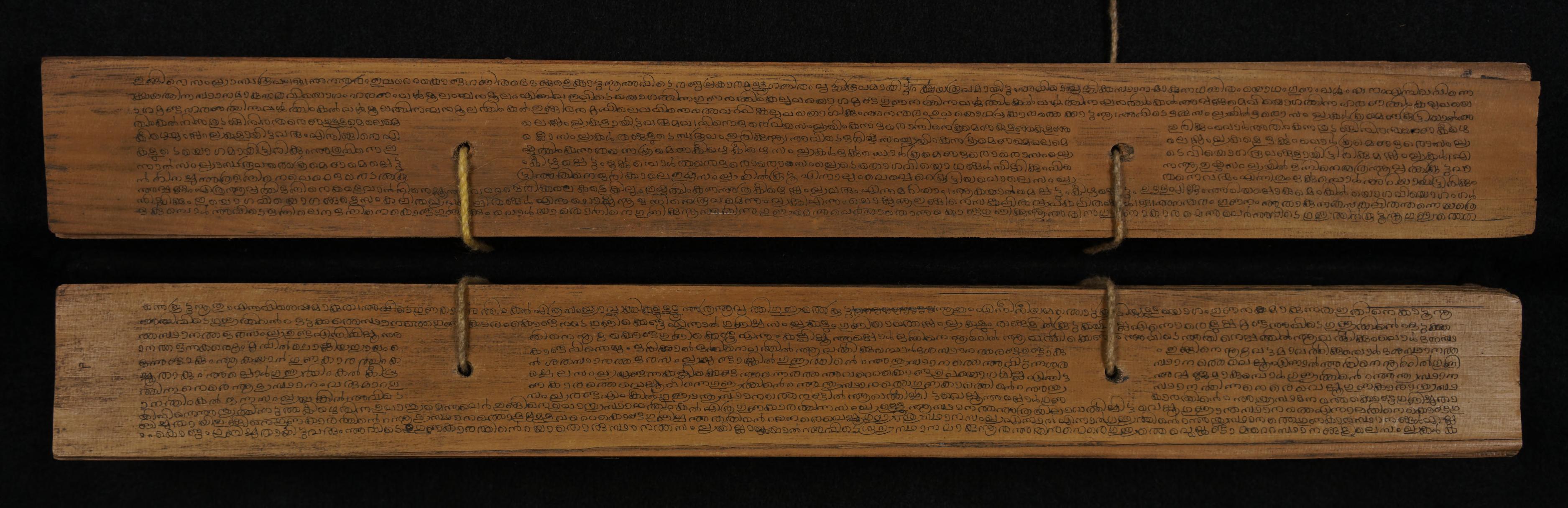
Hindu astronomy, mathematics, science school in India
| Field | Value |
|---|---|
| name | Kerala school of astronomy and mathematics |
| image | Kerala school chain of teachers.jpg |
| caption | Chain of teachers of the Kerala school |
| location | Central and Northern Kerala, India |
| coordinates | |
| other_name | |
| former_name | |
| founder | Madhava of Sangamagrama |
| type | Astronomy, Mathematics, Science |
| established | |
| gender | |
| age_range | |
| enrollment | |
| colors | |
| website |
The Kerala school of astronomy and mathematics or the Kerala school was a school of mathematics and astronomy founded by Madhava of Sangamagrama in Tirur, Malappuram, Kerala, India, which included among its members: Parameshvara, Nilakantha Somayaji, Jyeshtadeva, Achyuta Pisharati, Melpathur Narayana Bhattathiri, Achyuta Panikkar,Govinda Menon, Madhava Nair, Keshava Menon. The school flourished between the 14th and 16th centuries and its original discoveries seem to have ended with Narayana Bhattathiri (1559–1632). In attempting to solve astronomical problems, the Kerala school independently discovered a number of important mathematical concepts. Their most important results—series expansion for trigonometric functions—were described in Sanskrit verse in a book by Neelakanta called Tantrasangraha (around 1500), and again in a commentary on this work, called Tantrasangraha-vakhya, of unknown authorship. The theorems were stated without proof, but proofs for the series for sine, cosine, and inverse tangent were provided a century later in the work Yuktibhasa (), written in Malayalam, by Jyesthadeva, and also in a commentary on Tantrasangraha.
Their work, completed two centuries before the invention of calculus in Europe, provided what is now considered the first example of a power series (apart from geometric series).
Background
Islamic scholars nearly developed a general formula for finding integrals of polynomials by 1000 AD —and evidently could find such a formula for any polynomial in which they were interested. But, it appears, they were not interested in any polynomial of degree higher than four, at least in any of the material that has been found to date. Indian scholars, on the other hand, were by the year 1600 able to use formula similar to Ibn al-Haytham's sum formula for arbitrary integral powers in calculating power series for the functions in which they were interested. By the same time, they also knew how to calculate the differentials of these functions. So some of the basic ideas of calculus were known in Egypt and India many centuries before Isaac Newton. It does not appear, however, that either Islamic or Indian mathematicians saw the necessity of connecting some of the disparate ideas that we include under the name calculus. They were apparently only interested in specific cases in which these ideas were needed.
Contributions
Infinite series
The Kerala school has made a number of contributions to the fields of infinite series .These include the following infinite geometric series:
The Kerala school made intuitive use of mathematical induction, though the inductive hypothesis was not yet formulated or employed in proofs. They used this to discover a semi-rigorous proof of the result:
{p+1}}}
for large n.
They applied ideas from (what was to become) differential and integral calculus to obtain (Taylor–Maclaurin) infinite series for \sin x, \cos x, and \arctan x. The Tantrasangraha-vakhya gives the series in verse, which when translated to mathematical notation, can be written as:
where, for r = 1, the series reduce to the standard power series for these trigonometric functions, for example:
(The Kerala school did not use the "factorial" symbolism.)
The Kerala school made use of the rectification (computation of length) of the arc of a circle to give a proof of these results. (The later method of Leibniz, using quadrature (i.e. computation of area under the arc of the circle), was not yet developed.) They also made use of the series expansion of \arctan x to obtain an infinite series expression (later known as Gregory series) for \pi:
Their rational approximation of the error for the finite sum of their series are of particular interest. For example, the error, f_i(n+1), (for n odd, and i = 1, 2, 3) for the series:
They manipulated the terms, using the partial fraction expansion of :\frac{1}{n^3-n} to obtain a more rapidly converging series for \pi:
They used the improved series to derive a rational expression, though the notion of a function, or of exponential or logarithmic functions, was not yet formulated.
Recognition
In 1825 John Warren published a memoir on the division of time in southern India, called the Kala Sankalita, which briefly mentions the discovery of infinite series by Kerala astronomers.
The works of the Kerala school were first written up for the Western world by Englishman C. M. Whish in 1835. According to Whish, the Kerala mathematicians had "laid the foundation for a complete system of fluxions" and these works abounded "with fluxional forms and series to be found in no work of foreign countries". However, Whish's results were almost completely neglected until over a century later, when the discoveries of the Kerala school were investigated again by C. T. Rajagopal and his associates. Their work includes commentaries on the proofs of the arctan series in Yuktibhasa given in two papers, a commentary on the Yuktibhasas proof of the sine and cosine series and two papers that provide the Sanskrit verses of the Tantrasangrahavakhya for the series for arctan, sine, and cosine (with English translation and commentary).
In 1972 K. V. Sarma published his A History of the Kerala School of Hindu Astronomy which described features of the School such as the continuity of knowledge transmission from the 13th to the 17th century: Govinda Bhattathiri to Parameshvara to Damodara to Nilakantha Somayaji to Jyesthadeva to Acyuta Pisarati. Transmission from teacher to pupil conserved knowledge in "a practical, demonstrative discipline like astronomy at a time when there was not a proliferation of printed books and public schools."
In 1994 it was argued that the heliocentric model had been adopted about 1500 A.D. in Kerala.
Possible transmission of Kerala school results to Europe
A. K. Bag suggested in 1979 that knowledge of these results might have been transmitted to Europe through the trade route from Kerala by traders and Jesuit missionaries. Kerala was in continuous contact with China and Arabia, and Europe. The suggestion of some communication routes and a chronology by some scholars According to David Bressoud, "there is no evidence that the Indian work of series was known beyond India, or even outside of Kerala, until the nineteenth century". V. J. Katz notes some of the ideas of the Kerala school have similarities to the work of 11th-century Iraqi scholar Ibn al-Haytham,
Both Indian and Arab scholars made discoveries before the 17th century that are now considered a part of calculus. According to Katz, they were yet to "combine many differing ideas under the two unifying themes of the derivative and the integral, show the connection between the two, and turn calculus into the great problem-solving tool we have today", like Newton and Leibniz. The intellectual careers of both Newton and Leibniz are well documented and there is no indication of their work not being their own; however, it is not known with certainty whether the immediate predecessors of Newton and Leibniz, "including, in particular, Fermat and Roberval, learned of some of the ideas of the Islamic and Indian mathematicians through sources of which we are not now aware". This is an active area of current research, especially in the manuscript collections of Spain and Maghreb, research that is now being pursued, among other places, at the Centre national de la recherche scientifique in Paris.
Notes
References
--
- {{Citation
- Gupta, R. C. (1969) "Second Order of Interpolation of Indian Mathematics", Indian Journal of History of Science 4: 92-94
- {{Citation | editor1-last=Grattan-Guinness | editor1-first=Ivor
- {{Citation | url-access=registration
- {{Citation
- Parameswaran, S. (1992) "Whish's showroom revisited", Mathematical Gazette 76, no. 475 pages 28–36
- {{Citation | doi-access=free
- {{Citation | doi-access=free
- {{Citation | editor1-last=Katz | editor1-first=Victor J. | publication-date=2007
- C. K. Raju. 'Computers, mathematics education, and the alternative epistemology of the calculus in the Yuktibhâsâ', Philosophy East and West 51, University of Hawaii Press, 2001.
- {{Citation
- {{Citation
- {{Citation
- Tacchi Venturi. 'Letter by Matteo Ricci to Petri Maffei on 1 Dec 1581', Matteo Ricci S.I., Le Lettre Dalla Cina 1580–1610, vol. 2, Macerata, 1613.
References
- Roy, Ranjan. 1990. "Discovery of the Series Formula for \pi by Leibniz, Gregory, and Nilakantha." ''Mathematics Magazine'' (Mathematical Association of America) 63(5):291–306.
- {{Harv. Stillwell. 2004
- {{Harv. Bressoud. 2002
- {{Harvnb. Plofker. 2001
- {{Harvnb. Pingree. 1992
- {{Harvnb. Katz. 1995
- (1936). "On the Use of Series in Hindu Mathematics". Osiris.
- 104348/33215 for \pi correct up to nine decimal places, i.e. 3.141592653. They made use of an intuitive notion of a [[Limit (mathematics). link. (8 December 2023 ) ''Mathematics Magazine'' (Mathematical Association of America), 68(3):163-174.)
- John Warren (1825) [https://books.google.com/books?id=nttCAAAAcAAJ A Collection of Memoirs on Various Modes According to which Nations of the Southern Part of India Divide Time] from [[Google Books]]
- Whish, Charles M.. (1835). "XXXIII. On the Hindú Quadrature of the Circle, and the infinite Series of the proportion of the circumference to the diameter exhibited in the four S'ástras, the Tantra Sangraham, the Yucti Bháshá, Carana Padhati, and Sadratnamáka". Transactions of the Royal Asiatic Society.
- (1949). "A Neglected Chapter of Hindu Mathematics". Scripta Mathematica.
- (1951). "On the Hindu proof of Gregory's series". Scripta Mathematica.
- (1949). "The sine and cosine power series in Hindu mathematics". Journal of the Royal Asiatic Society of Bengal (Science).
- (1977). "On an untapped source of medieval Keralese mathematics". Archive for History of Exact Sciences.
- (1986). "On Medieval Kerala Mathematics". Archive for History of Exact Sciences.
- K. Ramasubramanian, M. D. Srinivas & M. S. Sriram (1994) [https://web.archive.org/web/20101223145939/http://www.physics.iitm.ac.in/~labs/amp/kerala-astronomy.pdf Modification of the earlier Indian planetary theory by the Kerala astronomers (c. 1500 A.D.) and the implied heliocentric picture of planetary motion], ''[[Current Science]]'' [https://www.currentscience.ac.in/show.issue.php?volume=66&issue=10 '''66''' (10)]: 784–90
- A. K. Bag (1979) ''Mathematics in ancient and medieval India''. Varanasi/Delhi: Chaukhambha Orientalia. page 285.
- (2001). "Computers, Mathematics Education, and the Alternative Epistemology of the Calculus in the Yuktibhasa". Philosophy East and West.
- (2001). "Keralese Mathematics: Its Possible Transmission to Europe and the Consequential Educational Implications". Journal of Natural Geometry.
- (1991). "A hitherto unknown Sanskrit work concerning Madhava's derivation of the power series for sine and cosine". Historia Scientiarum.
- suggesting a possible transmission of ideas from [[Islamic mathematics]] to Kerala.{{Harvnb. Katz. 1995
This article was imported from Wikipedia and is available under the Creative Commons Attribution-ShareAlike 4.0 License. Content has been adapted to SurfDoc format. Original contributors can be found on the article history page.
Ask Mako anything about Kerala school of astronomy and mathematics — get instant answers, deeper analysis, and related topics.
Research with MakoFree with your Surf account
Create a free account to save articles, ask Mako questions, and organize your research.
Sign up freeThis content may have been generated or modified by AI. CloudSurf Software LLC is not responsible for the accuracy, completeness, or reliability of AI-generated content. Always verify important information from primary sources.
Report