From Surf Wiki (app.surf) — the open knowledge base
Kenilworth Road
Football stadium in Luton, Bedfordshire, England
Football stadium in Luton, Bedfordshire, England
| Field | Value | |
|---|---|---|
| name | Kenilworth Road | |
| nickname | The Kenny | |
| image | [[File:Luton Town FC - geograph.org.uk - 1407783.jpg | 270px]] |
| caption | The pitch at the Kenilworth Road Stadium | |
| coordinates | ||
| fullname | Kenilworth Road Stadium | |
| location | 1 Maple Road East | |
| Bury Park | ||
| Luton LU4 8AW | ||
| Bedfordshire | ||
| England | ||
| built | 1905 | |
| opened | 1905 | |
| renovated | 2023–present | |
| owner | Luton Borough Council | |
| operator | Luton Town | |
| surface | Grass | |
| seating_capacity | 12,056 | |
| tenants | Luton Town (1905–present) | |
| dimensions | 110 x |
Bury Park Luton LU4 8AW Bedfordshire England
Kenilworth Road, known affectionately as The Kenny, is a football stadium in the area of Bury Park, Luton, Bedfordshire, England. It has been the home ground of Luton Town Football Club since 1905. The stadium has also hosted women's and youth international matches, including the second leg of the 1984 European Competition for Women's Football final.
The 12,000 all-seater stadium is situated in the district of Bury Park, one mile (1.6 km) west of the centre of Luton. It is named after the road which runs along one end of it, though its official address is 1 Maple Road. Kenilworth Road hosted football in the Southern League until 1920, then in the Football League until 2009, when Luton were relegated to the Conference Premier. It has hosted Football League matches once more since 2014. With Luton Town's promotion to the Premier League in 2023, the first Premier League game at Kenilworth Road was against West Ham United in September 2023.
Floodlights were fitted in 1953, and the ground became all-seated in 1991. The record attendance of 30,069 was set in 1959, in an FA Cup sixth round replay against Blackpool. The ground is known for the unusual entrance to the Oak Road End, and the five-season ban on away supporters that Luton Town imposed following a riot by visiting fans in 1985.
History
Luton Town moved to Kenilworth Road in 1905, leaving their previous home at Dunstable Road after their landlord sold the site for housing at short notice.{{cite book
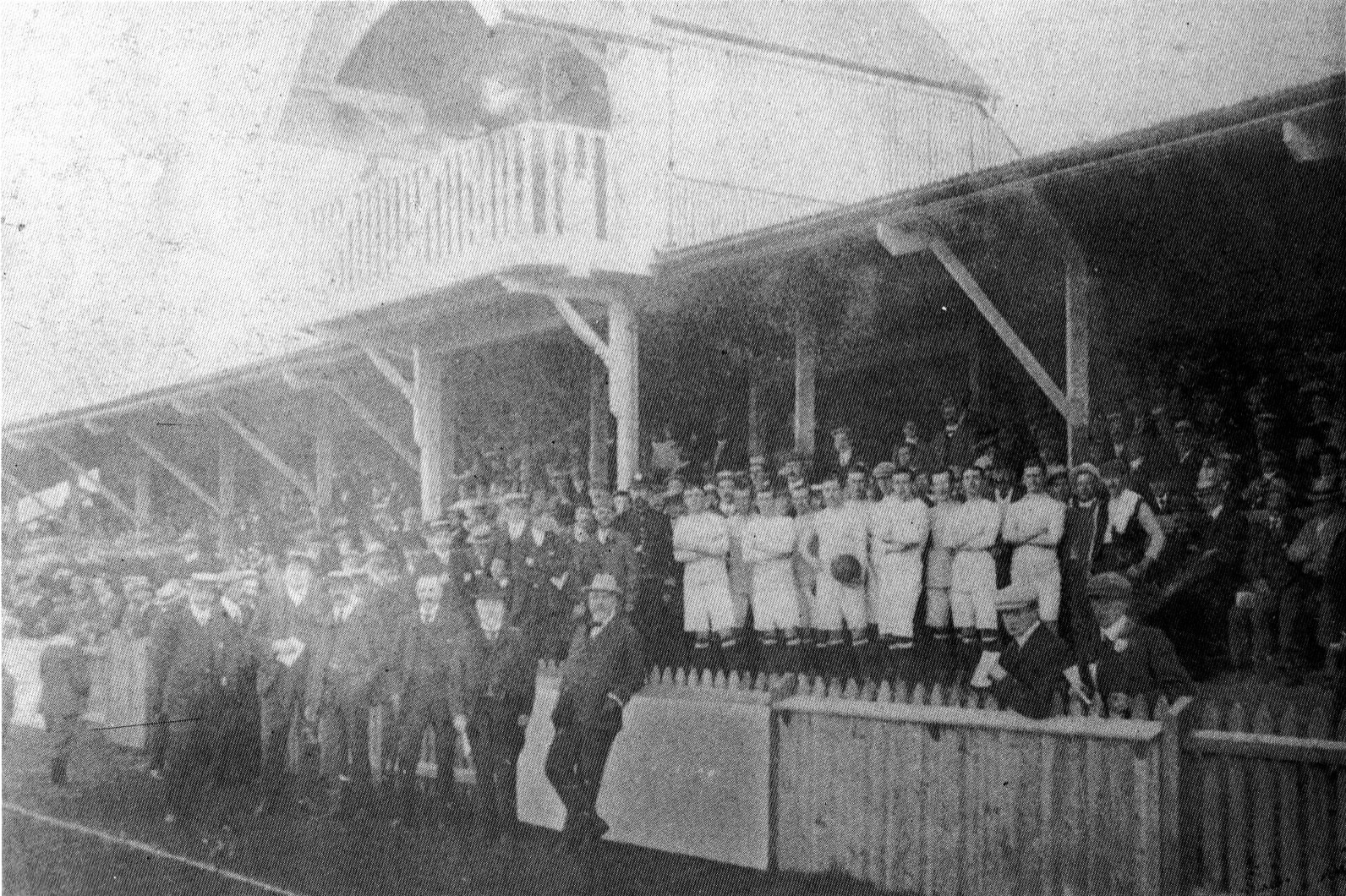
The ground has undergone several major changes since its original construction in 1905. The original Main Stand, boasting a press loft and a balcony above the roof, burnt down in 1921,{{cite book
When attendances were first counted, in the 1932–33 season, Luton Town's average home attendance was taken at 5,868.{{cite book
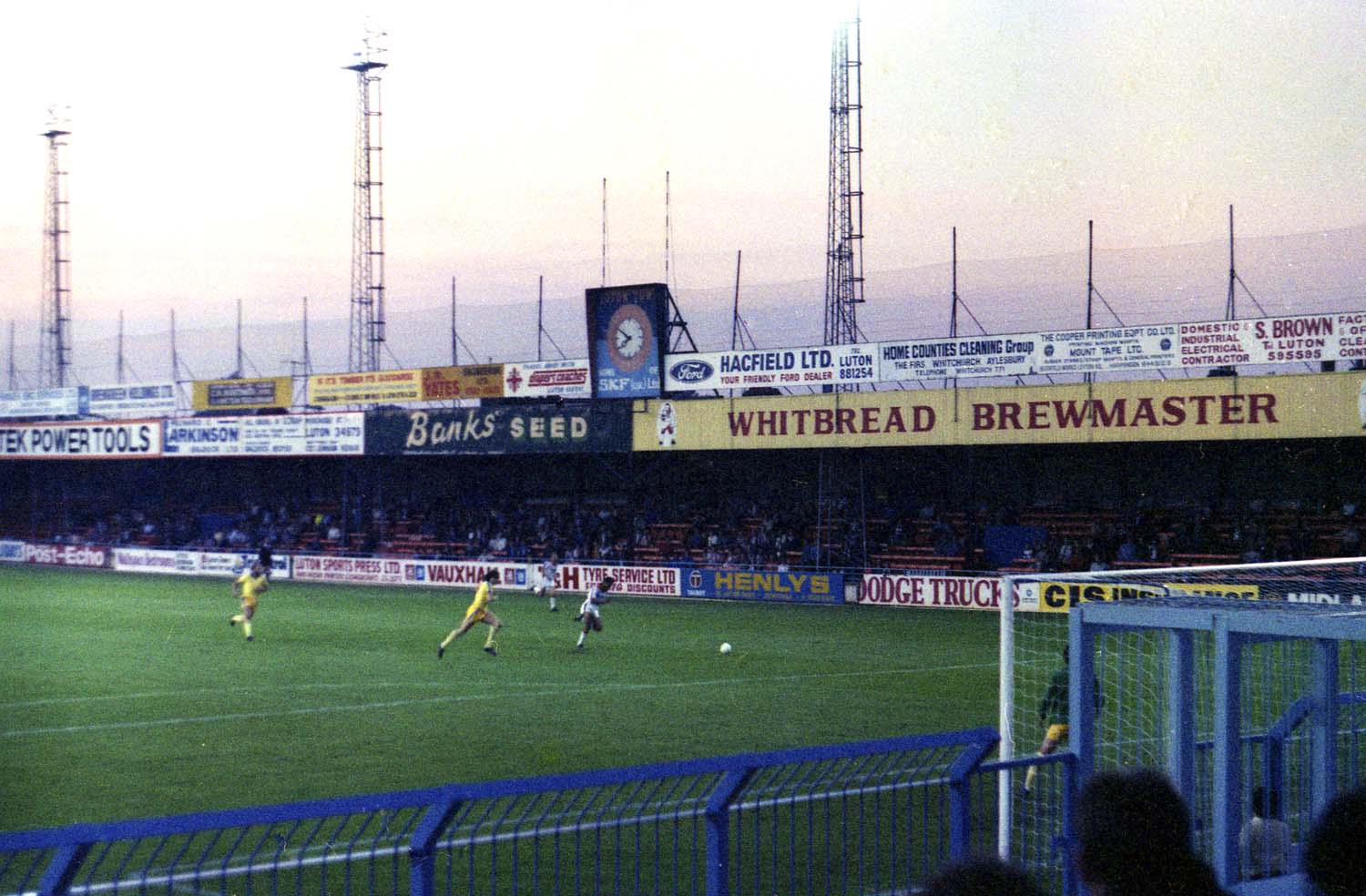
The first ten years following Kenilworth Road's renovation saw average attendances of between 15,000 and 18,000; a huge improvement on what the club had previously been able to attract. Floodlights were installed at the ground before the 1953–54 season, and used for the first time in a friendly against Turkish side Fenerbahçe on 7 October 1953.{{cite book The Oak Road terrace was extended in 1955, and promotion to the First Division for 1955–56 saw the average attendance climb as high as 21,454.{{cite book
Renovation of Kenilworth Road was neglected for the next two decades—financial difficulties and the club's ambitions to build a new ground meant that regeneration was unaffordable, and would also prove unnecessary should relocation occur. However, following the rejection of several potential sites for a new ground, the club finally turned their attentions back to the maintenance of Kenilworth Road. The first real modernisation of the ground came in 1973, with the first addition of seats at the stadium since the construction of the new Main Stand in 1922. The Bobbers Stand became all-seated, while the rest of the ground remained terracing. The new look stand could hold only 1,539 seats, and as a result the capacity of the ground dropped to 22,601.
A £1 million refurbishment got underway in 1985 with the introduction of an artificial turf playing surface, as well as the conversion of the ground to become all-seated, which began a year later in 1986. The Oak Road End terrace was filled with seats, while the Bobbers Stand had its seats ripped out to be replaced with executive boxes. The Main Stand's terraced enclosure received seats, and work also began on converting the Kenilworth Stand, which had a roof added to it at this time and would also receive seats in stages over the coming years. |access-date=2009-05-08 |url-status=dead |archive-url=https://web.archive.org/web/20090620235507/http://www.lutontown.co.uk/page/KenilworthStadium/0%2C%2C10372%2C00.html |archive-date=20 June 2009
The David Preece Stand was erected in 1991, simply called the New Stand on construction. The most recent improvements to the ground came in 2005, when the conversion of the Kenilworth Stand was finally completed to bring the capacity to 10,356.
On 24 March 2015 the ground was officially renamed "The Prostate Cancer UK Stadium" for one day, for the game against Wycombe Wanderers, in support of charity and raising awareness of prostate cancer.{{cite news | access-date = 2015-03-24 | archive-date = 24 September 2015 | archive-url = https://web.archive.org/web/20150924222430/http://www.bbc.com/sport/0/football/31944432 | url-status = live
Artificial pitch
In 1985, following the lead of Queen Park Rangers' experiment at Loftus Road four years earlier, the grass pitch was dug up and replaced with an artificial playing surface. The surface, called Sporturf Professional, was manufactured by En-Tout-Cas, and cost the club £350,000. The first match on the new pitch resulted in a 1–1 draw with Nottingham Forest.{{cite book | archive-date = 25 March 2012 | archive-url = https://web.archive.org/web/20120325002307/http://www.liverpooldailypost.co.uk/sport/liverpool-football/2009/04/17/sean-mcguire-unlucky-luton-a-reminder-of-football-s-forgotten-days-92534-23405017/ | url-status = dead | access-date = 2008-03-26}}
Away fan ban
Main article: 1985 Kenilworth Road riot
On 13 March 1985, Millwall visited Kenilworth Road for an FA Cup sixth round match. After only 14 minutes the match was halted as the visiting fans began to riot. The referee took both teams off for 25 minutes, before bringing them back on to complete the match. Following the final whistle, and a 1–0 victory for Luton, another pitch invasion and subsequent riot by away supporters caused noticeable damage to the ground and the surrounding area.{{cite news | access-date = 2009-06-01 | archive-url = https://web.archive.org/web/20070928103151/http://www.lutontoday.co.uk/545/REVENGE-FOR-MILLWALL-RIOT.284315.jp | archive-date = 28 September 2007 | url-status = dead | url-access=subscription | access-date = 2008-03-26 | archive-date = 11 April 2016 | archive-url = https://web.archive.org/web/20160411045944/http://www.japantimes.co.jp/sports/2004/05/21/sports/millwall-hopes-to-leave-dark-history-behind-in-f-a-cup-final/ | url-status = live | access-date = 2009-06-01 | archive-date = 28 September 2007 | archive-url = https://web.archive.org/web/20070928103214/http://www.lutontoday.co.uk/lut-news/Extra-cash-to-keep-soccer.577780.jp | url-status = dead
Ownership
The ground was first constructed in 1905, soon before the club moved in. The club rented the ground until 1933, when newly appointed chairman Charles Jeyes organised the purchase of the stadium. The club retained ownership of the ground until February 1989, when the freehold was sold to Luton Borough Council for £3.25 million.{{cite book | access-date = 2009-05-11 | archive-date = 3 October 2008 | archive-url = https://web.archive.org/web/20081003235720/http://www2.luton.gov.uk/localplan/written/cpt6.htm | url-status = dead |access-date = 2010-01-14 |url-status = dead |archive-url = https://web.archive.org/web/20100116135020/http://www.lutontown.co.uk/page/NewsDetail/0%2C%2C10372~1931642%2C00.html |archive-date = 16 January 2010
Structure and facilities

The ground is made up of five stands—opposite the eponymous Kenilworth Stand is the Oak Road End, and to the left is the Main Stand, which is flanked to its right by the David Preece Stand. Opposite them is the Bobbers Stand.
The Main Stand covers approximately two-thirds of the length of the pitch, though the attached enclosure is longer, covering the whole distance. The Main Stand, which seats 4,277 fans, also contains the dressing rooms, club offices and television gantry, as well as a number of supporting pillars, a car park and the Nick Owen and Eric Morecambe suites. To the Main Stand's right, in the corner above the end of the enclosure and next to the Kenilworth Stand, is the David Preece Stand, a family area which seats 711 spectators. The David Preece Stand acquired its present name in 2008, a year after the former player's death.
Opposite the Main and Preece Stands is the Bobbers Stand. In 1986, the original Bobbers was rebuilt, with the seats removed and replaced with 25 executive boxes.
To the right of the Main Stand is the 3,229-seater Kenilworth Stand, which backs onto Kenilworth Road. The Club Shop is behind this stand, which was once an open terrace but is now a roofed all-seater stand. In the corner between the Kenilworth Stand and the boxes is the stadium clock.
Opposite the Kenilworth Stand is the Oak Road End, which bears an electronic scoreboard on its roof and can seat a maximum of 1,800 fans.{{cite journal | access-date = 2009-05-20}} Originally a home section, the Oak Road End was turned into a stand for away fans only at the start of the 1991–92 season. Early in the 2013–14 season, the Oak Road End was re-opened for home supporters for fixtures where visiting support was predicted to be especially low, with the section for away fans moved to A Block of the Kenilworth Stand for these games.{{cite news | access-date = 4 October 2013 | archive-date = 30 September 2013 | archive-url = https://web.archive.org/web/20130930194129/http://www.lutontoday.co.uk/sport/luton-town/hatters-to-open-oak-road-for-home-supporters-1-5533609 | url-status = dead | access-date = 26 February 2013 | archive-date = 8 March 2014 | archive-url = https://web.archive.org/web/20140308203144/http://www.lutontown.co.uk/news/article/oak-road-2502-1383000.aspx | url-status = live |access-date = 2009-04-11 |url-status = dead |archive-url = https://web.archive.org/web/20110711020247/http://www.footballgroundguide.com/luton_town/fans_review2.htm |archive-date = 11 July 2011
Moving and redevelopment plans
Luton Town have been looking for a new ground since 1955, when club chairman Percy Mitchell spoke of building a stadium "to hold 35,000 in comfort ... [and] get a lot of support which goes to London at the moment". However, due to unstable finances and an inability to find a site, no ground was built.{{cite book The club proposed a move to Milton Keynes in 1982, according to The Luton News, to play as "MK Hatters" in an indoor "super-stadium". Despite consistent fan opposition to the idea, relocation up the M1 motorway to the new town was raised several more times over the next two decades; for example, the Football League later refused Luton permission to move to Milton Keynes in 2000, saying that a member club was not allowed to leave its home town.{{cite web | access-date = 2009-11-01 | archive-url = https://web.archive.org/web/20080704200226/http://www.wsc.co.uk/content/view/591/29/ | archive-date = 4 July 2008 | url-status = dead
The first time Luton managed to get as far as a planning application for a new ground was when chairman David Kohler's Kohlerdome was proposed in 1995. The Kohlerdome was envisioned by Kohler as a 20,000 all-seater indoor arena with a retractable roof and pitch, hosting 85 capacity events each year. Kohler's plans, though ambitious, were perhaps not very realistic, and the plans were turned down by the Secretary of State in 1998, with the reason given that the ground was not feasible unless the M1 motorway was widened. Kohler put the club on the market upon the plan's rejection and after a period under Cliff Bassett, the club came under the control of Mike Watson-Challis in 2000. Watson-Challis bought 55 acre of land by Junction 10 of the M1 in 2001, intending to move the club there, but once again, nothing came of the scheme.{{cite web | access-date = 2009-05-20 | archive-date = 27 July 2011 | archive-url = https://web.archive.org/web/20110727132306/http://agendas.luton.gov.uk/cmiswebpublic/Binary.ashx?Document=3796 | url-status = live | access-date = 2009-05-11 | archive-date = 20 September 2021 | archive-url = https://web.archive.org/web/20210920022927/http://news.bbc.co.uk/sport1/hi/football/teams/l/luton_town/1194646.stm | url-status = live |access-date = 2009-04-11 |url-status = dead |archive-url = https://archive.today/20130114012650/http://www.ldexpress.co.uk/ldexpress-sport-lutontownfc/displayarticle.asp?id=302524 |archive-date = 14 January 2013 |access-date = 2009-04-11 |url-status = dead |archive-url = https://web.archive.org/web/20080803090424/http://www.lutontown.co.uk/page/Stadium/ |archive-date = 3 August 2008
By 2012, the club was undertaking an independent feasibility study to determine a viable location to move to. Sites mooted included a ground built as part of a new housing development to the west of Luton and a site by the proposed Junction 11A of the M1, which is the preferred site of the local authorities. Luton Town did not rule out staying at a redeveloped Kenilworth Road, entering talks to buy the stadium back from the council in October 2012, but by mid-2015 these plans had been dropped in favour of a move to a new location. Managing director Gary Sweet confirmed that the club was in a position to "buy land, secure the best possible professional advice ... and to see the [planning] application process through to the receipt of consent."
Planning permission for this ground, with potential to expand to 23,000 seats, was granted by Luton Borough Council on 16 January 2019.
2023–24 redevelopment

Following the club’s promotion, for the first time to the Premier League in May 2023, they embarked on a £10m work programme to construct a new stand to meet broadcast and media requirements in readiness for the 2023–24 season. On 14 July 2023, the club announced that there was uncertainty that this would be completed in time for their planned first home fixture of the season, against Burnley on 19 August and consequently this match was postponed. On 25 July, Luton Borough Council agreed to pay £400,000 towards upgrading CCTV, construction and widening of steps at Beech End road near the Bobbers Stand. Following redevelopment of the Bobbers Stand, the club announced that their EFL Cup game against Gillingham on 29 August 2023 would be a test event to ensure safety compliance for the stand before their first Premier League game, against West Ham United on 1 September. The stand would operate at 75% capacity with tickets distributed for free to displaced hospitality guests. The first full operation of the stand, for a Premier League game was on 1 September as Luton lost 2–1 to West Ham.
On 1 March 2024, work was completed on the installation of safe standing in the Oak Road stand which increased the stadium's capacity by 800. The club plans to install additional safe standing in the Enclosure.
Other uses
Kenilworth Road has been used occasionally by the England women's team. The inaugural UEFA Women's Championship in 1984 saw Kenilworth Road play host to the second leg of the Final against Sweden, won by Sweden on penalties. The most recent use of the stadium by the women's team was a 4–2 victory over Spain on 22 March 2001.{{cite news | access-date = 2009-05-11 | access-date = 2009-05-11 | archive-date = 2 August 2020 | archive-url = https://web.archive.org/web/20200802081158/http://news.bbc.co.uk/sport2/hi/in_depth/2001/womens_euro_2001/1396709.stm | url-status = live
The ground is home to the Hatters Study Support Centre, which provides local school pupils with ICT equipment, football training and lessons in numeracy and literacy.{{cite web |access-date = 2009-05-21 |access-date = 2009-05-11 |url-status = dead |archive-url = https://web.archive.org/web/20090316064028/http://www.london-luton.co.uk/en/news/5/79/pirton-hill-junior-school-wins-airport%27s-under-9s-football-tournament.html?arc=5%2F2008 |archive-date = 16 March 2009 |access-date = 2009-05-11 |url-status = dead |archive-url = https://web.archive.org/web/20090516060931/http://www.bedfordshire.police.uk/onlinenews/2009/may/050509_kick_knife_crime.html |archive-date = 16 May 2009
On 23 March 2024, Hashtag United F.C. Women defeated Newcastle United W.F.C. 2–1 at Kenilworth Road in the FA Women's National League Cup final.
Records

The highest attendance record at this stadium was 30,069 against Blackpool in the FA Cup on 4 March 1959. The highest attendance in the Football League was 27,911 against Wolverhampton Wanderers in Division One on 5 November 1955.{{cite book
The highest seasonal average for Luton at Kenilworth Road was 21,455 in the 1955–56 season. Luton's lowest seasonal average was 5,527 in 1998–99.
Transport
: The ground is located about half a mile away from Luton railway station, which lies on the Midland Main Line. Thameslink operate trains north to Bedford and south via London St Pancras to Brighton. East Midlands Railway operate trains north to Nottingham and Sheffield, and south to London St Pancras. Many of the roads near the ground are for residential permit holders only, meaning car parking at the ground is notoriously difficult.{{cite web |access-date = 2009-05-10 |url-status = dead |archive-url = https://web.archive.org/web/20110519181654/http://www.footballgroundguide.com/luton_town/ |archive-date = 19 May 2011 | access-date = 2009-05-21 | archive-date = 27 July 2011 | archive-url = https://web.archive.org/web/20110727094905/http://www.arrivabus.co.uk/content.aspx?id=5515 | url-status = live |access-date = 2009-05-21 |url-status = dead |archive-url = https://web.archive.org/web/20090310085644/http://www.lutontown.co.uk/page/HowtoGetHere/0,,10372,00.html |archive-date = 10 March 2009 | archive-url = https://archive.today/20130419194026/http://www.bedfordtoday.co.uk/dunstable-news/Green-light-for-LutonDunstable-Busway.4431611.jp | url-status = dead | archive-date = 19 April 2013 | access-date = 2009-05-22
References
Notes
Bibliography
- {{cite book
- {{cite book
- {{cite book
- {{cite book
References
- Kelly, Ryan. (1 September 2023). "Inside Luton Town's stadium Kenilworth Road: Capacity, famous away end & everything you need to know". GOAL.
- "Getting to Kenilworth Road". Luton Town F.C..
- Lawton, Graham. (4 June 2005). "Pitch battle over artificial grass".
- . (1 September 2023). ["Luton's Kenilworth Road stadium ready for Premier League action"](https://www.premierleague.com/news/3659886).
- Culley, Jon. (3 September 1983). "What City missed...". [[Leicester Mercury]].
- (June 2005). "Luton Town 1 MK Dons 0". When Saturday Comes.
- "Chapter 9 – Action Areas". Luton Borough Council.
- (1 October 2012). "Luton Town FC in talks to buy back Kenilworth Road". BBC.
- (19 April 2015). "Hatters' new stadium location to be revealed soon". Johnston Publishing Ltd.
- (February 2019). "Luton Town announce proposals for 17,500 seater town centre stadium on Power Court". Local World.
- (16 January 2019). "Power Court: Luton Town football stadium gains planning permission". BBC Sport.
- (14 July 2023). "Luton's first Premier League home game postponed".
- Duncan, Euan. (24 July 2023). "Council agree to put £400,000 towards Luton Town stadium improvement works".
- Holland, Kris. (28 August 2023). "Luton: Premier League side confirm Bobbers Stand test event".
- Yew, Oliver. (1 September 2023). "Luton Town 1–2 West Ham: Hammers spoil Kenilworth Road homecoming to go top of the Premier League".
- "Safe standing installation complete in the Oak". Luton Town Football Club.
- "Hashtag United win FA WNL Cup".
- "Luton Town all time records". Soccerbase.
- "Premier League – Average Attendances – Home Matches – 2023-2024".
This article was imported from Wikipedia and is available under the Creative Commons Attribution-ShareAlike 4.0 License. Content has been adapted to SurfDoc format. Original contributors can be found on the article history page.
Ask Mako anything about Kenilworth Road — get instant answers, deeper analysis, and related topics.
Research with MakoFree with your Surf account
Create a free account to save articles, ask Mako questions, and organize your research.
Sign up freeThis content may have been generated or modified by AI. CloudSurf Software LLC is not responsible for the accuracy, completeness, or reliability of AI-generated content. Always verify important information from primary sources.
Report