From Surf Wiki (app.surf) — the open knowledge base
Kendrick mass
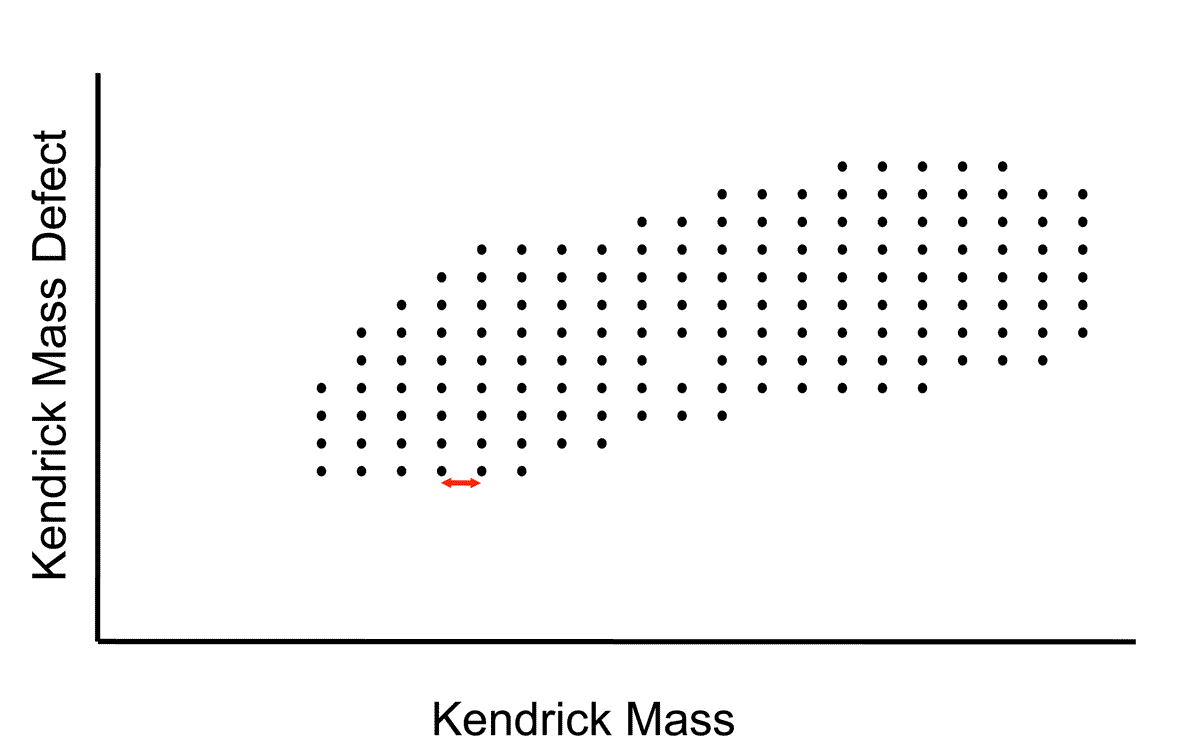
The Kendrick mass is defined by setting the mass of a chosen molecular fragment, typically CH2, to an integer value in Da (dalton). It is different from the IUPAC definition, which is based on setting the mass of 12C isotope to exactly 12 u. The Kendrick mass is often used to identify homologous compounds differing only by a number of base units in high resolution mass spectra. This definition of mass was first suggested in 1963 by chemist Edward Kendrick, and it has been adopted by scientists working in the area of high-resolution mass spectrometry, environmental analysis, proteomics, petroleomics, metabolomics, polymer analysis, etc.
Definition
According to the procedure outlined by Kendrick, the mass of CH2 is defined as exactly 14 Da, instead of the IUPAC mass of 14.01565 Da.
To convert an IUPAC mass of a particular compound to the Kendrick mass, the equation : \text{Kendrick mass} = \text{IUPAC mass} \times \frac{14.00000}{14.01565} is used. The mass in dalton units (Da) can be converted to the Kendrick scale by dividing by 1.0011178.
Other groups of atoms in addition to CH2 can be used define the Kendrick mass, for example CO2, H2, H2O, and O. In this case, the Kendrick mass for a family of compounds F is given by : \text{Kendrick mass (F)} = \text{(observed mass)} \times \frac{\text{nominal mass (F)}}{\text{exact mass (F)}}.
For the hydrocarbon analysis, F=CH2.
As an example, Kendrick analysis has been used for visualizing families of halogenated compounds of environmental interest that differ only by the number of chlorine, bromine or fluorine substitutions.
It has been suggested that Kendrick mass be expressed in Kendrick units with symbol Ke.
Kendrick mass defect
The Kendrick mass defect is defined as the exact Kendrick mass subtracted from the nominal (integer) Kendrick mass: : \text{Kendrick mass defect}= \text{nominal Kendrick mass} - \text{Kendrick mass}
In recent years the equation has changed due to rounding errors to: : \text{Kendrick mass defect}= \text{nominal mass} - \text{Kendrick exact mass}
The members of an alkylation series have the same degree of unsaturation and number of heteroatoms (nitrogen, oxygen and sulfur) but differ in the number of CH2 units. Members of an alkylation series have the same Kendrick mass defect.
The Kendrick mass defect has also been defined as : \text{Kendrick mass defect}= (\text{nominal Kendrick mass} - \text{Kendrick mass}) \times 1{,}000 .
The abbreviations KM and KMD have been used for Kendrick mass and Kendrick mass defect, respectively.
Kendrick mass analysis
In a Kendrick mass analysis, the Kendrick mass defect is plotted as function of nominal Kendrick mass for ions observed in a mass spectrum. Ions of the same family, for example the members of an alkylation series, have the same Kendrick mass defect but different nominal Kendrick mass and are positioned along a horizontal line on the plot. If the composition of one ion in the family can be determined, the composition of the other ions can be inferred. Horizontal lines of different Kendrick mass defect correspond to ions of different composition, for example degree of saturation or heteroatom content.
A Kendrick mass analysis is often used in conjunction with a Van Krevelen diagram, a two- or three- dimensional graphical analysis in which the elemental composition of the compounds are plotted according to the atomic ratios H/C, O/C, or N/C.
Kendrick mass defect analysis of polymers and alternative base units
Because Kendrick mass defect analysis can be carried out by substituting any repeating unit for CH2, KMD analysis is particularly useful for the visualizing the data from polymer mass spectra. For example, a Kendrick mass defect plot of an ethylene oxide/propylene oxide copolymer can be created by using ethylene oxide (C2H4O) as the base unit and calculating the Kendrick mass as: : \text{Kendrick mass} = \text{IUPAC mass} \times \frac{44.00000}{44.02621} where 44.02621 is the calculated IUPAC mass for C2H4O. Alternatively, a KMD plot can be constructed for the same copolymer by using propylene oxide as the base unit.
Polymer mass spectra containing multiple charge ions exhibit isotopic splitting.
Fractional base units and referenced KMD plots
Kendrick mass defect plots created by using fractional base units exhibit enhanced resolution. Referenced Kendrick mass defect plots (KMD plots referenced to the terminal group and adduct composition) with fractional base units can be used to obtain an overview of copolymer composition.
Notes
References
- Kendrick, Edward. (1963). "A mass scale based on CH2 = 14.00000 for high resolution mass spectrometry of organic compounds". [[Anal. Chem.]].
- (January 2004). "Petroleomics: the next grand challenge for chemical analysis". [[Acc. Chem. Res.]].
- (2014-08-05). "Characterization of Naphthenic Acids by Gas Chromatography-Fourier Transform Ion Cyclotron Resonance Mass Spectrometry". Analytical Chemistry.
- (2015). "Non-targeted analysis of electronics waste by comprehensive two-dimensional gas chromatography combined with high-resolution mass spectrometry: Using accurate mass information and mass defect analysis to explore the data". Journal of Chromatography A.
- (2014-04-01). "Using mass defect plots as a discovery tool to identify novel fluoropolymer thermal decomposition products". Journal of Mass Spectrometry.
- (2013-04-01). "The use of mass defect plots for the identification of (novel) halogenated contaminants in the environment". Analytical and Bioanalytical Chemistry.
- (2007). "Advanced Instrumental Approaches for Characterization of Marine Dissolved Organic Matter: Extraction Techniques, Mass Spectrometry, and Nuclear Magnetic Resonance Spectroscopy". Chemical Reviews.
- (2006). "Mathematical tools in analytical mass spectrometry". Analytical and Bioanalytical Chemistry.
- (2009). "Mass spectrometric characterization of naphthenic acids in environmental samples: A review". Mass Spectrometry Reviews.
- (2010). "Application of Fourier-transform ion cyclotron resonance mass spectrometry to metabolic profiling and metabolite identification". Current Opinion in Biotechnology.
- (2009). "Determination of molecular formulas of natural organic matter molecules by (ultra-) high-resolution mass spectrometryStatus and needs". Journal of Chromatography A.
- (2007). "Mass-spectrometric analysis of complex volatile and nonvolatile crude oil components: a challenge". Analytical and Bioanalytical Chemistry.
- (2003). "Graphical Method for Analysis of Ultrahigh-Resolution Broadband Mass Spectra of Natural Organic Matter, the Van Krevelen Diagram". Analytical Chemistry.
- (2011). "Molecular chemistry of organic aerosols through the application of high resolution mass spectrometry". Physical Chemistry Chemical Physics.
- (2010). "A high-resolution mass spectrometer to measure atmospheric ion composition". Atmospheric Measurement Techniques.
- (October 2001). "Kendrick mass defect spectrum: a compact visual analysis for ultrahigh-resolution broadband mass spectra". [[Anal. Chem.]].
- (2008). "Mass Spectrometry Special Feature: Petroleomics: Chemistry of the underworld". Proceedings of the National Academy of Sciences.
- (2007). "Mass-spectrometric analysis of complex volatile and nonvolatile crude oil components: a challenge". Analytical and Bioanalytical Chemistry.
- (2009). "Determination of molecular formulas of natural organic matter molecules by (ultra-) high-resolution mass spectrometry Status and needs". Journal of Chromatography A.
- (2004). "Two- and Three-Dimensional van Krevelen Diagrams: A Graphical Analysis Complementary to the Kendrick Mass Plot for Sorting Elemental Compositions of Complex Organic Mixtures Based on Ultrahigh-Resolution Broadband Fourier Transform Ion Cyclotron Resonance Mass Measurements". Analytical Chemistry.
- (2014-08-01). "Structural Characterization of Polymers by MALDI Spiral-TOF Mass Spectrometry Combined with Kendrick Mass Defect Analysis". Journal of the American Society for Mass Spectrometry.
- (2016-04-15). "MALDI SpiralTOF high-resolution mass spectrometry and Kendrick mass defect analysis applied to the characterization of poly(ethylene-co-vinyl acetate) copolymers". Rapid Communications in Mass Spectrometry.
- (2017). "Paper spray and Kendrick mass defect analysis of block and random ethylene oxide/propylene oxide copolymers". Analytica Chimica Acta.
- (2017-03-07). "Extension of the Kendrick Mass Defect Analysis of Homopolymers to Low Resolution and High Mass Range Mass Spectra Using Fractional Base Units". Analytical Chemistry.
- (2017-09-01). "Capabilities of the remainders of nominal Kendrick masses and the referenced Kendrick mass defects for copolymer ions". Journal of Mass Spectrometry.
This article was imported from Wikipedia and is available under the Creative Commons Attribution-ShareAlike 4.0 License. Content has been adapted to SurfDoc format. Original contributors can be found on the article history page.
Ask Mako anything about Kendrick mass — get instant answers, deeper analysis, and related topics.
Research with MakoFree with your Surf account
Create a free account to save articles, ask Mako questions, and organize your research.
Sign up freeThis content may have been generated or modified by AI. CloudSurf Software LLC is not responsible for the accuracy, completeness, or reliability of AI-generated content. Always verify important information from primary sources.
Report