From Surf Wiki (app.surf) — the open knowledge base
Kelvin functions
_in_the_complex_plane_from_-2-2i_to_2+2i_with_colors_created_with_Mathematica_13.1_function_ComplexPlot3D.svg)
In applied mathematics, the Kelvin functions berν(x) and beiν(x) are the real and imaginary parts, respectively, of
:J_\nu \left (x e^{\frac{3 \pi i}{4}} \right ),,
where x is real, and Jν(z), is the νth order Bessel function of the first kind. Similarly, the functions kerν(x) and keiν(x) are the real and imaginary parts, respectively, of
:e^{-\nu\pi i/2}K_\nu \left (x e^{\frac{\pi i}{4}} \right ),,
where Kν(z) is the νth order modified Bessel function of the second kind.
These functions are named after William Thomson, 1st Baron Kelvin.
While the Kelvin functions are defined as the real and imaginary parts of Bessel functions with x taken to be real, the functions can be analytically continued for complex arguments {{math|xe**iφ, 0 ≤ φ n(x) and bein(x) for integral n, the Kelvin functions have a branch point at x = 0.
Below, Γ(z) is the gamma function and ψ(z) is the digamma function.
ber(''x'')
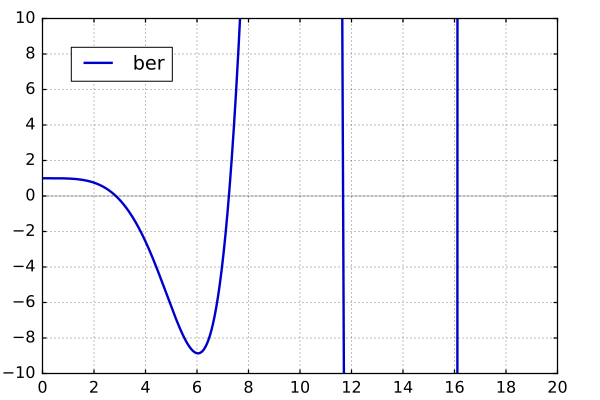

For integers n, bern(x) has the series expansion
:\mathrm{ber}n(x) = \left(\frac{x}{2}\right)^n \sum{k \geq 0} \frac{\cos\left[\left(\frac{3n}{4} + \frac{k}{2}\right)\pi\right]}{k! \Gamma(n + k + 1)} \left(\frac{x^2}{4}\right)^k ,
where Γ(z) is the gamma function. The special case ber0(x), commonly denoted as just ber(x), has the series expansion
:\mathrm{ber}(x) = 1 + \sum_{k \geq 1} \frac{(-1)^k}{[(2k)!]^2} \left(\frac{x}{2} \right )^{4k}
and asymptotic series
:\mathrm{ber}(x) \sim \frac{e^{\frac{x}{\sqrt{2}}}}{\sqrt{2 \pi x}} \left (f_1(x) \cos \alpha + g_1(x) \sin \alpha \right ) - \frac{\mathrm{kei}(x)}{\pi},
where
:\alpha = \frac{x}{\sqrt{2}} - \frac{\pi}{8}, :f_1(x) = 1 + \sum_{k \geq 1} \frac{\cos(k \pi / 4)}{k! (8x)^k} \prod_{l = 1}^k (2l - 1)^2 :g_1(x) = \sum_{k \geq 1} \frac{\sin(k \pi / 4)}{k! (8x)^k} \prod_{l = 1}^k (2l - 1)^2 .
_in_the_complex_plane_from_-2-2i_to_2+2i_with_colors_created_with_Mathematica_13.1_function_ComplexPlot3D.svg)
bei(''x'')


For integers n, bein(x) has the series expansion
:\mathrm{bei}n(x) = \left(\frac{x}{2}\right)^n \sum{k \geq 0} \frac{\sin\left[\left(\frac{3n}{4} + \frac{k}{2}\right)\pi\right]}{k! \Gamma(n + k + 1)} \left(\frac{x^2}{4}\right)^k .
The special case bei0(x), commonly denoted as just bei(x), has the series expansion
:[[File:Plot of the Kelvin function ker(z) in the complex plane from -2-2i to 2+2i with colors created with Mathematica 13.1 function ComplexPlot3D.svg|alt=Plot of the Kelvin function ker(z) in the complex plane from -2-2i to 2+2i with colors created with Mathematica 13.1 function ComplexPlot3D|thumb|Plot of the Kelvin function ker(z) in the complex plane from -2-2i to 2+2i with colors created with Mathematica 13.1 function ComplexPlot3D]]\mathrm{bei}(x) = \sum_{k \geq 0} \frac{(-1)^k }{[(2k+1)!]^2} \left(\frac{x}{2} \right )^{4k+2}
and asymptotic series
:\mathrm{bei}(x) \sim \frac{e^{\frac{x}{\sqrt{2}}}}{\sqrt{2 \pi x}} [f_1(x) \sin \alpha - g_1(x) \cos \alpha] - \frac{\mathrm{ker}(x)}{\pi},
where α, f_1(x), and g_1(x) are defined as for ber(x).
ker(''x'')


For integers n, kern(x) has the (complicated) series expansion
:\begin{align} &\mathrm{ker}_n(x) = - \ln\left(\frac{x}{2}\right) \mathrm{ber}n(x) + \frac{\pi}{4}\mathrm{bei}n(x) \ &+ \frac{1}{2} \left(\frac{x}{2}\right)^{-n} \sum{k=0}^{n-1} \cos\left[\left(\frac{3n}{4} + \frac{k}{2}\right)\pi\right] \frac{(n-k-1)!}{k!} \left(\frac{x^2}{4}\right)^k \ &+ \frac{1}{2} \left(\frac{x}{2}\right)^n \sum{k \geq 0} \cos\left[\left(\frac{3n}{4} + \frac{k}{2}\right)\pi\right] \frac{\psi(k+1) + \psi(n + k + 1)}{k! (n+k)!} \left(\frac{x^2}{4}\right)^k . \end{align}[[File:Plot of the Kelvin function kei(z) in the complex plane from -2-2i to 2+2i with colors created with Mathematica 13.1 function ComplexPlot3D.svg|alt=Plot of the Kelvin function kei(z) in the complex plane from -2-2i to 2+2i with colors created with Mathematica 13.1 function ComplexPlot3D|thumb|Plot of the Kelvin function kei(z) in the complex plane from -2-2i to 2+2i with colors created with Mathematica 13.1 function ComplexPlot3D]]
The special case ker0(x), commonly denoted as just ker(x), has the series expansion
:\mathrm{ker}(x) = -\ln\left(\frac{x}{2}\right) \mathrm{ber}(x) + \frac{\pi}{4}\mathrm{bei}(x) + \sum_{k \geq 0} (-1)^k \frac{\psi(2k + 1)}{[(2k)!]^2} \left(\frac{x^2}{4}\right)^{2k}
and the asymptotic series
:\mathrm{ker}(x) \sim \sqrt{\frac{\pi}{2x}} e^{-\frac{x}{\sqrt{2}}} [f_2(x) \cos \beta + g_2(x) \sin \beta],
where
:\beta = \frac{x}{\sqrt{2}} + \frac{\pi}{8}, :f_2(x) = 1 + \sum_{k \geq 1} (-1)^k \frac{\cos(k \pi / 4)}{k! (8x)^k} \prod_{l = 1}^k (2l - 1)^2 :g_2(x) = \sum_{k \geq 1} (-1)^k \frac{\sin(k \pi / 4)}{k! (8x)^k} \prod_{l = 1}^k (2l - 1)^2.
kei(''x'')


For integer n, kein(x) has the series expansion
:\begin{align} &\mathrm{kei}_n(x) = - \ln\left(\frac{x}{2}\right) \mathrm{bei}n(x) - \frac{\pi}{4}\mathrm{ber}n(x) \ &-\frac{1}{2} \left(\frac{x}{2}\right)^{-n} \sum{k=0}^{n-1} \sin\left[\left(\frac{3n}{4} + \frac{k}{2}\right)\pi\right] \frac{(n-k-1)!}{k!} \left(\frac{x^2}{4}\right)^k \ &+ \frac{1}{2} \left(\frac{x}{2}\right)^n \sum{k \geq 0} \sin\left[\left(\frac{3n}{4} + \frac{k}{2}\right)\pi\right] \frac{\psi(k+1) + \psi(n + k + 1)}{k! (n+k)!} \left(\frac{x^2}{4}\right)^k . \end{align}
The special case kei0(x), commonly denoted as just kei(x), has the series expansion
:\mathrm{kei}(x) = -\ln\left(\frac{x}{2}\right) \mathrm{bei}(x) - \frac{\pi}{4}\mathrm{ber}(x) + \sum_{k \geq 0} (-1)^k \frac{\psi(2k + 2)}{[(2k+1)!]^2} \left(\frac{x^2}{4}\right)^{2k+1}
and the asymptotic series
:\mathrm{kei}(x) \sim -\sqrt{\frac{\pi}{2x}} e^{-\frac{x}{\sqrt{2}}} [f_2(x) \sin \beta + g_2(x) \cos \beta],
where β, f2(x), and g2(x) are defined as for ker(x).
References
This article was imported from Wikipedia and is available under the Creative Commons Attribution-ShareAlike 4.0 License. Content has been adapted to SurfDoc format. Original contributors can be found on the article history page.
Ask Mako anything about Kelvin functions — get instant answers, deeper analysis, and related topics.
Research with MakoFree with your Surf account
Create a free account to save articles, ask Mako questions, and organize your research.
Sign up freeThis content may have been generated or modified by AI. CloudSurf Software LLC is not responsible for the accuracy, completeness, or reliability of AI-generated content. Always verify important information from primary sources.
Report