From Surf Wiki (app.surf) — the open knowledge base
Kefir
Fermented milk drink made from kefir grains

Fermented milk drink made from kefir grains
| Field | Value |
|---|---|
| name | Kefir |
| image | Kefir in a glass.JPG |
| image_size | 175px |
| caption | Plain milk kefir being poured |
| alternate_name | Milk kefir, gıpı ayran, qundəps, búlgaros |
| main_ingredient | Milk and kefir grains |
Kefir ( ; alternative spellings: kephir or kefier) is a fermented milk drink similar to a thin yogurt or ayran that is made from kefir grains, a specific type of mesophilic symbiotic culture. It is prepared by inoculating the milk of cows, goats, or sheep with kefir grains.
Kefir is a common breakfast, lunch or dinner drink consumed in countries of West Asia and Eastern Europe. Kefir is consumed at any time of the day, alongside European pastries like zelnik (zeljanica), burek and banitsa/gibanica, and is an ingredient in cold soups.
Origin and etymology
Kefir has been found in graves in the Bronze Age Xiaohe Cemetery, dating back 3,600 years.
The word kefir, which is of North Caucasian origin, became an international word, having originally spread to Russia, Central European and Eastern European countries at least by 1884.
A Russian borrowing in English, its ultimate origin is unknown, though one theory is that the word comes from köpür in Old Turkic. More likely is another Caucasian origin; compare Georgian კეფირი (k'epiri), Mingrelian ქიფური (kipuri), Ossetian къӕпы (k'æpy), and Karachay-Balkar гыпы (gıpı).
Traditional kefir was made in goatskin bags that were hung near a doorway; the bags would be knocked by anyone passing through to keep the milk and kefir grains well mixed. In Karachay-Balkar, gıpı has a connection with gıpıt (wineskin). It was under the name wineskin that Karachay kefir was distributed in the second half of the 19th century and at the beginning of the 20th century. Kefir spread from the former Soviet Union to the rest of Europe, Canada, Japan, and the United States by the early 21st century. It has become known in parts of Latin America as búlgaros, or "Bulgarians".
Fermentation and kefir grain formation

Traditional kefir is fermented at ambient temperatures, generally overnight. Fermentation of the lactose yields a sour, carbonated, slightly alcoholic beverage, with a consistency and taste similar to drinkable yogurt.
The kefir grains initiating the fermentation are initially created by auto-aggregations of Lactobacillus kefiranofaciens and Maudiozyma turicensis or M. humilis, where multiple biofilm producers cause the surfaces to adhere which form a three dimensional microcolony. The biofilm is a matrix of heteropolysaccharides called kefiran, which is composed of equal proportions of glucose and galactose. It resembles small cauliflower grains, with color ranging from white to creamy yellow. A complex and highly variable symbiotic community can be found in these grains, which can include acetic acid bacteria (such as Acetobacter aceti and Acetobacter rasens), yeasts (such as Candida kefyr, K. lactis, K. marxianus*,* Saccharomyces cerevisiae, M. turicensis) and a number of Lactobacillus species, such as L. parakefiri, L. kefiranofaciens (and subsp. kefirgranum), L. kefiri, L. brevis*,* etc. While some microbes predominate, Lactobacillus species are always present. The microbe flora can vary between batches of kefir due to factors such as the kefir grains rising out of the milk while fermenting or curds forming around the grains, as well as temperature. Additionally, Tibetan kefir composition differs from that of the Russian kefir, Irish kefir, Taiwan kefir and Turkey fermented beverage with kefir. In recent years, the use of freeze-dried starter culture has become common due to stability of the fermentation result, because the species of microbes are selected in laboratory conditions, as well as easy transportation.
During fermentation, changes in the composition of ingredients occur. Lactose, the sugar present in milk, is broken down mostly to lactic acid by the lactic acid bacteria, which results in acidification. Propionibacteria further break down some of the lactic acid into propionic acid (these bacteria also carry out the same fermentation in Swiss cheese). Other substances that contribute to the flavor of kefir are pyruvic acid, acetic acid, diacetyl and acetoin (both of which contribute a "buttery" flavor), citric acid, acetaldehyde, and amino acids resulting from protein breakdown.
Decreased lactose content
During the fermentation process, bacteria and yeast break lactose down into glucose and galactose. As a result of the fermentation, lactose levels are decreased by 20–30% with respect to the initial lactose levels present in the milk. One study found that when people with lactose intolerance consumed the same amount of lactose in milk, kefir or yogurt products, the latter two showed significantly reduced symptoms of lactose intolerance during the first 8 hours after consumption. This result suggests that yoghurt and kefir might be suitable for people with lactose intolerance. However, the long-term impact of kefir consumption on lactose intolerance has not been studied. It has also been shown that fermented milk products have a slower transit time than milk, which may further improve lactose digestion.
Alcohol content
Kefir contains a small amount of ethanol. The level of ethanol in kefir can vary by production method. A 2016 study of kefir sold in Germany showed an ethanol level of only 0.02 g per litre, which was attributed to fermentation under controlled conditions allowing the growth of Lactobacteria only, but excluding the growth of other microorganisms that generate much higher amounts of ethanol. A 2008 study of German commercial kefir found levels of 0.002–0.005% of ethanol. Kefir produced by small-scale dairies in Russia in the early 20th century had 1–2% ethanol, but this is no longer common.
Nutrition
Plain kefir is 87% water, 7% carbohydrates, 4% protein, and 1% fat (table). In a reference amount of 100 g, kefir provides 52 calories of food energy, and contains moderate amounts (10-19% of the Daily Value, DV) of vitamin A, vitamin B12, riboflavin, and calcium (table).
Kefir contains byproducts of the fermentation process, including carbon dioxide and ethanol.
Microbiota
Probiotic bacteria found in kefir products include Lactobacillus acidophilus, Bifidobacterium bifidum, Streptococcus thermophilus, Lactobacillus delbrueckii subsp. bulgaricus, Lactobacillus helveticus, Lactobacillus kefiranofaciens, Lactococcus lactis, and Leuconostoc species. Lactobacilli in kefir may exist in concentrations varying from approximately 1 million to 1 billion colony-forming units per milliliter, and are the bacteria responsible for the synthesis of the polysaccharide kefiran.
In addition to bacteria, kefir often contains strains of yeast that can metabolize lactose, such as Kluyveromyces marxianus, Kluyveromyces lactis, and Saccharomyces fragilis, as well as strains of yeast that do not metabolize lactose, including Saccharomyces cerevisiae, Torulaspora delbrueckii, and Kazachstania unispora. The nutritional significance of these strains is not currently known with certainty.
Production
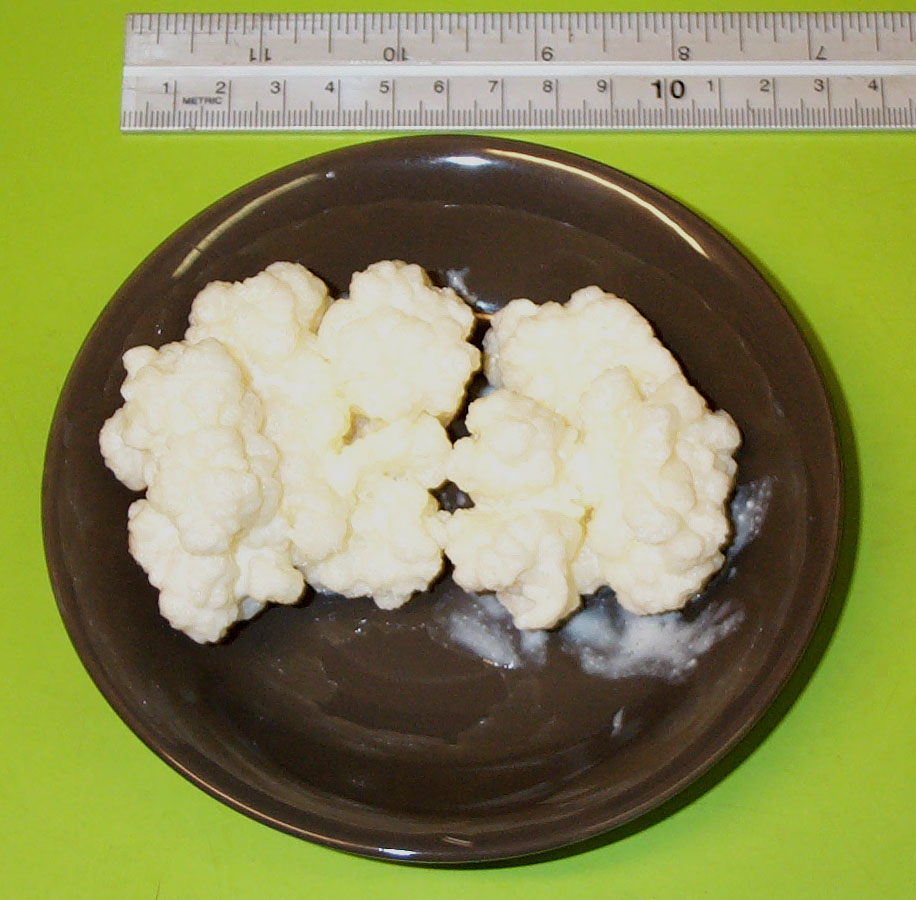

Modern kefir is made by adding kefir grains to milk typically at a proportion of 2–5% grains-to-milk. The mixture is then placed in a corrosion-resistant container, such as a glass jar, and stored preferably in the dark to prevent degradation of light-sensitive vitamins. After a period between 12 and 24 hours of fermentation at mild temperature, ideally 20 –, the grains are strained from the milk using a corrosion-resistant (stainless steel or plastic) utensil and kept to produce another batch. During the fermentation process the grains enlarge and eventually split forming new units.
The resulting fermented liquid may be drunk, used in recipes, or kept aside in a sealed container for additional time to undergo a secondary fermentation. Because of its acidity the beverage should not be stored in reactive metal containers such as aluminium, copper, or zinc, as these may leach into it over time. The shelf life, unrefrigerated, is up to thirty days.
The Russian method permits production of kefir on a larger scale and uses two fermentations. The first step is to prepare the cultures by inoculating milk with 2–3% grains as described. The grains are then removed by filtration and 1–3% of the resulting liquid mother culture is added to milk and fermented for 12 to 18 hours.
Kefir can be made using freeze-dried cultures commonly available in powder form from health food stores. A portion of the resulting kefir can be saved to be used a number of times to propagate further fermentations but ultimately does not form grains.
In Taiwan, researchers were able to produce kefir in a laboratory using microorganisms isolated from kefir grains. They report that the resulting kefir drink had chemical properties similar to homemade kefir.
Milk types
Kefir grains will ferment the milk from most mammals and will continue to grow in such milk. Typical animal milks used include cow, goat, and sheep, each with varying organoleptic (flavor, aroma, and texture) and nutritional qualities. Raw milk has been traditionally used.
Milk sugar is not essential for the synthesis of the polysaccharide that makes up the grains (kefiran), and rice hydrolysate is a suitable alternative medium. Additionally, kefir grains will reproduce when fermenting soy milk, although they will change in appearance and size due to the differing proteins available to them.
A different type of SCOBY that thrives in sugary water also exists, called water kefir (or tibicos), and can vary markedly from milk kefir in both appearance and microbial composition.
Culinary
.jpg)
As it contains Lactobacillus bacteria, kefir can be used to make a sourdough starter. It is also useful as a buttermilk substitute in baking. Kefir is one of the main ingredients in cold borscht soup in Lithuania, also known in Poland as Lithuanian cold soup (chłodnik litewski), and other countries. The kefir-based soup okroshka is common across the former Soviet Union. Kefir may be used in place of milk on cereal, granola, milkshakes, salad dressing, ice cream, smoothies and soup.
In Estonia, kefir is also often mixed with kama and eaten as a snack or a quick breakfast.
References
Informational notes
Citations
Further reading
References
- [https://web.archive.org/web/20120720192208/http://oxforddictionaries.com/definition/english/kefir "kefir"]. Oxford Dictionaries.
- [http://dictionary.reference.com/browse/kefir kefir] {{Webarchive. link. (25 February 2011 . dictionary.reference.com)
- (October 2013). "A review on traditional Turkish fermented non-alcoholic beverages: microbiota, fermentation process and quality characteristics". International Journal of Food Microbiology.
- (2024). "Bronze Age cheese reveals human-Lactobacillus interactions over evolutionary history". Cell.
- (30 October 2015). "Milk kefir: composition, microbial cultures, biological activities, and related products". Frontiers in Microbiology.
- (27 April 2023). "Origin of KEFIR". Merriam-Webster Dictionary Online.
- "Kefir dictionary definition | kefir defined".
- (2008). "Prescott, Harley, and Klein's Microbiology". McGraw–Hill.
- Ibragim Shamanov. (26 April 2006). "Milk. How much there is in this word...". Elbrusoid.
- (2014). "Karachays. Balkars". .Institute of Ethnology and Anthropology. N.N. Miklouho-Maclay RAS. Science.
- (September 2015). "Kefir Consumption—a Growing Culture". International Milk Genomics Consortium.
- (26 November 2014). "A review: chemical, microbiological and nutritional characteristics of kefir". CyTA – Journal of Food.
- (1997). "Cheese and Fermented Milk Foods". FV Kowsikowski.
- (30 June 2024). "Saccharomycetaceae: delineation of fungal genera based on phylogenomic analyses, genomic relatedness indices and genomics-based synapomorphies". Persoonia – Molecular Phylogeny and Evolution of Fungi.
- (2004-12-01). "Screening of Dairy Yeast Strains for Probiotic Applications". Journal of Dairy Science.
- (December 2012). "Investigation of microorganisms involved in biosynthesis of the kefir grain". Food Microbiology.
- (September 1999). "Description of Saccharomyces turicensis sp. nov., a new species from kefyr". Systematic and Applied Microbiology.
- (2019). "Kazachstania turicensis CAU Y1706 ameliorates atopic dermatitis by regulation of the gut–skin axis". Journal of Dairy Science.
- (March 2004). "Reclassification of Lactobacillus kefirgranum Takizawa et al. 1994 as Lactobacillus kefiranofaciens subsp. kefirgranum subsp. nov. and emended description of L. kefiranofaciens Fujisawa et al. 1988". International Journal of Systematic and Evolutionary Microbiology.
- (August 2018). "Draft Genome Sequence of Lactobacillus kefiri SGL 13, a Potential Probiotic Strain Isolated from Kefir Grains". Microbiology Resource Announcements.
- Pidoux, M.. (1989-06-01). "The microbial flora of sugary kefir grain (the gingerbeer plant): biosynthesis of the grain fromLactobacillus hilgardii producing a polysaccharide gel". MIRCEN Journal of Applied Microbiology and Biotechnology.
- (October 2013). "Microbiological, technological and therapeutic properties of kefir: a natural probiotic beverage". Brazilian Journal of Microbiology.
- (2005). "Variability of the microbial abundance of kefir grain starter cultivated in partially controlled conditions". Biotechnologie, Agronomie, Société et Environnement.
- (September 2006). "Evaluation of freeze-dried kefir coculture as starter in feta-type cheese production". Applied and Environmental Microbiology.
- (31 October 2014). "Microbial diversity of a Camembert-type cheese using freeze-dried Tibetan kefir coculture as starter culture by culture-dependent and culture-independent methods". PLOS ONE.
- (January 2020). "Freeze-Dried Immobilized Kefir Culture in Low Alcohol Winemaking". Foods.
- Van Wyk, Jessy. (2019). "Chapter 12 – Kefir: The Champagne of Fermented Beverages". Fermented Beverages.
- (June 2017). "Milk kefir: nutritional, microbiological and health benefits". Nutrition Research Reviews.
- (1 May 2005). "Microbiological, physicochemical, and sensory characteristics of kefir during storage". Food Chemistry.
- (1 May 2003). "Kefir improves lactose digestion and tolerance in adults with lactose maldigestion". Journal of the American Dietetic Association.
- (2005). "Kefir – a complex probiotic". Food Science and Technology Bulletin: Functional Foods.
- (April 2014). "Microbial species diversity, community dynamics, and metabolite kinetics of water kefir fermentation". Applied and Environmental Microbiology.
- (September 2016). "Estimates of Ethanol Exposure in Children from Food not Labeled as Alcohol-Containing". Journal of Analytical Toxicology.
- (2008). "Handbook of fermented functional foods". CRC Press.
- (2013). "Kefir and health: a contemporary perspective". Critical Reviews in Food Science and Nutrition.
- (March 2011). "Review: functional properties of kefir". Critical Reviews in Food Science and Nutrition.
- (4 April 2005). "Kefir-a complex probiotic". Food Science and Technology Bulletin: Functional Foods.
- (1997). "Kefir production in Iran". World Journal of Microbiology and Biotechnology.
- Saloff-Coste, Cathy J.. (2002). "Section Fabrication of kefir".
- (July 2009). "Microbiological and chemical properties of kefir manufactured by entrapped microorganisms isolated from kefir grains". Journal of Dairy Science.
- (August 2004). "Structural characterization and biological activities of an exopolysaccharide kefiran produced by Lactobacillus kefiranofaciens WT-2B(T)". Journal of Agricultural and Food Chemistry.
- (May 1999). "Characterization of kefir grains grown in cows' milk and in soya milk". The Journal of Dairy Research.
- (2021). "A comparison of milk kefir and water kefir: Physical, chemical, microbiological and functional properties". Trends in Food Science & Technology.
- Zak, Zuza. (2021). "Amber & Rye: A Baltic Food Journey". [[Interlink Books]].
- Zak, Zuza. (2021). "Amber & Rye: A Baltic Food Journey". [[Interlink Books]].
This article was imported from Wikipedia and is available under the Creative Commons Attribution-ShareAlike 4.0 License. Content has been adapted to SurfDoc format. Original contributors can be found on the article history page.
Ask Mako anything about Kefir — get instant answers, deeper analysis, and related topics.
Research with MakoFree with your Surf account
Create a free account to save articles, ask Mako questions, and organize your research.
Sign up freeThis content may have been generated or modified by AI. CloudSurf Software LLC is not responsible for the accuracy, completeness, or reliability of AI-generated content. Always verify important information from primary sources.
Report