From Surf Wiki (app.surf) — the open knowledge base
Keeling Curve
Graph of atmospheric CO2 from 1958 to the present
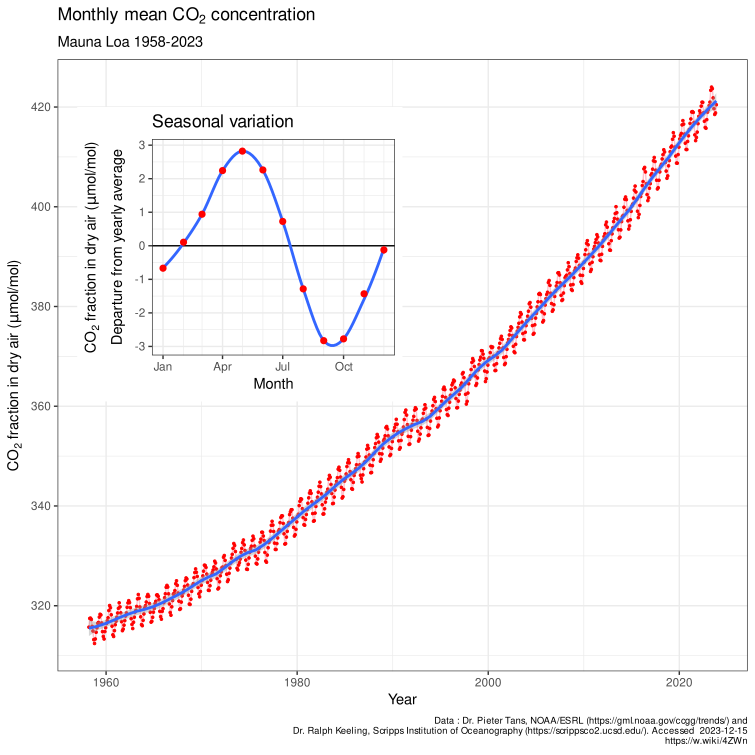
Graph of atmospheric CO2 from 1958 to the present
The Keeling Curve is a graph of the annual variation and overall accumulation of carbon dioxide in the Earth's atmosphere based on continuous measurements taken at the Mauna Loa Observatory on the island of Hawaii from 1958 to the present day. The curve is named for the scientist Charles David Keeling, who started the monitoring program and supervised it until his death in 2005.
Keeling's measurements showed the first significant evidence of rapidly increasing carbon dioxide (CO2) levels in the atmosphere. According to Naomi Oreskes, Professor of History of Science at Harvard University, the Keeling curve is one of the most important scientific works of the 20th century. Many scientists credit the Keeling curve with first bringing the world's attention to the current increase of in the atmosphere.
Background
Prior to the 1950s, measurements of atmospheric concentrations had been taken on an ad hoc basis at various locations. In 1938, engineer and amateur meteorologist Guy Stewart Callendar compared datasets of atmospheric from Kew in 1898–1901, which averaged 274 parts per million by volume (ppm), and from the eastern United States in 1936–1938, which averaged 310 ppm, and concluded that concentrations were rising due to anthropogenic emissions. However, Callendar's findings were not widely accepted by the scientific community due to the patchy nature of the measurements.
Charles David Keeling, of the Scripps Institution of Oceanography at UC San Diego, was the first person to make frequent regular measurements of atmospheric CO2 concentrations in Antarctica, and on Mauna Loa, Hawaii from March 1958 onwards. Keeling had previously tested and employed measurement techniques at locations including Big Sur near Monterey, rain forests of the Olympic Peninsula in Washington state, and high mountain forests in Arizona. He observed strong diurnal behavior of CO2, with excess CO2 at night due to respiration by plants and soils, and afternoon values representative of the "free atmosphere" over the Northern Hemisphere.
Mauna Loa measurements
![]]In 1957–1958, the [[International Geophysical Year]], Keeling obtained funding from the [[Weather Bureau]] to install [[infrared gas analyzer]]s at remote locations, including the [[South Pole]] and on the volcano of [[Mauna Loa]] on [[Hawaii (island)](https://upload.wikimedia.org/wikipedia/commons/c/c7/Mauna_Loa_Observatory_from_air.jpg)
Keeling's Tellus article of 1960 presented the first monthly records from Mauna Loa and Antarctica (1957 to 1960), finding a "distinct seasonal cycle...and possibly, a worldwide rise in from year to year." By the 1970s, it was well established that the increase of atmospheric carbon dioxide was ongoing and due to anthropogenic emissions.
Carbon dioxide measurements at the Mauna Loa Observatory in Hawaii are made with a type of infrared spectrophotometer, now known as a nondispersive infrared sensor, that is calibrated using World Meteorological Organization standards. This type of instrument, originally called a capnograph, was first invented by John Tyndall in 1864, and recorded by pen traces on a strip chart recorder. Currently, several laser-based sensors are being added to run concurrently with the infrared spectrophotometer at the Scripps Institute of Oceanography, while NOAA measurements at Mauna Loa still use the nondispersive infrared sensor.
Results and interpretation
The measurements collected at Mauna Loa Observatory show a steady increase in mean atmospheric CO2 concentration from 313 parts per million by volume (ppm) in March 1958 to 406 ppm in November 2018, with a current increase of 2.48 ± 0.26 (mean ± 2 std dev) ppm CO2 per year. This increase in atmospheric CO2 is due to the combustion of fossil fuels, and has been accelerating in recent years. Since CO2 is a greenhouse gas, this has significant implications for global warming. Measurements of CO2 concentration in ancient air bubbles trapped in polar ice cores show that mean atmospheric CO2 concentration was between 275 and 285 ppm during the Holocene epoch (9,000 BCE onwards), but started rising sharply at the beginning of the nineteenth century.
The Keeling Curve also shows a cyclic variation of about 6 ppm each year corresponding to the seasonal change in uptake of by the world's land vegetation. Most of this vegetation is in the Northern Hemisphere, where most of the land is located. From a maximum in May, the level decreases during the northern spring and summer as new plant growth takes out of the atmosphere through photosynthesis. After reaching a minimum in September, the level rises again in the northern fall and winter as plants and leaves die off and decay, releasing back into the atmosphere.
Legacy
Global monitoring
Due in part to the significance of Keeling's findings, NOAA began monitoring CO2 levels worldwide in the 1970s. Today, atmospheric CO2 levels are monitored at about 100 sites around the globe through the Global Greenhouse Gas Reference Network. Measurements at many other isolated sites have confirmed the long-term trend shown by the Keeling Curve, although no sites have as long a record as Mauna Loa.

ICOS Curve
The Integrated Carbon Observation System gathers data from 38 monitoring sites across Europe in a curve similar to the Keeling Curve. It is dubbed the "ICOS Curve". It shows an average concentration that is slightly higher than the global average, since Europe is densely populated and still emits high levels of .
Ralph Keeling
Since Charles David Keeling's death in 2005, responsibility and oversight of the project were transferred to Keeling's son, Ralph Keeling. On the fiftieth anniversary of the project's start, the younger Keeling wrote an article in Science magazine describing his father's life and work and how the project has grown and evolved over time. Along with more precise measurement materials and funds for the project of monitoring of the Earth's levels, Keeling wrote about his pride for his father's work and how he has continued it in his memory.
Recognition
In 2015, the Keeling Curve was designated a National Historic Chemical Landmark by the American Chemical Society. Commemorative plaques were installed at Mauna Loa Observatory and at the Scripps Institution of Oceanography at the University of California, San Diego.
Passing 400 ppm in 2013
On May 9, 2013, the daily mean concentration of in the atmosphere measured at Mauna Loa surpassed 400 parts per million (ppm). Estimates of during previous geologic eras suggest that has not reached this level since the mid-Pliocene, 2 to 4 million years ago. This level of carbon dioxide, causing climate change, suggests a continued worsening in natural and ecological disasters, which increasingly threatens human and animal habitats on Earth, if greenhouse gas emissions are not significantly reduced.
Keeling Plot
A Keeling Plot is a graphical representation of variations in δ13C (carbon isotope ratios) (y-axis), plotted against the inverse of concentration (1/[]) (x-axis), used to identify sources and sinks of carbon within ecosystems, for paleoclimate studies, or for carbon cycle researches.
References
References
- "The Early Keeling Curve {{!}} Scripps CO2 Program".
- (23 January 2017). "Climate Disruption". Awesome Documentaries TV.
- Nisbet, Euan. (2007). "Cinderella science". Nature.
- (1905). "On the variations in the amount of carbon dioxide in the air of Kew during the years 1898-1901". Proc. R. Soc. Lond. B.
- Callendar, Guy Stewart. (1938). "The artificial production of carbon dioxide and its influence on temperature". Quarterly Journal of the Royal Meteorological Society.
- (1998). "Historical Perspectives on Climate Change". [[Oxford University Press]].
- "The Carbon Dioxide Greenhouse Effect".
- Harris, Daniel C.. (2010). "Charles David Keeling and the Story of Atmospheric CO2 Measurements". Analytical Chemistry.
- (1998). "Rewards and Penalties of Monitoring the Earth". [[Annual Review of Energy and the Environment]].
- Keeling, Charles D.. (1960). "The concentration and isotopic abundances of carbon dioxide in the atmosphere". Tellus.
- (1965). "The Concentration of Atmospheric Carbon Dioxide in Hawaii". Journal of Geophysical Research.
- (1976). "Atmospheric carbon dioxide variations at Mauna Loa Observatory, Hawaii". Tellus.
- (March 2018). "How we measure background CO2 levels on Mauna Loa".
- (December 22, 2010). "Sampling the Air". [[The New York Times]].
- "Recent Monthly Average Mauna Loa CO2".
- Rasmussen, Carl Edward. "Atmospheric Carbon Dioxide Growth Rate".
- (1985). "Evidence from polar ice cores for the increase in atmospheric CO2 in the past two centuries". Nature.
- Keeling, Charles D. (1978). "The Influence of Mauna Loa Observatory on the Development of Atmospheric CO2 Research". In ''Mauna Loa Observatory: A 20th Anniversary Report''. (National Oceanic and Atmospheric Administration Special Report, September 1978), edited by John Miller, pp. 36–54. Boulder, CO: [[NOAA]] Environmental Research Laboratories.
- NOAA, Earth System Laboratory, US Department of Commerce Research. "ESRL Global Monitoring Division - Global Greenhouse Gas Reference Network".
- [https://scrippsco2.ucsd.edu/graphics_gallery/other_stations/global_stations_co2_concentration_trends.html Global Stations {{CO2 Concentration Trends]. Scripps CO2 Program.
- (2004). "Atmospheric CO2 from Continuous Air Samples at Mauna Loa Observatory, Hawaii, U.S.A.".
- "New ICOS Curve shows CO2 concentrations and trends over Europe {{!}} ICOS".
- "ICOS Curve".
- Keeling, Ralph F.. (2008). "Recording Earth's Vital Signs". Science.
- "Keeling Curve – American Chemical Society".
- Showstack, Randy. (2013). "Carbon dioxide tops 400 ppm at Mauna Loa, Hawaii". Eos, Transactions American Geophysical Union.
- "Son of Climate Science Pioneer Ponders A Sobering Milestone". Yale School of Forestry & Environmental Studies.
- (2006). "On the application and interpretation of Keeling plots in paleo climate research – Deciphering ''δ''13C of atmospheric CO2 measured in ice cores". Biogeosciences Discussions.
- (2003). "The application and interpretation of Keeling plots in terrestrial carbon cycle research". American Geophysical Union (AGU).
This article was imported from Wikipedia and is available under the Creative Commons Attribution-ShareAlike 4.0 License. Content has been adapted to SurfDoc format. Original contributors can be found on the article history page.
Ask Mako anything about Keeling Curve — get instant answers, deeper analysis, and related topics.
Research with MakoFree with your Surf account
Create a free account to save articles, ask Mako questions, and organize your research.
Sign up freeThis content may have been generated or modified by AI. CloudSurf Software LLC is not responsible for the accuracy, completeness, or reliability of AI-generated content. Always verify important information from primary sources.
Report