From Surf Wiki (app.surf) — the open knowledge base
Keble College, Oxford
College of University of Oxford
.jpg)
College of University of Oxford
| Field | Value | |
|---|---|---|
| name | Keble College | |
| motto | Plain living and high thinking | |
| university | University of Oxford | |
| photo | [[File:Keble College Chapel - Oct 2006.jpg | 290px]] |
| scarf | ||
| latin_name | Collegium Keblense | |
| named_for | John Keble | |
| architect | William Butterfield | |
| established | ||
| sister_college | Selwyn College, Cambridge | |
| Benjamin Franklin College, Yale | ||
| warden | Sir Michael Jacobs | |
| senior_tutor | Dr Ali Rogers | |
| chaplain | Fr Max Kramer | |
| undergraduates | 465 | |
| graduates | 550 | |
| endowment | £66.3 million (2024) | |
| location | Parks Road, Oxford OX1 3PG | |
| coordinates | ||
| location_map | Oxford (central) | |
| shield | [[File:Coat of Arms of Keble College Oxford.svg | 135px]] |
| blazon | Argent, a chevron engrailed gules, on a chief azure, three mullets pierced or | |
| homepage | ||
| JCR | ||
| MCR |
Benjamin Franklin College, Yale Keble College () is one of the constituent colleges of the University of Oxford in England. Its main buildings are on Parks Road, opposite the University Museum and the University Parks. The college is bordered to the north by Keble Road, to the south by Museum Road, and to the west by Blackhall Road.
Keble was established in 1870, having been built as a monument to John Keble, who had been a leading member of the Oxford Movement which sought to stress the catholic nature of the Church of England. Consequently, the college's original teaching focus was primarily theological, although the college now offers a broad range of subjects, reflecting the diversity of degrees offered across the wider university. In the period after the Second World War, the trends were towards scientific courses (proximity to the university science area east of the University Museum influenced this). As originally constituted, it was for men only and the fellows were mostly bachelors resident in the college. Like many of Oxford's men's colleges, Keble admitted its first mixed-sex cohort in 1979.
Keble remains distinctive for its once-controversial neo-gothic red-brick buildings designed by William Butterfield. The buildings are also notable for breaking from Oxbridge tradition by arranging rooms along corridors rather than around staircases, in order that the scouts could supervise the comings and goings of visitors (Girton College, Cambridge, similarly breaks this tradition).
Keble is one of the largest colleges of the University of Oxford, with 465 undergraduates and 550 graduate students as of 2024. Keble's sister college at the University of Cambridge is Selwyn College.
History
The best-known of Keble's Victorian founders was Edward Pusey, after whom the Pusey quad and Pusey room are named. The college itself is named after John Keble, one of Pusey's colleagues in the Oxford Movement, who died four years before the college's foundation in 1870. It was decided immediately after Keble's funeral that his memorial would be a new Oxford college bearing his name. The chosen architect was William Butterfield. Two years later, in 1868, the foundation stone was laid by the Archbishop of Canterbury on St Mark's Day (25 April, John Keble's birthday). The college first opened in 1870, taking in thirty students, whilst the chapel was opened on St Mark's Day 1876. Accordingly, the college continues to celebrate St Mark's Day each year.
Butterfield produced a notable example of Victorian Gothic architecture, among his few secular buildings, which Pevsner characterised as "actively ugly", and which, according to Charles Eastlake, defied criticism. The social historian G. M. Trevelyan expressed the then commonly held, and highly dismissive, view: "the monstrosities of architecture erected by order of the dons of Oxford and Cambridge colleges in the days of William Butterfield and Alfred Waterhouse give daily pain to posterity." Sir Kenneth Clark recalled that during his Oxford years it was generally believed in Oxford not only that Keble College was "the ugliest building in the world" but that its architect was John Ruskin, author of The Stones of Venice. The college is built of red, blue, and white bricks; the main structure is of red brick, with white and blue patterned banding. The builders were Parnell & Son of Rugby.

On its construction, Keble was not always admired within the university. Undergraduates at St John's College started the Destroy Keble Society, which aimed to dismantle the college brick by brick.
An apocryphal story claims that a French visitor, on first sight of the college exclaimed C'est magnifique mais ce n'est pas la gare? ("It is magnificent but is it not the railway station?"). This is a play on Field Marshal Pierre Bosquet's memorable line, referring to the Charge of the Light Brigade, C'est magnifique, mais ce n'est pas la guerre ("It is magnificent, but it is not war"). This story may have been borrowed from Arthur Wing Pinero's identical quip said to have been made at the opening ceremony for the Royal Courts of Justice in London.
Keble is mentioned in John Betjeman's poem "Myfanwy at Oxford", as well as in the writings of John Ruskin and in Monty Python's "Travel Agent" sketch. Horace Rumpole, the barrister in John Mortimer's books, was a Law graduate of Keble.
In 2005, Keble College featured in the national UK press when its bursar, Roger Boden, was found guilty of racial discrimination by an employment tribunal. An appeal was launched by the college and Boden against the tribunal's judgement, resulting in a financial out-of-court settlement with the aggrieved employee.
In Christmas of 2017, a team of alumni from Keble College won the Christmas University Challenge, a seasonal programme on BBC2. They beat the University of Reading by 240 points to 0 in the final, the only time a team has ever failed to score a point.
Buildings


The main site of Keble contains five quads: Liddon (the largest, named after Henry Parry Liddon), Pusey (named after Edward Bouverie Pusey), Hayward (named after Charles Hayward), De Breyne (named after Andre de Breyne) and Newman (named after John Henry Newman).
Original buildings


The best-known portion of Keble's buildings is the distinctive main brick complex, designed by Butterfield. The design remained incomplete due to shortage of funds. The Chapel and Hall were built later than the accommodation blocks to the east and west of the two original quadrangles and the warden's house at the southeast corner. The Chapel and Hall were both fully funded by William Gibbs and were also designed by Butterfield.
Modern buildings
A section west of the chapel was built in a different style in the 1950s with funds from Antonin Besse. Later still further significant additions have been added, most notably the modern, brick Hayward and de Breyne extensions by Ahrends, Burton and Koralek (ABK). The extensions were made possible by a generous response from the businessmen Charles Hayward and André de Breyne and other fund-raising efforts. The ABK buildings included the college's memorable, futuristic "goldfish bowl" bar, opened on 3 May 1977 and later refurbished and expanded. In 1995, work was completed on the ARCO building by the US-born architect Rick Mather. This was followed in 2002 by another similarly styled building also designed by Mather, the Sloane Robinson Building. Along with a number of additional student bedrooms the Sloane Robinson Building also provided the college with the O'Reilly Theatre (a large multipurpose lecture theatre), a dedicated room for musical practice, several seminar rooms and a large open plan space known as the Douglas Price Room. A Grade II* listed building comprising a Fellow's flat and a transformer station were lost upon its construction.
O'Reilly Theatre
The O'Reilly Theatre is a flexible studio theatre that was completed in 2002.
The seating capacity of the space ranges from 128 to 250, depending on the setup chosen. The standard configuration is end-on, but alternatives include traverse and in-the-round. The theatre is named after Sir Tony O'Reilly, the billionaire Irish businessman and former international rugby union player, who contributed most of the funds.
Construction
The theatre is part of the Sloane Robinson Building. Theatreplan designed the theatre itself in collaboration with Rick Mather Architects, at a cost of £1.2 million. The project won the following awards:
; 2003
- Brick Awards Building of the Year
- Brick Awards Best Public Building
- Oxford Preservation Trust Environmental Award
; 2004
- RIBA Award
; 2005
- Civic Trust Award – Commendation
Performances
The Theatre is managed by the Martin Esslin Society, who are responsible for choosing the productions staged in the theatre each term. Talks are also given by well-known actors.
; 2020
- The Entertainer (February 6 – February 10)
; 2018
- Twelfth Night (January 17 – January 20_
- The 39 Steps (January 31 – February 3)
- Oxford Alternotives (March 7)
; Other performances More performances have occurred but are not listed. Performances are often reviewed in the Oxford Mail newspaper.
H B Allen Centre
Main article: H. B. Allen Centre
In July 2004 Keble announced the purchase of the former Acland Hospital for £10.75 million. This 1.7 acre site, situated a couple of minutes walk from the main college buildings, housed an estimated 100 graduate students. In October 2015 it was confirmed that Keble College had received funding from The H B Allen Charitable Trust to redevelop the Acland Site in order to provide double the number of graduate rooms. This was the largest single donation in the college's history. Work on construction of the H B Allen Centre, designed by Rick Mather, began in 2016, with the first graduate students moving in in October 2018. Keble previously owned several houses across Oxford which were used as additional student accommodation, but these were sold following the purchase of the Acland site.
The H B Allen Centre was officially opened by Prince William, Duke of Cambridge on 3 October 2019.
Student life

The college publishes a termly magazine called The Brick which is sent to Keble alumni to update them on college life. Students used to publish an irreverent spoof version on the last Friday of each term, also named The Brick, recording college gossip but this version has not been published since Hilary 2006.
Graduating students who make a donation to the college receive a foam brick on the day of their graduation ceremony.
Keble were champions of the television quiz show University Challenge in 1975 and 1987.
Each year the Advanced Studies Centre invites distinguished speakers for their Creativity Lecture Series. In 2011 the list included Nicholas Humphrey, Tim Ingold and Steve Rayner; in 2012 Robin Dunbar, Kevin Warwick and Margaret Boden were featured.
The Keble Ball was last held in 2024.
Sport
Keble fields several sports teams. Its rugby teams have been successful in winning the intercollegiate league for five seasons in a row and triumphing in the 2007, 2009, 2011, 2015 and 2017 rugby Cuppers, having also been finalists in 2008 and 2010. Keble College Boat Club, the college rowing club, competes annually in Torpids and Summer Eights. Keble has also had significant success in football, with the college football teams completing an unprecedented treble in 2024 by winning the Men's first XI, second XI and Women's Cuppers in the same season.
Keble College Sports Ground is located on Woodstock Road, and as well as hosting Cuppers matches, also lays the stage for annual fixtures between current undergraduates and Old Members, particularly in football and cricket. Commemorative photographs of important matches adorn the walls of the Keble Cricket Pavilion inside the ground.
''The Light of the World''
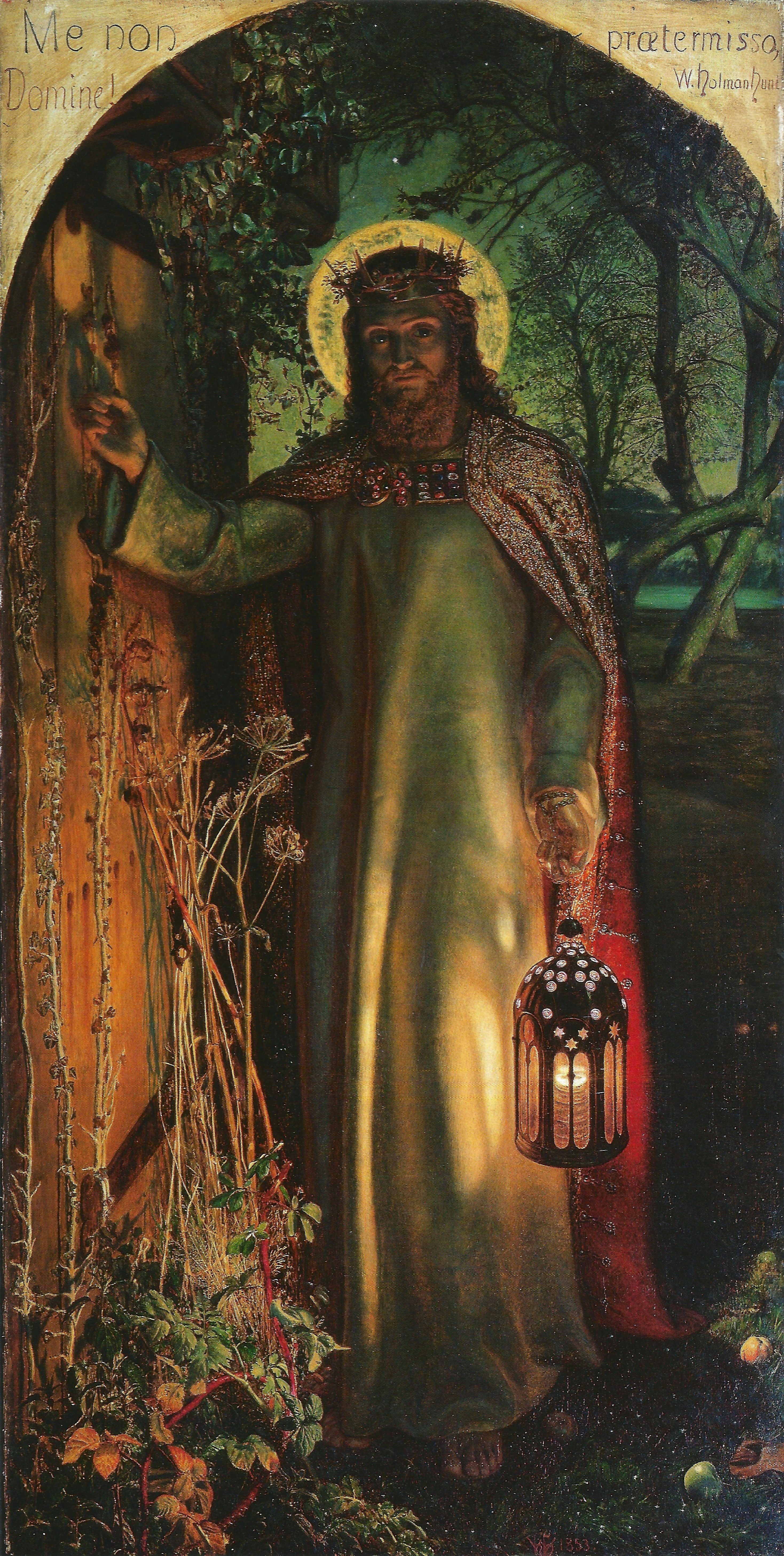
Keble owns the original of William Holman Hunt's painting The Light of the World, which is hung in the side chapel (accessed through the chapel). The picture was completed in 1853 after eight years of work and originally hung in the Royal Academy. It was then given as a gift to the college. Hunt originally wanted the painting to be hung in the main chapel but the architect rejected this idea, as a result, he painted another version of the painting which is in St Paul's Cathedral, London. This copy was painted by Hunt when he was nearly 70.
College stamps
Main article: Oxford and Cambridge College Stamps
Keble College has the distinction of being the first college to issue stamps for the prepayment of a porter/messenger delivery service in 1871 only one year after it was founded, and it set the pace for other Oxford colleges to issue their own stamps. This service was successfully challenged by the post office in 1886. Keble also issued a college stamp in 1970 to mark its 100th anniversary.
Notable conferences at Keble
- The Declaration of Clergy on Ritual Conference (January, 1904)
- The Conference on New Ideals in Education (31 March – 7 April 1923)
- The Oxford Movement Conference (July, 1983)
- The J. R. R. Tolkien Centenary Conference (17–24 August 1992)
- The 12th International Conference on Brain Tumour Research and Therapy (September, 1997)
- The 19th International Radiocarbon Conference (April, 2006)
In popular culture
Keble, under snow, appears as Baidley College in an episode of the television detective show Endeavour, with the young Morse investigating the murder of a don.
Notable members of Keble
File:Imran Khan 2019 crop.jpg|Imran Khan, Cricketer turned philanthropist & politician, (former Prime Minister of Pakistan) File:Ed balls.jpg|Ed Balls, former Shadow Chancellor of the Exchequer File:Lord Adonis.jpg|Andrew Adonis, British Labour Party politician File:David Wilson 2008.jpg|David Wilson, former Governor of Hong Kong
References
Sources
References
- Batson, Judy G.. (2008). "Her Oxford". Vanderbilt University Press.
- Cherwell News. (17 October 2018). "Keble Warden 'mightily sorry' for undergrad accommodation cock-up". Cherwell.
- "Keble College : Annual Report and Financial Statements : Year ended 31 July 2024".
- Monteith, Peter. (2024-04-19). "Latin Name and English Pronunciation of Keble College".
- "Keble College {{!}} University of Oxford".
- (2008). "Keble past and present". Third Millennium.
- In 1875, a writer in ''[[The Guardian (Anglican newspaper). The Guardian]]'' dismissed Butterfield's Chapel as "fantastically picked out with zig-zag or checkerboard ornamentation", to which Butterfield responded stoutly in print, citing his East Anglian and Cotswold precedents: Paul Thompson, ''William Butterfield'', 1971, noted in a review by [[J. Mordaunt Crook]] in '' The English Historical Review'' 1974.
- Wilberforce, Samuel. (1868). "The Resurrections of the Truth: A Sermon, preached in the Church of Saint Mary the Virgin, Oxford, on Saint Mark's Day, April 25, 1868, being the Day of Laying the First Stone of Keble College".
- (23 April 2023). "St Mark's Day Celebration". Keble Chapel.
- (2024). "St Mark's Day: Ed Balls (1985, Honorary Fellow)".
- (2025). "St Mark's Day: Sir Andy Street (1982, Honorary Fellow)".
- Eastlake, ''A History of the Gothic Revival'' "Chapel of Baliol College, Oxford", p 261f.
- Whyte, William. (14 October 2013). "Eye of the Beholder". Oxford University.
- . (2009). ["And finally..."](http://thebrick.keble.net/brick47/brick47.pdf). *Keble College, Oxford*.
- Taylor, Matthew. (8 April 2005). "Oxford college guilty of race discrimination". [[The Guardian.
- "Employment Tribunal (Reading) case no. 2701126/04".
- Dagnall, Andrew. (5 October 2005). "Keble to settle racism tribunal out of court". Cherwell.
- Smith, Neil. (2 August 2021). "Has any team scored zero on University Challenge?".
- "Tour the College". keble.ox.ac.uk.
- Risebero, Bill. (1985). "Modern Architecture and Design: An Alternative History". MIT Press.
- "Sloane Robinson Building".
- (2000). "New building on course to start this year". Keble College.
- "O'Reilly Theatre (Keble College)".
- "O'Reilly Theatre".
- "O’Reilly Theatre at Keble College, Oxford".
- "O'Reilly Theatre, Oxford".
- "The O'Reilly Theatre, Oxford".
- "The Architecture of Keble College". Keble College, Oxford.
- (18 October 2002). "New addition at college". [[Oxford Mail]].
- "Sloane Robinson Building". [[Rick Mather Architects]].
- Brindley, Tim. (24 September 2015). "Sloane Robinson Building". New Oxford Architecture.
- "Keble College, Oxford". Theatreplan.
- (2019). "Great Breaks Oxford". [[Apa Publications]].
- "O'Reilly Theatre, Oxford Events & Tickets 2023".
- Marnoch, Cameron. (13 October 2017). "A Modern Day Adaptation of Caesar in the O'Reilly".
- Phillips, Kiaya. (25 October 2023). "'Hamlet' in the Modern World: Interview with Cast and Crew". [[Cherwell (newspaper).
- Shamash, Yolanda. (16 February 2017). "Anna Karenina is Given a New Lease of Life in the O'Reilly".
- Hagerty, Maeve. (28 November 2022). "Delightful, witty and well-rendered: 'Blithe Spirit' in review". [[Cherwell (newspaper).
- Gray, Christopher. (10 March 2010). "Bent: O'Reilly Theatre, Keble Colleged". [[Oxford Mail]].
- Woodforde, Giles. (29 November 2013). "Chicago @ O’Reilly Theatre, Keble College, Oxford". [[Oxford Mail]].
- (22 October 2015). "Keble College receives largest donation in its history for major new development – University of Oxford".
- (3 October 2019). "Duke of Cambridge opens university centre". BBC.
- (27 May 2025). "At graduation, our students can take a piece of Keble with them. Fortunately, these bricks are made of foam. The real ones are staying put! By getting their brick, graduates also support current students and the future of Keble through the Talbot Fund 🧱 #KebleCollege #DegreeDay".
- "University Challenger former champions".
- "University of Oxford Podcasts: Keble College".
- Morris, Jade. (2024). "Keble Ball Returns". The Brick.
- "Keble Rowing: A History".
- Saxon, Adam. (2024-03-03). "Football Cuppers 2024: Keble's historic treble".
- ''The Declaration of Clergy on Ritual: Conference of Clergy at Keble College, Oxford, January 12th and 13th 1904'' ([[Society for Promoting Christian Knowledge]], 1904)
- ''Report of the Conference on New Ideals in Education: Held at Keble College, Oxford, from March 31 to April 7, 1923''
- ''Oxford Movement Conference: Keble College Oxford July 11th-15th 1983'' (Oxford Movement, 1983)
- Jane Chance, ''[[Tolkien and the Invention of Myth]]: A Reader'' (University Press of Kentucky, 2008, {{ISBN. 9780813192017), p. 222; ''[[The J. R. R. Tolkien Centenary Conference]] Souvenir Book: Keble College, Oxford 17–24 August 1992'' (Tolkien Society, 1992)
- ''Abstracts Presented at the 12th International Conference on Brain Tumour Research and Therapy, Keble College, Oxford, UK, September 20–23, 1997'' (Kluwer Academic, 1997)
- ''Proceedings of the 19th International Radiocarbon Conference: Keble College, Oxford, England, 3–7 April 2006'' (University of Arizona Department of Geosciences, 2007)
- Phoebe Taplin, ''Oxford Film Locations'' (Pitkin, 2018, {{ISBN
This article was imported from Wikipedia and is available under the Creative Commons Attribution-ShareAlike 4.0 License. Content has been adapted to SurfDoc format. Original contributors can be found on the article history page.
Ask Mako anything about Keble College, Oxford — get instant answers, deeper analysis, and related topics.
Research with MakoFree with your Surf account
Create a free account to save articles, ask Mako questions, and organize your research.
Sign up freeThis content may have been generated or modified by AI. CloudSurf Software LLC is not responsible for the accuracy, completeness, or reliability of AI-generated content. Always verify important information from primary sources.
Report