From Surf Wiki (app.surf) — the open knowledge base
Kayapo
Indigenous people in Brazil
.jpg)
Indigenous people in Brazil
| Field | Value |
|---|---|
| group | Mebêngôkre |
| Kayapó | |
| image | Tuíre.jpg |
| caption | Former Kayapó chief Tuíre Kayapó |
| population | 8,638 (2010) |
| popplace | Brazil (Mato Grosso, Pará) |
| languages | Kayapo language |
Kayapó The Kayapo (Portuguese: Caiapó ) people are an indigenous people in Brazil, living over a vast area across the states of Pará and Mato Grosso, south of the Amazon River and along the Xingu River and its tributaries. This location has given rise to the tribe's nickname of "the Xingu". The name Kayapo is used by neighboring groups rather than referring by the Kayapo to themselves; they refer to outsiders as Poanjos.
A type of sweet potato/tuber forms an important part of the Kayapó diet, and is sometimes named "caiapo", after the tribe. It is cultivated under that name in Japan, and has been found to decrease insulin resistance in type 2 diabetic patients.
History
In the 18th century, in the northeastern region of the present state of São Paulo, the Kayapó tribe first encountered Portuguese-Brazilian bandeirantes, who were looking for gold, among other precious stones and metals, as well as indigenous slaves. As a result, the Kayapó left the area and migrated to the west.
In the 1950s and 1960s, the Brazilian government contacted the "warlike" Kayapós with the intention of making peace with them. As a result, most Kayapós are currently in-contact with and aware-of modern Brazilian society.
Location
The Kayapo tribe lives alongside the Xingu River in the most east part of the Amazon rainforest, in the Amazon basin, in several scattered villages ranging in population from one hundred to one thousand people in Brazil. Their land consists of tropical rainforest savannah (grassland) and is arguably the largest tropical protected area in the entire world, covering 11346326 ha of Neotropical forests and scrubland containing many endangered species. They have small hills scattered around their land and the area is criss-crossed by river valleys. The larger rivers feed into numerous pools and creeks, most of which lack official names.
In 2018, there was an estimated 8,638 Kayapo people, Subgroups of the Kayapo include the Xikrin, Gorotire, Mekranoti, and Metyktire. Their villages typically consist of a dozen huts. A centrally located hut serves as a meeting place for village men to discuss community issues.
Name
The term Kayapo, also spelled Caiapó or Kaiapó, came from neighboring peoples in the early 19th century and means "those who look like monkeys". This name is probably based on a Kayapó men's ritual involving monkey masks. The autonym for one village is Mebêngôkre, which means "the men from the water hole." Other names for them include Gorotire, Kararaô, Kuben-Kran-Krên, Kôkraimôrô, Mekrãgnoti, Metyktire, and Xikrin.
Culture
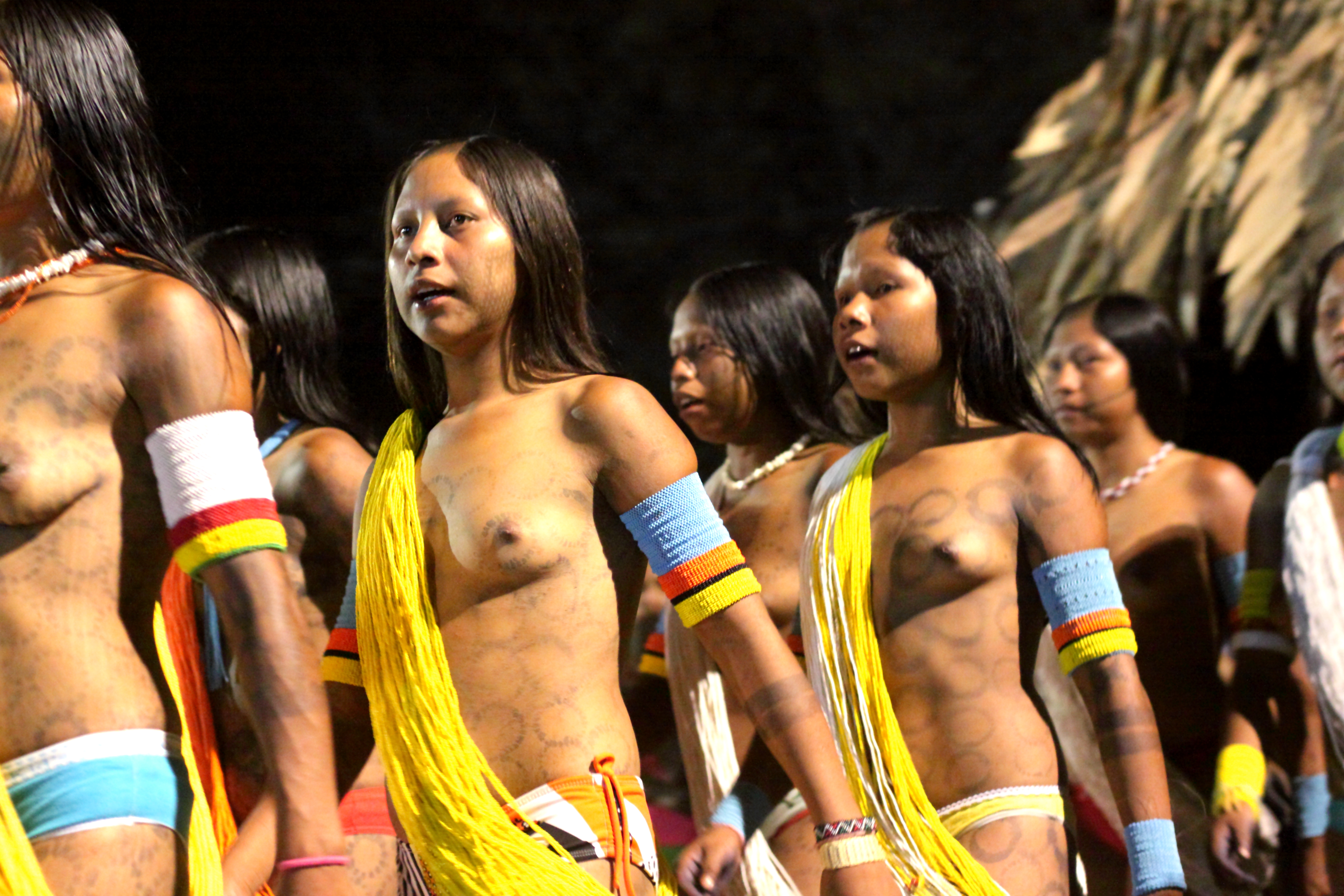
The Kayapó often don intricate, black body painting covering their entire bodies, with unique designs and patterns to each person. They believe that their ancestors learned the ways of life from insects, so they paint their bodies to mimic the invertebrates and to better communicate with the great spirit that exists in all things. The black body paint also allows them to blend into their surroundings when hunting in the forests. To help find their way through the jungle, the Kayapó paint their legs with a red pigment that rubs-off on the surrounding plants as they traverse through the vegetation. The colors that a Kayapó wears are representative of their tribe's colors.
Older generations of Kayapó men wear wooden disks in their lower lips, but the practice is less common among younger Kayapó men. Kayapó children wear cloth or beaded bands with colors representing their tribes. Typically, these bands are tied below the waist or crisscrossed around the torso. When a child comes of age, they go through a naming-ceremony, in which they wear large yellow headdresses.
Kayapó women can be distinguished by the "V" formation shaved into their hair.
Language
The Kayapo speak the Kayapo language, which belongs to the Jê language family. They are split into many groups, resulting in different dialects of their language. The Kayapo value oratory highly, calling themselves those who speak beautifully (Kaben mei) when compared to other indigenous groups. Beauty is valued highly in the Kayapo culture. A beautiful name is seen as a sign of wealth. The tribe will move and re-construct their camp in order to find the materials required to undertake the naming ceremony; eg. Sufficient food sources for celebration must be gathered and presented to the father of the newborn. During certain occasions, Kayapo men may speak as if someone is punching them in the stomach. The Kayapo possess varying knowledge of Portuguese, depending on the individual groups and their history of contact with outsiders.
Land control and environmental issues
The resource patterns of the Kayapo are non-destructive to the resource base but require a very large area of land. The Kayapo people use shifting cultivation, a type of farming where land is cultivated for a few years, after which the people move to a new area. New farmland is cleared and the old farm is allowed to lie fallow and replenish itself. The particular type of shifting agriculture employed most frequently by the Kayapo is the slash and burn technique. This process allows forested areas to be cut down and burned in order for cultivation of the lands to take place. These "new fields" "peak in production of principal domesticated crops in two or three years but continue to reproduce for many years; e.g., sweet potatoes for four to five years, yams and taro for five to six years, manioc for four to six years, and papaya for five or more years". Old fields are important for their concentration of medicinal plants. With the spread of indigenous groups, trail-side plantings and "forest fields" were also used for cultivating crops. Trails systems were extensive in the area and were used for transporting and growing crops along their margins. The field system was done by utilizing either naturally occurring or man made clearings in the forest for crop cultivation which required little maintenance afterward. The Kayapo also cultivated “war gardens” which were hidden plots used as a resource in times of food scarcity.
The Kayapo use approximately 250 different food plants and 650 different medicinal plants that they find around their village.
They also have trade agreements with The Body Shop.
References
References
- "Mebêngôkre (Kayapó)". Povos Indígenas no Brasil.
- (2002). "Kayapó Ethnoecology and Culture". Routledge.
- "Caiapo Sweet Potato (Ipomoea batatas) Shows Beneficial Effects of Improving Insulin Resistance".
- (2003). "Mode of action of ipomoea batatas (caiapo) in type 2 diabetic patients". Metabolism.
- https://www.al.sp.gov.br/noticia/?id=332308
- ''Povos indígenas no Brasil''. Disponível em https://pib.socioambiental.org/pt/povo/kayapo/181. Acesso em 13 de junho de 2016.
- (2009). "Conservation Refugees: The Hundred-Year Conflict between Global Conservation and Native People". The MIT Press.
- (2008). "Environmental Anthropology: A Historical Reader.". Blackwell Publishing.
- Popovic, Mislav. "Kayapo". Traditions And Customs.
- "Name: Kayapo". Povos Indígenas no Brasil.
- National Geographic. (2014-03-31). "Martin Schoeller: Kayapo Warrior Tribe {{!}} Nat Geo Live".
- Smarthistory. (October 2018}} Due to increased contact with outside cultures, contemporary Kayapó often wear western-style clothing, such as shorts and pants. Kayapó chiefs wear headdresses made of bright, yellow feathers, to represent the rays of the sun. The feathers used in their headdresses are from birds native to their area, such as the [[hyacinth macaw]] and [[crested oropendola]]. The birds found in the Amazon are naturally bright-colored, thus the Kayapó do not dye the feathers.{{Cite AV media). "Kayapó Headdress: a glimpse of life in the Amazon rainforest".
- (1989). "Kayapo - Out of the Forest". Granada Studios.
- (1999). "Earth, Air, Fire, Water: Humanistic Studies of the Environment". The University of Massachusetts Press.
- (1998). "Unnatural Selection: The Yanomami, the Kayapo, and the Onslaught of Civilisation". University of Washington Press.
- (November 2008). "Conflicting Cultures of Nature: Ecotourism, Education and the Kayapo of the Brazilian Amazon". Tourism Geographies.
- (6 July 2012). "Development, Dams and Dilma: the Saga of Belo Monte". Critical Sociology.
- Clendenning, Alan. (May 21, 2008). "Amazon Indians Attack Official Over Dam Project". [[Associated Press]].
- (1994). "Amazonian Indians: From Prehistory to the Present". The University of Arizona Press.
- International, Survival. "Belo Monte dam".
- (3 June 2011). "The Brazilian tribe that played by our rules, and lost". The Guardian.
- (2001). "Conservation and development alliances with the Kayapó of south-eastern Amazonia, a tropical forest indigenous people". Environmental Conservation.
- Langlois, Jill. (29 March 2022). "For the Kayapó, a Long Battle to Save Their Amazon Homeland". Yale Environment 360.
- (1988). "Biodiversity, Part 3". National Academies Press.
- McConnell, Douglas John. (2003). "The forest farms of Kandy: and other gardens of complete design". Ashgate Publishing, Ltd.
- "Kayapo: The Body Shop states its case".
This article was imported from Wikipedia and is available under the Creative Commons Attribution-ShareAlike 4.0 License. Content has been adapted to SurfDoc format. Original contributors can be found on the article history page.
Ask Mako anything about Kayapo — get instant answers, deeper analysis, and related topics.
Research with MakoFree with your Surf account
Create a free account to save articles, ask Mako questions, and organize your research.
Sign up freeThis content may have been generated or modified by AI. CloudSurf Software LLC is not responsible for the accuracy, completeness, or reliability of AI-generated content. Always verify important information from primary sources.
Report