From Surf Wiki (app.surf) — the open knowledge base
Karuizawa, Nagano

| Field | Value | |
|---|---|---|
| name | Karuizawa | |
| native_name | 軽井沢町 | |
| native_name_lang | ja | |
| settlement_type | Town | |
| image_skyline | File:Street in Karuizawa.jpg | |
| image_caption | Typical scenery of Karuizawa | |
| image_flag | Flag of Karuizawa, Nagano.svg | |
| image_blank_emblem | Emblem of Karuizawa, Nagano.svg | |
| blank_emblem_type | Emblem | |
| image_map | Karuizawa in Nagano Prefecture Ja.svg | |
| map_caption | Location of Karuizawa in Nagano Prefecture | |
| pushpin_map | Japan#Japan Kanto Chubu Kansai#Japan Nagano Prefecture | |
| pushpin_map_caption | ||
| coordinates | ||
| subdivision_type | Country | |
| subdivision_name | Japan Japan | |
| subdivision_type1 | Region | |
| subdivision_name1 | Chūbu (Kōshin'etsu) | |
| subdivision_type2 | Prefecture | |
| subdivision_name2 | Nagano | |
| subdivision_type3 | District | |
| subdivision_name3 | Kitasaku | |
| leader_title | Mayor | |
| area_total_km2 | 156.03 | |
| population_total | 21,834 | |
| population_as_of | ||
| population_density_km2 | auto | |
| timezone1 | Japan Standard Time | |
| utc_offset1 | +9 | |
| blank_name_sec1 | Phone number | |
| blank_info_sec1 | 0267-45-8111 | |
| blank1_name_sec1 | Address | |
| blank1_info_sec1 | 2381-1 Nagakura, Karuizawa-machi, Kitasaku-gun, Nagano-ken 389-0192 | |
| blank_name_sec2 | Climate | |
| blank_info_sec2 | Dfb | |
| website | ||
| module | {{Infobox place symbols | embedded=yes |
| tree | Magnolia kobus | |
| flower | Sakurasō (Primula sieboldii) | |
| bird | Brown-headed thrush |
Karuizawa is a resort town located in Nagano Prefecture, Japan. , the town had an estimated population of 21,834 in 11,285 households,{{cite web |url= https://www.town.karuizawa.lg.jp/ |title= Karuizawa Town Population and Households |archive-url=https://web.archive.org/web/20251011085153/https://www.town.karuizawa.lg.jp/ |archive-date=October 11, 2025 }} and a population density of 139 persons per km2. The total area of the town is 156.03 sqkm.
Originally, there was a stage station (shukuba) called Karuisawa-shuku on the Nakasendō. The Shin'etsu Line opened in 1888 and the town became popular as a Western-style hill station around that time.
Geography
Karuizawa is located in eastern Nagano Prefecture, bordered by Gunma Prefecture to the north, east and south. The town is located on an elevated plain at the foot of Mount Asama, one of Japan's most active volcanoes. The mountain is classed as a Category A active volcano. A small eruption was detected in June 2015, and a more significant eruption spewing hot rocks and a plume of ash occurred in February 2015. Mount Asama's most destructive eruption in recent recorded history took place in 1783, when over 1,000 were killed. The volcano is actively monitored by scientists and climbing close to the summit is prohibited.
- Usui Pass
- Highest elevation: 2568 m (Top of Mount Asama)
- Lowest elevation: 798.7 m
Surrounding municipalities
- Gunma Prefecture
- Annaka
- Naganohara
- Shimonita
- Takasaki
- Tsumagoi
- Nagano Prefecture
- Miyota
- Saku
Climate
Karuizawa has a humid continental climate (Köppen climate classification Dfb) with warm summers and cold winters. The average annual temperature in Karuizawa is 8.6 C. The average annual rainfall is 1246.2 mm with September as the wettest month. The temperatures are highest on average in August, at around 20.8 C, and lowest in January, at around -3.3 C. Precipitation is much heavier in the summer than in the winter.
|Jan record high C = 16.1 |Feb record high C = 18.8 |Mar record high C = 22.6 |Apr record high C = 28.3 |May record high C = 29.5 |Jun record high C = 31.1 |Jul record high C = 34.2 |Aug record high C = 33.9 |Sep record high C = 31.3 |Oct record high C = 27.7 |Nov record high C = 22.3 |Dec record high C = 20.7 |Jan record low C = -20.3 |Feb record low C = -19.6 |Mar record low C = -21.0 |Apr record low C = -11.6 |May record low C = -6.1 |Jun record low C = -0.9 |Jul record low C = 5.0 |Aug record low C = 7.0 |Sep record low C = -0.2 |Oct record low C = -6.5 |Nov record low C = -11.8 |Dec record low C = -18.0 |script-title=ja:観測史上1~10位の値(年間を通じての値) | access-date = 19 April 2022}}{{cite web |script-title=ja:気象庁 / 平年値(年・月ごとの値) | access-date = 19 April 2022}}}}
History
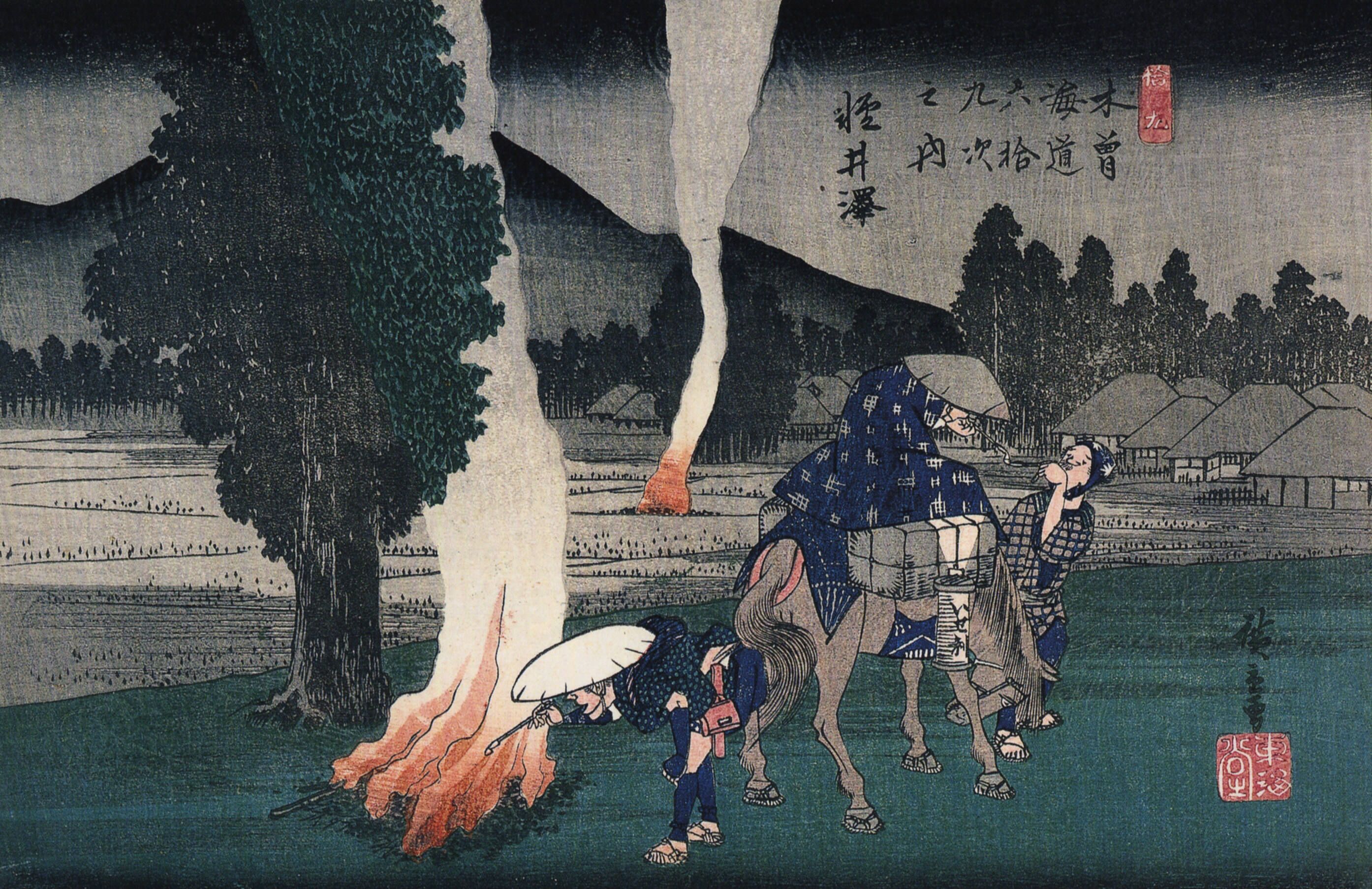


The area of present-day Karuizawa was part of ancient Shinano Province, and developed as Karuisawa-shuku, a post station on the Nakasendō highway connecting Edo with Kyoto during the Edo period.
- 2 August 1876: The hamlets of Kutsukake, Shiozawanitta, Karijuku, Narusawanitta, and Yui merged to form the village of Nagakura. The village of Hatsuji in Saku District absorbed the hamlet of Matorikaya.
- 14 January 1879: Kitasaku District was created, and the town of Usuitoge, and the villages of Karuizawa, Nagakura, Oiwake were established with Kitasaku District.
- 1886: Canadian Anglican missionary Rev. Alexander Croft Shaw and Tokyo Imperial University English professor James Main Dixon introduced Karuizawa as a summer resort.
- 1 April 1889: With the establishment of the modern municipalities system, the town of Usuitoge, and the villages of Karuizawa, and the areas of the former villages of Kutsukake, Shiozawanitta, and Karijuku from the village of Nagakura merged to form the village of Higashinagakura in Kitasaku District, and the areas of the former villages of Narusawanitta and Yui in the village of Nagakura, and the villages of Hatsuji and Oiwake merged to form the village of Nishinagakura in Kitasaku District.
- 1910s: Begins to attract the attention of other expatriates and Japanese. Specially Germans congregate here, language professors and academics hold annual conferences.
- 1 August 1923: The village of Higashinagakura gains town status to become the town of Karuizawa. (The pre-town areas before gaining the town status is known as Kyu-Karuizawa.)
- 8 May 1942: The village of Nishinagakura is merged into Karuizawa.
- 1942–45: Site of an internment camp for enemy foreigners and diplomats during World War 2
- From 1943 relocation of an increasing number of Germans from Tokyo, which is suffering from US fire bombing. The Supreme Commander for the Allied Powers deported most German nationals in late 1947.
- 1951: Selected as International Cultural and Tourism City
- 1 February 1957: Karuizawa absorbed Serizawa area from the former village of Goga, which was absorbed by the town of Miyota.
- 1 April 1959: The Kajikazawa area of the former village of Oiwake was split off and merged with the town of Miyota.
- 1964: 1964 Summer Olympics (Equestrian)
- February 1972: Asama-Sanso incident; Police besiege communist militants holed up in holiday resort after mass killing and hostage taking.
- 1 October 1997: The Nagano Shinkansen opens, serving Karuizawa.
- 1998: 1998 Winter Olympics (Curling)
- 2004: Mount Asama erupts.
- 2016: The G7 Transport Ministers' Meeting
- 2019: The G20 Energy and Environment Ministers' Meeting
- 2023: G7 Foreign Ministers' Meeting in conjunction with the G7 Summit
Demographics
Per Japanese census data, the population of Karuizawa has been increasing over the past 60 years. | 1940 | 8,746 | 1950 | 13,676 | 1960 | 13,299 | 1970 | 13,373 | 1980 | 14,195 | 1990 | 15,464 | 2000 | 16,181 | 2010 | 19,023 | 2020 | 19,188
Economy
Since one of the origins of the Seibu Group is in Karuizawa (see also Yasujiro Tsutsumi), Seibu is still developing big businesses in this town such as Prince Hotels.
Hoshino Resorts is headquartered in Karuizawa.
Education
Karuizawa has three public elementary school and one public middle school operated by the town government, and one public high school is operated by the Nagano Prefectural Board of Education. The UWC ISAK Japan international school is also located in the town.
Transportation
Railway
[[File:JR logo (east).svg|20px]] East Japan Railway Company – Hokuriku Shinkansen
- – –
Highway
- [[Image:JP Expressway E18.svg|24px|link=|alt=E18]] Jōshin-etsu Expressway
International relations
- Brazil Campos do Jordão, Brazil
- Canada Whistler, British Columbia, Canada
Local attractions


.jpeg)
Karuizawa was developed as a European-style resort town by a Scottish-Canadian missionary in 1888. In the following decades, the town attracted visitors from across the country seeking to escape the heat of summer and enjoy vacations, as well as a significant number of Westerners. Unlike many other hill stations, Karuizawa was actively open to the natives from the beginning, and many Japanese aristocrats (Kazoku), scholars, artists and others had already built "Western-style" villas in the town by the early 20th century. The Japanese and Western communities interacted well with each other through summer recreation activities and the like. In the 21st century the town retains significant Western cultural influence, and its alpine beauty and cool summer climate (similar to parts of Europe) continue to draw visitors.
More recently, Karuizawa has become a popular year-round resort for mainly Japanese, offering many outdoor sports, hot springs and recreational activities. Convenient road and rail access from central Tokyo has ensured Karuizawa's popularity as a location for second homes and resort hotels since the Meiji era.
Karuizawa is known for its historic shopping street known as "Ginza dōri" or "Kyū-dō" (Ginza Street, or the Old Road) and association with both Japanese royalty and visitors such as John Lennon and Yoko Ono. As a side note, The Crown Prince Akihito met Michiko Shoda for the first time on a tennis court in Karuizawa in August 1957, and John Lennon spent several summers in Karuizawa with his family in the late 1970s.
Karuizawa hosted equestrian events in the 1964 Summer Olympics as well as curling in the 1998 Winter Olympics. It is the first city in the world to host both Summer and Winter Olympic events.
Since 1997, Karuizawa has been accessible via the JR East Nagano Shinkansen. New high speed rail links has resulted in modest population growth and the development of large outlet style shopping malls.
In popular media
- The Birds of Karuizawa from Sept haïkaï, Olivier Messiaen's composition
- The Wind Rises, Studio Ghibli film : Karuizawa appeared in a part of the film.
- When Marnie Was There, Studio Ghibli film : The model of the mansion that appeared in the film is the villa in Karuizawa.
- Karuizawa Yūkai Annai, Enix adventure game
- The Curious Adventures of Sherlock Holmes in Japan, Dale Furutani's novel : The story is based on the premise that Sherlock Holmes was in Karuizawa in the "missing years (1891–1894)".
- The anime series Ouran High School Host Club : Episodes 15 and 16 are set in Karuizawa.
Notable residents
- Massimo Baistrocchi, Italian diplomat
- Paul Bryan, British Conservative politician
- Tatsuo Hori, Japanese writer
- Paul Jacoulet, French woodblock print artist
- T. Canby Jones, American professor
- Neil Gordon Munro, Scottish physician and anthropologist
- E. Herbert Norman, Canadian diplomat and historian
- Tabaimo, Japanese artist
- Yukihiro Takahashi, Japanese drummer
- Masayoshi Takanaka, Japanese musician, producer and composer
- Kōji Tamaki, Japanese singer
- Towa Tei, Japanese record producer
- Kazumi Watanabe, Japanese guitarist
- Ken Watanabe, Japanese actor
- Ronald Lampman Watts, Canadian professor
- Willie Weeks, American bass guitarist
Summer residents
- Akihito, Japanese emperor
- Ryūnosuke Akutagawa, Japanese writer
- Topazia Alliata, Italian noblewoman and painter
- Takeo Arishima, Japanese writer
- Prince Yasuhiko Asaka, member of the Japanese imperial family
- Tarō Asō, Japanese prime minister
- Edgar Bancroft, American diplomat
- Edward Bickersteth, Anglican missionary
- Francis Brinkley, Anglo-Irish editor
- Robert L. Eichelberger, American general officer
- Ichikawa Ennosuke III, Japanese kabuki actor
- Joseph Grew, American diplomat
- Walter de Havilland, English patent attorney
- James Main Dixon, Scottish professor
- Hugh Fraser, English diplomat
- Beate Sirota Gordon, Austrian-born American performing arts presenter
- Matsumoto Hakuō II, Japanese kabuki actor
- Ichirō Hatoyama, Japanese prime minister
- Shigeaki Hinohara, Japanese physician
- Hirohito, Japanese emperor
- Morihiro Hosokawa, Japanese prime minister
- Nitobe Inazō, Japanese author
- Shōjirō Ishibashi, Japanese businessman
- Arata Isozaki, Japanese architect
- Yasunari Kawabata, Japanese writer
- Donald Keene, American writer and professor
- Mary Eddy Kidder, American missionary
- Kunihiko Kodaira, Japanese mathematician
- Fumimaro Konoe, Japanese prime minister
- Bernard Leach, British studio potter
- John Lennon, English musician
- Dacia Maraini, Italian writer
- Fosco Maraini, Italian photographer
- Empress Masako, Japanese empress
- Empress Michiko, Japanese empress
- Akio Morita, Japanese businessman
- Naruhito, Japanese emperor
- Sadako Ogata, Japanese professor
- Yoko Ono, Japanese artist
- Antonin Raymond, Czech-American architect
- August Karl Reischauer, American missionary
- Edwin O. Reischauer, American diplomat
- Hannah Riddell, English missionary
- Roman Rosen, Russian baron and diplomat
- Junzo Sakakura, Japanese architect
- Eisaku Satō, Japanese prime minister
- William J. Sebald, American diplomat
- Alexander Croft Shaw, Canadian missionary
- Ōkuma Shigenobu, Japanese prime minister
- Leo Sirota, Ukrainian-born Jewish pianist
- Masayoshi Son, Korean-Japanese businessman
- D. T. Suzuki, Japanese Buddhist monk
- Yoshiaki Tsutsumi, Japanese businessman
- Merrell Vories Hitotsuyanagi, American architect
- J. G. Waller, Canadian missionary
- Walter Weston, English missionary
- Sayuri Yoshinaga, Japanese actress
Evacuees of World War II
- Widar Bagge, Swedish diplomat
- Varvara Bubnova, Russian painter
- Karlfried Graf Dürckheim, German diplomat and Zen master
- Robert Guillain, French journalist
- Francis Haar, Hungarian socio-photographer
- Eta Harich-Schneider, German harpsichordist
- Manfred Gurlitt, German conductor
- Leonid Kreutzer, Russian-born Jewish pianist
- Alexander Mogilevsky, Ukrainian violinist
- Victor Pokrovsky, Russian choral director
- Joseph Rosenstock, Polish-born American conductor
- Victor Starffin, Russian baseball player
References
References
- Shotenkenchiku-sha, ''HOTEL RESTAURANTS & BARS'', 1995, p.15
- Demetriou, Danielle. (16 June 2015). "Mount Asama volcano erupts near Tokyo". The Telegraph.
- ''Tohoku: The Scotland of Japan'', p. 181
- "G7 Foreign Ministers' Meeting in Karuizawa, Nagano". Ministry of Foreign Affairs.
- "Karuizawa population statistics".
- "[https://web.archive.org/web/20080209235819/http://investing.businessweek.com/research/stocks/private/snapshot.asp?privcapId=23316508 Company Overview of Hoshino Resort Co., Ltd.] ([https://archive.today/20130922173104/http://investing.businessweek.com/research/stocks/private/snapshot.asp?privcapid=23316508 Archive]). [[Bloomberg Businessweek]]. Retrieved on September 22, 2013. "2148, oazanagakura karuizawa-machi Kitasaku, 389-0111 Japan"
- "International Exchange". Council of Local Authorities for International Relations (CLAIR).
- Cargill Gilston Knott, [https://archive.org/details/transactionsasi07japagoog/page/n574/mode/2up?q=In+addition+to+the+heavier+rainfall+at+Karuizawa “On the Summer Climate of Karuizawa”], Transactions of the Asiatic Society of Japan, Vol. XIX, Ginza: Hakubunsha, 1891, p.574
- Ernest Foxwell, A Tale of Karuizawa, The Living Age, Vol. 236, Boston : Living Age Company, 1903, p.107
- Arthur Lloyd, [https://archive.org/details/japaneveryday00lloyrich/page/208/mode/2up? ''Every-day Japan''], London, New York, Toronto and Melbourne: Cassell and Company Limited, 1909, p.281
- Anne Shannon, Lana Okerlund, "Finding Japan: Early Canadian Encounters with Asia”, p.56, Heritage House, 2012.
- [https://mainichi.jp/english/articles/20220209/p2a/00m/0op/027000c Edging Toward Japan: My Karuizawa Dreams], The Mainichi, 12 February 2022.
- [https://www.japantimes.co.jp/life/2019/03/05/travel/resort-town-links-east-west/ Resort town links East with West], The Japan Times, 5 May 2019.
- Davis, Tony. (8 May 2015). "Nakasendo walking trail leads to the heart of old Japan – and bear country". The Australian Financial Review.
- [https://www.japantimes.co.jp/news/2019/08/25/national/former-emperor-empress-visit-karuizawa-tennis-court-first-met-1957/ Former emperor, empress visit Karuizawa tennis court where they first met in 1957] The Japan Times, 25 August 2019.
- William Horsley, Roger Buckley, "Nippon New Superpower: Japan Since 1945”, p.85, BBC Books, 1990.
- “[https://books.google.com/books?id=CGZYAAAAYAAJ&q=karuizawa The Olympian Volume 24]", p.29, [[United States Olympic Committee]], 1998.
- Mrs. Hugh Fraser, [https://archive.org/details/adiplomatistswi01frasgoog/page/n7/mode/2up?q=And+now+I+am+writing+in+the+most+lovely+study+in+the+world.+Over+my+head+the+pine+branches+meet+in+arches+of+kindly+green''A Diplomatist's Wife in Japan: Letters from Home to Home''], Vol. II, London: Hazell, Watson and Viney, 1899, p.53
- [https://www.asianturfgrass.com/post/a-golfers-paradise/ A golfers' paradise], Asian Turfgrass Center.
- [http://www.oldtokyo.com/karuizawa-c-1920/ Karuizawa, c. 1920.] {{Webarchive. link. (2021-04-11 Old Tokyo.com)
- James Henke, "Lennon: His Life and Work”, p.11, Rock and Roll Hall of Fame and Museum, 2000.
- [https://mobile.twitter.com/yokoono/status/1377280495176839168 Yoko Ono (April 1, 2021)], Twitter
- [https://achievement.org/achiever/olivia-de-havilland/#interview Dame Olivia de Havilland], Academy of Achievement
This article was imported from Wikipedia and is available under the Creative Commons Attribution-ShareAlike 4.0 License. Content has been adapted to SurfDoc format. Original contributors can be found on the article history page.
Ask Mako anything about Karuizawa, Nagano — get instant answers, deeper analysis, and related topics.
Research with MakoFree with your Surf account
Create a free account to save articles, ask Mako questions, and organize your research.
Sign up freeThis content may have been generated or modified by AI. CloudSurf Software LLC is not responsible for the accuracy, completeness, or reliability of AI-generated content. Always verify important information from primary sources.
Report