From Surf Wiki (app.surf) — the open knowledge base
Kareem Abdul-Jabbar
American basketball player (born 1947)

American basketball player (born 1947)
| Field | Value | |
|---|---|---|
| name | Kareem Abdul-Jabbar | |
| image | Kareem Abdul-Jabbar May 2014.jpg | |
| caption | Abdul-Jabbar in 2014 | |
| height_ft | 7 | |
| height_in | 2 | |
| weight_lbs | 225 | |
| birth_date | ||
| birth_place | New York City, U.S. | |
| highschool | Power Memorial | |
| (New York City, New York) | ||
| college | UCLA (1966–1969) | |
| draft_year | 1969 | |
| draft_round | 1 | |
| draft_pick | 1 | |
| draft_team | Milwaukee Bucks | |
| career_start | 1969 | |
| career_end | 1989 | |
| career_position | Center | |
| career_number | 33 | |
| coach_start | 1998 | |
| coach_end | 2011 | |
| years1 | – | |
| team1 | Milwaukee Bucks | |
| years2 | – | |
| team2 | Los Angeles Lakers | |
| cyears1 | 1998–1999 | |
| cteam1 | Alchesay HS (assistant) | |
| cyears2 | ||
| cteam2 | Los Angeles Clippers (assistant) | |
| cyears3 | 2002 | |
| cteam3 | Oklahoma Storm | |
| cyears4 | – | |
| cteam4 | Los Angeles Lakers (assistant) | |
| * 3× First-team All-Pac-8 (1967–1969){{efn | name | c}} |
| stats_league | NBA | |
| stat1label | Points | |
| stat1value | 38,387 (24.6 ppg) | |
| stat2label | Rebounds | |
| stat2value | 17,440 (11.2 rpg) | |
| stat3label | Assists | |
| stat3value | 5,660 (3.6 apg) | |
| HOF_player | kareem-abdul-jabbar | |
| CBBASKHOF_year | 2006 |
(New York City, New York)
- 6× NBA champion (, , , , , )
- 2× NBA Finals MVP (, )
- 6× NBA Most Valuable Player (, , , , , )
- 19× NBA All-Star (–, –)
- 10× All-NBA First Team (–, , , , , , )
- 5× All-NBA Second Team (, , , , )
- 5× NBA All-Defensive First Team (, , –)
- 6× NBA All-Defensive Second Team (, , –, )
- NBA Rookie of the Year ()
- NBA All-Rookie First Team ()
- 2× NBA scoring champion (, )
- NBA rebounding leader ()
- 4× NBA blocks leader (, , , )
- NBA anniversary teams (35th, 50th, 75th)
- No. 33 retired by Milwaukee Bucks
- No. 33 retired by Los Angeles Lakers
- Sports Illustrated Sportsperson of the Year (1985)
- 3× NCAA champion (1967–1969)
- 3× NCAA Final Four Most Outstanding Player (1967–1969)
- 3× National college player of the year (1967–1969)
- 3× Consensus first-team All-American (1967–1969)
- 3× First-team All-Pac-8 (1967–1969)
- No. 33 retired by UCLA Bruins
- 2× Mr. Basketball USA (1964, 1965)
- 3× First-team Parade All-American (1963–1965)
- Presidential Medal of Freedom (2016) As head coach:
- USBL champion (2002) As assistant coach:
- 2× NBA champion (, ) Kareem Abdul-Jabbar (born Ferdinand Lewis Alcindor Jr., April 16, 1947) is an American former basketball player. He played professionally for 20 seasons for the Milwaukee Bucks and Los Angeles Lakers in the National Basketball Association (NBA), and played college basketball for the UCLA Bruins as a center. A member of the Naismith Memorial Basketball Hall of Fame, Abdul-Jabbar won a record six NBA Most Valuable Player (MVP) awards. He was a 19-time NBA All-Star, a 15-time All-NBA Team member, and an 11-time NBA All-Defensive Team selection. He was a member of six NBA championship teams as a player and two more as an assistant coach, and was twice voted the NBA Finals MVP. He was named to three NBA anniversary teams (35th, 50th, and 75th). Widely regarded as one of the greatest players of all time, Abdul-Jabbar broke the NBA's career scoring record in 1984, and held it until LeBron James surpassed him in 2023.
Abdul-Jabbar was known as Lew Alcindor when he played at Power Memorial, a private Catholic high school in New York City, where he led their team to 71 consecutive wins. He played college basketball for the UCLA Bruins, winning three consecutive national championships under head coach John Wooden. Alcindor was a record three-time most outstanding player of the NCAA tournament. Drafted with the first overall pick by the one-season-old Milwaukee Bucks franchise in the 1969 NBA draft, he spent six seasons with the team. After leading the Bucks to their first NBA championship at age 24 in 1971, he took the Muslim name Kareem Abdul-Jabbar. Using his trademark skyhook shot, he established himself as one of the league's top scorers. In 1975, he was traded to the Lakers, with whom he played the final 14 seasons of his career, during which time the team won five NBA championships. Abdul-Jabbar's contributions were a key component in the Showtime era of Lakers basketball. Over his 20-year NBA career, his teams reached the playoffs 18 times, got past the first round 14 times, and reached the NBA Finals ten times.
At the time of his retirement at age 42 in 1989, Abdul-Jabbar was the NBA's regular season career leader in points (38,387), games played (1,560), minutes (57,446), field goals made (15,837), field goal attempts (28,307), blocked shots (3,189), defensive rebounds (9,394), and personal fouls (4,657). He remains the all-time leader in field goals made. He ranks second in career points, minutes played and field goal attempts, and is third all-time in both total rebounds (17,440) and blocked shots. the greatest player in college basketball history in 2008, and the second best player in NBA history (behind Michael Jordan) in 2016. Abdul-Jabbar has also been an actor, a basketball coach, a best-selling author, and a martial artist, having trained in Jeet Kune Do under Bruce Lee and appeared in his film Game of Death (1972). In 2012, Abdul-Jabbar was selected by Secretary of State Hillary Clinton to be a U.S. global cultural ambassador. In 2016, President Barack Obama awarded him the Presidential Medal of Freedom.
Early life
Ferdinand Lewis Alcindor Jr. was born in Harlem, New York City, the only child of Cora Lillian, a department store price checker, and Ferdinand Lewis Alcindor Sr., a transit police officer and jazz musician. Cora was born in North Carolina but came to Harlem as part of the Great Migration. Ferdinand Sr. was the child of immigrants from Trinidad; his uncle was the Black activist and medical pioneer Dr. John Alcindor. Alcindor grew up in the Dyckman Street projects in the Inwood neighborhood of Upper Manhattan, which he moved to at the age of 3 in 1950. At birth, Alcindor weighed 12 lb and was 22+1/2 in long. Always very tall for his age, Alcindor was often depressed as a teenager because of the stares and comments about his height.
Alcindor attended Power Memorial Academy, a private all-boys Catholic high school, where he was one of the few Black students. He wore the jersey number 33, which he chose in tribute to his favorite player, New York Giants fullback Mel Triplett. He would continue wearing this number throughout his college and professional career. He led coach Jack Donohue's teams to three straight New York City Catholic championships, a 71–game winning streak, and a 79–2 overall record. This earned him "The Tower from Power" nickname. His 2,067 total points were a New York City high school record. The team won the national high school boys basketball championship when Alcindor was in 10th and 11th grade and was runner-up his senior year. He had a strained relationship in his final year with Donohue after the coach called him a nigger.
Alcindor wrote for the Harlem Youth Action Project newspaper. The Harlem riot of 1964, which was prompted by the fatal shooting of 15-year old black boy James Powell by a New York police officer, triggered Alcindor's interest in racial politics. "Right then and there, I knew who I was, who I had to be. I was going to be black rage personified, Black Power in the flesh", he said.{{cite web|first=Martenzie|last=Johnson|title= NBA creates Kareem Abdul-Jabbar Social Justice Champion award|date=May 13, 2021|work=ESPN|url=https://www.espn.com/nba/story/_/id/31437539/nba-creates-kareem-abdul-jabbar-social-justice-champion-award|access-date=March 1, 2023}}
College career
Alcindor was not able to play professionally in the NBA out of high school. At the time, the league only accepted players beginning with the year that they could have hypothetically graduated from college. after being recruited by Bruins assistant coach Jerry Norman. Baseball Hall of Famer and UCLA alumnus Jackie Robinson also wrote to Alcindor, encouraging him to attend the college.
By now 7 ft tall, Alcindor was relegated to the freshman team in his first year with the Bruins, The freshman squad included Lucius Allen, Kenny Heitz, and Lynn Shackelford, who were fellow high-school All-Americans. On November 27, 1965, Alcindor made his first public performance in UCLA's annual varsity–freshman exhibition game, attended by 12,051 fans in the inaugural game at the Bruins' new Pauley Pavilion. The 1965–66 varsity team was the two-time defending national champions and the top-ranked team in preseason polls. The freshman team won 75–60 behind Alcindor's 31 points and 21 rebounds. After the game, UPI wrote: "UCLA's Bruins open defense of their national basketball title this week, but right now they're only the second best team on campus." The freshman team was 21–0 that year, dominating against junior college and other freshman teams, as Alcindor averaged 33 points and 21 rebounds per game.

Alcindor made his varsity debut as a sophomore in 1966 and received national coverage. Sports Illustrated described him as "The New Superstar" after he scored 56 points in his first game, which is still an NCAA record for a player in their debut. critics dubbed it the "Alcindor Rule". Alcindor was the main contributor to the team's three-year record of 88 wins and only two losses: one to the University of Houston in which Alcindor had an eye injury, and the other to crosstown rival USC who played a "stall game"; there was no shot clock in that era, allowing the Trojans to hold the ball as long as it wanted before attempting to score. They limited Alcindor to only four shots and 10 points.
During his college career, Alcindor was a three-time national player of the year (1967–1969), a three-time unanimous first-team All-American (1967–1969), played on three NCAA basketball champion teams (1967, 1968, and 1969), was honored as the Most Outstanding Player in the NCAA Tournament three times, and became the first-ever Naismith College Player of the Year in 1969. He was the only player to win the Helms Foundation Player of the Year award three times. He had considered transferring to Michigan because of unfulfilled recruiting promises. UCLA player Willie Naulls introduced Alcindor and teammate Lucius Allen to athletic booster Sam Gilbert, who convinced the pair to remain at UCLA.
During his junior year, Alcindor suffered a scratched left cornea on January 12, 1968, in a game against California (UC Berkeley) when he was struck by Tom Henderson in a rebound battle. He missed the next two games against Stanford and Portland. His cornea would again be scratched during his pro career, which subsequently caused him to wear goggles for eye protection. On January 20, the Bruins faced coach Guy Lewis's Houston Cougars in the first-ever nationally televised regular-season college basketball game, with 52,693 in attendance at the Astrodome. In a contest billed as the "Game of the Century", Cougar forward Elvin Hayes scored 39 points and had 15 rebounds, while Alcindor, suffering from his eye injury, was held to just 15 points as Houston won 71–69, ending UCLA's 47-game winning streak. Hayes and Alcindor had a rematch in the semifinals of the NCAA tournament, where UCLA, with a healthy Alcindor, defeated Houston 101–69 en route to the national championship. UCLA limited Hayes, who was averaging 37.7 points per game, to only ten points. Wooden credited his assistant Norman for devising the diamond-and-one defense that contained Hayes. Sports Illustrated ran a cover story on the game and used the headline: "Lew's Revenge: The Rout of Houston." As a senior in 1968–69, Alcindor led the Bruins to their third consecutive national title.

During the summer of 1968, Alcindor took the shahada twice and converted to Sunni Islam from Catholicism. He adopted the Arabic name Kareem Abdul-Jabbar, though he did not begin using it publicly until 1971. He boycotted the 1968 Summer Olympics, deciding not to try out for the U.S. Olympic basketball team, who went on to win the gold medal. Alcindor was protesting the unequal treatment of African Americans in the United States, stating that he was "trying to point out to the world the futility of winning the gold medal for this country and then coming back to live under oppression".
As the NBA did not allow college underclassmen to make an early NBA draft declaration, Alcindor completed his studies and earned a Bachelor of Arts with a major in history in 1969. In his free time, he practiced martial arts. He studied aikido in New York between his sophomore and junior year before learning Jeet Kune Do under Bruce Lee in Los Angeles.
School records
As of the 2019–20 UCLA Bruins men's basketball team season, he still holds or shares a number of individual records at UCLA:
- Highest career scoring average: 26.4
- Most career field goals: 943 — tied with Don MacLean
- Most points in a season: 870 (1967)
- Highest season scoring average: 29.0 (1967)
- Most field goals in a season: 346 (1967) — also the second most at 303 (1969) and the third most at 294 (1968)
- Most free throw attempts in a season: 274 (1967)
- Most points in a single game: 61
- Most points in a college debut game: 56
- Most field goals in a single game: 26 (vs. Washington State, February 25, 1967)
He is represented in the top ten in a number of other school records, including season and career rebounds, second only to Bill Walton.
Professional career
Milwaukee Bucks (1969–1975)
Rookie of the Year (1969–1970)
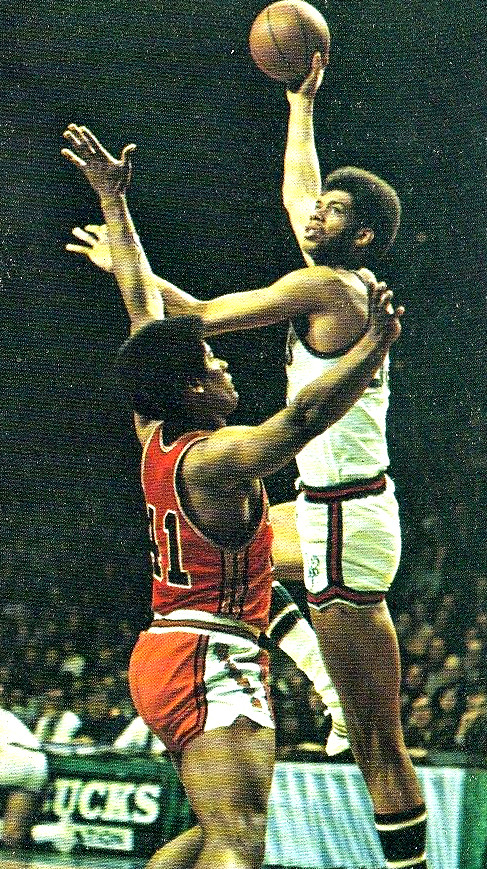
The Globetrotters offered Alcindor $1 million to play for them, but he declined and was picked first overall in the 1969 NBA draft by the Milwaukee Bucks, who were in only their second season of existence. The Bucks had won a coin toss with the Phoenix Suns for the first pick. He was also chosen first overall in the 1969 American Basketball Association draft by the New York Nets. The Nets believed that they had the upper hand in securing Alcindor's services because he was from New York; however, when Alcindor told both the Bucks and the Nets that he would accept only one offer from each team, he rejected the Nets' bid as too low. Sam Gilbert negotiated the contract along with Los Angeles businessman Ralph Shapiro at no charge. After Alcindor chose the Milwaukee Bucks' offer of $1.4 million, the Nets offered a guaranteed $3.25 million. Alcindor declined the offer, saying: "A bidding war degrades the people involved. It would make me feel like a flesh peddler, and I don't want to think like that."
Alcindor's presence enabled the Bucks to claim second place in the NBA's Eastern Division with a 56–26 record (improved from 27–55 the previous year). On February 21, 1970, he scored 51 points in a 140–127 win over the SuperSonics.{{cite web|url=https://www.basketball-reference.com/boxscores/197002210MIL.html|title=Seattle SuperSonics vs Milwaukee Bucks Box Score, February 21, 1970
First championship, MVP, and Finals MVP (1970–1971)
The next season, the Bucks acquired All-Star guard Oscar Robertson. Milwaukee went on to record the best record in the league with 66 victories in the 1970–71 season, including a then-record 20 straight wins. Alcindor was awarded his first of six NBA Most Valuable Player Awards, along with his first scoring title (31.7 ppg). He also led the league in total points, with 2,596. The Bucks won the NBA title, sweeping the Baltimore Bullets 4–0 in the 1971 NBA Finals. Alcindor posted 27 points, 12 rebounds and seven assists in Game 4, and he was named the Finals MVP after averaging 27 points per game on 60.5% shooting in the series.
MVP recognition and trade request (1971–1975)
During the offseason, Alcindor and Robertson joined Bucks head coach Larry Costello on a three-week basketball tour of Africa on behalf of the State Department. In a press conference at the State Department on June 3, 1971, he stated that going forward he wanted to be called by his Muslim name, Kareem Abdul-Jabbar, its translation roughly "noble one, servant of the Almighty i.e., servant of [God]".
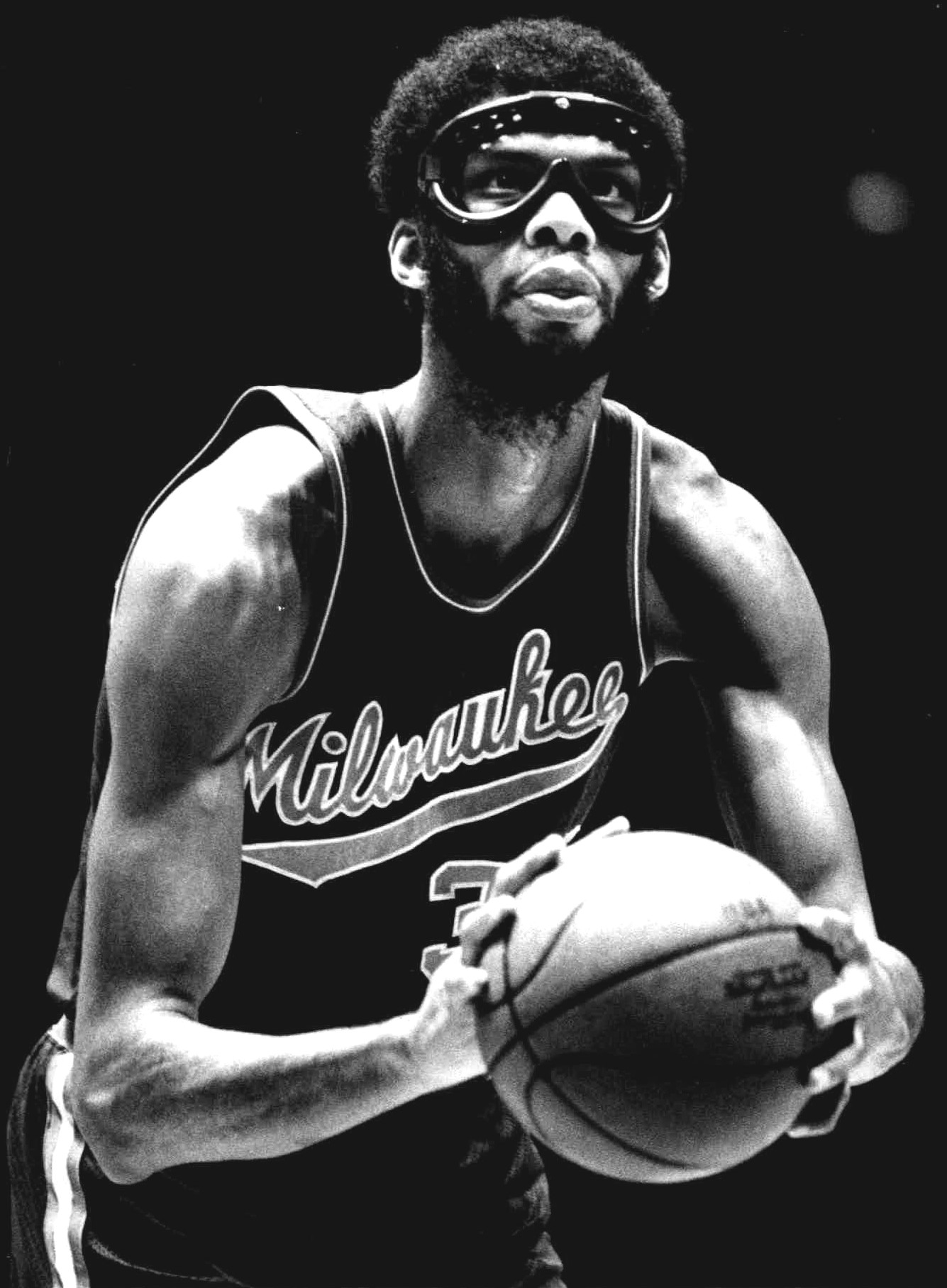
Abdul-Jabbar remained a dominant force for the Bucks. The following year, he repeated as scoring champion (34.8 ppg and 2,822 total points) In 1974, Abdul-Jabbar led the Bucks to their fourth consecutive Midwest Division title, and he won his third MVP Award in four years. He was among the top five NBA players in scoring (27.0 ppg, third), rebounding (14.5 rpg, fourth), blocked shots (283, second), and field goal percentage (.539, second).
Robertson, who became a free agent in the offseason, retired in September 1974 after he was unable to agree on a contract with the Bucks. On October 3, Abdul-Jabbar privately requested a trade to the New York Knicks, with his second choice being the Washington Bullets (now the Wizards) and his third, the Los Angeles Lakers. Two days later in a pre-season game before the 1974–75 season against the Celtics in Buffalo, New York, Abdul-Jabbar caught a fingernail in his left eye from Don Nelson and suffered a corneal abrasion; this angered him enough to punch the backboard stanchion, breaking two bones in his right hand. On March 13, 1975, sportscaster Marv Albert reported that Abdul-Jabbar requested a trade to either New York or Los Angeles, preferably to the Knicks. The following day after a loss in Milwaukee to the Lakers, Abdul-Jabbar confirmed to reporters his desire to play in another city. He averaged 30.0 points during the season, but Milwaukee finished in last place in the division at 38–44.
Los Angeles Lakers (1975–1989)
Fourth and fifth MVP awards (1975–1977)

In 1975, the Lakers acquired Abdul-Jabbar and reserve center Walt Wesley from the Bucks for center Elmore Smith, guard Brian Winters, blue-chip rookies Dave Meyers and Junior Bridgeman, and cash. His 1,111 defensive rebounds remains the NBA single-season record (defensive rebounds were not recorded prior to the 1973–74 season). He earned his fourth MVP award, becoming the first winner in Lakers' franchise history, but missed the post-season for the second straight year as the Lakers finished 40–42.
After acquiring a cast of no-name free agents, the Lakers were projected to finished near the bottom of the Pacific Division in 1976–77. Abdul-Jabbar helped lead the team to the best record (53–29) in the NBA, and he won his fifth MVP award, tying Bill Russell's record. Abdul-Jabbar led the league in field goal percentage (.579), was third in scoring (26.2), and was second in rebounds (13.3) and blocked shots (3.18). In the playoffs, the Lakers beat the Golden State Warriors in the Western Conference semifinals, setting up a confrontation with the Portland Trail Blazers. The result was a memorable matchup, pitting Abdul-Jabbar against a young, injury-free Bill Walton. Although Abdul-Jabbar dominated the series statistically, Walton and the Trail Blazers (who were experiencing their first-ever run in the playoffs) swept the Lakers, behind Walton's skillful passing and timely plays.
Playoff disappointments (1977–1979)
Two minutes into the opening game of the 1977–78 season, Abdul-Jabbar broke his right hand punching Milwaukee's Kent Benson in retaliation to the rookie's elbow to his stomach. Benson suffered a black right eye and required two stitches. According to Benson, Abdul-Jabbar initiated the elbowing, but there were no witnesses and it was not captured on replays. He was fined a then-league record $5,000 but was not suspended. The Lakers were 8–13 when Abdul-Jabbar returned. He was not named to the 1978 NBA All-Star Game, the only time in his 20-year career he was not selected to an All-Star Game. Chicago's Artis Gilmore and Detroit's Bob Lanier were chosen as reserves for the West, with Walton starting at center. Amid criticism from the media over his performance, Abdul-Jabbar had 39 points, 20 rebounds, six assists and four blocks in a win over the Philadelphia 76ers the day the All-Star rosters were announced. He added 37 points and 30 rebounds in a victory over the New Jersey Nets (now Brooklyn) in the final game before the All-Star break.
Abdul-Jabbar's play remained strong during the next two seasons, being named to the All-NBA Second Team twice, the All-Defense First Team once, and the All-Defense Second Team once. The Lakers, however, continued to be stymied in the playoffs, being eliminated by the Seattle SuperSonics in both 1978 (first round) and 1979 (semifinals).
Last MVP award and championship success (1979–1985)
.jpg)
The Lakers selected Magic Johnson with the first overall pick of 1979 NBA draft. They had acquired the pick from the New Orleans Jazz (later Utah) in 1976, when league rules required that they compensate Los Angeles for their signing of free agent Gail Goodrich. The addition of Johnson paved the way for the Lakers' Showtime dynasty of the 1980s, appearing in the finals eight times and winning five NBA championships. While less dominant than in his younger years, Abdul-Jabbar reinforced his status as one of the greatest basketball players ever, In the 1980 finals, Abdul-Jabbar averaged 33.4 points in five games, spraining his ankle in Game 5, but returning to finish the contest with 40 points and leading the team to a win. He missed Game 6, when the Lakers clinched the title, and Johnson was named the Finals MVP after recording 42 points, 15 rebounds, and seven assists in the finale.
Abdul-Jabbar continued to average 20 or more points per game in the following six seasons. In 14 playoff games, he finished with a 20.4 point average, the lowest of his career at the time. Malone had 27 offensive rebounds, which nearly equaled Abdul-Jabbar's total rebounds (30).
Before the 1983–84 season, Abdul-Jabbar signed a two-year, $3 million contract with the Lakers, with none of the amount deferred. He fell ill with viral hepatitis during training camp, rendering him weak for a month after returning. He scored 10 points at Golden State on December 22, 1983, dropping his season average to 17.7, almost 10 points below his career average. His scoring picked up after Christmas. On the road against Utah on April 5, 1984, Abdul-Jabbar broke Chamberlain's record for most career points in the NBA. He received a pass from Johnson and scored from 15 ft on his patent skyhook over the 7 ft shot-blocking specialist Mark Eaton. For the first time since the 1980–81 season, Abdul-Jabbar led the Lakers in both scoring (21.5) and rebounding (7.3) during the season. Playing consistently better than he had over the past few years, he was named to the All-NBA First Team for the ninth time in his career, and he was voted to the All-NBA Defensive Second Team, the final all-defensive selection of his career. The team advanced to the 1984 NBA Finals but lost to Boston.
.jpg)
The 1984–85 season was expected to be Abdul-Jabbar's final season, as he had maintained since breaking Chamberlain's record that he would be retiring. Teams began honoring him in his final appearance in their home arena, but the Lakers instructed them not to use the word retirement in their ceremony. On December 5, 1984, Abdul-Jabbar agreed to a one-year, $2 million contract extension with the Lakers, with none of the money deferred. He won his second Finals MVP in 1985, He averaged 25.7 points, 9 rebounds, 5.2 assists and 1.5 blocks in the series against the Celtics. He was initially outplayed in Game 1, scoring 12 points with three rebounds against 30-year-old Boston center Robert Parish, who had 18 points and eight rebounds in a 148–114 win over the Lakers, dubbed the "Memorial Day Massacre". The title ended the Celtics' streak of eight consecutive championships against the Lakers.
Final playing years and sixth ring (1985–1989)
Abdul-Jabbar played in his 17th season in 1985–86, breaking the previous NBA record for seasons played of 16, held by Dolph Schayes, John Havlicek, Paul Silas, and Elvin Hayes. On November 12, 1985, he signed to a one-year extension of his contract at the same $2 million salary, while maintaining the option to retire after the 1985–86 season. Prior to the 1986–87 season, he gained 13 lb, reaching close to 270 lb, to compete against the growing number of 7-footers (2.1 m) in the league. The Lakers advanced to the NBA Finals in each of his final three seasons, starting with a championship over Boston in 1987.
Riley guaranteed that the Lakers would be the first NBA team to win consecutive titles since the 1968–69 Celtics, and they defeated the Detroit Pistons for the championship in 1988. Abdul-Jabbar made only 3 of 14 shots in Game 6 of the finals, but he converted two free throws with 14 seconds remaining to extend the series to seven games. His points, rebounds, and minutes had dropped in his 19th season, and there were reports prior to the game that he was retiring after the contest. On his "retirement tour" he received standing ovations at games, both home and away, and gifts ranging from a yacht that said "Captain Skyhook" to framed jerseys from his career to a Persian rug. At the Forum against Seattle in his final regular season game, The Lakers lost to the Pistons in a four-game sweep in the 1989 finals.
At the time of his retirement, Abdul-Jabbar held the record for most career games played in the NBA. He was also the all-time record holder for most minutes played (57,446), most field goals made (15,837), most points (38,387), and most 1,000-point seasons (19).
Coaching career
In 1995, Abdul-Jabbar began expressing an interest in coaching and imparting knowledge from his playing days. His opportunities were limited despite the success he enjoyed during his playing days. During his playing years, Abdul-Jabbar had developed a reputation for being introverted and sullen. He was often unfriendly with the media. His sensitivity and shyness created a perception of him being aloof and surly. At the time, his mentality was that he either did not have the time or did not owe anything to anyone. Magic Johnson recalled as a kid being brushed off after asking him for an autograph. Abdul-Jabbar might freeze out a reporter if they touched him, and he once refused to stop reading the newspaper while giving an interview.
Abdul-Jabbar had spent most of his career with a reserved attitude towards media attention (since he did not have to deal with it as a star at UCLA) before he softened up near the end of his career. Abdul-Jabbar said: "I didn't understand that I also had affected people that way and that's what it was all about. I always saw it like they were trying to pry. I was way too suspicious and I paid a price for it." However, he believes it was his reputation as a "difficult person", alongside his attempts at trying to break into coaching while nearing the age of fifty, that affected his chances of becoming a head coach within the NBA or NCAA.
Abdul-Jabbar worked as an assistant for the Los Angeles Clippers and the Seattle SuperSonics, helping mentor, among others, their young centers, Michael Olowokandi and Jerome James. Abdul-Jabbar was the head coach of the Oklahoma Storm of the United States Basketball League in 2002, leading the team to the league's championship that season, but he failed to land the head coaching position at Columbia University a year later. He then worked as a scout for the New York Knicks. He returned to the Lakers as a special assistant coach to Phil Jackson for six seasons (2005–2011). Early on, he mentored their young center, Andrew Bynum. Abdul-Jabbar also served as a volunteer coach at Alchesay High School on the Fort Apache Indian Reservation in Whiteriver, Arizona, in 1998. He moved on from coaching in 2013 after unsuccessfully lobbying for open head coach positions with UCLA and the Milwaukee Bucks.
Player profile
On offense, Abdul-Jabbar was a dominant low-post threat. In contrast to other low-post specialists like Wilt Chamberlain or Shaquille O'Neal, he was a slender giant, standing tall while weighing around 240 to, although he bulked to 270 lb in 1986; in his early years, he used that frame for agility and speed while in later years he utilized a bigger frame for trying to guard under the basket. Abdul-Jabbar was famous for his ambidextrous skyhook shot. It contributed to his .559 career field goal percentage, which ranked eighth in NBA history at the time of his retirement, and reputation as a feared clutch shooter. He shot above 50% in every season but his last.
Abdul-Jabbar maintained a dominant presence on defense. He was selected to the NBA All-Defensive Team eleven times. After the pounding he endured early in his career, his rebounding average fell to between six or eight a game in his latter years. He had an even temperament, which Riley said made him coachable.
A strict fitness regime made Abdul-Jabbar one of the most durable players of all time. He began a year-around conditioning program at age 26. While in Los Angeles, Abdul-Jabbar started doing yoga in 1976 to improve his flexibility, and was notable for his physical fitness regimen. He said: "There is no way I could have played as long as I did without yoga." Because of his metabolism, he had difficulty putting on weight. Prior to the 1979–80 season, he gained 10 lb from 240 to 250 lb after switching from free weights to Nautilus equipment. He also switched that offseason from tai chi to yoga. To reduce wear during his later years, Riley did not have him inbound the ball on made baskets, and had him wait at the opposite end of the court on free throws. In what he described as playing a "smarter game" to conserve energy, Abdul-Jabbar sometimes would be the last player to set up on offense by several seconds after staying behind on defense to see if the Lakers scored on a fast break. In 1981, he responded to criticism that he did not hustle: "You have to understand I have to play 42 to 45 minutes a night, and it's like mowing a huge estate lawn. If you rush out and run around furiously, it's self-defeating. You'll be worn out just at the point when you're most needed." Abdul-Jabbar finished his career with then-NBA records of 20 seasons and 1,560 games played, later broken by former Celtics center Robert Parish.
Abdul-Jabbar began wearing his trademark goggles after getting poked in the eye during preseason in 1974. He continued wearing them for years until abandoning them in the 1979 playoffs. He resumed wearing goggles in October 1980 after being accidentally poked in the right eye by Houston's Rudy Tomjanovich. After years of being jabbed in the eyes, Abdul-Jabbar developed corneal erosion syndrome, occasionally experiencing pain when his eyes dry up. He missed three games in December 1986 due to the condition.
Skyhook
Abdul-Jabbar was well known for his trademark skyhook, a hook shot in which he raised the ball and released it at the highest point of his arm's arching motion. He could shoot the skyhook from up to 16 ft. With his long arms and great height, he released the ball so high that it was difficult for a defender to block without committing a goaltending violation. His body being between the defender and the ball made it further difficult to block, as did extending his non-shooting arm to fend off opponents. He was stronger shooting the skyhook with his right hand than he was with his left, which he developed in his later years.
According to Abdul-Jabbar, he learned the move in fifth grade after practicing with the ambidextrious Mikan Drill and soon learned to value it, as it was "the only shot I could use that didn't get smashed back in my face". He also watched Cliff Hagan shoot the hook with the St. Louis Hawks.
Legacy
Abdul-Jabbar won a record six MVP awards. Abdul-Jabbar attended the game, and passed the game ball to James during the in-game ceremony after the record was broken. Abdul-Jabbar held the scoring mark for nearly 39 years, the longest span in league history. His skyhook is considered one of the most unstoppable shots ever. Abdul-Jabbar was named to the NBA's 35th, 50th, and 75th anniversary teams. He averaged 24.6 points, 11.2 rebounds, 3.6 assists, and 2.6 blocks per game in his career, including three straight seasons where he averaged at least 30 points and 16 rebounds, and six times he averaged at least 27 points and 14.5 rebounds in the same season. He is ranked as the NBA's third leading all-time rebounder (17,440). He is the third all-time in registered blocks (3,189), which is impressive because this basketball statistic was not recorded until the fourth year of his career (1974). He is one of five players who have led the NBA in rebounding and blocks in the same season.
Abdul-Jabbar combined dominance during his career peak with the longevity and sustained excellence of his later years. A pioneer in using yoga in the NBA, Abdul-Jabbar played in 95 percent of his team's regular-season games during his career,
Among the most graceful basketball players ever, and ranked No. 4 in Slams "Top 100 Players Of All-Time" in 2018, and No. 3 in ESPN's list of the top 74 NBA players of all time in 2020, the best center ever ahead of Bill Russell and Chamberlain. League experts and basketball legends frequently mentioned him when considering the greatest player of all time. Riley said in 1985: "Why judge anymore? When a man has broken records, won championships, endured tremendous criticism and responsibility, why judge? Let's toast him as the greatest player ever." Isiah Thomas remarked: "If they say the numbers don't lie, then Kareem is the greatest ever to play the game." In 2013, Julius Erving said: "In terms of players all-time, Kareem is still the number one guy. He's the guy you gotta start your franchise with." In 2015, ESPN named Abdul-Jabbar the best center in NBA history, In 2022, he was ranked No. 3 (first in his position) in ESPN's NBA 75th Anniversary Team list, and No. 3 (behind Jordan and James) in a similar list by The Athletic.
Abdul-Jabbar was also the first ever NBA player to sign a sneaker endorsement deal with Adidas in 1978. He went on to become the first ever player with a signature shoe shortly after. In 2014, the UCLA Bruins wore "The Blueprint" Crazy 8 against Colorado on Feb. 13, and the shoes were sold online and at an Adidas store in New Orleans—during NBA All-Star weekend—starting on Feb. 14.
NBA career statistics
Regular season
| - |
|---|
| 82 |
| - |
| 81 |
| - |
| 76 |
| - |
| 81 |
| - |
| 65 |
| - |
| 82 |
| - |
| 82 |
| - |
| 62 |
| - |
| 80 |
| - |
| 82 |
| - |
| 80 |
| - |
| 76 |
| - |
| 79 |
| - |
| 80 |
| - |
| 79 |
| - |
| 79 |
| - |
| 78 |
| - |
| 80 |
| - |
| 74 |
| - class="sortbottom" |
| 1,560 |
| - class="sortbottom" |
| 18 |
Playoffs
|- | 10 || || 43.5 || .567 || || .733 || 16.8 || 4.1 || || || 35.2 |- | 14 || || 41.2 || .515 || || .673 || 17.0 || 2.5 || || || 26.6 |- | 11 || || 46.4 || .437 || || .704 || 18.2 || 5.1 || || || 28.7 |- | 6 || || 46.0 || .428 || || .543 || 16.2 || 2.8 || || || 22.8 |- | 16 || ||47.4 || .557 || || .736 || 15.8 || 4.9 || 1.3 || 2.4 || 32.2 |- | 11 || || 42.5 || .607 || || .725 || 17.7 || 4.1 || 1.7 || 3.5 || 34.6 |- | 3 || || 44.7 || .521 || || .556 || 13.7 || 3.7 || .7 || 4.0 || 27.0 |- | 8 || || 45.9 || .579 || || .839 || 12.6 || 4.8 || 1.0 || 4.1 || 28.5 |- | 15 || || 41.2 || .572 || || .790 || 12.1 || 3.1 || 1.1 || 3.9 || 31.9 |- | 3 || || 44.7 || .462 || || .714 || 16.7 || 4.0 || 1.0 || 2.7 || 26.7 |- | 14 || || 35.2 || .520 || || .632 || 8.5 || 3.6 || 1.0 || 3.2 || 20.4 |- | 15 || || 39.2 || .568 || .000 || .755 || 7.7 || 2.8 || 1.1 || 3.7 || 27.1 |- | 21 || || 36.5 || .555 || || .750 || 8.2 || 3.8 || 1.1 || 2.1 || 23.9 |- | 19 || 19 || 32.1 || .560 || || .777 || 8.1 || 4.0 || 1.2 || 1.9 || 21.9 |- | 14 || 14 || 34.9 || .557 || || .787 || 5.9 || 3.5 || 1.1 || 1.7 || 25.9 |- | 18 || 18 || 31.1 || .530 || .000 || .795 || 6.8 || 2.0 || .4 || 1.9 || 19.2 |- | 24 || 24 || 29.9 || .464 || .000 || .789 || 5.5 || 1.5 || .6 || 1.5 || 14.1 |- | 15 || 15 || 23.4 || .463 || || .721 || 3.9 || 1.3 || .3 || .7 || 11.1 |- class="sortbottom" | 237 || 90 || 37.3 || .533 || .000 || .740 || 10.5 || 3.2 || 1.0 || 2.4 || 24.3
Awards and honors
.svg)
Halls of Fame
- National Collegiate Basketball Hall of Fame – Class of 2007
- Naismith Memorial Basketball Hall of Fame – Class of 1995
- NYC Basketball Hall of Fame – Inaugural Class of 1990
- Pac-12 Conference Hall of Honor – Class of 2003
- UCLA Athletics Hall of Fame – Inaugural Class of 1984
High School
- 2× Mr. Basketball USA (1964, 1965)
- 3× First-team Parade All-American (1963–1965)
- 3× CHSAA champion (1963–1965)
NCAA
- 3× National College Player of the Year
- 3× Helms Foundation College Basketball Player of the Year (1967–1969)
- 2× Associated Press College Basketball Player of the Year (1967, 1969)
- 2× Sporting News College Basketball Player of the Year (1967, 1969)
- 2× Oscar Robertson Trophy winner (1967, 1968)
- 2× UPI College Basketball Player of the Year (1967, 1969)
- Naismith College Player of the Year (1969)
- 3× Consensus first-team All-American (1967–1969)
- 3× NCAA champion (1967–1969)
- 3× NCAA Tournament Most Outstanding Player (1967–1969)
- 3× Pac-8 regular season champion (1967–1969)
- 3× First-team All-Pac-8 (1967–1969)
- 3× Pac-8 scoring champion (1967–1969)
- 3× Pac-8 rebounding leader (1967–1969)
- Pac-12 Player of the 20th Century
- Pac-12 All-Century Team
- No. 33 retired by UCLA Bruins
- UC Presidential Medal (2024)
- Pac-12 records
- Points per game, career: 26.42
- Points per game, single-season: 29 (1967)
- Total points, single-season: 870 (1967)
NBA
- 6× NBA champion (1971, 1980, 1982, 1985, 1987, 1988)
- 2× NBA Finals MVP (1971, 1985)
- 6× NBA MVP (1971, 1972, 1974, 1976, 1977, 1980)
- 19× NBA All-Star (1970–1977, 1979–1989)
- 15× All-NBA
- 10× First team (1971–1974, 1976–1977, 1980, 1981, 1984, 1986)
- 5× Second team (1970, 1978, 1979, 1983, 1985)
- 11× NBA All-Defensive Team
- 5× First team (1974, 1975, 1979, 1980, 1981)
- 6× Second team (1970, 1971, 1976, 1977, 1978, 1984)
- NBA Rookie of the Year (1970)
- NBA All-Rookie First Team ()
- 2× NBA scoring champion (, )
- NBA rebounding leader ()
- 4× NBA blocks leader (, , , )
- Elected to the NBA 35th Anniversary Team
- One of the 50 Greatest Players in NBA History (1996)
- Elected to the NBA 75th Anniversary Team (2021)
- No. 33 retired by Milwaukee Bucks
- No. 33 retired by Los Angeles Lakers
- November 16, 2012 – a statue of Abdul-Jabbar was unveiled in front of Staples Center in Los Angeles As head coach:
- USBL champion (2002) As assistant coach:
- 2× NBA champion (, )
Media
- 6× Sporting News NBA MVP (1971, 1972, 1974, 1976, 1977, 1980)
- 2× Sam Davis Memorial Award (1971, 1974)
- Sports Illustrated Sportsperson of the Year (1985)
- Sporting News Rookie of the Year (1970)
- Hy Turkin Memorial Award (1970)
- Associated Press NBA 1970s All-Decade First Team
- Academy of Achievement Golden Plate Award (1989)
- Marca Leyenda (2010)
- Sports Illustrated's Muhammad Ali Legacy Award (2016)
- W. E. B. Du Bois Medal (2022)
Film and television
Playing in Los Angeles facilitated Abdul-Jabbar's trying his hand at acting. He made his film debut in Bruce Lee's 1972 film Game of Death.
In 1980, Abdul-Jabbar played co-pilot Roger Murdock in Airplane!, spoofing the appearance of football star Elroy "Crazylegs" Hirsch as an airplane pilot in the 1957 drama that served as the main source of inspiration for Airplane!, Zero Hour!. In Airplane!, there is a scene in which a little boy invited to the cockpit looks at Abdul-Jabbar and remarks that he is in fact Abdul-Jabbar. This causes Abdul-Jabbar's character to snap and break character: "The hell I don't!" He then grabs the boy and snarls that he has "been hearing that crap ever since I was at UCLA" and is on the court "busting my buns every night." He instructs the boy: "Tell your old man to drag [Bill] Walton and [Bob] Lanier up and down the court for 48 minutes." Later in the film, Murdock loses consciousness and collapses at the controls wearing Abdul-Jabbar's goggles and yellow Lakers shorts.

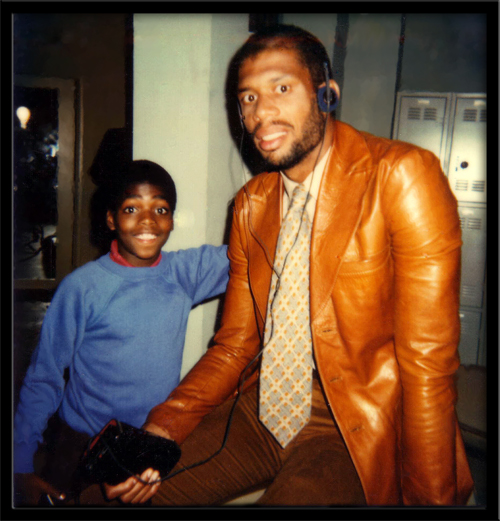
Abdul-Jabbar has had numerous other television and film appearances, often playing himself. He has had roles in movies such as Fletch, Troop Beverly Hills and Forget Paris, and television series such as Full House, Living Single, Amen, Everybody Loves Raymond, Martin, Diff'rent Strokes (his height humorously contrasted with that of diminutive child star Gary Coleman), The Fresh Prince of Bel-Air, Scrubs, 21 Jump Street, Emergency!, Man from Atlantis, and New Girl. Abdul-Jabbar played a genie in a lamp in a 1984 episode of Tales from the Darkside. He also played himself on the February 10, 1994, episode of the sketch comedy television series In Living Color.
Abdul-Jabbar appeared in the television version of Stephen King's The Stand, played the Archangel of Basketball in Slam Dunk Ernest, and had a brief non-speaking cameo appearance in BASEketball. Abdul-Jabbar was also the co-executive producer of the 1994 TV film The Vernon Johns Story. He has also made appearances on The Colbert Report in a 2006 skit called "HipHopKetball II: The ReJazzebration Remix '06", and in 2008 as a stage manager who is sent out on a mission to find Nazi gold. Abdul-Jabbar also voiced himself in a 2011 episode of The Simpsons titled "Love Is a Many Strangled Thing". He had a recurring role as himself on the NBC series Guys with Kids, which aired from 2012 to 2013.
Abdul-Jabbar appeared in the music video for "Good Goodbye", a 2017 song by rock band Linkin Park featuring rappers Pusha T and Stormzy. In the video, Abdul-Jabbar plays the role of a warlord or emperor of a dunk contest where Linkin Park lead singer Chester Bennington has to dunk on several people in order to save his own life. In an interview about the video, Bennington said that he believes Abdul-Jabbar is the "greatest [basketball] player of all-time".
In February 2019, he appeared in season 12 episode 16 of The Big Bang Theory, "The D&D Vortex". In 2021, Abdul-Jabbar made a guest appearance as himself in a season 2 episode of Dave. The episode he appeared in was also named after him. Abdul-Jabbar makes a cameo appearance as himself in the 2022 Netflix film Glass Onion: A Knives Out Mystery. In 2023, Abdul-Jabbar appeared as himself in season 7, episode 3 of the Showtime series Billions.
Writing
In September 2018, Abdul-Jabbar was announced as one of the writers for the July 2019 revival of Veronica Mars.
Documentaries
On February 10, 2011, Abdul-Jabbar debuted his film On the Shoulders of Giants, documenting the tumultuous journey of the famed yet often-overlooked New York Renaissance professional basketball team, at Science Park High School in Newark, New Jersey. The event was simulcast live throughout the school, city, and state. In 2015, he appeared in Kareem: Minority of One, an HBO documentary on his life. In 2020, Abdul-Jabbar was the executive producer and narrator of the History channel special Black Patriots: Heroes of the Revolution. He was nominated for an Emmy Award for his narration.
Reality television
Abdul-Jabbar participated in the 2013 ABC reality series Splash, a celebrity diving competition. In April 2018, Abdul-Jabbar competed in the all-athlete season of season 26 of Dancing with the Stars and partnered with professional dancer Lindsay Arnold.
Writing and activism

In 1967, Abdul-Jabbar was the only college athlete to attend the Cleveland Summit, a meeting of prominent black athletes who convened in support of Muhammad Ali's refusal to fight in the Vietnam War.
Abdul-Jabbar became a best-selling author and cultural critic. He published several books, mostly on African-American history. His first book, his autobiography Giant Steps, was written in 1983 with co-author Peter Knobler. The book's title is an homage to jazz great John Coltrane, referring to his album Giant Steps. Others include On the Shoulders of Giants: My Journey Through the Harlem Renaissance, co-written with Raymond Obstfeld, and Brothers in Arms: The Epic Story of the 761st Tank Battalion, World War II's Forgotten Heroes, co-written with Anthony Walton, which is a history of the first black armored unit to fight in World War II.
In 2015, Abdul-Jabbar made his adult fiction writing debut with the Victorian mystery novel Mycroft Holmes, based around the titular character from the Sherlock Holmes stories. Two sequels followed: Mycroft and Sherlock (2018) and Mycroft and Sherlock: The Empty Birdcage (2019). All three titles were co-written with Anna Waterhouse.
A regular contributor to discussions about issues of race and religion, among other topics, in national magazines and on television, Abdul-Jabbar has written a regular column for Time. He appeared on Meet the Press on January 25, 2015, to talk about a column saying that Islam should not be blamed for the actions of violent extremists, just as Christianity has not been blamed for the actions of violent extremists who profess Christianity. When asked about being Muslim, he said: "I don't have any misgiving about my faith. I'm very concerned about the people who claim to be Muslims that are murdering people and creating all this mayhem in the world. That is not what Islam is about, and that should not be what people think of when they think about Muslims. But it's up to all of us to do something about all of it."
In November 2014, Abdul-Jabbar published an essay in Jacobin calling for just compensation for college athletes, writing that "in the name of fairness, we must bring an end to the indentured servitude of college athletes and start paying them what they are worth." Commenting on Donald Trump's 2017 travel ban, he condemned it, saying: "The absence of reason and compassion is the very definition of pure evil because it is a rejection of our sacred values, distilled from millennia of struggle."
In 2017, Abdul-Jabber spoke at an event marking Ramadan organized by the Israeli consul Sam Grundwerg at the Israeli consulate in Los Angeles, stressing the importance of Muslim-Jewish relations and cross-cultural exchange.
In June 2021, he published an essay in Jacobin on the negative impact on public health of those refusing to receive the COVID-19 vaccine, criticizing Kyrie Irving, among others. Abdul-Jabbar began publishing an online newsletter in 2021.
Government appointments
Cultural ambassador
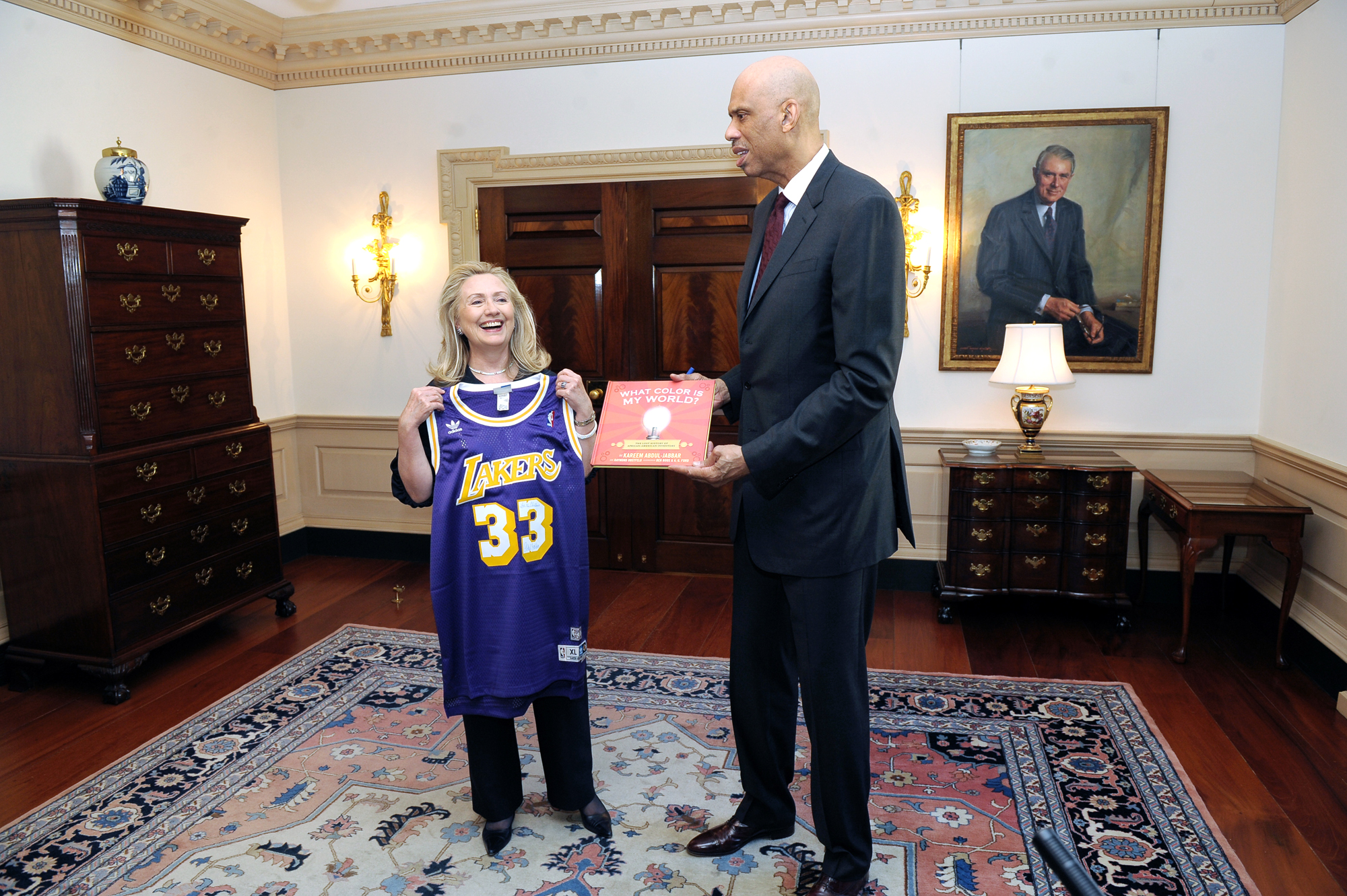
In January 2012, United States Secretary of State Hillary Clinton announced that Abdul-Jabbar had accepted a position as a cultural ambassador for the United States. During the announcement press conference, Abdul-Jabbar commented on the historical legacy of African-Americans as representatives of U.S. culture: "I remember when Louis Armstrong first did it back for President Kennedy, one of my heroes. So it's nice to be following in his footsteps." As part of this role, Abdul-Jabbar traveled to Brazil to promote education for local youths.
President's Council on Fitness, Sports, and Nutrition
Former President Barack Obama announced in his last days of office that he has appointed Abdul-Jabbar along with Gabrielle Douglas and Carli Lloyd to the President's Council on Fitness, Sports, and Nutrition.
Citizens Coinage Advisory Committee
In January 2017, Abdul-Jabbar was appointed to the Citizens Coinage Advisory Committee by United States Secretary of the Treasury Steven Mnuchin. According to the United States Mint, Abdul-Jabbar is a keen coin collector whose interest in the life of Alexander Hamilton had led him into the hobby. He resigned in 2018 due to what the Mint described as "increasing personal obligations".
Personal life

Abdul-Jabbar met Habiba Abdul-Jabbar (born Janice Brown) at a Lakers game during his senior year at UCLA. They married in 1971, and together had three children: daughters Habiba and Sultana and son Kareem Jr., who played basketball at Western Kentucky after attending Valparaiso. Abdul-Jabbar and Janice divorced in 1978. He has another son, Amir, with Cheryl Pistono. Another son, Adam, made an appearance on the TV sitcom Full House with him.
In 1983, Abdul-Jabbar's house burned down. Many of his belongings, including his beloved jazz LP collection of about 3,000 albums, were destroyed. Many Lakers fans sent and brought him albums, which he found uplifting.
In 2016, Abdul-Jabbar performed a tribute to friend Muhammad Ali along with Chance the Rapper.
Religion and name
Alcindor grew up in the Catholic Church, but abandoned the faith when he left his home in New York for UCLA. At age 24 in 1971, he converted to Islam and legally became Kareem Abdul-Jabbar, which means "noble one, servant of the Almighty". He was named by Hamaas Abdul Khaalis of the Hanafi Movement which split from the Nation of Islam. Abdul-Jabbar purchased and donated 7700 16th Street NW, a house in Washington, D.C., for Khaalis to use as the Hanafi Madh-Hab Center; a few years later, the location would become the place of the 1973 Hanafi Muslim massacre. Eventually, Kareem "found that [he] disagreed with some of Hamaas' teachings about the Quran, and [they] parted ways." In 1973, Abdul-Jabbar embarked on a pilgrimage to Libya and Saudi Arabia with the goal of learning enough Arabic for self-study of the Quran, and he "emerged from this pilgrimage with [his] beliefs clarified and [his] faith renewed". Abdul-Jabbar was also heavily influenced by Malcolm X, a leader of the Nation of Islam. Abdul-Jabbar was invited to join the group, but he declined.
Abdul-Jabbar has spoken about the thinking that was behind his name change when he converted to Islam. He stated that he was "latching on to something that was part of my heritage, because many of the slaves who were brought here were Muslims. My family was brought to America by a French planter named Alcindor, who came here from Trinidad in the 18th century. My people were Yoruba, and their culture survived slavery ... My father found out about that when I was a kid, and it gave me all I needed to know that, hey, I was somebody, even if nobody else knew about it. When I was a kid, no one would believe anything positive that you could say about black people. And that's a terrible burden on black people, because they don't have an accurate idea of their history, which has been either suppressed or distorted." His name change further eroded his public image in the United States, mostly in white areas.
In 1998, Abdul-Jabbar reached a settlement after he sued Miami Dolphins running back Karim Abdul-Jabbar (now Abdul-Karim al-Jabbar, born Sharmon Shah) because he felt Karim was profiting off the name he made famous by having the Abdul-Jabbar moniker and number 33 on his Dolphins jersey. As a result, the younger Abdul-Jabbar had to change his jersey nameplate to "Abdul" while playing for the Dolphins. The football player had also been an athlete at UCLA.
Health problems
Abdul-Jabbar suffers from migraines, and his use of cannabis to reduce the symptoms has had legal ramifications. In November 2009, Abdul-Jabbar announced that he was suffering from a form of leukemia, Philadelphia chromosome-positive chronic myeloid leukemia, a cancer of the blood and bone marrow. The disease was diagnosed in December 2008, but Abdul-Jabbar said his condition could be managed by taking oral medication daily, seeing his specialist every other month, and having his blood analyzed regularly. He expressed in a 2009 press conference that he did not believe the illness would stop him from leading a normal life. Abdul-Jabbar is a spokesman for Novartis, the company that produces Gleevec, his cancer medication.
In February 2011, Abdul-Jabbar announced via Twitter that his leukemia was gone and he was "100% cancer free". A few days later, he clarified his misstatement: "You're never really cancer-free and I should have known that. My cancer right now is at an absolute minimum."
In 2020, Abdul-Jabbar revealed that he had been diagnosed with prostate cancer eleven years earlier.
In February 2023, he spoke out about his atrial fibrillation diagnosis. He partnered with Bristol Myers Squibb and Pfizer's "No Time to Wait" to raise awareness of the symptoms of the irregular and rapid heart rhythm condition which increase the risk of stroke. In December 2023, he was hospitalized after he fell and broke his hip while attending a concert.
Non-athletic honors
In 2011, Abdul-Jabbar was awarded the Double Helix Medal for his work in raising awareness for cancer research. Also in 2011, Abdul-Jabbar received an honorary degree from New York Institute of Technology. In 2016, Abdul-Jabbar was awarded the Presidential Medal of Freedom by outgoing U.S. President Barack Obama. In 2020, Abdul-Jabbar was nominated for the Primetime Emmy Award for Outstanding Narrator for his work on the documentary special Black Patriots: Heroes of The Revolution. After receiving an honorary degree from the same, Abdul-Jabbar was named Harvard College Class Day speaker in 2025.
Works
Books
- Kareem, with Mignon McCarthy (1990) .
- Selected from Giant Steps (Writers' Voices) (1999) .
- Black Profiles in Courage: A Legacy of African-American Achievement, with Alan Steinberg (1996) .
- A Season on the Reservation: My Sojourn with the White Mountain Apaches, with Stephen Singular (2000) .
- Brothers in Arms: The Epic Story of the 761st Tank Battalion, World War II's Forgotten Heroes with Anthony Walton (2004) .
- On the Shoulders of Giants: My Journey Through the Harlem Renaissance with Raymond Obstfeld (2007) .
- What Color Is My World? The Lost History of African American Inventors with Raymond Obstfeld (2012) .
- Streetball Crew Book One Sasquatch in the Paint with Raymond Obstfeld (2013) .
- Streetball Crew Book Two Stealing the Game with Raymond Obstfeld (2015) .
- Mycroft Holmes with Anna Waterhouse (September 2015) .
- Writings on the Wall: Searching for a New Equality Beyond Black and White with Raymond Obstfeld (2016) .
- Coach Wooden and Me: Our 50-Year Friendship On and Off the Court (2017) .
- Becoming Kareem: Growing Up On and Off the Court (2017) .
- Mycroft and Sherlock with Anna Waterhouse (October 9, 2018) .
- Mycroft and Sherlock: The Empty Birdcage with Anna Waterhouse (September 24, 2019) .
Audio book
- On the Shoulders of Giants: An Audio Journey Through the Harlem Renaissance 8-CD Set Vol. 1–4, with Avery Brooks, Jesse L. Martin, Maya Angelou, Herbie Hancock, Billy Crystal, Charles Barkley, James Worthy, Julius Erving, Jerry West, Clyde Drexler, Bill Russell, Coach John Wooden, Stanley Crouch, Quincy Jones and other chart-topping musicians, as well as legendary actors and performers such as Samuel L. Jackson. (2008)
Notes
References
References
- "Kareem Abdul-Jabbar Bio".
- "NBA Legends: Profiling the league's greatest players".
- (2005). "Africana: The Encyclopedia of the African and African American Experience". [[Oxford University Press]].
- (September 13, 2021). "Legends profile: Kareem Abdul-Jabbar".
- (March 6, 2007). "The Game's Greatest Giants Ever". ESPN.
- (March 8, 2008). "25 Greatest Players in College Basketball". ESPN.
- (February 10, 2016). "All-Time #NBArank: Kareem No. 2". ESPN.
- (January 19, 2012). "Kareem Abdul-Jabbar named U.S. global cultural ambassador". Los Angeles Times.
- (November 16, 2016). "President Obama Names Recipients of the Presidential Medal of Freedom".
- (July 6, 2015). "KAREEM ABDUL-JABBAR".
- "Kareem Abdul-Jabbar Biography and Interview". American Academy of Achievement.
- (2001-01-01). "Caribbean American Heritage Month Wall of Fame Day 7: Kareem Abdul Jabbar "Big Al"".
- Karim, Andrew. (2017-11-03). "Kareem Abdul-Jabbar goes back to his roots".
- Jamie Greene (27 December 2017), [https://geekdad.com/2017/12/gbbp-162-kareem-abdul-jabbar/ "The Great Big Beautiful Podcast, Episode 162: Kareem Abdul-Jabbar"], ''Geek Dad''.
- "Childhood in New York".
- (March 1967). "Alcindor The Awesome".
- "African American Registry: Mr. Basketball and much more, Kareem Abdul-Jabbar!". The African American Registry.
- (2013). "Kareem Abdul-Jabbar biography".
- "ESPN.com: A dominate force".
- (2010). "Great athletes: Basketball". Salem Press.
- Didinger, Ray. (May 25, 1989). "They Still Remember Power's Tower".
- "Kareem Abdul-Jabbar".
- Zaccardi, Nick. (May 22, 2017). "Kareem Abdul-Jabbar details passing on 1968 Olympics in new book".
- Irving, Kyle. (February 9, 2023). "Kareem Abdul-Jabbar college stats: How many more NBA points could he have scored?". Sporting News.
- Abdul-Jabbar, Kareem. (April 19, 2012). "Freshman life has changed".
- Apodaca, Patrice. (March 21, 2014). "Let's pause and recall the influence of Jerry Norman". Daily Pilot.
- McSweeney, John. (February 25, 1966). "Rival cage coaches agree Alcindor may be greatest". Spokesman-Review.
- Smith, Dean. (October 2, 1983). "Why Freshman Should Not Play". The New York Times.
- (October 16, 1965). "21 Turn Out As UCLA Opens Cage Practice". The San Francisco Examiner.
- Lopresti, Mike. (March 3, 2017). "Remembering the start of UCLA's dynasty, 50 years later".
- Crowe, Jerry. (May 27, 1990). "A Grand Opening : Pauley Pavilion and UCLA's Best Freshman Team Made Their Debuts Together 25 Years Ago". Los Angeles Times.
- Florence, Mal. (November 28, 1965). "Who's No. 1? UCLA Frosh Too Hot for Varsity, 75–60". Los Angeles Times.
- Wittry, Andy. (August 12, 2020). "Kareem Abdul-Jabbar: College stats, best moments, quotes".
- "NCAA Men's Basketball Records".
- McLeaod, Mac. (April 8, 1976). "The Dunk Is Back, What Does It Bring". The Daily Item.
- Crowe, Jerry. (February 2, 2009). "His USC team stood around and waited to beat UCLA". Los Angeles Times.
- Johnson, Gary K.. (2005). "NCAA Men's Basketball Finest". National Collegiate Athletic Association.
- "Men's Basketball Award Winners".
- "Lew Alcindor HeadsHelms All American Hoop Quintet". The Daily Herald.
- Florence, Mal. (April 7, 1974). "Papa Sam Gilbert is someone special to UCLA cagers". Sarasota Herald-Tribune.
- Prugh, Jeff. (January 14, 1968). "Bruins win again without Alcindor. Big Lew Sidelined By Eye Injury Suffered in Game against Bears". [[Los Angeles Times]].
- (December 20, 1986). "Los Angeles Lakers center Kareem Abdul-Jabbar flew home from Dallas". [[United Press International]].
- Wizig, Jerry. (January 20, 1988). "It's been 20 years since they've played The Game of the Century". Houston Chronicle.
- Nguyen, Thuc Nhi. (January 19, 2018). "UCLA-Houston 'Game of the Century' still leaves impression 50 years later". [[Los Angeles Daily News]].
- Esper, Dwain. (March 25, 1968). "Bruins Hope Norman Stays". [[The Independent]].
- Gasaway, John. (June 7, 2010). "John Wooden's Century". Basketball Prospectus.
- "Lew's Revenge: The Rout of Houston".
- Diamant, Jeff. (2010). "Abdul-Jabbar, Kareem (Lew Alcindor)". Facts On File.
- Streeter, Kurt. (February 7, 2023). "Kareem Abdul-Jabbar Is Greater Than Any Basketball Record". The New York Times.
- Smith, Johnny. (March 30, 2018). "The reign of Lew Alcindor in the age of revolt". [[Andscape]].
- (May 2, 1972). "Black Journal; 60; Kareem". American Archive of Public Broadcasting.
- (January 27, 2006). "Lakers Now". Los Angeles Times.
- Huang, Mike. (November 30, 2017). "How Bruce Lee became a muse for Kareem and an All-Rookie guard".
- (October 2, 2019). "UCLA 2019–2020 Men's basketball Information Guide".
- (November 19, 2009). "2009–10 UCLA men's basketball media guide".
- "New York Nets (1968–1975) 1969 Stats, History, Awards and More".
- (April 7, 1969). "Scorecard".
- (March 30, 1969). "Alcindor Rejects A.B.A.'s $3.2-Million Offer and Will Sign With Bucks". The New York Times.
- "Philadelphia 76ers at Milwaukee Bucks Box Score, April 3, 1970". Basketball-Reference.
- (November 25, 2021). "Top 10 NBA Players With The Most PPG During A Rookie Season: Wilt Chamberlain Was A Scoring God Since His First Season".
- (June 18, 2018). "Jayson Tatum's rookie season ranks alongside best in Celtics' history". Sporting News.
- (December 15, 1971). "... And Bucks Win Sixth". The Ithaca Journal.
- (May 1, 2021). "Oscar Had No Doubt". Wisconsin State Journal.
- Spears, Marc J.. (July 12, 2021). "Giannis dominating like Kareem revives Bucks' title hopes". [[Andscape]].
- Smith, Terence. (June 4, 1971). "Biggest Name in N.B.A.: Jabbar". The New York Times.
- Seppy, Tom. (June 4, 1971). "Kareem Abdul Jabbar (Also Known As Lew Alcindor) To Tour Africa". Sheboygan Press.
- (March 22, 1971). "Abdul-Jabbar is Most Valuable". Kenosha News.
- (October 24, 1974). "Basketball Pro Chart". The Lompoc Record.
- (March 21, 1974). "Jabbar—Most Valuable Player". The Fresno Bee.
- Deb, Sopan. (July 11, 2021). "The Bucks Have Big-Time Supporters: Kareem and Oscar Robertson". The New York Times.
- Putnam, Pat. (December 9, 1974). "Return of Ol Goggle-Eyes".
- Goldaper, Sam. (September 4, 1974). "Robertson Ends Career". The New York Times.
- Goldaper, Sam. (March 18, 1975). "Bucks See No Need Now to Make Deal for Unhappy Abdul-Jabbar". [[The New York Times]].
- (May 30, 2001). "Say It Ain't So Milwaukee Bucks".
- Bonk, Thomas. (December 25, 1987). "June 16, 1975: A Banner Day For Lakers : Kareem Takes His Post : 4 Players Bucks Got in Trade Gone, but He's Still on Job". Los Angeles Times.
- (October 6, 1974). "Abdul-Jabbar Fractures Hand". The New York Times.
- (November 25, 1974). "Kareem Looks Different, Acts The Same". Wisconsin State Journal.
- (March 15, 1975). "Jabbar Finally Confirms It: He Wants To Be Traded". Los Angeles Times.
- Cady, Steve. (June 17, 1975). "Abdul-Jabbar Traded by Bucks for Four Lakers". The New York Times.
- (October 7, 1976). "Kareem keeps getting better". The Bakersfield Californian.
- Bock, Hal. (May 14, 1995). "Special K : Kareem Abdul-Jabbar Survived on Talent and a Quiet Dignity". Los Angeles Times.
- (April 2, 1976). "The Players' Player: Jabbar". Los Angeles Times.
- Abadie, Chuck. (April 13, 1976). "Jabbar is most valuable player?". Hattiesburg American.
- Goldaper, Sam. (May 24, 1977). "Abdul-Jabbar Is Chosen M.V. P. for a Fifth Time". The New York Times.
- Dwyer, Kelly. (September 4, 2014). "Dunk History: A healthy Bill Walton meets Kareem Abdul-Jabbar at the summit". Ball Dont Lie.
- Kirkpatrick, Curry. (May 23, 1977). "L.A. Couldn't Move the Mountain".
- Green, Ted. (October 19, 1977). "Jabbar scores KO Over Benson". Los Angeles Times.
- Montgomery, Paul L.. (October 21, 1977). "Abdul-Jabbar Fined $5,000 for One Punch". The New York Times.
- Wolfley, Pete. (February 20, 2011). "Benson's NBA start did not lack punch". Milwaukee Journal-Sentinel.
- Simmons, Bill. (2009). "The Book of Basketball: The NBA According to the Sports Guy". Ballantine and ESPN Books.
- Bonk, Thomas. (May 16, 1985). "Abdul-Jabbar Tells His Side of the Fight—Just to League Office". Los Angeles Times.
- Green, Ted. (December 4, 1977). "An Added Punch*". Los Angeles Times.
- (February 11, 1989). "Jabbar replaces Magic for 19th All-Star game". Journal Gazette.
- (January 25, 1978). "After Another Hearing, Kuhn Still Undecided on Blue Deal". Los Angeles Times.
- Green, Ted. (January 25, 1978). "Jabbar Silences Critics, 76ers—and Jabbar". Los Angeles Times.
- Green, Ted. (February 4, 1978). "Lakers Pull One Out of the Fire". Los Angeles Times.
- {{cite basketball-reference
- Green, Ted. (April 26, 1979). "SuperSonics Finish Off The Lakers, 106–101". Los Angeles Times.
- Pearlman, Jeff. (May 14, 2014). "The 'Magic' coin flip (book excerpt)".
- Knoblauch, Austin. (October 11, 2011). "Kareem Abdul-Jabbar". Los Angeles Times.
- Mahoney, Rob. (March 2, 2022). "The Ineffable Cool—and Playing Style—That Made the Showtime Lakers 'Showtime'". The Ringer.
- Hollinger, John. (June 16, 2011). "Greatest Finals performances: 21-30".
- [[#simmons2009. Simmons 2009]], [https://archive.org/details/bookofbasketball00simm/page/598/mode/1up p. 598].
- Johnson, Roy S.. (June 2, 1985). "For Abdul-Jabbar, It's a Matter of Pride". The New York Times.
- Aschburner, Steve. (September 13, 2015). "Moses Malone, dead at 60, was an NBA elite". National Basketball Association.
- Hollinger, John. (June 16, 2011). "Greatest Finals performances: 11-20". ESPN.
- Bonk, Thomas. (October 11, 1983). "Nixon Traded to San Diego; Kareem Signs". Los Angeles Times.
- Newman, Bruce. (April 16, 1984). "A SKY HOOK THAT WAS FOR THE BOOK".
- Schwartz, Larry. "Kareem just kept on winning".
- Strasen, Marty. (2004). "The Best Book of Basketball Facts & Stats". Firefly Books.
- (February 2, 2023). "Kareem Abdul-Jabbar Was the 'Best Weapon in Basketball'". The New York Times.
- Johnson, Roy S.. (April 7, 1984). "ABDUL-JABBAR MAKES RETIREMENT POINTS". The New York Times.
- Fink, David. (October 16, 1984). "Abdul-Jabbar says he'll retire". Pittsburgh Post-Gazette.
- Littwin, Mike. (October 25, 1984). "Lakers Are Hoping Abdul-Jabbar Has a Change of Heart". Los Angeles Times.
- Nightengale, Bob. (December 2, 1984). "Abdul-Jabbar vague on retirement". The Kansas City Star.
- Jasner, Phil. (December 23, 1984). "Kareem continues for Lucky Lakers". The Sunday Dispatch.
- Barnard, William R.. (November 23, 1984). "Abdul-Jabbar still unsure about retirement". The Messenger.
- Bonk, Thomas. (December 6, 1984). "Abdul-Jabbar Will Play Another Year—for $2 Million". Los Angeles Times.
- Zillgitt, Jeff. (May 2, 2020). "Day 52 without sports 🏀: Don't forget Kareem Abdul-Jabbar in greatest NBA player of all-time debates". USA Today.
- McCallum, Jack. (January 4, 1985). "When L.A. Buried the Garden Ghost".
- Bonk, Thomas. (September 28, 1985). "Lakers Move Closer to Signing Kareem for a Year or 2 More". Los Angeles Times.
- Johnson, Roy S.. (May 22, 1983). "THE LONG-RUN SUCCESS OF KAREEM ABDUL-JABBAR". The New York Times.
- Goldaper, Sam. (February 12, 1984). "HAYES ENJOYING FAREWELL SEASON". The New York Times.
- Bonk, Thomas. (November 13, 1985). "Abdul-Jabbar Signs for Another Year, Delays Decision on Whether to Play It". Los Angeles Times.
- Edes, Gordon. (November 25, 1986). "The NBA : Abdul-Jabbar Adds Weight and Strength to Battle the Other 7-Footers". Los Angeles Times.
- Baker, Chris. (June 22, 1988). "Abdul-Jabbar Makes a Promise—He'll Return". Los Angeles Times.
- (June 23, 1988). "Abdul-Jabbar will return for one final season with Lakers". News Journal.
- (June 23, 1988). "The Lakers:Player by Player: Kareem Abdul-Jabbar". Los Angeles Times.
- Goldstein, Alan. (June 23, 1988). "Guarantees no longer necessary". Shreveport Journal.
- McManis, Sam. (April 23, 1989). "A Last Hurrah: For Abdul-Jabbar, a Season of Farewells Will Be Capped Today". Los Angeles Times.
- (1992). "My Life". Random House.
- Littwin, Mike. (June 18, 1989). "Pistons Win Title With Huge Asterisk Attached". Los Angeles Times.
- (April 30, 1989). "10 memories top his all-time list of great moments". Des Moines Sunday Register.
- Broussard, Chris. (April 25, 2004). "A Legend Learns That He Needs to Be Liked". The New York Times.
- Plaschke, Bill. (December 2, 1997). "Abdul-Jabbar Figures NBA Needs a Coach Kareem". Los Angeles Times.
- (1992). "My Life". Random House.
- Rogers, John. (February 16, 2018). "A talkative Kareem Abdul-Jabbar reflects on becoming himself". Associated Press.
- Beard, Alison. (January–February 2012). "Life's Work: An Interview with Kareem Abdul-Jabbar". Harvard Business Review.
- Crowe, Jerry. (September 7, 2005). "Kareem Hopes to Teach Young Laker a Lesson". Los Angeles Times.
- Jonathan Lemire. (January 2004). "Keeping Up". Columbia College Today.
- Doug Cantor. (June 1, 2004). "Esquire: Q + A: Kareem Abdul-Jabbar".
- (September 2, 2005). "Lakers hire Kareem Abdul-Jabbar as Special Assistant Coach". NBA.com.
- Markazi, Arash. (May 19, 2011). "Kareem Abdul-Jabbar unhappy".
- (November 23, 1998). "Kareem Abdul-Jabbar Volunteers As High School Coach On Indian Reservation in Arizona".
- Abramson, Mitch. "Kareem Abdul-Jabbar promotes new book, says he is not upset about lack of coaching opportunity in NBA". New York Daily News.
- (February 8, 2023). "LeBron's 38,390-point scoring record a triumph in longevity of mind, body". ESPN.
- (1990). "The World Almanac And Book of Facts, 1991". Pharos Books.
- "NBA & ABA Career Leaders and Records for Field Goal Pct".
- Sexton, Joshua. (August 4, 2011). "LA Lakers: Ranking the Most Clutch Players in Lakers History".
- Adande, J. A.. "Secrets of the Skyhook".
- Harvey, Randy. (May 26, 1983). "Lakers Have New Plan To Stop Malone". Los Angeles Times.
- Johnson, Roy S.. (May 22, 1983). "The Long-Run Success Of Kareem Abdul-Jabbar". The New York Times.
- Goodwin, James. (October 28, 2014). "Kareem Abdul Jabbar in UAE: NBA legend reveals fitness secrets". Gulf News.
- Bonk, Thomas. (May 29, 1984). "At 37, Abdul-Jabbar Is Going Against All Odds". Los Angeles Times.
- "Kareem Abdul-Jabbar is hot for yoga".
- sports and yoga Posted by: dionne on 10-Jan-11. (January 13, 2011). "Kareem Abdul-Jabbar does Bikram Yoga". Bikramyogavernon.com.
- Ostler, Scott. (September 26, 1979). "Lakers Hope More Is Less". Los Angeles Times.
- Smith, Gary. (December 23, 1985). "Now More Than Ever, A Winner".
- Ostler, Scott. (December 19, 1980). "Lakers Are Finding Out Why NBA Champs Don't Repeat". Los Angeles Times.
- Murray, Jim. (October 6, 1981). "Kareem Doesn't Get Any Respect". Los Angeles Times.
- Murray, Jim. (November 17, 1992). "A Chapter Closed, He Is Opening". Los Angeles Times.
- Bjarkman, Peter C.. (2002). "Boston Celtics Encyclopedia". Sports Publishing.
- (October 14, 1980). "Abdul-Jabbar to miss two games". The Morning News.
- (December 21, 1986). "Abdul-Jabbar out with eye trouble". The Spokesman-Review.
- DuPree, David. (March 26, 1983). "Sky's the Limit With the Hook Of All Hooks". The Washington Post.
- Maule, Tex. (March 12, 2015). "SI Vault: How a coin flip helped the Milwaukee Bucks land Lew Alcindor".
- (January 27, 2006). "Talking with Kareem Abdul-Jabbar, Part II". [[Los Angeles Times]].
- Nielsen, John. (March 8, 1988). "The Shot That Reigns Over the Rim". The New York Times.
- (February 8, 2023). "Watch: Kareem passes basketball to LeBron after breaking record".
- Botkin, Brad. (February 8, 2023). "LeBron James passes Kareem Abdul-Jabbar to become NBA's all-time leading scorer". CBS Sports.
- Reynolds, Tim. (January 25, 2024). "LeBron James makes history with 20th All-Star selection".
- "Everything you need to know about the NBA's 75th Anniversary Season".
- Turner, Broderick. (November 12, 2009). "It just adds up: On points, Kareem Abdul-Jabbar is Lakers' top center". Los Angeles Times.
- [[#simmons2009. Simmons 2009]], p. [https://archive.org/details/bookofbasketball00simm/page/601/mode/1up 601].
- "NBA History – Rebounds Leaders". ESPN.
- "All Time Leaders: Blocks".
- ''Pro Basketball's All-Time All-Stars: Across the Eras''. p. xxxi. Scarecrow Press, 2013.
- (April 21, 2009). "Magic's Dwight Howard wins NBA defensive award".
- Aschburner, Steve. (September 6, 2021). "Ben Wallace went from undrafted to Hall of Fame".
- Simmons 2009]], pp. [https://archive.org/details/bookofbasketball00simm/page/594/mode/1up 594], [https://archive.org/details/bookofbasketball00simm/page/595/mode/1up 595]
- (May 3, 2018). "SLAM's Top 100 Players Of All-Time: Kareem Abdul-Jabbar, No. 4".
- (May 13, 2020). "Ranking the top 74 NBA players of all time: Nos. 10-1".
- (January 19, 2016). "All-time #NBArank: Counting down the 10 greatest centers ever".
- Spears, Marc J.. (July 31, 2018). "Kareem Abdul-Jabbar on the GOAT debate, his upcoming speaking tour and LeBron joining the Lakers". Andscape.
- Mitchell, Fred. (March 23, 2012). "NBA's best all-time player? You be the judge". Chicago Tribune.
- (December 20, 2013). "Julius Erving interview".
- (August 30, 2016). "Heritage Auctions Summer Platinum Night Auction commands $13.67+ Million". [[Heritage Auctions]].
- (February 21, 2022). "The NBA's 75th Anniversary Team, ranked: Where 76 basketball legends check in on our list".
- (February 23, 2022). "NBA 75: Top 75 NBA players of all time, from MJ and LeBron to Lenny Wilkens".
- (2024-09-16). "adidas' Timeless Basketball Shoe Is Having a Incredibly Stylish Revival".
- (2024-10-14). "Adidas Relaunches Kareem Abdul-Jabbar's Retro Sneakers".
- Newport, Kyle. "Adidas Honors Kareem Abdul-Jabbar with 'The Blueprint' Crazy 8 Shoe".
- Marshall, John. (November 18, 2007). "Abdul-Jabbar Honored by College Hall". The Washington Post.
- "Hall of Famers". Basketball Hall of Fame.
- (2015-01-21). "Pac-12 Men's Basketball Hall Of Honor Inductees - CBS Sacramento".
- "Lew (Kareem Abdul-Jabbar) Alcindor (1984) - Hall of Fame".
- "Kareem Abdul-Jabbar". Sports Reference.
- [https://www.sports-reference.com/cfb/conferences/pac-12/ Pac-12 Conference @ Sports-Reference]
- "Men's Pac-12 Conference Yearly Leaders and Records for Points Per Game".
- "Men's Pac-12 Conference Yearly Leaders and Records for Total Rebounds Per Game".
- Abdul-Jabbar, Kareem. (2016-03-10). "UCLA's Kareem Abdul-Jabbar selected as Pac-12 Men's Basketball Player of the Century (VIDEO)".
- FitzGerald, Tom. (2016-03-11). "John Wooden, Kareem Abdul-Jabbar lead Pac-12 All-Century team". SFGATE.
- (2024-09-24). "Kareem Abdul-Jabbar awarded UC Presidential Medal".
- [https://pac-12.com/sports/2024/6/16/history.aspx History of the Pac-12]
- "Men's Pac-12 Conference Career Leaders and Records for Points Per Game".
- "Men's Pac-12 Conference Single Season Leaders and Records for Points Per Game".
- "Men's Pac-12 Conference Single Season Leaders and Records for Points".
- "All-NBA & All-ABA Selections by Player". Basketball Reference.
- "All-Defensive Selections by Player". Basketball Reference.
- Elliot, Helene. (November 17, 2012). "Lakers honor Kareem Abdul-Jabbar with long-awaited statue". Los Angeles Times.
- "Sam Davis Memorial Award (MBWA NBA MVP) Winners".
- Bonk, Thomas. (December 18, 1985). "Kareem Is Second NBA Player Named Sports Illustrated Sportsman of the Year". Los Angeles Times.
- "NBA Sporting News Rookie of the Year Award Winners".
- "Hy Turkin Memorial Award (MBWA NBA Rookie of the Year) Winners".
- (2021-12-16). "Kareem Abdul-Jabbar headlines AP's 1970s all-decade NBA team".
- "All Honorees".
- (June 3, 2010). "El MARCA Leyenda se acerca al cielo con Kareem Abdul-Jabbar". Marca.
- "Kareem Abdul-Jabbar, Jim Brown and Bill Russell to Receive the Sports Illustrated Muhammad Ali Legacy Award {{!}} Los Angeles Lakers".
- "W. E. B. Du Bois Medal Recipients {{!}} The Hutchins Center for African & African American Research".
- Raymond, Nicholas. (March 20, 2021). "Bruce Lee's Game Of Death: Why Kareem Abdul-Jabbar Really Cameoed".
- Mertes, Micah. (May 24, 2017). "'Don't call me Shirley': Memorable 'Airplane' lines, little-known facts". Omaha World-Herald.
- Zupanic, Jeffrey. (April 5, 2017). "Kareem Abdul-Jabbar, from 'Airplane!' to Mount Union". Kent Record-Courier.
- "Kareem Abdul-Jabaar". Rotten Tomatoes.
- Mark Medina. (April 10, 2012). "Kareem Abdul-Jabbar guest stars on Fox's 'New Girl' on Tuesday". Los Angeles Times.
- Fields, Curt. (April 14, 2006). "An All-Star Lineup 'In Living Color'". The Washington Post.
- "Kareem Abdul-Jabbar List of Movies and TV Shows". TV Guide.
- Kilian, Michael. "Vernon Johns: A New Hero For America". Chicago Tribune.
- (March 14, 2006). "HipHopKetball II: The ReJazzebration Remix '06". Comedy Central.
- (March 18, 2008). "Das Booty – Hitler's Gold Pt. 2". Comedy Central.
- "The Simpsons – Season 22 Episode 17". Rotten Tomatoes.
- (February 6, 2010). "One on One – Kareem Abdul Jabbar – Part 2". Al Jazeera English.
- Platon, Adelle. (May 5, 2017). "Watch Chester Bennington Ball Hard to Save His Life in Linkin Park's 'Good Goodbye' Video". [[Penske Media Corporation]].
- (February 6, 2019). "Melissa Rauch And Kareem Abdul-Jabbar Make Quite A Pair In 'Big Bang Theory' Photo".
- Keveney, Bill. (June 30, 2021). "How Kareem Abdul-Jabbar dunking on 'Dave' fits rapper's self-deprecating TV persona". USA Today.
- Lee Lenker, Maureen. (November 25, 2022). "Angela Lansbury filmed her ''Glass Onion'' role on a laptop: Inside all the ''Knives Out 2'' cameos".
- (August 25, 2023). "Kareem Abdul-Jabbar's Cameo in Billions Season 7 Episode 3".
- Polacek, Scott. (September 25, 2018). "Kareem Abdul-Jabbar Joins Writing Staff of 'Veronica Mars' TV Show Reboot".
- Crucchiola, Jordan. (September 25, 2018). "Veronica Mars Writers Room Adds Kareem Abdul-Jabbar, Of Course".
- Gelman, Vlada. (April 28, 2019). "How Kareem Abdul-Jabbar Ended Up Writing for the Veronica Mars Revival".
- (February 11, 2011). "Kareem Abdul-Jabbar tells Newark students a tale worth learning". New Jersey Star Ledger.
- Lowry, Brian. (November 2, 2015). "TV Review: 'Kareem: Minority Of One'". Variety.
- "HISTORY® Announces 'Black Patriots: Heroes of the Revolution'".
- "Kareem Abdul-Jabbar". Emmys.com.
- (February 8, 2013). "Bucks Legend Kareem Abdul Jabbar Making a Splash". NBA.com.
- Thorbecke, Catherine. (April 13, 2018). "Adam Rippon, Tonya Harding and more superstar athletes to face-off in ''Dancing With the Stars'' season 26".
- Desta, Yohana. (September 26, 2018). "Yes, Kareem Abdul-Jabbar Is Really Writing for the New Veronica Mars".
- Carroll, Rory. (April 15, 2020). "On this day: Born April 16, 1947: Kareem Abdul-Jabbar, American basketball player". Reuters.
- Rhoden, William C.. (June 14, 2017). "Locker Room Talk: Abdul-Jabbar Is The Best Basketball Player—Period". [[Andscape]].
- (2007). "On The Shoulders Of Giants : My Journey Through the Harlem Renaissance". [[Simon & Schuster]].
- Zeise, Paul. (May 16, 2004). "Plight of WWII black battalion brought to light". Pittsburgh Post-Gazette.
- Flood, Alison. (September 24, 2015). "Basketball veteran Kareem Abdul-Jabbar pens story of Sherlock Homes's brother". The Guardian.
- Parker, James. (October 26, 2015). "'The Big Book of Sherlock Holmes Stories' and Kareem Abdul-Jabbar's 'Mycroft Holmes'". The New York Times.
- "MYCROFT AND SHERLOCK: THE EMPTY BIRDCAGE". San Francisco Book Review.
- Abdul-Jabbar, Kareem. (January 9, 2015). "Kareem Abdul-Jabbar: These Terrorist Attacks Are Not About Religion".
- (January 25, 2015). "Kareem Abdul-Jabbar on Meet the Press". NBC News.
- Martin, Michael. (November 1, 2015). "Kareem Abdul-Jabbar: 'If It's Time To Speak Up, You Have To Speak Up'". NPR.
- Abdul-Jabbar, Kareem. (November 12, 2014). "College Athletes of the World, Unite". Jacobin.
- Long, Michael G.. (February 9, 2021). "42 Today: Jackie Robinson and His Legacy". NYU Press.
- "Kareem Abdul-Jabbar joins Israeli Ramadan event".
- "Kareem Abdul-Jabbar in Jacobin: On Kyrie Irving's Vaccine Refusal".
- Stein, Marc. (September 14, 2021). "One-on-one with Kareem Abdul-Jabbar". The Stein Line.
- Beck, Howard. (January 18, 2012). "Abdul-Jabbar Drafted by U.S. as Cultural Ambassador". The New York Times.
- [https://web.archive.org/web/20120123022225/http://www.state.gov/secretary/rm/2012/01/181301.htm Remarks With Cultural Ambassador Kareem Abdul-Jabbar] . ''U.S. Department of State''. January 18, 2012.
- "Kareem Abdul-Jabbar – Global Cultural Ambassador – Bureau of Educational and Cultural Affairs".
- (January 18, 2017). "Obama makes wave of final appointments for well-connected friends, celebs". Fox News.
- (April 5, 2018). "Kareem Abdul-Jabbar to Step Down from Citizens Coinage Advisory Committee". [[United States Mint]].
- Abdul-Jabbar, Kareem. (1983). "Giant Steps". Bantam Books.
- (May 29, 1971). "No Lew Help". El Paso Herald-Post.
- "Kareem's Son To Leave Valparaiso". Chicago Tribune.
- "The Official Website of Kareem Abdul-Jabbar '2008' March".
- Toone, Stephanie. (June 13, 2020). "Kareem Abdul-Jabbar's son accused of stabbing his neighbor". The Atlanta Journal-Constitution.
- Thomas, Ron. (February 11, 1983). "NBA Notes: Kareem loses a lot". [[USA Today]].
- (January 25, 2006). "Talking with Kareem Abdul-Jabbar, Part I". Los Angeles Times.
- Williams, Janice. (July 12, 2016). "2016 Espy Award Nominees".
- Abdul-Jabbar, Kareem. (May 4, 2017). "Kareem Abdul-Jabbar on being Muslim from the Sixties to today". [[Foster's Daily Democrat]].
- (March 29, 2015). "Why I converted to Islam". Al Jazeera.
- (February 9, 1996). "KAREEM STILL CONTROLS 'ALCINDOR' NAME, COURT RULES". Chicago Tribune.
- (February 19, 1973). "Center in a Storm".
- Carswell, Shirley. (February 16, 2017). "Who is Kareem Abdul-Jabbar?". The Hilltop.
- Linderman, Larry. (June 1, 1986). "A candid conversation with one of the greatest basketball players of all time".
- Dwyre, Bill. (January 21, 2015). "Let's appreciate Kareem Abdul-Jabbar while he's still with us". Los Angeles Times.
- (April 30, 1998). "Abdul-Jabbars Settle Their Suit". The New York Times.
- (Dec 1, 1997). "NBA great Kareem Abdul-Jabbar wants NFL player to stop using name – the former Sharmon Shah, Miami Dolphin running back being sued by former basketball player". Jet.
- Anderson, Dave. (May 28, 1984). "Transferring A Headache". The New York Times.
- (July 19, 2000). "Abdul-Jabbar in drug arrest". [[BBC Sport]].
- Turner, Broderick. (November 10, 2009). "Lakers great Kareem Abdul-Jabbar has leukemia". Los Angeles Times.
- (November 10, 2009). "Abdul-Jabbar battling leukaemia". BBC Sport.
- (February 10, 2011). "Kareem Abdul-Jabbar updates health". ESPN.
- Medina, Mark. (February 4, 2011). "Kareem Abdul-Jabbar tweets that he's 100% cancer free". Los Angeles Times.
- Holmes, Baxter. (April 17, 2015). "Kareem Abdul-Jabbar has quadruple bypass surgery". [[ESPN]].
- "Kareem Abdul-Jabbar opens up about prostate cancer diagnosis to raise awareness about health care disparities".
- "How I found out I had AFib - Kareen Abdul-Jabbar". Bristol Myers Squibb and Pfizer.
- Kaplan, Anna. (February 16, 2023). "Kareem Abdul-Jabbar speaks out about atrial fibrillation diagnosis and shares symptoms". [[Today (American TV program).
- Burke, Minyvonne. (December 16, 2023). "NBA legend Kareem Abdul-Jabbar hospitalized in L.A. after breaking his hip". NBC News.
- "Double Helix Medals Dinner". Doublehelixmedals.cshl.edu.
- [http://am.blogs.cnn.com/2011/11/17/kareem-abdul-jabbar-on-being-honored-with-double-helix-medal-nba-lockout/ "Kareem Abdul-Jabbar on being honored with Double Helix Medal, NBA lockout"] {{Webarchive. link. (May 7, 2015 . ''CNN – American Morning''. (November 17, 2007). Retrieved June 8, 2015.)
- "Kareem Abdul-Jabbar: NYIT Commencement 2011".
- "Home – Kareem Abdul-Jabbar".
- Huntington, Lucia. (May 29, 2025). "Six honorary degrees to be awarded at 374th Commencement". [[Harvard Gazette]].
- Speers, Laura. (April 22, 2025). "Kareem Abdul-Jabbar named Class Day speaker". [[Harvard Gazette]].
This article was imported from Wikipedia and is available under the Creative Commons Attribution-ShareAlike 4.0 License. Content has been adapted to SurfDoc format. Original contributors can be found on the article history page.
Ask Mako anything about Kareem Abdul-Jabbar — get instant answers, deeper analysis, and related topics.
Research with MakoFree with your Surf account
Create a free account to save articles, ask Mako questions, and organize your research.
Sign up freeThis content may have been generated or modified by AI. CloudSurf Software LLC is not responsible for the accuracy, completeness, or reliability of AI-generated content. Always verify important information from primary sources.
Report