From Surf Wiki (app.surf) — the open knowledge base
Karanovo culture
Neolithic to Chalcolithic culture in Bulgaria

Neolithic to Chalcolithic culture in Bulgaria
| Field | Value |
|---|---|
| name | Karanovo culture |
| map | File:European-middle-neolithic-en.svg |
| horizon | Old Europe, First Temperate Neolithic |
| period | Neolithic, Chalcolithic |
| dates | circa 7th millennium BC — 4,000 BC |
| typesite | Karanovo |
| precededby | Mesolithic Europe |
| followedby | Hamangia culture, Varna culture, Gumelnița culture, Cernavodă culture |
The Karanovo culture () is a Neolithic culture (Karanovo I-III ca. 62nd to 55th centuries BC) named after the Bulgarian village of (Караново, Sliven Province ). The culture, which is part of the Danube civilization, is considered the largest and most important of the Azmak River Valley agrarian settlements.
Discovery

Archaeologists discovered the Karanovo settlement in the 1930s when a tell - a settlement mound - was excavated at Karanovo. The hilltop settlement is constituted of 18 buildings, which housed some 100 inhabitants. The site was inhabited more or less continuously from the early 7th to the early 2nd millennia BC.
The Karanovo culture served as the foundation of the East Balkan cultural sequence. The layers at Karanovo are employed as a chronological system for Balkans prehistory. This culture had seven major phases: Karanovo I and II, which existed parallel to Starčevo; Karanovo III (Veselinovo); Karanovo IV; Karanovo V (Marica); Karanovo VI (Gumelniţa); and, Karanovo VII, which emerged during the Early Bronze Age. The Karanovo I is considered a continuation of Near Eastern settlement type. Karanovo VI appeared to have collapsed around 4000 BC without any signs of conquest or resettlement.
Characteristics
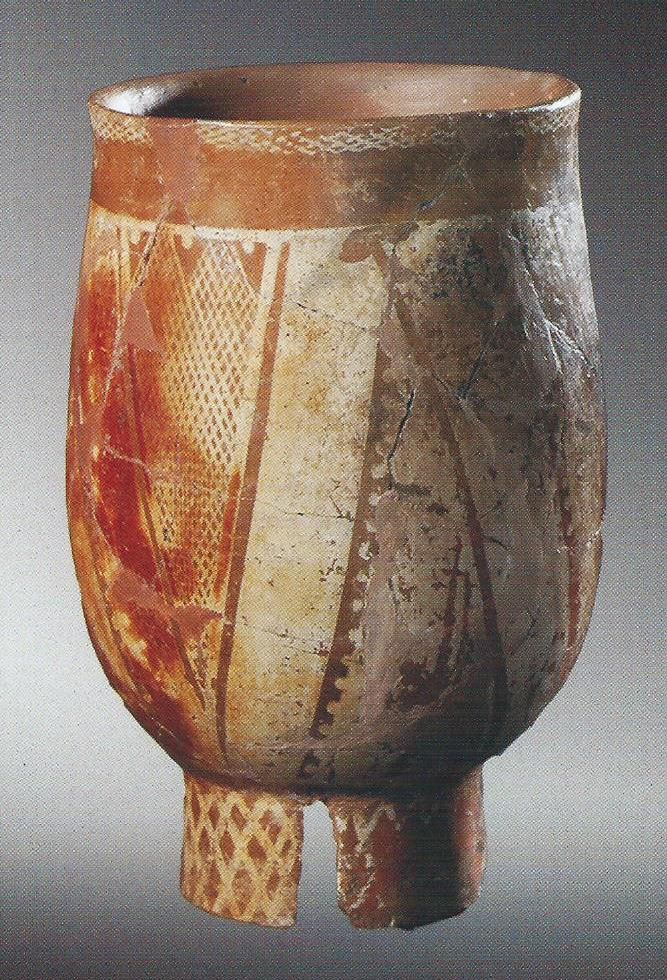
Some of the main characteristics of the Karanovo culture are the white-painted pottery and dark-painted vessels obtained from the tell. These artifacts were particularly associated with the first and second phases. There is also the case of The Gumelnita Lovers, a terracotta statuette crafted from 5000-4750 BCE. This artifact, which was excavated at the Gumelnita Tell in southern Romania, is associated with the culture's notion of fertility. There is also the Karanovo macroblade technology, which featured semi-steep and steep retouching as well as the use of yellow flint with white spots. This particular technology, which is also known as "Karanovo blade", emerged during the culture's early Neolithic phase. Scholars note its interesting length and width: 100 mm long and between 15 mm and 23 mm wide.
Karanovo II is distinguished from its predecessor due to its influence on the Thracian culture, or the assimilation of its elements into those inherited from Karanovo I. The basic characteristics of this phase continued until Karanovo III and were particularly pronounced in its coarsely made ware, such as pitchers, shallow dishes, and cylindrical vases (e.g. Kügel).
The burial practices of Karanovo I and II were similar to the practices of other eastern Balkan cultures, such as the Kremikovci, Dudesti, and Ovcarovo cultures.
Gallery
File:NHM - Pazardzik Sitzidol.jpg|"Lady of Pazardžik" (c. 4500 BC) File:Karanovo4.jpg|Pottery, 6th millennium BC (Karanovo I). File:Tulip-shaped ceramic vase, Karanovo culture, Bulgaria, 6th millennium BC.jpg|Tulip vase, 6th mill. BC (Karanovo I). File:Керамичен съд от с. Слатино, ранен халколит 009.jpg|Ceramic vessel from Slatino File:Керамичен съд от с. Слатино, ранен халколит 006.jpg|Ceramic vessel, 5th mill. BC (Slatino-Dikili Tass). File:Керамичен съд от с. Слатино, ранен халколит 003.jpg|Pottery from Slatino File:Ovcharovo tell, miniature culture scene, Bulgaria, 6th millennium BC.jpg|Cult scene, 5th mill. BC (Karanovo VI). File:Necklace from Galabnik Tell Pernik Bulgaria.jpg|Necklace from Galabnik, 6th millennium BC (Galabnik Culture). File:Clay figure in the Regional archaeological museum, Plovdiv 01.jpg|Zoomorphic ceramic vessel from Muldava File:Керамичен съд от с. Слатино, ранен халколит 002.jpg|Pottery from Slatino File:Керамичен съд от с. Дяково, късен халколит 005.jpg|Pottery from Djakovo File:Керамични антропоморфни и зооморфни фигурки - с. Слатино, ранен халколит 004.jpg|Ceramic figurine from Slatino File:Керамичен предмет с 16 ямички - с. Слатино, ранен халколит.jpg|Ceramic object from Slatino File:Museum of History Kardzhali 2011 PD 015.JPG|Jade amulet from Kardzali, 6th mill. BC (Karanovo I). File:Karanovo 1.jpg|Anthropomorphic vessel, 6th-5th mill. BC (Karanovo III-IV). File:Nova-Zagora-history-museum-vessel-5200yBC.jpg|Pottery File:Дъното на пещта с таблицата, календарна система - с. Слатино, ранен халколит.jpg|Inscribed object from Slatino with possible numerical meaning. File:Nova-Zagora-history-neolith-cult-plastics.jpg|Various artefacts File:Karanovo-culture-scale-2.jpg|Karanovo tell, Bulgaria, excavation stratigraphy. File:TellYunatsite.jpg|Tell Yunatsite, Bulgaria. File:Neolitic houses reconstruction 01.JPG|Neolithic house reconstructions, Chavdar, Bulgaria, c. 5000 BC.
Literature
- Stefan Hiller, Vassil Nikolov (eds.), Karanovo III. Beiträge zum Neolithikum in Südosteuropa Österreichisch-Bulgarische Ausgrabungen und Forschungen in Karanovo, Band III, Vienna (2000), .
References
References
- Danver, Steven L.. (2015). "Native Peoples of the World: An Encyclopedia of Groups, Cultures and Contemporary Issues". Routledge.
- (1974). "The Gods and Goddesses of Old Europe: 7000 to 3500 BC Myths, Legends and Cult Images". University of California Press.
- (2008). "Living Well Together? Settlement and Materiality in the Neolithic of South-East and Central Europe". Oxbow Books.
- Stornoway, Jack. (2019). "Broken Timelines - Book 3: The Indo-Europeans and Harappans". Digital Ink Productions.
- (2007). "The Origins and Spread of Domestic Plants in Southwest Asia and Europe". Routledge.
- (2007). "The Origins and Spread of Domestic Plants in Southwest Asia and Europe". Left Coast Press.
- Reichard, Joy. (2011). "Celebrate the Divine Feminine". Bush Street Press.
- (2017). "Going West?: The Dissemination of Neolithic Innovations Between the Bosporus and the Carpathians, Volume 3". Routledge.
- (2017). "Going West?: The Dissemination of Neolithic Innovations between the Bosporus and the Carpathians". Routledge.
- (2003). "The Cambridge Ancient History". Cambridge University Press.
- (2015). "The Oxford Handbook of Neolithic Europe". Oxford University Press.
- (18 October 2012). "Ceramic vessel".
- "Karanovo culture, tulip-shaped vase".
- (18 October 2012). "Tulip vessel".
- (18 October 2012). "Ceramic vessel".
- (18 October 2012). "Altar from a cult scene".
- (18 October 2012). "Priestess from a cult scene".
- "Cult scene".
- (18 October 2012). "Beads".
- (18 October 2012). "Amulet".
- (18 October 2012). "Anthropomorphic vessel".
- (2020). "The Mystery of the Danube Civilisation". Marix Verlag.
- "Photo of the excavated Karanovo Tell site".
- "Photo of the excavated Karanovo Tell site".
- (2023). "Early contact between late farming and pastoralist societies in southeastern Europe". Nature.
- (11 February 2022). "Tell Yunatsite".
- "Archaeological Park Topolnitsa".
- (2016). "The chronological framework in Greece and Bulgaria between the late 6th and the early 3rd millennium BC". MOM Éditions.


This article was imported from Wikipedia and is available under the Creative Commons Attribution-ShareAlike 4.0 License. Content has been adapted to SurfDoc format. Original contributors can be found on the article history page.
Ask Mako anything about Karanovo culture — get instant answers, deeper analysis, and related topics.
Research with MakoFree with your Surf account
Create a free account to save articles, ask Mako questions, and organize your research.
Sign up freeThis content may have been generated or modified by AI. CloudSurf Software LLC is not responsible for the accuracy, completeness, or reliability of AI-generated content. Always verify important information from primary sources.
Report