From Surf Wiki (app.surf) — the open knowledge base
Karakalpakstan
Autonomous republic of Uzbekistan
.jpg)
Autonomous republic of Uzbekistan
| Field | Value |
|---|---|
| name | Republic of Karakalpakstan |
| native_name | Qaraqalpaqstan Respublikası / kaa |
| Qoraqalpogʻiston Respublikasi / uz | |
| settlement_type | Autonomous republic |
| image_flag | Flag of Karakalpakstan.svg |
| flag_size | 130px |
| flag_link | Flag of Karakalpakstan |
| image_seal | Emblem of Karakalpakstan.svg |
| seal_size | 90px |
| seal_type | Emblem |
| seal_link | Emblem of Karakalpakstan |
| subdivision_type | Sovereign state |
| subdivision_name | Uzbekistan |
| motto | |
| Jayxun yoqasida o‘sgan boyterak (Uzbek) | |
| anthem | kaa |
| Qoraqalpog‘iston Respublikasining Davlat Madhiyasi (Uzbek) | |
| image_map | Qaraqalpaqstan Respublikasi in Uzbekistan.svg |
| map_caption | Karakalpakstan in Uzbekistan |
| capital | Nukus |
| official_languages | |
| ethnic_groups | |
| ethnic_groups_year | 2021 |
| religion | Islam |
| government_type | Autonomous republic |
| leader_title1 | Chairman of the Supreme Council |
| leader_name1 | Amanbai Orynbaev |
| leader_title2 | Chairman of the Council of Ministers |
| leader_name2 | Farkhat Ermanov |
| legislature | Supreme Council of Karakalpakstan |
| area_km2 | 166590 |
| population_total | 2 015 000 |
| population_as_of | 2024 |
| population_estimate | 2,015,000 |
| population_estimate_year | 2024 |
| population_density_km2 | 12.06 |
| population_density_sq_mi | |
| GDP_PPP | $15.2 billion |
| GDP_PPP_year | 2024 |
| GDP_nominal | $4.5 billion |
| GDP_nominal_year | 2024 |
| GDP_nominal_rank | 12th |
| Gini_change | |
| HDI | 0.725 |
| HDI_year | 2022 |
| HDI_change | |
| currency | Uzbekistani sum |
| currency_code | UZS |
| timezone | Uzbekistan Standard Time |
| utc_offset | +5:00 |
| iso_code | UZ-QR |
Qoraqalpogʻiston Respublikasi / uz Jayxun yoqasida o‘sgan boyterak (Uzbek) Qoraqalpog‘iston Respublikasining Davlat Madhiyasi (Uzbek)
"State Anthem of the Republic of Karakalpakstan"
Karakalpakstan, officially the Republic of Karakalpakstan, is an autonomous republic of Uzbekistan. It spans the northwestern portion of Uzbekistan. Its capital is Nukus (Nókis / Нөкис). Karakalpakstan has an area of 166590 km2, and has a population of about 2 million people. Its territory covers the classical land of Khwarazm, which in classical Persian literature was known as fa (کات).
Name
The name Karakalpakstan means "land of the Karakalpaks". Although most Karakalpaks reside in Uzbekistan, Karakalpak culture and language are closer to those of the Kazakhs and Nogais.
History
From about 500 BC to 500 AD, the region of what is now Karakalpakstan was a thriving agricultural area supported by extensive irrigation. It was strategically important territory and fiercely contested, as is seen by the more than 50 Khorezm fortresses which were constructed here. The Karakalpak people, who used to be nomadic herders and fishers, were first recorded by foreigners in the 16th century. Karakalpakstan was ceded to the Russian Empire by the Khanate of Khiva in 1873.
Under Soviet rule, it was an autonomous area within the Russian Soviet Federative Socialist Republic before becoming part of Uzbekistan in 1936 as the Karakalpak ASSR.
The region was probably at its most prosperous in the 1960s and 1970s, when irrigation from the Amu Darya was being expanded. However, the evaporation of the Aral Sea has made Karakalpakstan one of Uzbekistan's poorest regions.
The region is suffering from extensive drought, partly due to climate patterns, but also largely because the Amu Darya and Syr Darya rivers are mostly diverted in the eastern parts of Uzbekistan. Crop failures have deprived about 48,000 people of their main source of income and shortages of potable water have created a surge of infectious diseases.
Geography
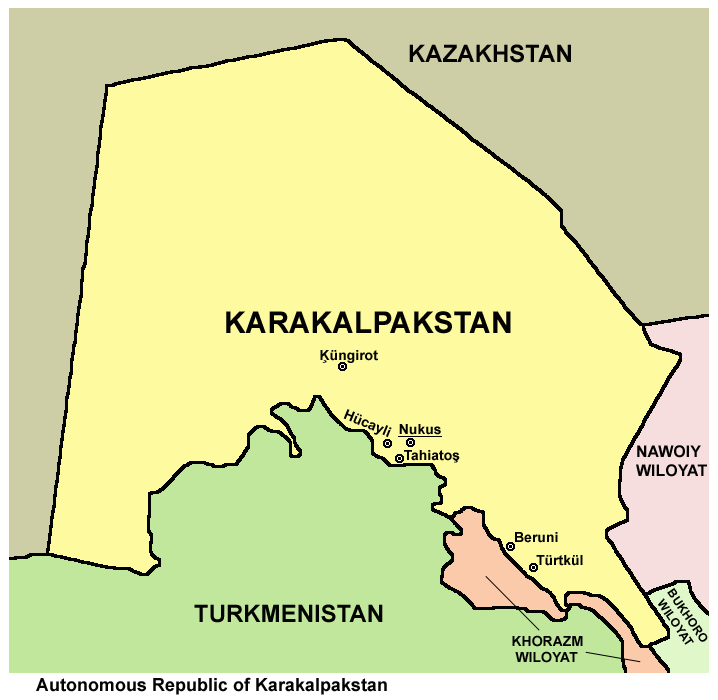
Karakalpakstan is now mostly desert and is located in western Uzbekistan near the Aral Sea, in the lowest part of the Amu Darya basin. It has an area of 164,900 km2 and is surrounded by desert. The Kyzyl Kum Desert is located to the east and the Karakum Desert is located to the south. A rocky plateau extends west to the Caspian Sea.
Politics
Autonomous status
Its predecessor, the Karakalpak Autonomous Soviet Socialist Republic, was an autonomous republic in the Soviet Union until its incorporation into the Uzbek Soviet Socialist Republic in 1932. The Republic of Karakalpakstan maintained its predecessor's formal sovereignty, even after the independence of Uzbekistan in 1990. Karakalpakstan shares veto power with Uzbekistan over decisions concerning its affairs. According to the constitution, relations between Karakalpakstan and Uzbekistan are "regulated by treaties and agreements" and any disputes are "settled by way of reconciliation". Article 89, chapter XVII, Constitution of Uzbekistan, provides that: "The Republic of Karakalpakstan shall have the right to secede from the Republic of Uzbekistan on the basis of a nationwide referendum held by the people of Karakalpakstan."
In July 2022, large protests broke out in the region over a proposed constitutional change which would strip Karakalpakstan of its autonomy. The proposed change was later scrapped in response to the demonstrations.
Leadership
The head of the republic is the Chairman of the Supreme Council of Karakalpakstan or parliament (known as the "President of the Republic" from 1991 to 1992). The head of the government is the Chairman of the Council of Ministers of Karakalpakstan.
One of the deputy chairmen of the Senate of the Oliy Majlis is a representative of Karakalpakstan as per the constitution.
Demographics
On 1 July 2023, the population of Karakalpakstan was 1,986,900 people. It increased of 1.2% compared to the corresponding period of 2022. The number of men (997,800) slightly exceeded the number of women (989,100). There were slightly more people living in rural areas (1,015,500) than in urban areas (971,400).
In 2007, it was estimated that about 400,000 of the population are of the Karakalpak ethnic group, 400,000 are Uzbeks and 300,000 are Kazakhs. Though 95% of Karakalpaks reside in Uzbekistan, mostly in Karakalpakstan, the Karakalpak language is closer to Kazakh than to Uzbek. The language was written in a modified Cyrillic in Soviet times and has been written in the Latin alphabet since 1996.
Other than the capital Nukus, major cities include Xojeli, Taqiyatas, Shimbay, Qońirat (Kungrad) and Moynaq.
The crude birth rate is 2.2%: approximately 39,400 children were born in 2017. Nearly 8,400 people died in the same period. The crude death rate is 0.47%. The natural growth rate is 31,000, or 1.72%.
The median age was 27.7 years old in 2017, which is younger than the rest of Uzbekistan (median age of 28.5 countrywide). Men are 27.1 years old, while women are 28.2 years old.
Dynamics of the number and ethnic composition of the population of Karakalpakstan according to the All-Union censuses of 1926–1989:
| Nationality | 1926 (people) | % | 1939 (people) | % | 1959 (people) | % | 1970 (people) | % | 1979 (people) | % | 1989 (people) | % |
|---|---|---|---|---|---|---|---|---|---|---|---|---|
| Total | 304 539 | 100.00% | 469 702 | 100.00% | 510 101 | 100.00% | 702 264 | 100.00% | 905 500 | 100.00% | 1 212 207 | 100.00% |
| Uzbeks | 84 099 | 27.62% | 116 054 | 24.71% | 146 783 | 28.78% | 212 597 | 30.27% | 285 400 | 31.52% | 397 826 | 32.82% |
| Karakalpaks | 116 125 | 38.13% | 158 615 | 33.77% | 155 999 | 30.58% | 217 505 | 30.97% | 281 809 | 31.12% | 389 146 | 32.10% |
| Kazakhs | 85 782 | 28.17% | 129 677 | 27.61% | 133 844 | 26.24% | 186 038 | 26.49% | 243 926 | 26.94% | 318 739 | 26.29% |
| Turkmens | 9686 | 3.18% | 23 259 | 4.95% | 29 225 | 5.73% | 37 547 | 5.35% | 48 655 | 5.37% | 60 244 | 4.97% |
| Russians | 4924 | 1.62% | 24 969 | 5.32% | 22 966 | 4.50% | 25 165 | 3.58% | 21 287 | 2.35% | 19 846 | 1.64% |
| Koreans | 7347 | 1.56% | 9956 | 1.95% | 8958 | 1.28% | 8081 | 0.89% | 9174 | 0.76% | ||
| Tatars | 884 | 0.29% | 4162 | 0.89% | 6177 | 1.21% | 7619 | 1.08% | 7617 | 0.84% | 7767 | 0.64% |
| Ukrainians | 621 | 0.20% | 3130 | 0.67% | 2201 | 0.43% | 2316 | 0.33% | 2005 | 0.22% | 2271 | 0.19% |
| Bashkirs | 29 | 0.01% | 381 | 0.08% | 571 | 0.11% | 854 | 0.12% | 920 | 0.10% | 1090 | 0.09% |
| Kyrgyz | 277 | 0.09% | 181 | 0.04% | 177 | 0.03% | 400 | 0.06% | 1955 | 0.22% | 867 | 0.07% |
| Moldovans | 10 | 0.00% | 16 | 0.00% | 57 | 0.01% | 343 | 0.04% | 632 | 0.05% | ||
| Belarusians | 30 | 0.01% | 214 | 0.05% | 328 | 0.06% | 517 | 0.07% | 852 | 0.09% | 567 | 0.05% |
| other | 2072 | 0.68% | 1697 | 0.36% | 1874 | 0.37% | 2691 | 0.38% | 2650 | 0.29% | 4038 | 0.33% |
|graph-pos = bottom |graph-width = |graph-height = |1979 |904,315 |1989 |1,214,000 |2000 |1,503,000 |2010 |1,632,000 |2020 |1,898,351
Economy

The economy of the region used to be heavily dependent on fisheries in the Aral Sea. It is now supported by cotton, rice, and fruits, such as plums, pears, grapes, and apricots, in addition to all kinds of melons. Hydroelectric power comes from a large Soviet-built station on the Amu Darya, which was once heavily populated and supported extensive irrigation based agriculture for thousands of years. Under the Khorezm, the area attained considerable power and prosperity.
However, climate change over the centuries, accelerated by human induced evaporation of the Aral Sea in the late 20th century has created a desolate scene in the region. The ancient oases of rivers, lakes, reed marshes, forests and farms are drying up and being poisoned by wind-borne salt and by fertilizer and pesticide residues from the dried bed of the Aral Sea. Summer temperatures have risen by 10 C-change and winter temperatures have decreased by 10 C-change. The rates of incidence of anemia, respiratory diseases and other health problems has risen dramatically.
Administrative divisions

The autonomous republic of Karakalpakstan consists of 16 districts (listed below) and one district-level city: Nukus (number 1 on map).
| № | District name | District capital | ||
|---|---|---|---|---|
| 2 | ||||
| 3 | ||||
| 4 | ||||
| 15 | ||||
| 17 | ||||
| 7 | ||||
| 9 | ||||
| 10 | ||||
| 5 | ||||
| 8 | ||||
| 6 | ||||
| 16 | ||||
| 11 | ||||
| 12 | ||||
| 13 | ||||
| 14 |
Taqiyatas district was created in 2017 from part of Xojeli district. Bozataw district was created in September 2019 from parts of the Kegeyli district and the Shimbay district.
There are 12 cities (Nókis, Mańģit, Beruniy, Xaliqabat, Qońirat, Moynaq, Taqiyatas, Tórtkúl, Xojeli, Shimbay, Shomanay, Bostan) and 26 urban-type settlements in Karakalpakstan.
Media
Journalism
Journalists can face intimidation in the region, for example Lola Kallikhanova has been questioned by police, and prosecuted. This treatment of Kallikhanova and other journalists was condemned by the Coalition for Women in Journalism.
Radio
In 2009, the first radio station of Karakalpakstan was opened, in Nukus. Named 'Nukus FM', the station broadcasts on radio frequency 100.4 MHz.
Television
Qaraqalpaqstan tеlеvideniesi is an Uzbek television channel that broadcasts to the autonomous republic of Karakalpakstan. The channel airs programming in four languages, Karakalpak, Uzbek, Kazakh and Russian.
Explanatory notes
References
References
- "Permanent population by national and / or ethnic group, urban / rural place of residence". Open Data Portal.
- (2024). "Demographic Situation in the Republic of Uzbekistan". Statistics Agency under the President of the Republic of Uzbekistan.
- (July 2021). "Oʻzbekiston Respublikasining maʼmuriy-hududiy boʻlinishi". The State Committee of the Republic of Uzbekistan on statistics.
- "Glottolog 4.8 - Kara-Kalpak".
- (2012). "Qaraqalpaqs of the Aral Delta". Prestel Verlag.
- Europa Publications Limited. (2002). "Eastern Europe, Russia and Central Asia". Taylor & Francis.
- Mayhew, Bradley. (2007). "Central Asia: Kazakhstan, Tajikistan, Uzbekistan, Kyrgyzstan, Turkmenistan". [[Lonely Planet]].
- Thomas, Troy S.. (2005). "Warlords rising: confronting violent non-state actors". Lexington Books.
- Batalden, Stephen K.. (1997). "The newly independent states of Eurasia: handbook of former Soviet republics". Greenwood Publishing Group.
- Merkel, Broder. (2011). "The New Uranium Mining Boom: Challenge and Lessons Learned". Springer.
- Roeder, Philip G.. (2007). "Where nation-states come from: institutional change in the age of nationalism". [[Princeton University Press]].
- Bolton, Roy. (2009). "Russian Orientalism: Central Asia and the Caucasus". Sphinx Fine Art.
- Rickleton, Chris. (1 February 2023). "In Uzbekistan's Karakalpakstan, Trial Over Deadly Unrest Makes A 'Hero' Of Its Intended Villain". [[Radio Free Europe/Radio Liberty]].
- (30 April 2023). "The Constitution of the Republic of Uzbekistan".
- "Constitution of the Republic of Uzbekistan".
- "Uzbekistan's new constitution: More for Mirziyoyev, less for Karakalpakstan".
- (1 July 2022). "Жители Узбекистана вышли на митинги после конституционной реформы".
- (2 July 2022). "Uzbekistan scraps plans to curb Karakalpak autonomy after protest". Reuters.
- (25 July 2023). "Distribution of the permanent population of the Republic of Karakalpakstan". Statistics Agency under the President of the Republic of Uzbekistan.
- (2012). "Language Policy and Language Conflict in Afghanistan and Its Neighbors". Brill.
- [https://windowonheartland.blogspot.com/2012/01/karakalpakstan-uzbekistans-latent.html Karakalpakstan: Uzbekistan's latent conflict] {{Webarchive. link. (4 March 2016 , 6 January 2012)
- "Uzbekistan: Provinces".
- Pearce, Fred. (2007). "When the Rivers Run Dry: Water, the Defining Crisis of the Twenty-first Century". [[Beacon Press]].
- (14 August 2017). "New Takhiatash region formed in Karakalpakstan".
- (5 September 2019). "About creation of Boʻzatov district of the Republic of Karakalpakstan".
- (July 2020). "Classification system of territorial units of the Republic of Uzbekistan". The State Committee of the Republic of Uzbekistan on statistics.
- (2020-08-03). "Pressure on Karakalpakstan journalist wrongly accused of spreading false information {{!}} RSF".
- "Uzbekistan: Arbitrary Summoning And Intimidation Of Women Journalists Over Absurd Claims Is Unacceptable".
- (May 17, 2019). "Uzbekistan: Keeping the Karakalpak Language Alive".
This article was imported from Wikipedia and is available under the Creative Commons Attribution-ShareAlike 4.0 License. Content has been adapted to SurfDoc format. Original contributors can be found on the article history page.
Ask Mako anything about Karakalpakstan — get instant answers, deeper analysis, and related topics.
Research with MakoFree with your Surf account
Create a free account to save articles, ask Mako questions, and organize your research.
Sign up freeThis content may have been generated or modified by AI. CloudSurf Software LLC is not responsible for the accuracy, completeness, or reliability of AI-generated content. Always verify important information from primary sources.
Report