From Surf Wiki (app.surf) — the open knowledge base
Karaganda Region
Region in central Kazakhstan
Region in central Kazakhstan
| Field | Value |
|---|---|
| name | Karaganda Region |
| native_name | kk |
| settlement_type | Region |
| image_skyline | {{multiple image |
| border | infobox |
| perrow | 1/2/2/2/2 |
| total_width | 250 |
| image1 | Каркаралы, Karkaraly National Park, Kazakhstan.jpg |
| image2 | Вид Бектау-Ата.png |
| image3 | Balkhash copper smelting complex.jpg |
| footer | From the top, Karkaraly National Park, Bektauata, Lake Balkhash}} |
| image_flag | Flag of Karagandy Oblast.svg |
| image_shield | Coat of Arms of Karagandy Province.svg |
| image_map | Karagandy in Kazakhstan.svg |
| map_caption | Map of Kazakhstan, location of Karaganda Region highlighted |
| coordinates | |
| subdivision_type | Country |
| subdivision_name | Kazakhstan |
| blank_name_sec1 | Districts |
| blank_info_sec1 | 9 |
| blank1_name_sec1 | Cities |
| blank1_info_sec1 | 11 |
| blank2_name_sec1 | Townships |
| blank2_info_sec1 | 39 |
| blank3_name_sec1 | Villages |
| blank3_info_sec1 | 557 |
| seat | Karaganda |
| seat_type | Capital |
| leader_title | Akim |
| leader_name | Ermaganbet Bulekpaev |
| area_footnotes | |
| demographics_type2 | GDP (Nominal, 2024) |
| demographics2_footnotes | |
| demographics2_title1 | Total |
| demographics2_info1 | KZT 9,237 billion |
| (US$ 19.398 billion) · 4th | |
| demographics2_title2 | Per capita |
| demographics2_info2 | KZT 8,141,000 |
| (US$ 17,096) | |
| area_total_km2 | 239046 |
| elevation_max_m | 1565 |
| elevation_min_m | 500 |
| utc_offset1 | +05:00 |
| timezone1_DST | unchanged |
| utc_offset1_DST | +05:00 |
| postal_code_type | Postal codes |
| postal_code | 100000 |
| area_code_type | Area codes |
| area_code | +7 (721) |
| population_footnotes | |
| elevation_max_footnotes | |
| population_total | 1134146 |
| population_as_of | 2022 |
| population_density_km2 | auto |
| iso_code | KZ-KAR |
| registration_plate | 09, M |
| blank_name_sec2 | HDI (2023) |
| blank_info_sec2 | 0.857 |
| · 2nd | |
| website |
(US$ 19.398 billion) · 4th (US$ 17,096) · 2nd
Karaganda Region is a region of Kazakhstan. Its capital is Karaganda. The region borders Akmola and Pavlodar Region to the north; Abai Region to the east; Jetisu, Almaty, and Zhambyl Regions to the south; and Kostanay and Ulytau regions to the west.
In 2022, the western parts of this region was split off and became the Ulytau Region.
History
The region was the site of intense coal mining during the days of the Soviet Union and also the site of several Gulag forced labor camps. Following World War II, Joseph Stalin, leader of the Soviet Union, had many ethnic Germans deported to the area.
There have been constant border changes within the region's history. The first took place in 1954 when it was ceded parts of Kustanay Oblast and parts of Taldy-Kurgan Oblast. In 1973, Dzhezkazgan Oblast was split off from Karaganda Oblast making it a fraction of the size it once was. In 1986, Karaganda Oblast was given the southern part of Tselinograd Oblast as part of another set of border reforms taking place in the Kazakh S.S.R. When Kazakhstan gained independence in 1991, Karaganda Oblast retained its post-1988 boundaries. The last change the region saw was in 1998 when Jezkazgan (Dzhezkazgan) Oblast was liquidated and re-merged with Karaganda oblast, thus making it the largest region of Kazakhstan in terms of area once again.
On 17 March 2022, Kazakh president Kassym-Jomart Tokayev announced that a part of the region would become a separate region, called Ulytau Region. The bill came into force on 8 June 2022.
Archaeological findings
In July 2019, remains of a young couple buried face to face dated 4,000 years back were unearthed in Karaganda Region in central Kazakhstan by a group of archaeologists led by Igor Kukushkin from Saryarka Archaeological Institute in Karaganda. It is assumed that the Bronze Age couple were 16 or 17 years old when they died. Kukushkin supposes that they were from a 'noble family' thanks to the buried gold and jewelry artifacts, ceramic pots, women's two bracelets on each arm beads, and remains of horses and knives found in the grave.
Geography
With an area of 428,000 km2, Karaganda Region is Kazakhstan's largest region. It is known for its natural environment and historical sights. Although it doesn't touch the borders of any country, it touches nearly every other region, due to its location in the center of the country. They are Aktobe Region to the west; Kostanay Region to the northwest; Akmola Region to the north; Pavlodar Region to the northeast; East Kazakhstan Region to the east; Almaty Region to the southeast; Jambyl Region and Turkistan Region to the south; and Kyzylorda Region to the southwest.
The area is arid with flat plains between hills and seasonal streams. The Karkaraly and Kent range, featuring the Karkaraly National Park, covering 90,300 hectares, is located in the Kazakh Uplands, as well as Kyzylarai, with the highest point of the region, 1565 m high mount Aksoran.
The Ishim (Esil) River, a tributary of the Irtysh River, begins in Karaganda Region; the Nura River and Tokrau are the region's other major rivers. The Ishim and Nura are replenished with water from the Irtysh, supplied by the 451 km long Irtysh–Karaganda Canal. Lake Balkhash is located on the Southeast side.
Demographics
|graph-pos = bottom |graph-width = |graph-height = |1979 |1,713,208 |1989 |1,745,448 |1999 |1,410,218 |2009 |1,341,700 |2021 |1,375,788 As of 2020, the Karaganda Region has a population of 1,376,882.
Ethnic groups (2020):
- Kazakh: 52.36%
- Russian: 35.07%
- Ukrainian: 2.84%
- German: 2.28%
- Tatar: 2.21%
- Others: 5.24%
Administrative divisions
The region is administratively divided into districts, as well as the cities of Karaganda, Balkhash, Saran, Shakhtinsk, and Temirtau. The districts are:
- Abay District, with the administrative center in the town of Abay;
- Aktogay District, the selo of Aktogay;
- Bukhar-Zhyrau District, the settlement of Botakara;
- Karkaraly District, the town of Karkaraly;
- Nura District, the settlement of Kiyevka;
- Sarybel District, the settlement of Osakarovka;
- Shet District, the selo of Aksu-Ayuly;
The following nine localities in Karaganda Region have town status: Karaganda, Balkhash, Priozersk, Saran, Shakhtinsk, and Temirtau.
For some decades during the USSR era, the southern part of what is today Karaganda Region was a separate region, known as Jezkazgan Region, with the administrative center in Jezkazgan.
Elections
Sister cities
- KOR Ulsan, South Korea (2010)
Notes
References
References
- "All-Biz Ltd. Карагандинская область".
- (8 December 2022). "О назначении Булекпаева Е.К.". akorda.kz.
- "Official site - General Information".
- DOSM. "Gross domestic product by region for January-December 2024 (GRP)".
- Agency of statistics of the Republic of Kazakhstan: [https://web.archive.org/web/20190511001020/http://www.stat.kz/digital/naselsenie/2012/2013/%25D0%25BC%25D0%25B0%25D1%2580%25D1%2582/01_2012_%25D0%25AD-14-05-%25D0%259C.xls Численность населения Республики Казахстан по областям с начала 2013 года до 1 февраля 2013 года] (russisch; Excel-Datei; 55 kB).
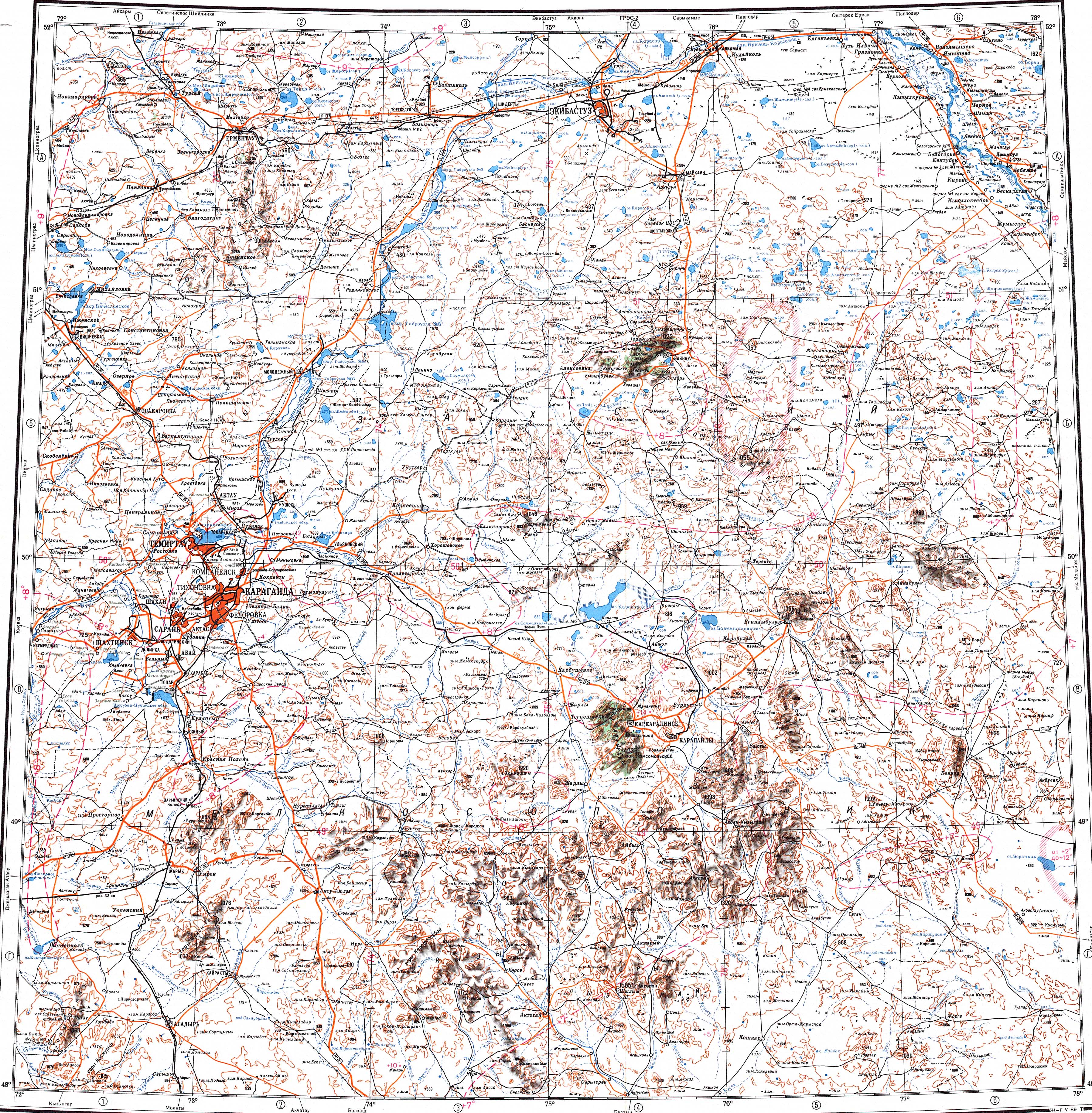
- "Map Karaganda and surroundings".
- "Sub-national HDI – Area Database – Global Data Lab".
- (16 March 2022). "В Казахстане появится четыре новых региона".
- (8 June 2022). "Улытауская область официально появилась на карте Казахстана". 24.kz.
- (August 2019). "Bronze Age Couple Unearthed in Kazakhstan - Archaeology Magazine".
- History, Owen Jarus 2019-08-01T16:07:52Z. (August 2019). "This Young Man and Woman Were Buried Face-to-Face 4,000 Years Ago in Kazakhstan".
- Ciaccia, Chris. (2 August 2019). "Mysterious 4,000-year-old grave reveals boy and girl buried face to face".
- "Karaganda travel guide".
- "Kazakhstan: Regions".
- "Численность населения Республики Казахстан по отдельным этносам на начало 2020 года". Stat.kz.
- "Численность населения Республики Казахстан по отдельным этносам на начало 2020 года". Stat.kz.
- link. Информационный портал Акимата Карагандинской области
This article was imported from Wikipedia and is available under the Creative Commons Attribution-ShareAlike 4.0 License. Content has been adapted to SurfDoc format. Original contributors can be found on the article history page.
Ask Mako anything about Karaganda Region — get instant answers, deeper analysis, and related topics.
Research with MakoFree with your Surf account
Create a free account to save articles, ask Mako questions, and organize your research.
Sign up freeThis content may have been generated or modified by AI. CloudSurf Software LLC is not responsible for the accuracy, completeness, or reliability of AI-generated content. Always verify important information from primary sources.
Report