From Surf Wiki (app.surf) — the open knowledge base
Kansu Braves
Qing-era Chinese Muslim military unit

Qing-era Chinese Muslim military unit
| Field | Value | |
|---|---|---|
| unit_name | Gansu Braves | |
| image | File:Chinese Muslim Kansu Braves 1900 Boxer Rebellion.jpg | |
| caption | Three Muslim soldiers from the Gansu Army | |
| dates | 1895–1901 | |
| country | Qing dynasty | |
| allegiance | [[File:Imperial standard of the Qing Emperor.svg | 23px]] Emperor of China |
| branch | Wuwei Corps | |
| type | Army | |
| role | Force protection | |
| Land warfare | ||
| Public security | ||
| size | Division ~10,000 | |
| garrison | Gansu, then Beijing | |
| equipment | Krupp artillery, Mauser rifles, swords, halberds | |
| nickname | Kansu Braves | |
| battles | Dungan revolt (1895–96) | |
| Battle of Langfang | ||
| Siege of the International Legations (Boxer Rebellion) | ||
| Battle of Peking | ||
| notable_commanders | Dong Fuxiang (general in chief) | |
| Ma Fuxiang, Ma Fulu, Ma Fuxing |
Land warfare Public security Battle of Langfang Siege of the International Legations (Boxer Rebellion) Battle of Peking Ma Fuxiang, Ma Fulu, Ma Fuxing
The Gansu Braves or Gansu Army was a combined army division of 10,000 Chinese Muslim troops from the northwestern province of Kansu (Gansu) in the last decades of the Qing dynasty (1644–1912). Loyal to the Qing, the Braves were recruited in 1895 to suppress a Muslim revolt in Gansu. Under the command of General Dong Fuxiang (1839–1908), they were transferred to the Beijing metropolitan area in 1898, where they officially became the Rear Division of the Wuwei Corps, a modern army that protected the imperial capital. The Gansu Army included Hui Muslims, Salar Muslims, Dongxiang Muslims, and Bonan Muslims.
The Braves, who wore traditional uniforms but were armed with modern rifles and artillery, played an important role in 1900 during the Boxer Rebellion. After helping to repel the Seymour Expedition, a multinational foreign force sent from Tianjin to relieve the Beijing Legation Quarter in early June, the Muslim troops were the fiercest attackers during the siege of the legations from 20 June to 14 August. They suffered heavy casualties at the Battle of Peking, in which the Eight-Nation Alliance relieved the siege. The Kansu Braves then guarded the Imperial Court on their journey to Xi'an.
Origins in Gansu
In the spring of 1895, a Muslim revolt erupted in the southern parts of Gansu province. Dong Fuxiang (1839–1908), who had fought under Zuo Zongtang (1812–1885) in the suppression of a larger Muslim rebellion in the 1860s and 1870s, had by 1895 become Imperial Commissioner in Gansu and he now commanded the Muslim militias that Zuo had recruited locally. In early July 1895, Dong commanded these troops in relieving the siege of Didao by Muslims rebels.
When he attended Empress Dowager Cixi's sixtieth birthday celebrations in Beijing in August 1895, he was recommended to Cixi by the powerful Manchu minister Ronglu. The Muslim rebels, who were armed with muzzleloaders and various white arms, were overwhelmed by the firepower of the modern Remington and Mauser rifles that Dong brought back from Beijing. Dong also used his understanding of local politics to convince the rebels to return to their homes. By the spring of 1896, Gansu was again pacified.
Generals Dong Fuxiang, Ma Anliang and Ma Haiyan were originally called to Beijing during the First Sino-Japanese War in 1894, but the Dungan Revolt (1895) broke out and they were subsequently sent to crush the rebels. During the Hundred Days' Reform in 1898 Generals Dong Fuxiang, Ma Anliang, and Ma Haiyan were called to Beijing and helped put an end to the reform movement along with Ma Fulu and Ma Fuxiang.
Transfer to Beijing

Following the killing of two German missionaries in Shandong in November 1897, foreign powers engaged in a "scramble for concessions" that threatened to split China into several spheres of influence. To protect the imperial capital against possible attacks, Cixi had the Gansu Army transferred to Beijing in the summer of 1898. She admired the Gansu Army because Ronglu, who was in her favor, had a close relation with its commander Dong Fuxiang. On their way to Beijing, Dong's troops attacked Christian churches in Baoding. After the failure of the Hundred Days' Reform (11 June – 21 September 1898) sponsored by the Guangxu Emperor, Cixi named Ronglu Minister of War and highest official in the Grand Council, and put him in charge of reforming the metropolitan armies. Ronglu made Dong's militia the "Rear Division" of a new corps called the "Wuwei Corps". Dong Fuxiang was the only commander of the five divisions who did not hide his hostility toward foreigners.
Beijing residents and foreigners alike feared the turbulent Muslim troops. It was said "the troops are to act tomorrow when all foreigners in Peking are to be wiped out and the golden age return for China." during 23 October 1898. Some Westerners described the Gansu Braves as the "10,000 Islamic rabble","a disorderly rabble of about 10,000 men, most of whom were Mohammedans", or Kansu Irregulars, others as "ten thousand Mohammedan cutthroats feared by even the Chinese". In late September and early October 1898, several minor clashes between the Gansu troops and foreigners heightened tensions in the capital. Soldiers from the United States Marine Corps were among the new guards called from Tianjin to protect the Beijing Legation Quarter from possible assaults. By late October, rumors were circulating that the Gansu Army was preparing to kill all foreigners in Beijing. Responding to an ultimatum by the foreign ministers, Cixi had the Gansu troops transferred to the "Southern Park" (Nanyuan 南苑), which was also known as the "Hunting Park" because emperors of the Ming and Qing dynasties had used it for large-scale hunts and military drills. By the 1880s, this large expanse of land south of Beijing – it was several times larger than the walled city – had been partly converted into farmland, but it was conveniently located near the railroad that connected Beijing to Tianjin. The Kansu braves were involved in a scuffle at a theatre. At the section of railroad at Fengtai, two British engineers were almost beaten to death by the Muslim Kansu troops, and foreign ministers asked that they be pulled back since they were threatening the safety of foreigners.
[67] Sir C. MacDonald to Lord Salisbury, April 15th, 1898, China, Xo. 1, 1899, p. 102.
On the 29th he telegraphed again: "The Foreign Representatives met yesterday, and drafted a note to the Yamfin demanding that the Kansu troops should be withdrawn at once. The troops in question have not been paid for some months, and are in a semi-mutinous state. They have declared their intention to drive all Europeans out of the north of China, and have cut the telegraph wires and destroyed portions of the railway line between Lukouchiao and Paoting Fu. Some disturbances have been caused by them on the railway to Tien-tsin, but the line has not been touched, and traffic has not been interrupted. In the city here all is quiet. The presence of these troops in the immediate vicinity of Peking undoubtedly constitutes a serious danger to all Europeans. The Yamfin gave me a promise that the force should be removed, but have not yet carried it into effect."|source = Alan Campbell Reiley, History for Ready Reference: From the Best Historians, Biographers, and Specialists; Their Own Words in a Complete System of History ..., p. 95.
13th June, 1900: 17th day of the 5th moon 26th year of Kuang Hsü:— About dusk, while in the University [of Peking]. I saw four places on fire, whereupon I immediately returned to my house, subsequently learning that all the Churches and mission properties inside the "Eastern City" had been set fire to and entirely destroyed, the conflagration in the Lamplight Market (Night Bazaar) having been especially destructive, lasting far into the next day.
14th June.—I passed the Panshih Residence this morning. The building in the rear of this is now the headquarters of Tung Fu-hsiang and his Kansu troops, who I may state, had already entered the city a few days previously. [The Kansu troops, ever since their arrival from Kansu in the autumn of 1898, had always been kept encamped outside Peking and prohibited from entering the City walls.] At noon, my friend Yang Ch'ao-chió, a Military Chüjén graduate, sent a servant over to my house suggesting that we should join our families together and escape from Peking in company from the dangers threatening all, and fixing to-morrow morning as our time of departure. I, fortunately as it turned out for us all, firmly refused to go with Yang's party, as I had just heard the rumour that steamers had stopped running to Tientsin. I had also heard that the road to T'ungchou was greatly infested by marauding bands of outlaws, that the railway to Tientsin had been destroyed, and the telegraph lines cut. Further, that a relief force of Foreign troops was on its way to Peking from Tientsin, and that that city was in great confusion. With these considerations in my mind, I decided to remain where I was for the present.|source = The Japan Daily Mail}}
The Boxer Rebellion
Main article: Boxer Rebellion
Rise of the Boxers and return to the walled city

On 5 January 1900, Sir Claude MacDonald, the British Minister in Beijing, wrote to the Foreign Office about a movement called the "Boxers" that had been attacking Christian property and Chinese converts in Shandong and southern Zhili province. In the early months of 1900, this "Boxer movement" took dramatic expansion in northern Zhili – the area surrounding Beijing – and Boxers even started to appear in the capital. In late May, the anti-Christian Boxers took a broader anti-foreign turn, and as they became more organized, they started to attack the Beijing–Baoding railway and to cut telegraph lines between Beijing and Tianjin.
The Qing court hesitated between annihilating, "pacifying", or supporting the Boxers. From 27 to 29 May, Cixi received Dong Fuxiang in audiences at the Summer Palace. Dong assured her that he could get rid of the foreign "barbarians" if necessary, increasing the dowager's confidence in China's ability to drive out foreigners if war became unavoidable. Meanwhile, an increase in the number of the legation guards – they arrived in Beijing on 31 May – further inflamed anti-foreign sentiment in Beijing and its surrounding countryside: for the first time, Boxers started to attack foreigners directly. Several foreign powers sent warships under the Dagu Forts, which protected access to Tianjin and Beijing.
On 9 June, the bulk of the Kansu Braves escorted Empress Dowager Cixi back to the Forbidden City from the Summer Palace; they set camp in the southern part of city, in empty lands in front of the Temple of Heaven and the Temple of Agriculture. Fearing the worst, Sir Claude MacDonald immediately sent a telegram calling for Admiral Seymour to send help from Tianjin. On 10 June, the anti-foreign and pro-Boxer prince Duan replaced the anti-Boxer and more moderate prince Qing as the head of the Zongli Yamen, the bureau through which the Qing government communicated with foreigners. On that same day the telegraph lines were cut off for good.
Assassination of Sugiyama Akira
The great mass of the population of Peking were greatly alarmed at these blood-thirsty proceedings, and all were expecting that the Empress Dowager would show some disapproval of the murder of the Japanese Chancellor, belonging to a friendly State, and the member of an Embassy; but the Manchus, one and all, were jubilant when they heard of the murder. Finally the official seal of approval from the highest quarter for this dastardly murder was made by Prince Tuan, who, when he met General Tung Fu-hsiang the next morning, slapped the latter on the back and raising his right thumb called out "Hao" (good!) The raising of the thumb denotes that the person addressed is a "first-class hero."
On the morning of 11 June, the British sent a large convoy of carts to greet the Seymour Expedition. The procession safely passed through the areas occupied by the Gansu troops inside the walled city and soon reached the Majiapu (Machiapu) train station south of Beijing, where the relief troops were expected to arrive soon. Except that it they never arrived, and the carts had to head back to the legations. A smaller Italian delegation guarded by a few riflemen narrowly escaped Dong Fuxiang's soldiers, who were lining up to block Beijing's main southern gate the Yongding Gate, but also managed to return safely.
That same afternoon, the Japanese legation sent secretary Sugiyama Akira to the station unguarded to greet the Japanese troops. With his formal western suit and a bowler hat, Sugiyama made a conspicuous target. The Kansu Muslim troops seized him from his cart near the Yongding Gate, hacked him into pieces, decapitated him, and left his mutilated body and severed head and genitals on the street. George Morrison, the Beijing correspondent for the London Times, claimed that they also carved his heart out and sent it to Dong Fuxiang. The Japanese legation lodged a formal protest at the Tsungli Yamen, which expressed its regrets and explained that Sugiyama had been killed by "bandits".
Combat
Dong was extremely anti-foreign, and gave full support to Cixi and the Boxers. General Dong committed his Muslim troops to join the Boxers to attack foreigners in Beijing. They attacked the legation quarter relentlessly. They were also known for their intolerance towards the Opium trade. A Japanese chancellor, Sugiyama Akira, and several Westerners were killed by the Kansu braves. The Muslim troops were reportedly enthusiastic about going on the offensive and killing foreigners.
The German diplomat in Beijing Clemens von Ketteler killed a Chinese civilian suspecting him of being a Boxer. In response, Boxers and thousands of Chinese Muslim Kansu Braves went on a violent riot against the westerners.
They were made out of 5,000 cavalry with the most modern repeating rifles. Some of them went on horseback.
The Kansu Braves and Boxers combined their forces to attack the foreigners and the legations.
In contrast to other units besieging the legations, like Ronglu's troops who let supplies and letters slip through to the besieged foreigners, the "sullen and suspicious" Kansu braves seriously pressed the siege and refused to let anything through, shooting at foreigners trying to smuggle things through their lines. Sir Claude Macdonald noted the "ferocity" of Dong Fuxiang's Kansu troops compared to the "restraint" of Ronglu's troops.
Battle summary
The Muslim troops led by Dong Fuxiang defeated the hastily assembled Seymour Expedition of the 8 nation alliance at the Battle of Langfang on 18 June. The Chinese won a major victory, and forced Seymour to retreat back to Tianjin with heavy casualties by 26 June. Langfang was the only battle the Muslim troops did outside of Beijing. After Langfang, Dong Fuxiang's troops only participated in battles inside of Beijing.
Summary of battles of General Dong Fuxiang: Ts'ai Ts'un, 24 July; Ho Hsi Wu, 25 July; An P'ing, 26 July; Ma T'ou, 27 July.
6,000 of the Muslim troops under Dong Fuxiang and 20,000 Boxers repulsed a relief column, driving them to Huang Ts'un. The Muslims camped outside the temples of Heaven and Agriculture.
The German Kaiser Wilhelm II was so alarmed by the Chinese Muslim troops that he requested the Caliph Abdul Hamid II of the Ottoman Empire to find a way to stop the Muslim troops from fighting. The Caliph agreed to the Kaiser's request and sent Enver Pasha (not the future Young Turk leader) to China in 1901, but the rebellion was over by that time. Because the Ottomans were not in a position to create a rift with the European nations, and to assist ties with Germany, an order imploring Chinese Muslims to avoid assisting the Boxers was issued by the Ottoman Khalifa and reprinted in Egyptian and Indian Muslim newspapers in spite of the fact that the predicament the British found themselves in the Boxer Rebellion was gratifying to Indian Muslims and Egyptians.
During the Battle of Peking at Zhengyang Gate the Muslim troops engaged in a fierce battle against the Alliance forces. The commanding Muslim general in the Chinese army, General Ma Fulu, and four cousins of his – his paternal cousins Ma Fugui 馬福貴, Ma Fuquan 馬福全, and his paternal nephews Ma Yaotu 馬耀圖, and Ma Zhaotu 馬兆圖— were killed while charging against the Alliance forces while a hundred Hui and Dongxiang Muslim troops from his home village in total died in the fighting at Zhengyang. The Battle at Zhengyang was fought against the British. After the battle was over, the Kansu Muslim troops, including General Ma Fuxiang, were among those guarding the Empress Dowager during her flight. The future Muslim General Ma Biao, who led Muslim cavalry to fight against the Japanese in the Second Sino-Japanese War, fought in the Boxer Rebellion as a private under General Ma Haiyan in the Battle of Peking against the foreigners. General Ma Haiyan died of exhaustion after the Imperial Court reached their destination, and his son Ma Qi took over his posts.
The role the Muslim troops played in the war incurred anger from the westerners towards them.
As the Imperial court evacuated to Xi'an in Shaanxi province after Beijing fell to the Alliance, the court gave signals that it would continue the war with Dong Fuxiang "opposing Count von Waldersee tooth and nail", and the court promoted Dong to Commander-in-chief.
The Muslim troops were described as "picked men, the bravest of the brave, the most fanatical of fanatics: and that is why the defence of the Emperor's city had been entrusted to them."
Organization and armament
They were organized into eight battalions of infantry, two squadrons of cavalry, two brigades of artillery, and one company of engineers. They were armed with modern weaponry such as Mauser repeater rifles and field artillery. They used scarlet and black banners.
List of people who served in the Kansu Braves
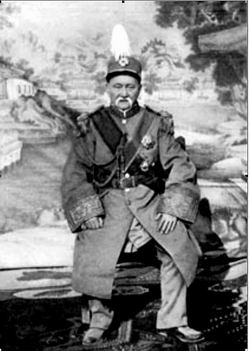
- Dong Fuxiang
- Ma Fuxiang
- Ma Fulu
- Ma Fuxing
- Ma Haiyan
- Ma Biao
- Ma Qi
- Ma Zhankui{{cite web|url=http://www.muslimwww.com/html/2012/lishi_1020/11389.html|access-date=21 April 2023|website=muslimwww.com
- Aema
References
References
- (2008-10-16). "韩有文传奇 然 也". 民革中央.
- 朱, 国琳. (2011-03-03). "马呈祥在新疆". 民族日报-民族日报一版 {{!}} 民族日报数字报刊平台.
- 韩, 芝华. (2009-10-16). "怀念我的父亲──韩有文".
- (1921). "Travels of a Consular Officer in North-West China". CUP Archive.
- Jonathan N. Lipman. (1997). "Familiar Strangers: A History of Muslims in Northwest China". University of Washington Press.
- Jonathan Lipman. (1997). "Familiar Strangers".
- Jonathan Lipman. (1997). "Familiar Strangers".
- Jonathan Lipman. (1997). "Familiar Strangers".
- Jonathan Lipman. (1997). "Familiar Strangers".
- Jonathan Lipman. (1997). "Familiar Strangers".
- Jonathan Lipman. (1997). "Familiar Strangers".
- (1922). "Indiscreet Letters From Peking". Kelly and Walsh, Limited British Empire and Continental Copyright Excepting Scandinavian Countries by Putnam Weale from 1921.
- (1922). "Indiscreet Letters From Peking Being the Notes of an Eye-Witness, Which Set Forth in Some Detail, from Day to Day, the Real Story of the Siege and Sack of a Distressed Capital in 1900--the Year of Great Tribulation". Kelly and Walsh, Limited British Empire and Continental Copyright Excepting Scandinavian Countries by Putnam Weale from 1921.
- (18 August 1907). "Indiscreet Letters From Peking". Dodd Mead And Company.
- (1907). "Indiscreet Letters from Peking (Year 1919)".
- Joseph W. Esherick. (1987). "The Origins of the Boxer Uprising". University of California Press.
- Joseph W. Esherick. (1987). "The Origins of the Boxer Uprising".
- Jonathan Lipman. (1997). "Familiar Strangers".
- Jane E. Elliott. (2002). "Some Did It for Civilisation, Some Did It for their Country: A Revised View of the Boxer War". Chinese University Press.
- Jane E. Elliott. (2002). "Some Did It for Civilisation, Some Did It for their Country". Chinese University Press.
- Jane E. Elliott. (2002). "Some Did It for Civilisation, Some Did It for their Country".
- Joseph W. Esherick. (18 August 1988). "The Origins of the Boxer Uprising". University of California Press.
- (1975). "The I. G. in Peking: Letters of Robert Hart, Chinese Maritime Customs, 1868-1907". Harvard University Press.
- Lynn E. Bodin. (1979). "The Boxer Rebellion". Osprey.
- (1972). "The rise of Chinese military power, 1895-1912". Kennikat Press.
- Ralph L. Powell. (8 December 2015). "Rise of the Chinese Military Power". Princeton University Press.
- (1949). "Papers on China, Volumes 3-4". East Asian Research Center, Harvard University.
- "Archived copy".
- Chester M. Biggs. (2003). "The United States Marines in North China, 1894–1942". McFarland.
- Joseph W. Esherick. (1987). "The Origins of the Boxer Uprising".
- Chester M. Biggs. (2003). "The United States Marines in North China". McFarland.
- Susan Naquin. (2000). "Peking: Temples and City Life, 1400–1900". University of California Press.
- Joseph Esherick. (1987). "The Origins of the Boxer Uprising".
- Susan Naquin. (2000). "Peking".
- Diana Preston. (2000). "The Boxer Rebellion: The Dramatic Story of China's War on Foreigners that Shook the World in the Summer of 1900". Berkley Books.
- (1910). "China Under the Empress Dowager".
- (16 June 1900). "The Defence of Peking. Preparing to Resist Expedition". The West Australian.
- Morse, Hosea Ballou. (1918). "The International Relations of the Chinese Empire, Volume 3". Longmans, Green, and Company.
- Reiley, Alan Campbell. (1901). "History for Ready Reference: From the Best Historians, Biographers, and Specialists; Their Own Words in a Complete System of History ...". C.A. Nichols Company.
- Josephus Nelson Larned. (1901). "History for Ready Reference from the Best Historians". C.A. Nichols Company.
- Alan Campbell Reiley. (1913). "History for Ready Reference, from the Best Historians, Biographers, and Specialists: Their Own Words in a Complete System of History". The C. A. Nichols co..
- (1900). "The Japan Daily Mail". A.H. Blackwell.
- (1899). "The Japan Daily Mail". A.H. Blackwell.
- (1898). "Japan Weekly Mail".
- (1914). "Annals & memoirs of the court of Peking: (from the 16th to the 20th century)". W. Heinemann.
- (1914). "The Atlantic Monthly, Volume 113". Atlantic Monthly Company.
- (1914). "Annals & memoirs of the court of Peking: (from the 16th to the 20th century)". W. Heinemann.
- (1907). "Indiscreet Letters From Peking". Dodd Mead And Company.
- (1909). "Indiscreet Letters from Peking: Being the Notes of an Eyewitness, which Set Forth in Some Detail, from Day to Day, the Real Story of the Siege and Sack of a Distressed Capital in 1900--the Year of Great Tribulation". Dodd, Mead.
- Paul A. Cohen. (1997). "History in Three Keys: The Boxers as Event, Experience, and Myth". Columbia University Press.
- Paul A. Cohen. (1997). "History in Three Keys".
- Joseph W. Esherick. (1987). "The Origins of the Boxer Uprising".
- Paul A. Cohen. (1997). "History in Three Keys".
- Lanxin Xiang. (2003). "The Origins of the Boxer War: A Multinational Study". RoutledgeCurzon.
- Joseph W. Esherick. (1987). "The Origins of the Boxer Uprising".
- Paul A. Cohen. (1997). "History in Three Keys".
- Joseph W. Esherick. (1987). "The Origins of the Boxer Uprising".
- Diana Preston. (2000). "The Boxer Rebellion". Bloomsbury Publishing USA.
- Diana Preston. (2000). "The Boxer Rebellion". Bloomsbury Publishing USA.
- Beals, Zephaniah Charles. (1901). "China and the Boxers: A short history of the Boxer outbreak, with two chapters on the sufferings of missionaries and a closing one on the outlook". M.E. Munson.
- (1901). "The Boxer Rising: A History of the Boxer Trouble in China". Shanghai Mercury.
- (1900). "The Boxer Rising: A History of the Boxer Trouble in China. Reprinted from the "Shanghai Mercury."". Shanghai mercury, limited.
- Diana Preston. (1 June 2000). "The Boxer Rebellion: The Dramatic Story of China's War on Foreigners That Shook the World in the Summer of 1900". Walker.
- Lanxin Xiang. (2003). "The origins of the Boxer War: a multinational study". Psychology Press.
- Diana Preston. (2000). "The Boxer Rebellion". Bloomsbury Publishing USA.
- (1980). "The Cambridge History of China". Cambridge University Press.
- Robert B. Edgerton. (1997). "Warriors of the rising sun: a history of the Japanese military". W. W. Norton & Company.
- (1970). "The siege of the Peking legations: a diary". University of Western Australia Press.
- Kelly, John S.. (1963). "A forgotten conference: the negotiations at Peking, 1900-1901". Librairie Droz.
- Boyd, Julia. (2012). "A Dance with the Dragon: The Vanished World of Peking's Foreign Colony". I.B.Tauris.
- Smith, Shirley Ann. (2012). "Imperial Designs: Italians in China 1900–1947". Lexington Books.
- Larry Clinton Thompson. (2009). "William Scott Ament and the Boxer Rebellion: heroism, hubris and the "ideal missionary"". McFarland.
- Lanxin Xiang. (2003). "The origins of the Boxer War: a multinational study".
- Harrington, Peter. (2013). "Peking 1900: The Boxer Rebellion". Osprey Publishing.
- "ANU - Digital Collections: Kansu Soldiers (Tung Fu Hsiang's)". dspace.anu.edu.au.
- "Kansu Braves". dspace.anu.edu.au.
- Clark, Kenneth G.. "The Boxer Uprising 1899–1900.".
- Robert B. Edgerton. (1997). "Warriors of the Rising Sun: a History of the Japanese Military". W. W. Norton & Company.
- (1992). "Dragon Lady: The Life and Legend of the Last Empress of China". Knopf.
- Smith, Arthur Henderson. (1901). "China in Convulsion, Volume 2". F. H. Revell Co..
- O'Connor, Richard. (1973). "The Boxer Rebellion". Hale.
- (1924). "Peking, North China, South Manchuria and Korea". T. Cook & son (F. H. & E. E. Cook).
- 内川芳美, 宮地正人, 每日コミュニケーションズ (Firm). 国際ニュース事典出版委員会. (1900). "外国新聞に見る日本: 国際ニュース事典, Volumes 2-3". 每日コミュニケーションズ.
- Wait, Eugene M.. (2001). "The Zenith of Imperialism, 1896-1906, Volume 2". Nova History Publications.
- Lipman, Jonathan N.. (July 1984). "Ethnicity and Politics in Republican China: The Ma Family Warlords of Gansu". Sage Publications, Inc..
- Tan, Chester C.. (1955). "The Boxer Catastrophe, by Chester C. Tan". Columbia University Press.
- Great Britain. Parliament. House of Commons. (1900). "Papers by Command, Volume 105". H.M. Stationery Office.
- MacDonald, Claude M.. (1900). "Reports from Her Majesty's minister in China respecting events at Peking: Presented to both houses of Parliament by command of Her Majesty, December 1900". H.M. Stationery Office.
- Whates, H. (1901). "The Politician's Handbook". Vacher & Sons.
- (1905). "British and Foreign State Papers". H.M. Stationery Office.
- O'Connor, Richard. (1973). "The Boxer Rebellion". Hale.
- Mersey (Viscount), Charles Clive Bigham. (1901). "A Year in China, 1899-1900". Macmillan and Company, limited.
- (1901). "Publication, Issue 33". U.S. Government Printing Office.
- United States. Adjutant-General's Office. Military Information Division. (1901). "Publications, Issues 33-34".
- (1901). "Reports on Military Operations in South Africa and China". U.S. Government Printing Office.
- Paul A. Cohen. (1997). "History in three keys: the Boxers as event, experience, and myth". Columbia University Press.
- O'Connor, Richard. (1973). "The Boxer Rebellion". Hale.
- Fleming, Peter. (1990). "The Siege at Peking". Dorset Press.
- Desmond Power. (1 January 1996). "Little Foreign Devil". Desmond Power author.
- Ralph L. Powell. (8 December 2015). "Rise of the Chinese Military Power". Princeton University Press.
- Jane E. Elliott. (2002). "Some did it for civilisation, some did it for their country: a revised view of the Boxer war". Chinese University Press.
- Arthur Henderson Smith. (1901). "China in convulsion, Volume 2". F. H. Revell Co..
- William Meyrick Hewlett. (1900). "Diary of the siege of the Peking legations, June to August, 1900". Pub. for the editors of the "Harrovian," by F. W. Provost.
- Bertram L. Simpson. (2001). "Indiscreet Letters from Peking: Being the Notes of an Eye-witness". Adegi Graphics LLC.
- Kemal H. Karpat. (2001). "The politicization of Islam: reconstructing identity, state, faith, and community in the late Ottoman state". Oxford University Press US.
- (1902). "The Spectator, Volume 87". F.C. Westley.
- (1993). "China Considers the Middle East". I. B. Tauris.
- (10 July 1901). "The official Russian announcement that...". The Straits Times.
- (1966). "The Moslem World, Volumes 1-3". Hartford Seminary Foundation.
- (2007). "The Boxers, China, and the World". Rowman & Littlefield.
- "The Well-Protected Domains Meet the Forbidden City: an Ottoman map of Beijing".
- Gratien, Chris. "The Well-Protected Domains Meet the Forbidden City: a map of Beijing".
- "Afternoon Map".
- Kemal, Hilmi. "Osmanlı haritaları".
- "osmanlldevleti.com".
- "Османская карта Запретного города в Пекине,.. | History and Islam | История и Ислам | VK".
- "VK photo".
- "马福祥--"戎马书生" - 新华网甘肃频道".
- [http://dev.gansudaily.com.cn/system/2011/09/29/012201290.shtml 缅怀中国近代史上的回族将领马福祥将军戎马一生] {{webarchive. link. (15 November 2014)
- "清末民国间爱国将领马福祥__中国甘肃网".
- Michael Dillon. (16 December 2013). "China's Muslim Hui Community: Migration, Settlement and Sects". Routledge.
- Lipman, Jonathan Newaman. (2004). "Familiar Strangers: A History of Muslims in Northwest China". [[University of Washington Press]].
- Susan Naquin. (2001). "Peking: Temples and City Life, 1400-1900". University of California Press.
- (25 September 1900). "The Powers and China". Evening Post.
- Arnold Henry Savage Landor. (1901). "China and the Allies". Charles Scribner's sons.
- (2001). "Peking 1900: the Boxer rebellion". Osprey Publishing.
- Patrick Taveirne. (2004). "Han-Mongol encounters and missionary endeavors: a history of Scheut in Ordos (Hetao) 1874–1911". Leuven University Press.
- Peter Fleming. (1990). "The Siege at Peking: The Boxer Rebellion". Dorset Press.

This article was imported from Wikipedia and is available under the Creative Commons Attribution-ShareAlike 4.0 License. Content has been adapted to SurfDoc format. Original contributors can be found on the article history page.
Ask Mako anything about Kansu Braves — get instant answers, deeper analysis, and related topics.
Research with MakoFree with your Surf account
Create a free account to save articles, ask Mako questions, and organize your research.
Sign up freeThis content may have been generated or modified by AI. CloudSurf Software LLC is not responsible for the accuracy, completeness, or reliability of AI-generated content. Always verify important information from primary sources.
Report