From Surf Wiki (app.surf) — the open knowledge base
Kamyenyets
Town in Brest Region, Belarus
Town in Brest Region, Belarus
| Field | Value |
|---|---|
| name | Kamyenyets |
| native_name | Каменец |
| other_name | Kamenets |
| settlement_type | Town |
| image_skyline | Kamyanets2.JPG |
| image_shield | Coat of Arms of Kamianiec.svg |
| pushpin_map | Belarus |
| pushpin_map_caption | Location in Belarus |
| subdivision_type | Country |
| subdivision_name | Belarus |
| subdivision_type1 | Region |
| subdivision_name1 | Brest Region |
| subdivision_type2 | District |
| subdivision_name2 | Kamyenyets District |
| established_title | First mentioned |
| established_date | 1276 |
| population_as_of | 2025 |
| population_footnotes | |
| population_total | 8,133 |
| timezone | MSK |
| utc_offset | +3 |
| coordinates | |
| postal_code_type | Postal code |
| postal_code | 225050, 225051 |
| area_code | +375 1631 |
| blank_name | License plate |
| blank_info | 1 |
Kamyenyets or Kamenets, also known as Kamyanyets, is a town in Brest Region, Belarus. It serves as the administrative center of Kamyenyets District. The town is located in the northwestern corner of Brest Region on the Lyasnaya River, about 40 km north from Brest. The Leśna Prawa river flows through the town. In 2002, its population was approximately 9,000. As of 2025, it has a population of 8,133.
History

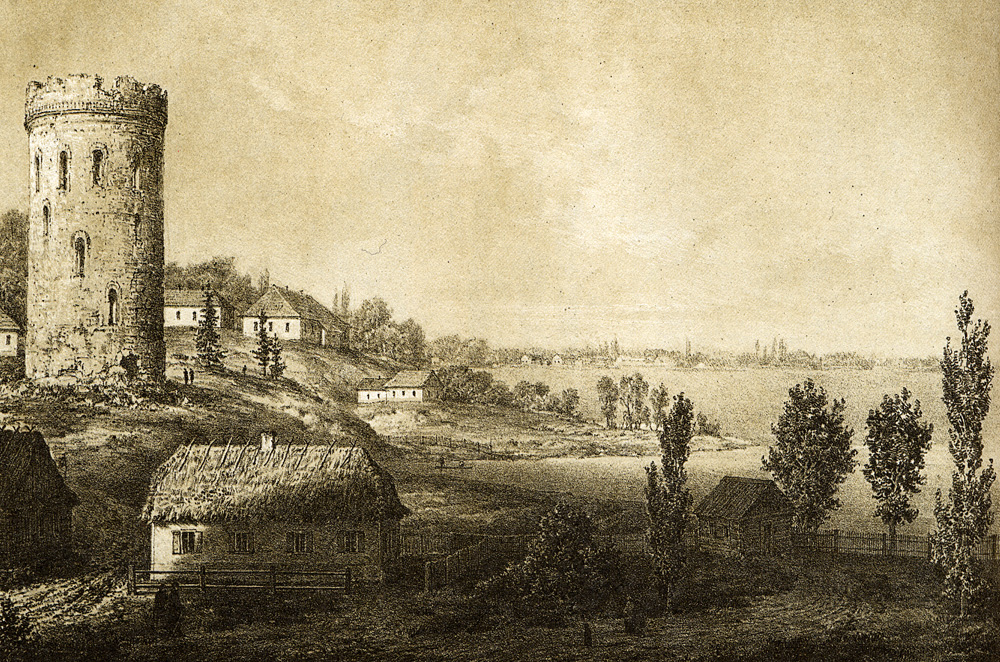
It was first mentioned in the Galician–Volhynian Chronicle in 1276, when a castle with a keep, the tower of Kamyenyets, was being constructed on this spot, to protect the northern boundary of Volhynia from the raids of invaders. This site on the stony steep bank of the Liasnaja (Lysna or Leśna) River had attracted Oleksa, the prominent builder and architect of Volhynia. He showed the site to Vladimir Vasilkovich, the Prince of Volhynia, who appreciated the place and ordered Oleksa to build a castle with a keep on the spot. Later a town appeared around the fortification. The tower is often called Bielaja Vieža (alternative transliteration: Belaya Vezha), which means White Tower or White Fortress in Belarusian, because after its foundation it was tiled in white. The neighboring primeval forest of Belavezhskaya Pushcha received its name, which also means White Tower, through association with the tower. However, today the color of the castle is brick-red, having weathered through the ages, not white.
The original name of the town comes from the Polish word Kamieniec which means stone fortress in English, as it served as one of the most important fortresses of Polish Kings during the Commonwealth.
In 1366, it was incorporated into the Grand Duchy of Lithuania and in 1376 it was burnt by Teutonic Crusaders but rapidly rebuilt. In 1503, local townsfolk received a limited self-administration right (probably the Magdeburg Rights) that was used by 1795, when it was annexed by Russia. In 1588 and 1659, the town was devastated with plague.
In the 19th century and the first four decades of the 20th century, the local Jewish community was the most active part of the townsfolk. Memories of the town are included in Yechezkel Kotik's memoir, published in English as Journey To a Nineteenth Century Shtetl: The Memoirs of Yekhezkel Kotik. Yeshivas Knesses Beis Yitzchak-Kaminetz was there 1926-1939.
In the years 1921-1939 it was in Poland. In 1939, it was occupied by Soviet Union and annexed to the Belorussian SSR. From 23 June 1941 until 22 July 1944, Kamyenyets was occupied by Nazi Germany and administered as a part of Bezirk Bialystok. During the Nazi occupation, most local Jews were killed.
After World War II, the town developed as a minor center of the food processing industry (cheese and butter making, baking of bread, etc.).
Notable residents
- Syarhey Kislyak (born 1987), footballer
Notes
References
References
- "Численность населения на 1 января 2025 г. и среднегодовая численность населения за 2024 год по Республике Беларусь в разрезе областей, районов, городов, поселков городского типа".
- (2010). "Назвы населеных пунктаў Рэспублікі Беларусь: Брэсцкая вобласць". Тэхналогія.
- Musevich, Georgiy. (2009). "Народ, который жил среди нас".
- Kotik, Yekhezkel. "Journey to a Nineteenth Century Shtetl: The Memoirs of Yekhezkel Kotik".
This article was imported from Wikipedia and is available under the Creative Commons Attribution-ShareAlike 4.0 License. Content has been adapted to SurfDoc format. Original contributors can be found on the article history page.
Ask Mako anything about Kamyenyets — get instant answers, deeper analysis, and related topics.
Research with MakoFree with your Surf account
Create a free account to save articles, ask Mako questions, and organize your research.
Sign up freeThis content may have been generated or modified by AI. CloudSurf Software LLC is not responsible for the accuracy, completeness, or reliability of AI-generated content. Always verify important information from primary sources.
Report