From Surf Wiki (app.surf) — the open knowledge base
Kalaloch, Washington
Unincorporated community in Washington, United States

Unincorporated community in Washington, United States
| Field | Value |
|---|---|
| official_name | Kalaloch, Washington |
| settlement_type | Unincorporated community |
| image_skyline | File:Kalaloch beach.jpg |
| image_caption | Kalaloch Beach |
| pushpin_map | Washington#USA |
| pushpin_label | Kalaloch |
| subdivision_type | Country |
| subdivision_name | United States |
| subdivision_type1 | State |
| subdivision_name1 | Washington |
| subdivision_type2 | County |
| subdivision_name2 | Jefferson |
| unit_pref | Imperial |
| timezone | Pacific (PST) |
| utc_offset | -8 |
| timezone_DST | PDT |
| utc_offset_DST | -7 |
| elevation_footnotes | |
| elevation_ft | 30 |
| coordinates | |
| postal_code_type | ZIP code |
| postal_code | 98331 |
| area_code | 360 |
| blank_name | FIPS code |
| blank1_name | GNIS feature ID |
| blank1_info | 1521546 |
Kalaloch is an unincorporated resort area entirely within Olympic National Park in western Jefferson County, Washington, United States. Kalaloch accommodations, which include a lodge, rental cabins, and campgrounds, are on a 50 ft bluff overlooking the Pacific Ocean, west of U.S. Route 101 on the Olympic Peninsula, north of the reservation of the Quinault Indian Nation.
The name Kalaloch is a corruption of the Quinault term k'–E–le–ok, pronounced Kq–â-lā'–ȯk, meaning "a good place to land", "canoe launch and landing", or "sheltered landing". The site was one of the few safe landing sites for dugout canoes between the Quinault River and Hoh River.
History
Artifacts discovered in Olympic National Park are evidence early humans inhabited the Olympic Peninsula 6,000 to 12,000 years ago. Today eight tribes (Elwha Klallam, Hoh, Jamestown S'Klallam, Makah, Port Gamble, Quileute, Quinault, S'Klallam, and Skokomish) live in reservations along the shores. In 1855 and 1856 Olympic Peninsula tribes ceded their lands and waters to the federal government.
In 1889, Washington became a state. President Grover Cleveland created the Olympic Forest Reserve in 1897, which was renamed to Olympic National Forest in 1907. Charles W. Becker, Sr., purchased a 40 acre coastal plot just south of where Kalaloch Creek meets the Pacific Ocean in 1925. Becker used milled lumber from driftwood logs that washed up on the beach to build a main lodge and cabins.

To preserve some of Washington's primeval forest lands, in 1938, President Franklin D. Roosevelt designated 898000 acre as Olympic National Park. Two years later, President Roosevelt added 300 mi2 to the park. President Harry S. Truman added 75 mi of coastal wilderness to the park in 1953, including the Kalaloch area. In 1976 the Olympic National Park was designated as an International Biosphere Reserve. The National Park Service (NPS) purchased the Becker property in 1978 and renamed it Kalaloch Lodge. Olympic National Park was designated in 1981 as a World Heritage Site. In 1988, Congress approved the designation of 95 percent of the park as the Olympic Wilderness.
Climate
Kalaloch weather is influenced by prevailing Pacific winds and two temperate rain forests, the Hoh Rainforest and the Quinault Rainforest. Annual rainfall at Kalaloch is measured in feet: on average, 8.5 ft fall annually.
- Spring – 8.94 in per month average
- Summer – 3.13 in per month average
- Fall – 11.17 in per month average
- Winter – 17.12 in per month average
Recreation

About 73 mi of beach in the Olympic National Park provide beachcombing opportunities. At Kalaloch, seven area beach trails lead to coastal hikes and Kalaloch Creek. Fishing possibilities at Kalaloch include surf perch, salmon, or native trout, or at low tide visitors may dig for razor clams. Bald eagles, black-legged kittiwakes, red-throated loons, black scoters, and brown pelicans are among birdwatchers' sightings at Kalaloch. From Kalaloch bluffs, whale watchers may see migratory gray whales, and sea lions, harbor porpoise, harbor seals, sea otters and orcas may also be spotted.
The National Park Service staffs a ranger station in the area during the summer.
Kalaloch Beach is known for the location of the "Tree of Life", a Sitka spruce with exposed roots that spans over a small creek that drains onto the sand from cliffs above the beach. Normally a tall species, the Tree of Life is shorter and thicker, with bent and windswept branches. The tree is a landmark in the county and is a popular site for social media photographers. In early January 2025, the tree had noticeably slumped approximately 5 ft after the creek gully eroded.
Kalaloch Lodge and Campground
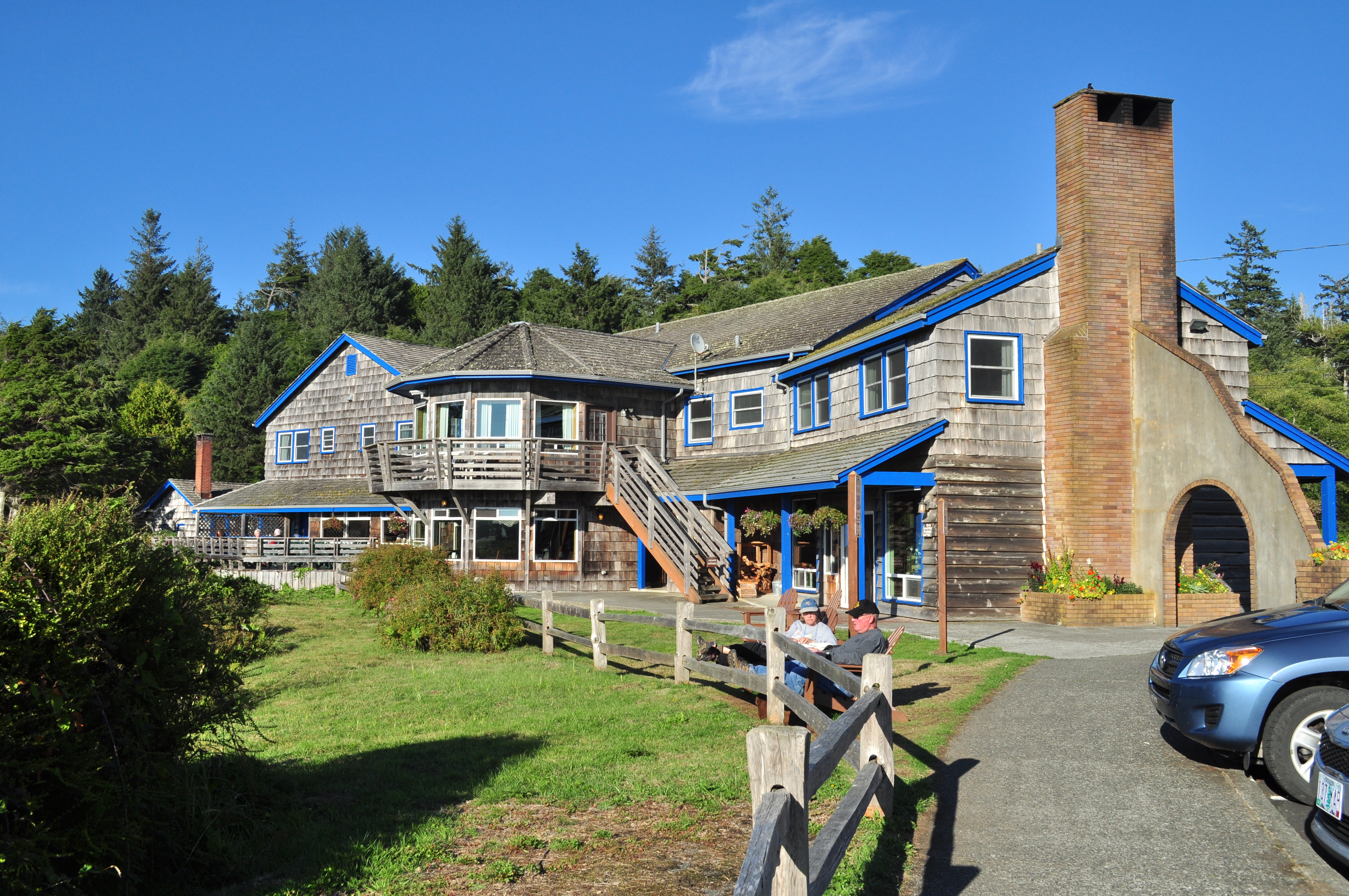
Kalaloch Lodge offers three types of accommodations: lodge, cabins, and campground. At its peak, forty cabins were available, including six on the bluff overlooking the ocean. Due to approximately 13 ft of erosion to the bluffs in 2023 and 2024, a total of seven cabins were demolished. The NPS stated that the lodge and remaining rental units were not considered threatened.
Kalaloch Campground, with 166 camp sites, is one of four campgrounds in Olympic National Park that accepts summer reservations.
References
References
- "ZIP Code 98331".
- {{GNIS. 1521546
- {{Cite gnis2. 1521546. Kalaloch
- Parratt, Smitty. (1984). "Gods & Goblins: A Field Guide to Place Names of Olympic National Park". CP Publications.
- Olympic National Park. "Prehistoric Inhabitants of the Olympic Peninsula".
- Olympic National Park. "The People of the Olympic Peninsula".
- Olympic National Park. "Tribes of the Olympic Peninsula".
- "A History of Treaties & Reservations on the Olympic Peninsula, 1855-1898". [[University of Washington.
- "Olympic National Forest - History & Culture". [[United States Forest Service.
- "Olympic National Park History".
- Olympic National Park. "History & Culture".
- Donovan, Lauren. (2024-03-28). "The erosion threat to Kalaloch Lodge's coastal haven".
- Scott, RL. "Ruth L. Scott Impacts to Olympic Wilderness Qualities".
- (November 16, 1988). "S.2165 - Washington Park Wilderness Act of 1988". Library of Congress.
- "Olympic National Park: Weather".
- "Olympic National Park Fishing and Clamming".
- "Kalaloch Birdwatching in Olympic National Park".
- Olympic National Park. "Visiting Kalaloch and Ruby Beach".
- "Washington Coast Whale Watching".
- Olympic National Park. "Kalaloch Area Brochure".
- Olympic National Park. "Exploring the Coast - Olympic National Park (U.S. National Park Service)".
- Olympic National Park. "Visitor Centers".
- (January 9, 2025). "Famous 'Tree of Life' slumps but struggles to survive on WA coast after recent storms". [[The Tacoma News Tribune]].
- "Kalaloch Lodge at Olympic National Park".
- "Olympic National Park Cabins at Kalaloch Lodge".
- Valentino, Silas. (March 8, 2024). "NPS is removing cabins along Highway 101 due to coastal erosion". SFGATE.
- (March 6, 2024). "NPS to demolish some Kalaloch cabins on WA coast as bluff erodes". The Seattle Times.
- "Kalaloch Lodge Group Campsite".
- Olympic National Park. "Camping".
This article was imported from Wikipedia and is available under the Creative Commons Attribution-ShareAlike 4.0 License. Content has been adapted to SurfDoc format. Original contributors can be found on the article history page.
Ask Mako anything about Kalaloch, Washington — get instant answers, deeper analysis, and related topics.
Research with MakoFree with your Surf account
Create a free account to save articles, ask Mako questions, and organize your research.
Sign up freeThis content may have been generated or modified by AI. CloudSurf Software LLC is not responsible for the accuracy, completeness, or reliability of AI-generated content. Always verify important information from primary sources.
Report