From Surf Wiki (app.surf) — the open knowledge base
Kakopetria
| Field | Value |
|---|---|
| name | Kakopetria |
| official_name | Κακοπετριά (Greek) |
| settlement_type | |
| image_skyline | View of Kakopetria village and Troodos Mountains in the background Republic of Cyprus.jpg |
| imagesize | 300px |
| pushpin_map | Cyprus |
| pushpin_relief | y |
| pushpin_label_position | bottom |
| pushpin_mapsize | 300 |
| pushpin_map_caption | Location in Cyprus |
| subdivision_type | Country |
| subdivision_name | Cyprus |
| subdivision_type1 | District |
| subdivision_name1 | Nicosia District |
| subdivision_type2 | Municipality |
| leader_title | Mayor |
| established_title | |
| unit_pref | Imperial |
| area_total_km2 | |
| area_land_km2 | |
| population_as_of | 2001 |
| population_total | 1198 |
| timezone | EET |
| utc_offset | +2 |
| timezone_DST | EEST |
| utc_offset_DST | +3 |
| coordinates | |
| elevation_footnotes | |
| postal_code_type | Postal code |
| postal_code | 2800 |
| website | https://www.kakopetria.org.cy/ |
Kakopetria is a town in Cyprus located 55 km southwest of the capital, Nicosia, on the north-facing foothills of the Troodos Mountains. It stands at an altitude of 667 metres and it is the highest village in the Solea Valley. The community has about 1,200 permanent inhabitants and a couple hundred more who either have a summer house or are originally from Kakopetria but work in Nicosia. Near Kakopetria there is church from 11th century, Agios Nikolaos tis Stegis, UNESCO World Heritage Site.
Landscape
Kakopetria is surrounded by thick forestland and is built on the banks of the Kargotis and Garillis Rivers. The two rivers join within village itself and form the river Klarios, which crosses the Solea Valley and empties into Morphou Bay.
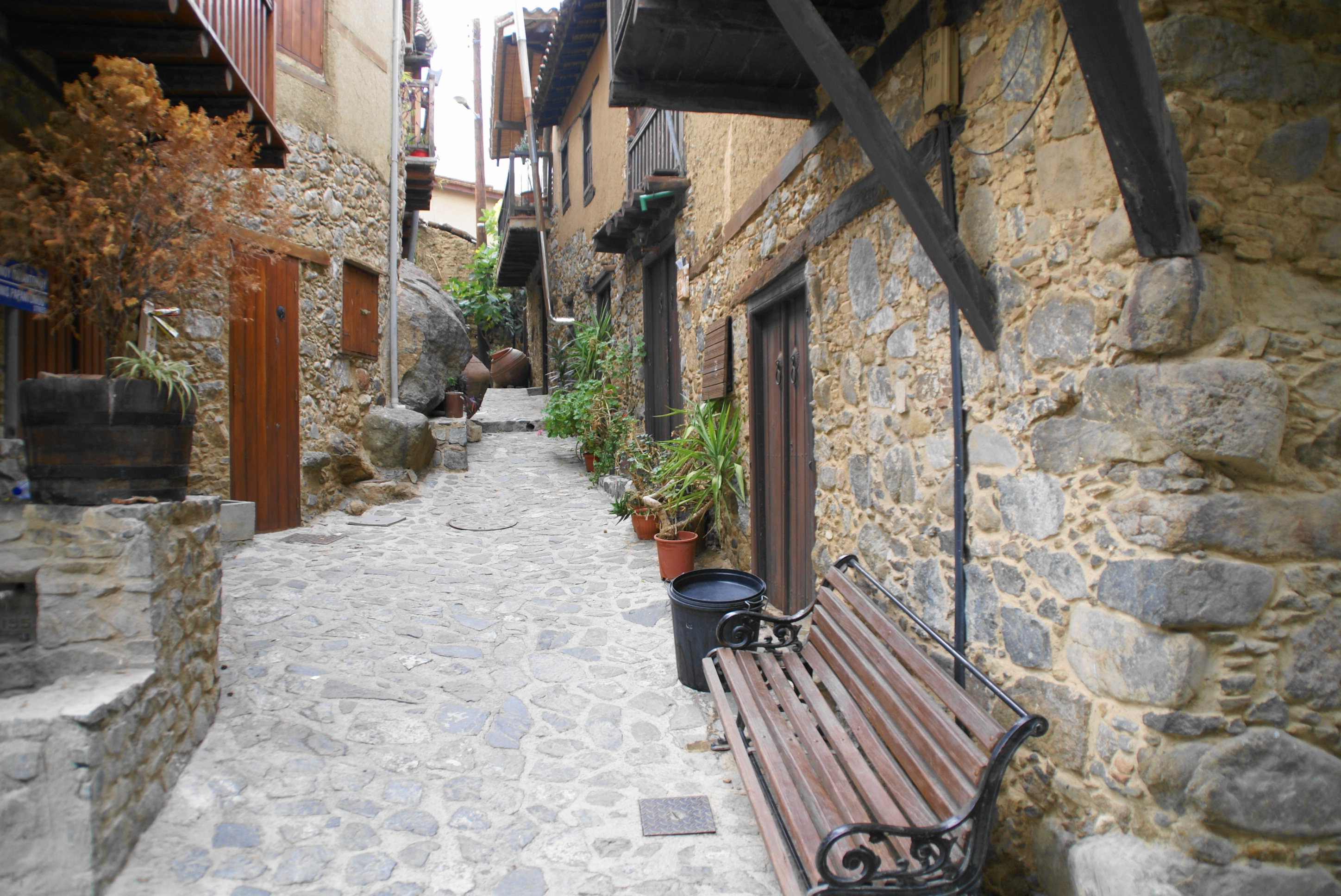
The settlement of Kakopetria is constructed along the valley of the Kargotis and Garillis rivers. The new Kakopetria with its large, modern houses and their tiled roofs, built in the gradient ground and the riverbanks, is located in the eastern part of the valley. The old Kakopetria is built west of the valley and between the two rivers. The roofs of the houses are sloped and tiled and almost all of the houses have an upper floor and a wooden balcony.
History
The settlement of Kakopetria, although mentioned by the Mediaeval annalists, existed -at least -since the Frank domination era (Lusignan Period 1192–1489). The village's region was inhabited around the 6th-7th centuries and the various excavations that have been conducted in 1938 around the old village of Kakopetria (in the Ailades venue) prove this. During the excavations a dispenser of an ancient shrine, most probably belonging to the goddess Athena came to light. A large number of movable findings were found, mainly terra-cotta, many of which depict the goddess Athena, as well as small, limestone, statues and parts of statues, and bronze and iron shafts from spearheads and arrows. The findings most probably date back to the Archaic and Classic eras of Cyprus. Other statuettes represent Hercules and are an indication that he was also worshiped in the area along with the goddess Athena. These findings are found in the Archaeological Museum of Nicosia.
Agios Nikolaos tis Stegis
Main article: Agios Nikolaos tis Stegis
Near Kakopetria there is church Agios Nikolaos tis Stegis (greek Αγίος Νικολάος της Στέγης, Saint Nicholas of the Roof) which is a UNESCO World Heritage Site along with nine other Painted Churches in the Troödos Region. Church is built in 11. century. The church is the only surviving Middle Byzantine katholikon (monastery church) in Cyprus during the 11th century. It prospered from the Middle Byzantine era until the beginning of Frankish rule, around the 12th century.
Village name
There are two versions about the origin of the village's name. According to first version Kakopetria name is a compound of greek words "kako" (bad) and "petra" (stone, rock). According to second version the name comes from a legend about a big rock called "Petra tou Androgynou" (Couples' Rock). That rock is now close to the bridge and newly wedded couples would sit on it, until according to legend the rock rolled over one couple and that rock they called bad rock. Agios Nikolaos tis Stegis.JPG|Agios Nikolaos tis Stegis Kakopetria Nikolaus.jpg |St. Nicholas Kakopetria Theodor.jpg|St George and Theodor Kakopetria Geburt Jesu.jpg |Birth of Christ
References
File:Kakopetria 01.JPG| File:Kakopetria 03.JPG| File:Kakopetria 05.JPG| File:Kakopetria 06.JPG| File:Kakopetria 07.JPG| File:Kakopetria 08.JPG| File:Kakopetria 09.JPG| File:Kakopetria 12.JPG| File:A rossz kő, Kakopetria - The bad stone, Kakopetria - panoramio.jpg|Bad stone
References
- ''Statistical Service of the Republic of Cyprus'', 2001 Population Census, MS Excel document [https://www.mof.gov.cy/mof/cystat/statistics.nsf/All/A5E0A9096615A568C2257122003FB72E/$file/POPULATION%20BY%20MUNICIPALITY_COMMUNITY-EN.xls?OpenElement]
- [http://www.kakopetria.eu/en/history-len Kakopetria]
This article was imported from Wikipedia and is available under the Creative Commons Attribution-ShareAlike 4.0 License. Content has been adapted to SurfDoc format. Original contributors can be found on the article history page.
Ask Mako anything about Kakopetria — get instant answers, deeper analysis, and related topics.
Research with MakoFree with your Surf account
Create a free account to save articles, ask Mako questions, and organize your research.
Sign up freeThis content may have been generated or modified by AI. CloudSurf Software LLC is not responsible for the accuracy, completeness, or reliability of AI-generated content. Always verify important information from primary sources.
Report