From Surf Wiki (app.surf) — the open knowledge base
Kagura
Type of ceremonial dance in Shinto ritual

Type of ceremonial dance in Shinto ritual
is a type of Shinto ritual ceremonial dance. The term is a contraction of the phrase , indicating the presence of gods (ja) in the practice.
One major function of ja is , involving a procession-trance process. Usually a female shaman will perform the dance and obtain the oracle from the god—in the setting, the dancer herself turns into the god during the performance. Once strictly a ceremonial art derived from , ja has evolved in many directions over the span of more than a millennium. Today, it is very much a living tradition, with rituals tied to the rhythms of the agricultural calendar, thriving primarily in parts of Shimane Prefecture, and urban centers such as Hiroshima.
Types of {{transliteration|ja|kagura}}
.jpg)
There are two major types of ja: ja and ja. ja consists of slow circular movement, stressing quiet and elegance, while ja consists of quick leaping and jumping, stressing activation and energy. The two types can be understood as two phases of ja: ja is a preparation process for trance and ja is the unconscious trance stage.
During ja, the female shaman, surrounded by a group of priests, holds a ja (a ceremonial wand used to cleanse or purify) as well as sound-producing instruments and engages with circling movement to summon deities. Once the female shaman enters a possessed state, she switches into the spontaneous leaping movements of ja.
History
The epics ja and ja describe a folktale origin for the dances. In these texts, there is a famous legendary tale about the sun goddess Amaterasu, who retreated into a cave, bringing darkness and cold to the world. Ame-no-Uzume, goddess of the dawn and of revelry, led the other gods in a wild dance, and persuaded Amaterasu to emerge to see what the ruckus was all about. ja is one of a number of rituals and arts said to derive from this event.
Originally called , ja began as sacred dances performed at the Imperial court by shrine maidens who were supposedly descendants of Ame-no-Uzume. During the performance, the shrine maidens usually utilize a channeling device for god such as masks and spears to imitate the trance. With the ja music that has the power to summon the gods, the ja start to dance to transform themselves into the representation of the gods and receive messages as well as blessings from the deities. In 1871, Iwami Shinto offices claimed that theatrical ja performed by priests in the west of Japan demeaned their dignity and therefore banned the performance. Owing to the support of civilian performing groups at that time, the performance pieces were still preserved.
Over time, however, these performed within the sacred and private precincts of the Imperial courts, inspired popular ritual dances, called , which, being popular forms, practiced in villages all around the country, were adapted into various other folk traditions and developed into a number of different forms. Among these are ja, ja, and Ise-style and Izumo-style ja dances. Many more variations have developed over the centuries, including some which are fairly new, and most of which have become highly secularized folk traditions.
ja, in particular those forms that involve storytelling or reenactment of fables, is also one of the primary influences on the Noh theatre.
File:Kagura-Dance-Shinto-1914.png|Kagura dance in 1914 File:Shinto gohei.jpeg|ja – a ceremonial wand used to cleanse or purify File:Kagura villain.jpg|Mask from contemporary ja performance
Imperial {{transliteration|ja|kagura}}

is a ritual dance performed at the imperial court and at important Shinto shrines: Kamo-jinja and Iwashimizu Hachiman-gū. It consists of welcoming, entertaining and greeting the deities with humorous or poetic syllabic songs. Today it is sometimes considered as a sub-genre of ja, of which it is one of the influences. It predated Chinese inspiration, and has indigenous elements as well as influences from other elements such as , and , which are forms of ja, More simply, ja can be considered dances accompanied by ja music.
The ja is the sacred vocal repertoire of 26 songs (ja, etc.) traditionally performed by a male choir for several days, but reduced today to 12 chants performed in six hours. Instruments used include the and/or the ja, with the possible addition of a ja and ja claves.
There are several ja dances, including:
- The , associated with the , making use of the ja or ja and a pair of ja, and with or without a zither;
- The , using the ja;
- The , associated with the ja, using the ja, the ja and the ja.
The formal Imperial ritual dances are performed in a number of sacred places and on a number of special occasions. At the Imperial Sanctuary, where a replica of the Yata no kagami is kept, they are performed as part of ja court music. ja are also performed at the Imperial harvest festival and at major shrines such as Ise, Kamo, and Iwashimizu Hachiman-gū. Since around the year 1000, these events have taken place every year.
According to the Board of Ceremonies of the Imperial Household Agency, ja still take place every December in the Imperial Sanctuary and at the Imperial harvest festival ceremonies.
Folk {{transliteration|ja|kagura}}
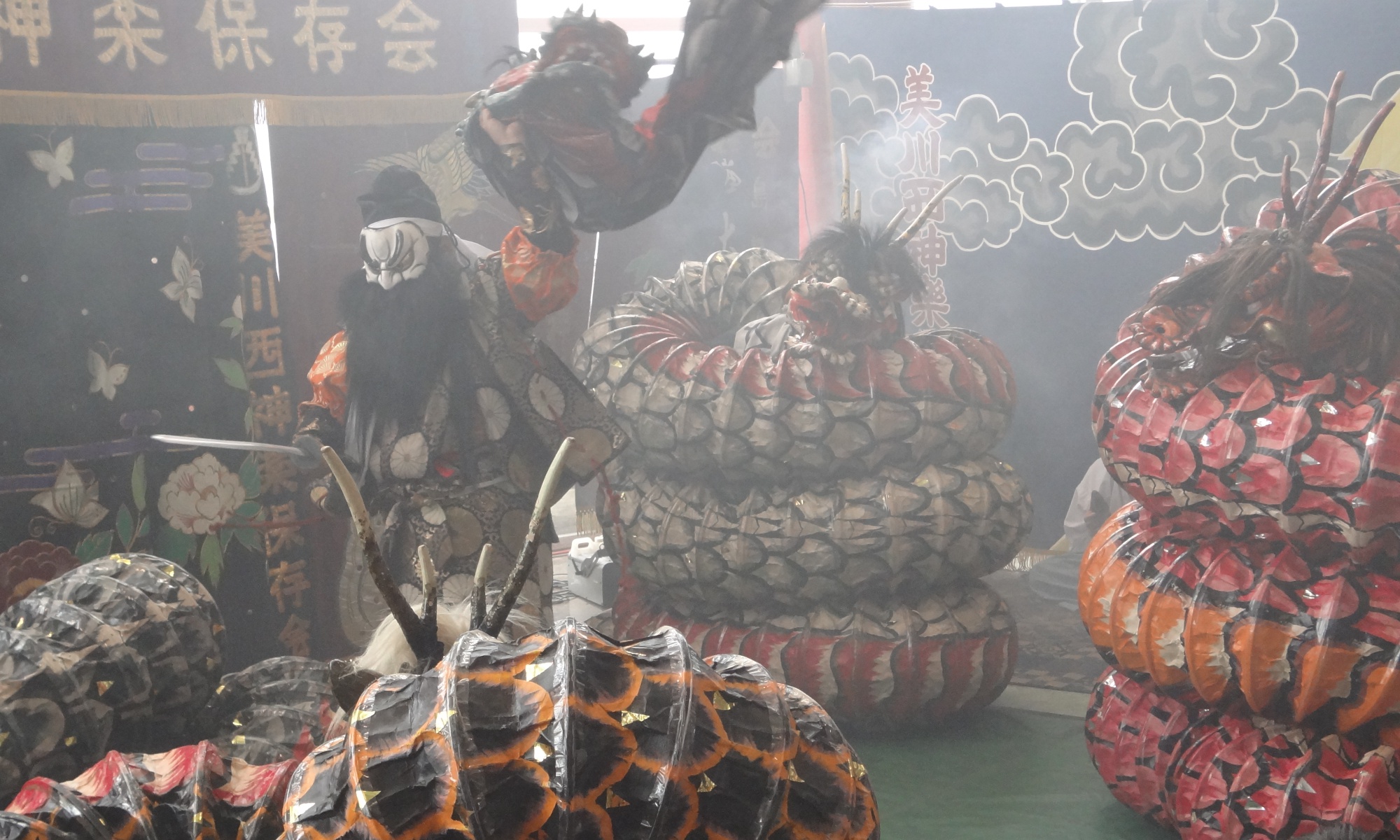
ja, or "normal ja", is a wide umbrella term containing a great diversity of folk dances derived from the Imperial ritual dances, and incorporated with other folk traditions. It is the partial origin of both Noh and ja. A number of traditions of folk ja exist:

- ja – dances performed by shrine maidens (ja) originally derived from ritual dances in which the ja channeled the ja, as part of Imperial Court dances. These originally had a very loose form, akin to similar god-possession dances and rituals, but over time they have developed, into highly regular set forms. Today, they are performed by shrines during the festival and in worship to ja as part of a ja. They are also performed at Buddhist temples as a martial arts performance. These dances are often performed with ritual props, such as bells, bamboo canes, sprigs of ja, or paper streamers.
- ja – dances based on those performed at Izumo Shrine serve a number of purposes, including ritual purification, celebration of auspicious days, and the reenactment of folktales. Originally quite popular in the Chūgoku region, near Izumo, these dances have spread across the country, and have developed over the centuries, becoming more of a secular folk entertainment and less of a formal religious ritual. The sacred dance of the Sada shrine has been inscribed on the UNESCO list of Intangible cultural heritage of humanity since 2011.
- ja – a form of dances derived from Yamabushi (a mobile group that embraces ascetic lives to gain power). This genre stresses on the power and energy. The performers always wear masks and use tools such as drum and sword to represent the magical power processed by Yamabushi. It was inscribed in 2009 as an Intangible cultural heritage of humanity by UNESCO.
- ja – a form of dances where ja and priests dip bamboo leaves in hot water and splash the hot water on themselves by shaking the leaves, and then scattering the hot water to people around the area.
- ja – a form of lion dance, in which a group of dancers take on the role of the lion (ja) and parade around the town. The lion mask and costume is seen as, in some ways, embodying the spirit of the lion, and this is a form of folk worship and ritual, as other forms of lion dances are in Japan and elsewhere.
- ja – a form of dance deriving from rituals performed by traveling priests between Ise Grand Shrine and Atsuta Shrine, who would travel to villages, crossroads, and other locations to help the locals by driving away evil spirits. Acrobatic feats and lion dances played a major role in these rituals.
Around the time of the beginning of the Tokugawa shogunate (1603–1868), performances derived from this emerged in Edo as a major form of entertainment. In connection with the celebrations surrounding the beginning of the shogunate, lion dances, acrobatics, juggling, and a great variety of other entertainments were performed on stages across the city, all nominally under the auspices of ja. Over the course of the period, these came to be more closely associated with ja storytelling and other forms of popular entertainment. ja continues to be performed to this day and include many elements of street entertainment.
References
- Derived primarily from the Japanese Wikipedia article.
- Giolai Andrea, Introducing Mikagura.Some Ethnomusicological Features of an Ancient Japanese Ritual, https://web.archive.org/web/20160316132415/http://www.centrostudiorientaliroma.net/introducing-mikagura-%e5%be%a1%e7%a5%9e%e6%a5%bd-some-ethnomusicological-features-of-an-ancient-japanese-ritual/?lang=en
References
- Averbuch, Irit. (1998). "Shamanic Dance in Japan: The Choreography of Possession in Kagura Performance". Asian Folklore Studies.
- Petersen, David. (2007). "Invitation to Kagura: Hidden Gem of the Traditional Japanese Performing Arts". Lulu Press.
- ''Nihongi: Chronicles of Japan from the Earliest Times to A.D. 697'', translated from the original Chinese and Japanese by [[William George Aston]]. Book I, part 1, page 44f. Tuttle Publishing. Tra edition (July 2005). First edition published 1972. {{ISBN. 978-0-8048-3674-6
- Lancashire, Terence. (2001). ""Kagura" - A "Shinto" Dance? Or Perhaps Not". Asian Music.
- (1993). "The Cambridge History of Japan". [[Cambridge University Press]].
- Akira Tamba. "''Musiques traditionnelles du Japon''". Actes Sud.
- S. Kishibe. (March 1984). "''The Traditional Music of Japan, Ongaku no tomo edition''". Ongaku No Tomo Sha Corp.
- Véronique Brindeau. "Musiques du Japon".
- "Shinto Shrines".
- Takayama Shigeru. (February 20, 2007). "''Performing Arts: Kagura''".
- "Le ''Sada shin noh'', danse sacrée au sanctuaire de Sada, Shimane".
- "Le ''kagura'' d'Hayachine".
This article was imported from Wikipedia and is available under the Creative Commons Attribution-ShareAlike 4.0 License. Content has been adapted to SurfDoc format. Original contributors can be found on the article history page.
Ask Mako anything about Kagura — get instant answers, deeper analysis, and related topics.
Research with MakoFree with your Surf account
Create a free account to save articles, ask Mako questions, and organize your research.
Sign up freeThis content may have been generated or modified by AI. CloudSurf Software LLC is not responsible for the accuracy, completeness, or reliability of AI-generated content. Always verify important information from primary sources.
Report