From Surf Wiki (app.surf) — the open knowledge base
Kabardino-Balkaria
Republic of Russia in the North Caucasus
Republic of Russia in the North Caucasus
| Field | Value | ||||
|---|---|---|---|---|---|
| name | Kabardino-Balkarian Republic | ||||
| subdivision_type | Country | ||||
| settlement_type | Republic | ||||
| image_flag | Flag_of_Kabardino-Balkaria.svg | ||||
| image_map | Map of Russia (2014–2022) - Kabardino-Balkaria (Crimea disputed).svg | ||||
| mapsize | 300px | ||||
| pushpin_map | European Russia | ||||
| pushpin_relief | 1 | ||||
| mapframe | yes | ||||
| mapframe-wikidata | yes | ||||
| mapframe-zoom | 6 | ||||
| mapframe-height | 250 | ||||
| mapframe-stroke-width | 1 | ||||
| subdivision_name | Russia | ||||
| coordinates | |||||
| subdivision_type2 | Federal district | ||||
| subdivision_name2 | North Caucasian | ||||
| subdivision_type3 | Economic region | ||||
| subdivision_name3 | North Caucasus | ||||
| leader_title | Head | ||||
| leader_name | Kazbek Kokov | ||||
| total_type | Total | ||||
| area_total_km2 | 12470 | ||||
| population_rank | 56th | ||||
| population_as_of | 2021 Census | ||||
| population_total | 904,200 | ||||
| {{ublist | item_style | white-space:nowrap; | |||
| 57.1% Kabardins | 19.8% Russians | 13.7% Balkars | 3% Cherkess | 6.7% other}}<ref name | 2021census |
| timezone1 | MSK | ||||
| blank_name | OKTMO ID | ||||
| blank_info | 83000000 | ||||
| native_name | kbd | ||||
| krc | |||||
| ru | |||||
| image_shield | Coat of Arms of Kabardino-Balkaria.svg | ||||
| iso_code | RU-KB | ||||
| registration_plate | 07 | ||||
| utc_offset | +3 | ||||
| anthem | State Anthem of the Kabardino-Balkarian Republic | ||||
| [[File:Гимн Кабардино-Балкарии.ogg | center]] | ||||
| flag_size | 120px | ||||
| shield_size | 75px | ||||
| flag_link | Flag of Kabardino-Balkaria | ||||
| shield_link | Coat of arms of Kabardino-Balkaria | ||||
| seat_type | Capital | ||||
| seat | Nalchik | ||||
| population_urban | 51.9% | ||||
| population_rural | 48.1% | ||||
| blank_name_sec1 | Official language(s) | ||||
| blank_info_sec1 | BalkarKabardianRussian | ||||
| government_type | Parliament of the Kabardino-Balkarian Republic | ||||
| website |
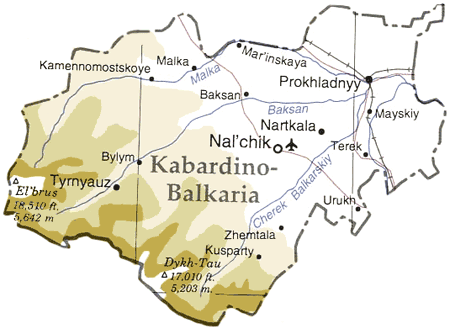
| mapframe-wikidata = yes | mapframe-zoom = 6 | mapframe-height = 250 | mapframe-stroke-width = 1 | 57.1% Kabardins|19.8% Russians|13.7% Balkars|3% Cherkess|6.7% other}} krc ru Kabardino-Balkaria (), officially the Kabardino-Balkarian Republic, is a republic of Russia located in the North Caucasus. As of the 2021 Census, its population was 904,200. Its capital is Nalchik. The area contains the highest mountain in Europe, Mount Elbrus, at 5642 m. Mount Elbrus has 22 glaciers that feed three rivers — Baksan, Malka and Kuban. The mountain is covered with snow year-round.
Geography
The republic is situated in the North Caucasus mountains, with plains in the northern part. The republic shares an international border with Georgia.
- Area: 12500 km2
- Borders:
- internal: Stavropol Krai (N/NE), North Ossetia–Alania (E/SE/S), Karachay–Cherkessia (W/NW)
- international: Georgia (Racha-Lechkhumi and Kvemo Svaneti, Zemo Svaneti) (S/SW)
- Highest point: Mount Elbrus (5,642 m)
- Maximum N-S distance: 167 km
- Maximum E-W distance: 123 km
Kabardino-Balkaria is traversed by the northeasterly line of equal latitude and longitude.
Rivers
Major rivers include:
- Terek River (623 km)
- Malka River (216 km)
- Baksan River (173 km)
- Urukh River (104 km)
- Chegem River (102 km)
- Cherek River (76 km)
- Argudan River
- Kurkuzhin River
- Lesken River
Lakes
There are about 100 lakes in the Republic, none of which is large. Just over half (55) are located between the Baksan and Malka rivers. Some of the lakes are:
- Tserikkel Lake (area 26,000 m2; depth 368 m)
- Lower Goluboye Lake
- Kel-Ketchen Lake (depth 177 m)
- Upper Tserikkel Lake (depth 18 m)
- Sekretnoye Lake
- Tambukan Lake (area 1.77 km2; depth 1.5 to 2 m), partially within Stavropol Krai.
Mountains
- Mount Elbrus (5,642 m), a volcanic mountain and the highest peak in Europe, Russia, and the Caucasus Other major mountains include:
- Mount Dykhtau (5,402 m)
- Mount Koshtantau (5,151 m)
- Mount Shkhara (5,068 m)
- Pushkin Peak (5,033 m)
- Mount Mizhergi (5,025 m)
Natural resources
Kabardino-Balkaria's natural resources include molybdenum, tungsten, and coal.
Climate
The republic has a continental-type climate.
- Average January temperature: -12 C (mountains) to -4 C (plains)
- Average July temperature: +4 C (mountains) to +23 C (plains)
- Average annual precipitation: 500–2,000 mm.
History
The ancestors of the modern Kabardians, known as Circassians or Kassogs, have inhabited the area since at least the 6th century BCE. During this period, the region was known as Zichia, a medieval Circassian kingdom located on the northeastern shore of the Black Sea. Historical sources first mention Zichia in the 6th century, with Byzantine historian Procopius of Caesarea recording that the people of the Zechoi had a king appointed by the Roman Emperor but had since become independent. The Notitiae Episcopatuum of the Patriarchate of Constantinople mentions an autocephalous archbishopric of Zichia from the 7th century onward, associated with Tamatarcha or the Cimmerian Bosporus.
Between 1242 and 1295, the region came under the control of the Mongols. From 1295 to around 1427, it was governed by the Georgians. In the early 15th century, the area became part of a unified Circassian Kingdom, which remained independent until the death of King Inal in 1453. Afterward, the kingdom experienced internal divisions and external pressures, leading to a gradual decline in its sovereignty.
Between 1769 and 1830, during the Russo-Circassian War, the region fell under Russian occupation. This period was marked by significant conflict and resistance from the indigenous populations. The war culminated in the annexation of Kabardino-Balkaria by Russia, leading to profound changes in the region's political and social structures.
During the Soviet era, Kabardino-Balkaria was part of the Russian SFSR, undergoing industrial growth but also facing cultural suppression. After the USSR's collapse, it became a republic within Russia and, on 1 July 1994, signed a power-sharing agreement granting it limited autonomy. This agreement allowed the republic to manage its own affairs to some extent, though it remained under the sovereignty of the Russian Federation. In 2001, Kabardino-Balkaria adopted a new constitution that reaffirmed its status within the Russian Federation, explicitly preventing the republic from existing independently.
Politics
The head of government in Kabardino-Balkaria is the Head. The current Head is Kazbek Kokov. The legislative body of the Republic is the Parliament comprising 70 deputies elected for a five-year term.
The republic adopted a new constitution in 2001 which prevents the republic from existing independently of the Russian Federation.
Administrative divisions
File:Абай къала.jpg|Cherek-Balkarskaya gorge File:Dykhtau.jpg|Mount Dykh-Tau File:ГКХ во второй половине дня.jpg|Prielbrusye File:Тызыльская теснина.jpg|Tyzyl Gorge
Demographics
|1926 | 230923 |1959 | 420115 |1970 | 588203 |1979 | 674605 |1989 | 759586 |2002 | 901494 |2010 | 859939 |2021 | 904200 |2025 | 908090 Population:

Life expectancy:
| 2019 | 2021 |
|---|---|
| Average: | 76.5 years |
| Male: | 72.6 years |
| Female: | 79.9 years |
Vital statistics
:Source:
| Average population (x 1000) | Live births | Deaths | Natural change | Crude birth rate (per 1000) | Crude death rate (per 1000) | Natural change (per 1000) | Fertility rates |
|---|---|---|---|---|---|---|---|
| 1970 | 592 | 11,683 | 3,913 | 7,770 | 19.7 | 6.6 | 13.1 |
| 1975 | 634 | 12,315 | 4,717 | 7,598 | 19.4 | 7.4 | 12.0 |
| 1980 | 680 | 14,098 | 5,457 | 8,641 | 20.7 | 8.0 | 12.7 |
| 1985 | 725 | 15,941 | 5,854 | 10,087 | 22.0 | 8.1 | 13.9 |
| 1990 | 772 | 15,412 | 6,573 | 8,839 | 20.0 | 8.5 | 11.5 |
| 1991 | 788 | 14,952 | 6,995 | 7,957 | 19.0 | 8.9 | 10.1 |
| 1992 | 799 | 13,728 | 7,093 | 6,635 | 17.2 | 8.9 | 8.3 |
| 1993 | 807 | 11,781 | 7,864 | 3,917 | 14.6 | 9.7 | 4.9 |
| 1994 | 816 | 11,407 | 8,052 | 3,355 | 14.0 | 9.9 | 4.1 |
| 1995 | 828 | 10,844 | 8,236 | 2,608 | 13.1 | 9.9 | 3.2 |
| 1996 | 840 | 10,293 | 8,199 | 2,094 | 12.2 | 9.8 | 2.5 |
| 1997 | 853 | 10,016 | 7,985 | 2,031 | 11.7 | 9.4 | 2.4 |
| 1998 | 866 | 9,997 | 8,201 | 1,796 | 11.5 | 9.5 | 2.1 |
| 1999 | 875 | 9,221 | 8,292 | 929 | 10.5 | 9.5 | 1.1 |
| 2000 | 883 | 9,207 | 8,792 | 415 | 10.4 | 10.0 | 0.5 |
| 2001 | 891 | 8,892 | 8,778 | 114 | 10.0 | 9.9 | 0.1 |
| 2002 | 897 | 9,119 | 8,954 | 165 | 10.2 | 10.0 | 0.2 |
| 2003 | 896 | 9,294 | 9,202 | 92 | 10.4 | 10.3 | 0.1 |
| 2004 | 889 | 9,414 | 8,695 | 719 | 10.6 | 9.8 | 0.8 |
| 2005 | 882 | 8,991 | 9,034 | - 43 | 10.2 | 10.2 | -0.0 |
| 2006 | 875 | 9,308 | 8,764 | 544 | 10.6 | 10.0 | 0.6 |
| 2007 | 870 | 11,397 | 8,441 | 2,956 | 13.1 | 9.7 | 3.4 |
| 2008 | 866 | 12,052 | 8,095 | 3,957 | 13.9 | 9.3 | 4.6 |
| 2009 | 863 | 12,143 | 8,406 | 3,737 | 14.1 | 9.7 | 4.3 |
| 2010 | 860 | 12,576 | 8,080 | 4,496 | 14.6 | 9.4 | 5.2 |
| 2011 | 860 | 12,848 | 8,136 | 4,712 | 14.9 | 9.4 | 5.5 |
| 2012 | 859 | 13,786 | 7,709 | 6,077 | 16.0 | 9.0 | 7.0 |
| 2013 | 859 | 13,365 | 7,712 | 5,653 | 15.6 | 9.0 | 6.6 |
| 2014 | 860 | 13,397 | 7,571 | 5,826 | 15.6 | 8.8 | 6.8 |
| 2015 | 861 | 12,627 | 7,582 | 5,045 | 14.6 | 8.8 | 5.8 |
| 2016 | 863 | 12,191 | 7,386 | 4,805 | 14.1 | 8.5 | 5.6 |
| 2017 | 865 | 11,092 | 7,391 | 3,701 | 12.8 | 8.5 | 4.3 |
| 2018 | 865 | 10,881 | 7,044 | 3,837 | 12.5 | 8.1 | 4.4 |
| 2019 | 866 | 9,973 | 7,142 | 2,831 | 11.5 | 8.2 | 3.3 |
| 2020 | 10,604 | 8,624 | 1,980 | 12.2 | 9.9 | 2.3 | |
| 2021 | 10,462 | 9,436 | 1,026 | 12.0 | 10.8 | 1.2 | |
| 2022 | 10,049 | 8,010 | 2,039 | 11.5 | 9.2 | 2.3 | |
| 2023 | 9,941 | 6,827 | 3,114 | 11.0 | 7.5 | 3.5 | |
| 2024 | 10,180 | 6,963 | 3,217 | 11.2 | 7.7 | 3.5 |
Note: TFR 2009, 2010, 2011, 2012 source.
Ethnic groups
Kabardino-Balkaria includes two major ethnic communities, the Kabardins (Circassians), who speak a North-West Caucasian language, and the Balkars who speak a Turkic language. According to the 2021 Census, Kabardins make up 57.1% of the republic's population, followed by Russians (19.8%) and Balkars (13.7%). Other groups include Cherkess (3.0%), Turks (1.9%), Ossetians (0.8%), Romani (0.5%), and a host of smaller groups, each accounting for less than 0.5% of the total population.
| Ethnic | |||||||||||||||||||||||||||
|---|---|---|---|---|---|---|---|---|---|---|---|---|---|---|---|---|---|---|---|---|---|---|---|---|---|---|---|
| group | 1926 Census1 | 1939 Census | 1959 Census | 1970 Census | 1979 Census | 1989 Census | 2002 Census | 2010 Census | 2021 Census3 | Number | % | Number | % | Number | % | Number | % | Number | % | Number | % | Number | % | Number | % | Number | % |
| Kabardin | 122,237 | 54.2% | 152,237 | 42.4% | 190,284 | 45.3% | 264,675 | 45.0% | 303,604 | 45.5% | 364,494 | 48.2% | 498,7022 | 55.3% | 490,453 | 57.2% | 502,615 | 57.1% | |||||||||
| Balkars | 33,197 | 14.7% | 40,747 | 11.3% | 34,088 | 8.1% | 51,356 | 8.7% | 59,710 | 9.0% | 70,793 | 9.4% | 104,951 | 11.6% | 108,577 | 12.7% | 120,898 | 13.7% | |||||||||
| Russians | 32,622 | 14.5% | 129,067 | 35.9% | 162,586 | 38.7% | 218,595 | 37.2% | 234,137 | 35.1% | 240,750 | 31.9% | 226,620 | 25.1% | 193,155 | 22.5% | 174,768 | 19.8% | |||||||||
| Ossetians | 3,839 | 1.7% | 4,608 | 1.3% | 6,442 | 1.5% | 9,167 | 1.6% | 9,710 | 1.5% | 9,996 | 1.3% | 9,845 | 1.1% | 9,129 | 1.1% | 6,877 | 0.8% | |||||||||
| Ukrainians | 24,723 | 11.0% | 11,142 | 3.1% | 8,400 | 2.0% | 10,620 | 1.8% | 12,139 | 1.8% | 12,826 | 1.7% | 7,592 | 0.8% | 4,800 | 0.6% | 1,461 | 0.2% | |||||||||
| Cherkess | 8,803 | 3.9% | 21,328 | 5.9% | 18,315 | 4.4% | 33,790 | 5.7% | 47,246 | 7.1% | 614 | 0.1% | 725 | 0.1% | 2,475 | 0.3% | 26,544 | 3.0% | |||||||||
| Others | 55,058 | 7.3% | 53,059 | 5.9% | 49,081 | 5.7% | 47,748 | 5.7% | |||||||||||||||||||
| 1 The results of the 1926 census refer to the present territory, which is a combination of the Kabardo-Balkarian AO and a part of the Terek district. The latter area was mainly inhabited by Russians and Ukrainians. |
File:Верхняя Балкария. Мечеть..jpg|Mosque in Kabardino-Balkaria File:Catholic church in Blagoveschenka, Kabardino-Balkaria, Russia.jpg|Catholic church in Kabardino-Balkaria (Diocese of Saratov, Blagoveshchenka) File:1936 год. Жабоев М. из селения Нижний Хулам за игрой в "Сыбызгы", на празднике в честь 15 -летия Кабардино-Балкарии.jpg|Balkars in 1936 File:Beslan Mudranov 01.jpg|Kabardian wrestler Beslan Mudranov won Russia's first gold medal at the Rio 2016 Olympics
Religion
According to a 2012 survey which interviewed 56,900 people, 70.8% of the population of Kabardino-Balkaria adhered to Islam, 11.6% to the Russian Orthodox Church, 3.8% were non-Orthodox Christians, and 1.8% followed Adyghe (Kabardian) folk religion and other indigenous faiths. In addition, 5.6% of the population declared to be "spiritual but not religious" and 4.4% was atheist or followed other religions, including Jehovah's Witnesses.
Notes
References
Sources
- {{Cite Russian law
References
- Constitution of the Kabardino-Balkarian Republic, Article 78
- Official website of the Head of the Kabardino-Balkarian Republic. [http://president-kbr.ru/en/glava/biography.html Biography] {{webarchive. link. (28 October 2014 {{in lang). ru
- "Оценка численности постоянного населения по субъектам Российской Федерации". [[Federal State Statistics Service (Russia).
- link
- Law #13-RZ
- Constitution of the Kabardino-Balkarian Republic, Article 136
- Constitution of the Kabardino-Balkarian Republic, Article 76
- Official throughout the Russian Federation according to Article 68.1 of the [[Constitution of Russia]].
- Constitution of the Kabardino-Balkarian Republic, Article 91
- (2 September 2017). "Head of Kabardino-Balkarian Republic reported to the President on the situation in Mount Elbrus region".
- "Russia's federal constituent entities".
- Skutsch, Carl. (2013-11-07). "Encyclopedia of the World's Minorities". Routledge.
- {{ru-pop-ref. 2021Census
- (1991). "The Oxford dictionary of Byzantium". Oxford University Press.
- Колли Л. Кафа в период владения ею банком св. Георгия (1454—1475) // Известия Таврической Ученой Архивной комиссии. № 47. Симферополь, 1912. С. 86
- Kazhdan, Aleksandr Petrovich. (1991). "The Oxford Dictionary of Byzantium". Oxford University Press.
- "Генофонд :: Итоги изучения Западного Кавказа".
- World, Abkhaz. (2020-05-17). "The Legendary Circassian Prince Inal, by Vitaliy Shtybin".
- EL-Nasr, Ahmed Seif. "Kabardino-Balkaria: Orbiting in Russia’s Axis of Oppression".
- Solnick, Steven. (29 May 1996). "Asymmetries in Russian Federation Bargaining". The National Council for Soviet and East European Research.
- "Russia signs power-sharing treaty with rebellious province - UPI Archives".
- "Kabardino-Balkaria - Geography, History, Politics".
- "Agreement between Russia and Tatarstan. Подробное описание экспоната, аудиогид, интересные факты. Официальный сайт Artefact".
- link. Meduza
- Constitution, Article 94.
- "Предварительная оценка численности постоянного населения на 1 января 2025 года". [[Federal State Statistics Service (Russia).
- "Демографический ежегодник России". [[Federal State Statistics Service (Russia).
- "Ожидаемая продолжительность жизни при рождении".
- [http://www.gks.ru/dbscripts/Cbsd/DBInet.cgi#1 Russian Federal State Statistics Service] {{Webarchive. link. (12 April 2008)
- "Официальные статистические показатели".
- "Каталог публикаций::Федеральная служба государственной статистики".
- "Национальный состав населения". [[Federal State Statistics Service (Russia).
- "население кабардино-балкарии".
- "ВПН-2010".
- [http://sreda.org/en/arena "Arena: Atlas of Religions and Nationalities in Russia"]. Sreda, 2012.
- [http://c2.kommersant.ru/ISSUES.PHOTO/OGONIOK/2012/034/ogcyhjk2.jpg 2012 Arena Atlas Religion Maps]. "Ogonek", № 34 (5243), 27 August 2012. Retrieved 21 April 2017. [https://web.archive.org/web/20170421154615/http://c2.kommersant.ru/ISSUES.PHOTO/OGONIOK/2012/034/ogcyhjk2.jpg Archived].
This article was imported from Wikipedia and is available under the Creative Commons Attribution-ShareAlike 4.0 License. Content has been adapted to SurfDoc format. Original contributors can be found on the article history page.
Ask Mako anything about Kabardino-Balkaria — get instant answers, deeper analysis, and related topics.
Research with MakoFree with your Surf account
Create a free account to save articles, ask Mako questions, and organize your research.
Sign up freeThis content may have been generated or modified by AI. CloudSurf Software LLC is not responsible for the accuracy, completeness, or reliability of AI-generated content. Always verify important information from primary sources.
Report