From Surf Wiki (app.surf) — the open knowledge base
Jumper (dress)
Sleeveless, collarless dress worn over a blouse, shirt or sweater
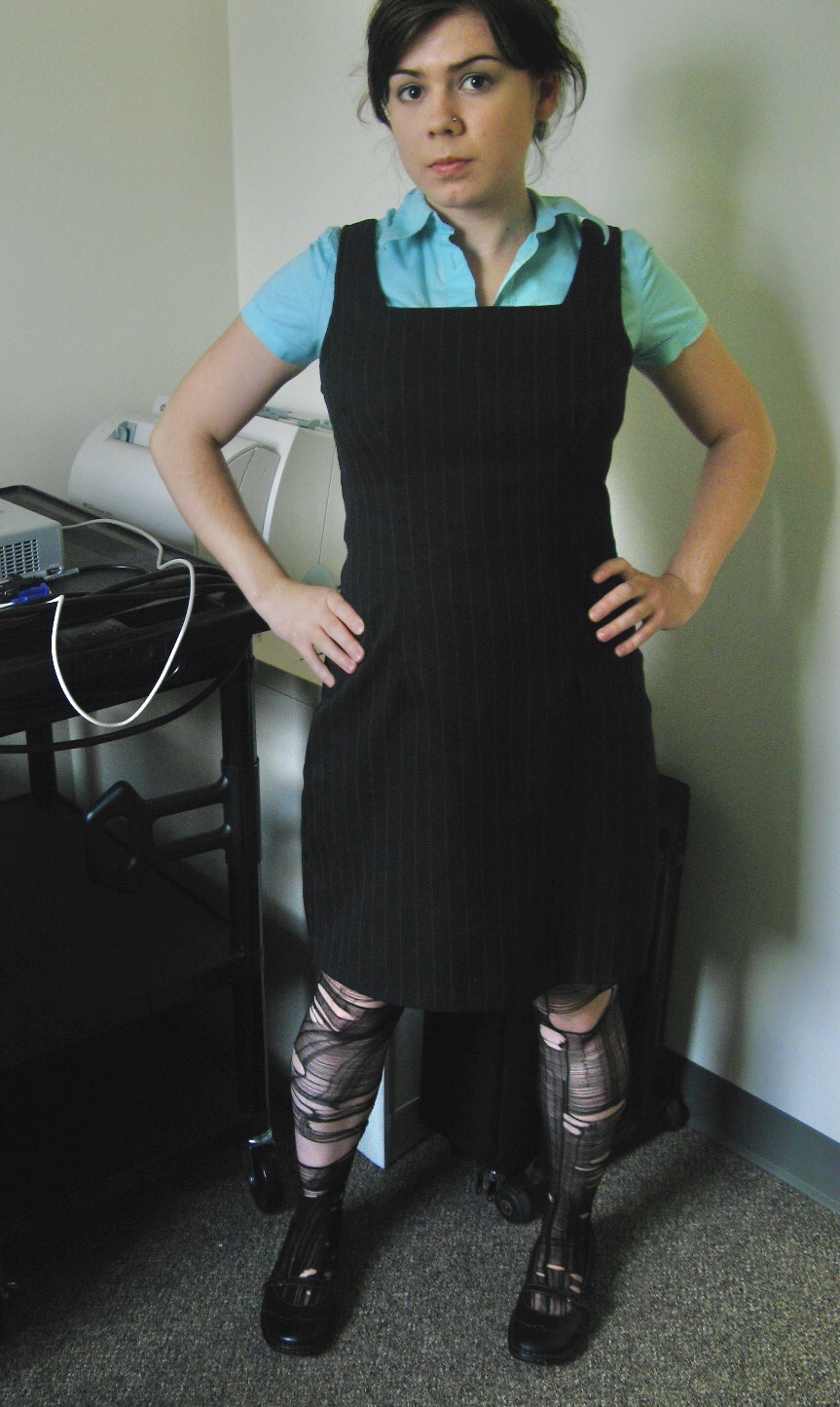
Sleeveless, collarless dress worn over a blouse, shirt or sweater

A jumper (in American English), jumper dress, or pinafore dress is a sleeveless, collarless dress intended to be worn over a blouse, shirt, T-shirt or sweater. Hemlines can be of different lengths and the type of collar and whether there is pleating are also variables in the design.
In British English, the term jumper describes what is called a sweater in American English. Also, in more formal British usage, a distinction is made between a pinafore dress and a pinafore. The latter, though a related garment, has an open back and is worn as an apron. In American English, pinafore always refers to an apron.
A jumper is distinct from a sundress, which is typically sleeveless and collarless likewise, but generally of a different cut and fashion and designed to be worn on its own.
The apron dress may be viewed as a special case of the jumper. If the design of the dress is directly inspired by an apron (having a bib in front and ties in the back, for example), the garment is typically described as an apron dress.
History
Jumpers for fall were described in The Fort Wayne Sentinel in 1906. The dresses were "imported from Paris" and featured "original lines".
Jumpers in the United States were part of the sportswear collections of Jean Patou, Coco Chanel and Paul Poiret. Suzanne Lenglen wore Patou's jumper design in the 1920s. The dresses, worn over blouses, became popular during the decade of the 1920s. Jumpers were often worn in the summer and made out of various types of fabrics.
Jumpers were touted as an "American" and a "sports fashion" in 1930 by the Pittsburgh Press. The dresses were also praised for allowing women to create color combinations through the choice of blouse worn underneath.
Jumpers were again popularized in 1953, when Hubert de Givenchy promoted his own jumper. Jumpers, now considered a "classic" look, were considered "suitable to all ages."
References
Citations
General and cited sources
References
- McKean, Erin. (2013). "The Hundred Dresses: The Most Iconic Styles of Our Time". Bloomsbury.
- (1906-11-11). "Hints for the Home Dressmaker". Chicago Tribune.
- (2007). "The Visual Dictionary of Fashion Design 2940373612".
- [http://www.collinsdictionary.com/dictionary/english/jumper Jumper], definition in Collins American Dictionary
- [https://web.archive.org/web/20120706124503/http://oxforddictionaries.com/definition/english/pinafore "Pinafore" Oxford Dictionaries]
- (1906-09-10). "A New Model 'Jumper' Dress for Fall". The Fort Wayne Sentinel.
- Marie, Jen. (2 June 2015). "A Brief History of the Jumper". Bustle.
- (2010). "History of American Dress from the 15th and 16th Century Through 1965". Chris Costilow.
- Bottomley, Julia. (1925-07-10). "Jumper Dress is Popular; In the Ultra Smart Mode". West Schuylkill Herald.
- Parrish, Amos. (1930-10-14). "What's In Fashion: The Youthful Jumper Dress". The Pittsburgh Press.
- Snodgrass, Mary Ellen. (2015). "World Clothing and Fashion: An Encyclopedia of History, Culture, and Social Influence". Routledge.
- Blair, Beth. (1957-03-07). "Classic Jumper Dress Is Suitable to All Ages". Courier-Post.
This article was imported from Wikipedia and is available under the Creative Commons Attribution-ShareAlike 4.0 License. Content has been adapted to SurfDoc format. Original contributors can be found on the article history page.
Ask Mako anything about Jumper (dress) — get instant answers, deeper analysis, and related topics.
Research with MakoFree with your Surf account
Create a free account to save articles, ask Mako questions, and organize your research.
Sign up freeThis content may have been generated or modified by AI. CloudSurf Software LLC is not responsible for the accuracy, completeness, or reliability of AI-generated content. Always verify important information from primary sources.
Report