From Surf Wiki (app.surf) — the open knowledge base
Julia Ward Howe
American abolitionist, social activist, and poet (1819–1910)
.png)
American abolitionist, social activist, and poet (1819–1910)
| Field | Value |
|---|---|
| name | Julia Ward Howe |
| image | JuliaWardHowe 2 (cropped).jpg |
| caption | Howe in 1895 |
| birth_name | Julia Ward |
| birth_date | |
| birth_place | New York City, U.S. |
| death_date | |
| death_place | Portsmouth, Rhode Island, U.S. |
| signature | Julia Ward Howe signature.png |
| spouse | |
| parents | Samuel Ward III |
| Julia Rush Cutler | |
| children | |
| relatives | Samuel Cutler Ward (brother) |
Julia Rush Cutler
Julia Ward Howe ( ; May 27, 1819 – October 17, 1910) was an American author and poet, known for writing the "Battle Hymn of the Republic" as new lyrics to the song "John Brown's Body," and the original 1870 pacifist Mothers' Day Proclamation. She was also an advocate for abolitionism and a social activist, particularly for women's suffrage.
Early life and education
Julia Ward was born in New York City on May 27, 1819. She was the fourth of seven children. Her father Samuel Ward III was a Wall Street stockbroker, banker, and strict Calvinist Episcopalian. Her mother was the poet Julia Rush Cutler Ward, related to Francis Marion, the "Swamp Fox" of the American Revolution. She died during childbirth when Howe was five.
Howe was educated by private tutors and schools for young ladies until she was sixteen. Her eldest brother, Samuel Cutler Ward, traveled in Europe and brought home a private library. She had access to these books, many contradicting the Calvinistic view. Though social, she became well-read, as well as scholarly. She met, because of her father's status as a successful banker, Charles Dickens, Charles Sumner, and Margaret Fuller.
Her brother, Sam, married into the Astor family, allowing him great social freedom that he shared with his sister. The siblings were cast into mourning with the death of their father in 1839, the death of their brother, Henry, and the deaths of Samuel's wife, Emily, and their newborn child.
Personal life
Though raised an Episcopalian, Julia became a Unitarian by 1841. In Boston, Ward met Samuel Gridley Howe, a physician and reformer who had founded the Perkins School for the Blind. Howe had courted her, but he had shown an interest in her sister Louisa. In 1843, they married despite their eighteen-year age difference. Howe raised her children in South Boston, while her husband pursued his advocacy work. She hid her unhappiness with their marriage, earning the nickname "the family champagne" from her children. She made frequent visits to Gardiner, Maine, where she stayed at "The Yellow House," a home built originally in 1814 and later home to her daughter Laura.
Howe was a vegetarian in the late 1830s but was eating meat again by 1843. In 1852, the Howes bought a "country home" with 4.7 acres of land in Portsmouth, Rhode Island, which they called "Oak Glen." They continued to maintain homes in Boston and Newport, but spent several months each year at Oak Glen.
Career
Writing

She attended lectures, studied foreign languages, and wrote plays and dramas. Prior to her marriage, Howe had published essays on Goethe, Schiller and Lamartine in the New York Review and Theological Review. Her second anonymous collection, Words for the Hour, appeared in 1857. She went on to write plays such as Leonora, The World's Own, and Hippolytus. These works all contained allusions to her stultifying marriage.
Unpublished during her lifetime but certainly part of her twenty-first century legacy is a fragmentary novel, The Hermaphrodite, assembled from manuscript fragments in Harvard's Houghton Library by Gary Williams and published in 2004 by the University of Nebraska Press.
She went on trips including several for missions. In 1860, she published A Trip to Cuba, which told of her 1859 trip. It had generated outrage from William Lloyd Garrison, an abolitionist, for its derogatory view of Black people. Howe believed it was right to free the slaves but did not believe in racial equality. Several letters on High Newport society were published in the New York Tribune in 1860, as well.
Howe's being a published author troubled her husband greatly, especially due to the fact that her poems many times had to do with critiques of women's roles as wives, her own marriage, and women's place in society. Their marriage problems escalated to the point where they separated in 1852. Samuel, when he became her husband, had also taken complete control of her estate income. Upon her husband's death in 1876, she found that through a series of bad investments, most of her money had been lost.
Howe's writing and social activism were greatly shaped by her upbringing and married life. Much study has gone into her difficult marriage and how it influenced her work, both written and active.
Politics
In the early 1870s, Howe was nominated by Massachusetts governor William Claflin as justice of the peace. However, there were uncertainties surrounding her appointment, as many believed women were not fit to hold office. In 1871, the Massachusetts Supreme Court made the decision that women could not hold any judicial offices without explicit authorization from the legislature, thereby nullifying Howe's appointment to justice of the peace. This led to activists petitioning for legislation allowing women to hold office, separate from legislating women's suffrage. Women's supporters believed that petitioning for officeholding before petitioning for a women's suffrage amendment would expedite women's involvement in politics.
Social activism
She was inspired to write "The Battle Hymn of the Republic" after she and her husband visited Washington, D.C., and met Abraham Lincoln at the White House in November 1861. During the trip, her friend James Freeman Clarke suggested she write new words to the song "John Brown's Body", which she did on November 19. The song was set to William Steffe's already existing music and Howe's version was first published in the Atlantic Monthly in February 1862. It quickly became one of the most popular songs of the Union during the American Civil War.
Howe produced eleven issues of the literary magazine, Northern Lights, in 1867. That same year she wrote about her travels to Europe in From the Oak to the Olive. After the war, she focused her activities on the causes of pacifism and women's suffrage. By 1868, Julia's husband no longer opposed her involvement in public life, so she decided to become active in reform. In 1869, she became co-leader with Lucy Stone of the American Woman Suffrage Association. Then, in 1870, she became president of the New England Women's Club. After her husband's death in 1876, she focused more on her interests in reform. In 1877 Howe was one of the founders of the Women's Educational and Industrial Union in Boston. She was the founder and from 1876 to 1897 president of the Association of American Women, which advocated for women's education. Unlike other suffragists at the time, Howe supported the final version of the Fifteenth Amendment, which had omitted the inclusion of language originally barring discrimination against women as well as people of color. Her reason for supporting this version of the Fifteenth Amendment was that "she viewed black men's suffrage as the priority."
In 1872, she became the editor of Woman's Journal, a widely-read suffragist magazine founded in 1870 by Lucy Stone and Henry B. Blackwell. She contributed to it for twenty years. which asked women around the world to join for world peace. (See :Category:Pacifist feminism.) She authored it soon after she evolved into a pacifist and an anti-war activist. In 1872, she asked that "Mothers' Day" be celebrated on June 2. Her efforts were not successful, and by 1893 she was wondering if July 4 could be remade into "Mothers' Day". In 1874, she edited a coeducational defense titled Sex and Education. She wrote a collection about the places she lived in 1880 called Modern Society. In 1883, Howe published a biography of Margaret Fuller. Then, in 1885 she published another collection of lectures called Is Polite Society Polite? ("Polite society" is a euphemism for the upper class.) In 1899 she published her popular memoirs, Reminiscences. She continued to write until her death.

In 1881, Howe was elected president of the Association for the Advancement of Women. Around the same time, Howe went on a speaking tour of the Pacific coast and founded the Century Club of San Francisco. In 1890, she helped found the General Federation of Women's Clubs, to reaffirm the Christian values of frugality and moderation. In 1908 Julia was the first woman to be elected to the American Academy of Arts and Letters, a society; its goal is to "foster, assist, and sustain excellence" in American literature, music, and art.
Death and legacy
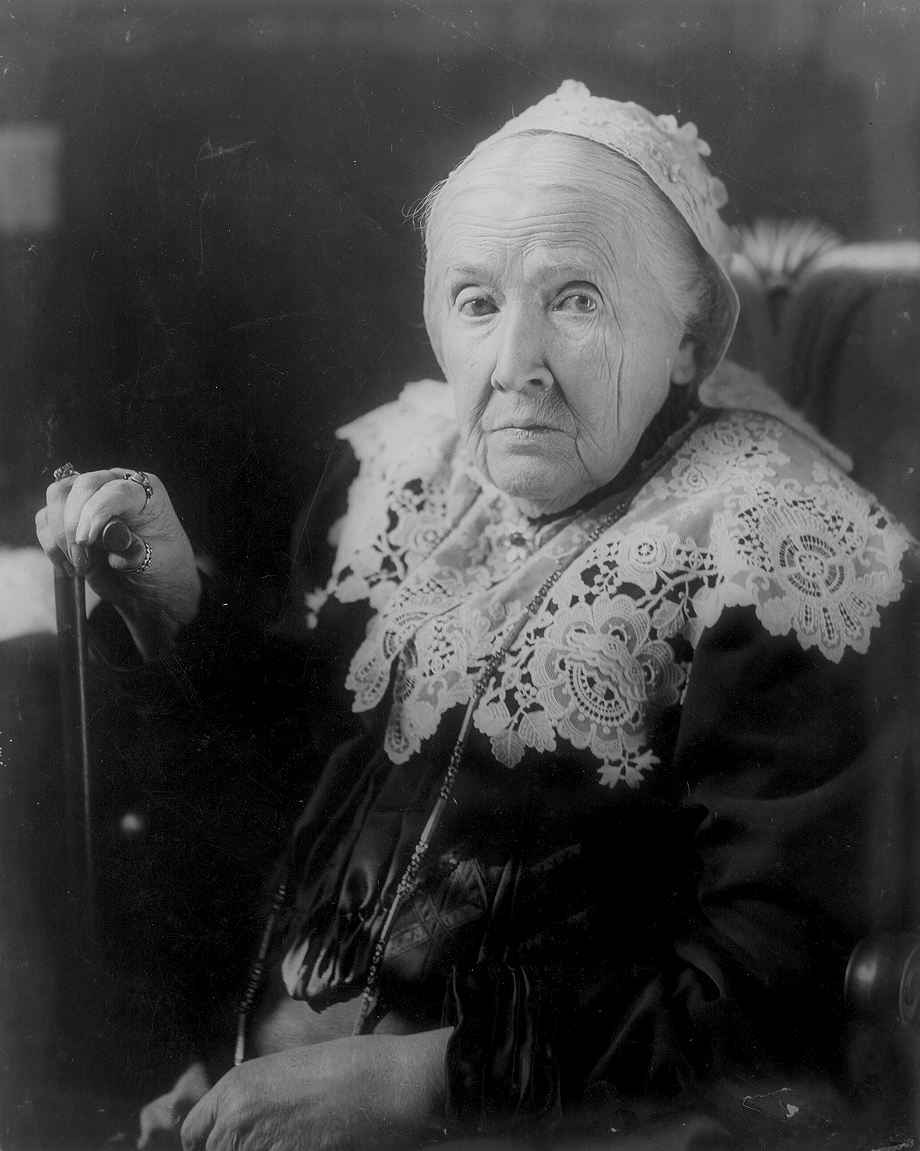

Howe died of pneumonia on October 17, 1910, at her Portsmouth home, Oak Glen at the age of 91. She is buried in the Mount Auburn Cemetery in Cambridge, Massachusetts. At her memorial service approximately 4,000 people sang "Battle Hymn of the Republic" as a sign of respect as it was the custom to sing that song at each of Julia's speaking engagements.
In 1912, the members of the New England Women's Club commissioned a marble bas-relief plaque of Howe in profile featuring the opening words of The Battle Hymn of the Republic by sculptor Cyrus Dallin. It was originally installed to the left wall of the then main hall of the Boston Museum of Fine Arts in 1913.
After her death, her children collaborated on a biography, published in 1916. It won the Pulitzer Prize for Biography.
In 1987, she was honored by the U.S. Postal Service with a 14¢ Great Americans series postage stamp.
Several buildings are associated with her name:
- The Julia Ward Howe School of Excellence in Chicago's Austin community is named in her honor.
- The Howe neighborhood in Minneapolis, Minnesota, was named for her.
- The Julia Ward Howe Academics Plus Elementary School in Philadelphia was named in her honor in 1913.
- Her Rhode Island home, Oak Glen, was added to the National Register of Historic Places in 1978.
- Her Boston home is a stop on the Boston Women's Heritage Trail.
- Julia Ward Howe Elementary School, located in Mount Lebanon, Pennsylvania.
Awards and honors
- January 28, 1908, at age 88, Howe became the first woman elected to the American Academy of Arts and Letters.
- 1970, inducted into the Songwriters Hall of Fame.
- In 1998, inducted into the National Women's Hall of Fame.
Selected works
Poetry
- Passion-Flowers (1854)
- Words for the Hour (1857)
- From Sunset Ridge: Poems Old and New (1898)
- Later Lyrics (1866)
- At Sunset (published posthumously, 1910)
Other works
- The Hermaphrodite. Incomplete, but probably composed between 1846 and 1847. Published by University of Nebraska Press, 2004
- From the Oak to the Olive (travel writing, 1868)
- Modern Society (essays, 1881)
- Margaret Fuller (Marchesa Ossoli) (biography, 1883)
- Woman's work in America (1891)
- Is Polite Society Polite? (essays, 1895)
- Reminiscences: 1819–1899 (autobiography, 1899)
References
References
- [http://www.oxfordlearnersdictionaries.com/definition/english/julia-ward-howe "Julia Ward Howe"]. ''Oxford Learner's Dictionaries''.
- Sandra F. VanBurkleo, Mary Jo Miles. (2000). "Howe, Julia Ward".
- "Howe, Julia Ward (1819–1910)", ''Encyclopedia of the American Civil War: A Political, Social, and Military History''. Santa Barbara: ABC-CLIO, 2000. Credo Reference. November 7, 2013.
- "Julia Ward Howe Biography".
- Richards, Laura. (1915). "Celebration of Women Writers". Houghton Mifflin Company.
- Joann, Goodman. "Julia Ward Howe".
- [http://uudb.org/articles/juliawardhowe.html Biography] {{Webarchive. link. (April 17, 2019 Dictionary of Unitarian & Universalist Biography)
- "Julia Ward Howe". National Women's History Museum.
- Williams, Gary. ''Hungry Heart: The Literary Emergence of Julia Ward Howe''. Amherst: [[University of Massachusetts Press]], 1999: 33. {{ISBN. 1-55849-157-0
- Martyris, Nina. (March 16, 2016). "Battle Hymn at the Dining Table: A Famous Feminist Subjugated Through Food". NPR.
- "Gardiner Public Library, Gardiner, Maine".
- Showalter, Elaine (2017). ''The Civil Wars of Julia Ward Howe: A Biography''. Simon & Schuster. p. 17. {{ISBN. 978-1451645910
- [https://digital.library.upenn.edu/women/richards/howe/howe-I.html "Julia Ward Howe: 1819-1910"]. digital.library.upenn.edu. Retrieved April 12, 2023.
- (March 24, 2014). "Julia Ward Howe, Author of Battle Hymn, Spent Much of Her Life in Portsmouth".
- "JULIA WARD HOWE (1819–1910)." Slavery in the United States: A Social, Political, and Historical Encyclopedia. Santa Barbara: ABC-CLIO, 2007. Credo Reference. Web. November 14, 2013.
- "Julia Ward Howe – National Women's Hall of Fame". National Women's Hall of Fame.
- "Open Collections Program: Women Working, Julia Ward Howe (1819–1910)". Harvard University Library.
- (February 29, 2016). "'The Civil Wars of Julia Ward Howe,' by Elaine Showalter". The New York Times.
- Katz, Elizabeth D.. (July 30, 2021). "Sex, Suffrage, and State Constitutional Law: Women's Legal Right to Hold Public Office". Yale Journal of Law & Feminism.
- Williams, Gary. ''Hungry Heart: The Literary Emergence of Julia Ward Howe''. Amherst: [[University of Massachusetts Press]], 1999: 208. {{ISBN. 1-55849-157-0
- (1998). "The business of charity: the woman's exchange movement, 1832–1900". University of Illinois Press.
- Ryan, Agnes E. "The Torch Bearer A Look Forward and Back at the Woman's Journal, the Organ of the Woman's Movement".
- Leigh, Eric Schmidt. (1997). "Consumer Rites: The Buying and Selling of American Holidays". Princeton University Press.
- [http://legacyproject.org/guides/mdhistory.html The History of Mothers' Day] from The Legacy Project, a Legacy Center (Canada) website
- Virginia Bernhard. (2002). "The family in America: an encyclopedia". [[ABC-CLIO]].
- ''The First Anniversary of "Mothers' Day"'', ''The New York Times'', June 3, 1874, p. 8: "'Mothers' Day', which was inaugurated in this city on the 2nd of June, 1872, by Mrs. Julia Ward Howards{{sic, was celebrated last night at Plimpton Hall by a mothers' peace meeting..."
- "Julia Ward Howe Elected to American Academy of Arts and Letters". [[Library of Congress]].
- Ehrlich, Eugene and Gorton Carruth. ''The Oxford Illustrated Literary Guide to the United States''. New York: Oxford University Press, 1982: 71. {{ISBN. 0-19-503186-5
- Corbett, William. ''Literary New England: A History and Guide''. Boston: Faber and Faber, 1993: 106. {{ISBN. 0-571-19816-3
- Howe, Julia Ward (1819–1910)." ''Encyclopedia of the American Civil War: A Political, Social, and Military History''. Santa Barbara: ABC-CLIO, 2000. Credo Reference. Web. November 7, 2013.
- (May 3, 1913). "Mrs. Howe's Bas Relief in Art Museum". Boston Herald.
- (January 1, 1915). "Julia Ward Howe, 1819–1910". Houghton Mifflin.
- Ziegler, Valarie H. ''Diva Julia: The Public Romance and Private Agony of Julia Ward Howe''. Harrisburg, PA: Trinity Press International, 2003: 11. {{ISBN. 1-56338-418-3
- (January 23, 1987). "Julia Ward Howe Stamp". [[Los Angeles Times]].
- "About". Academy for Urban School Leadership.
- "Howe". City of Minneapolis, Minnesota.
- Moak, J.M.. (May 1987). "Pennsylvania Historic Resource Survey Form: Julia Ward Howe School".
- "NRHP nomination for Oak Glen". Rhode Island Preservation.
- "Back Bay East".
- (April 22, 2024). "Home - Howe Elementary School".
- "Julia Ward Howe".
- [https://www.womenofthehall.org/inductee/julia-ward-howe/ National Women's Hall of Fame, Julia Ward Howe]
- Ziegler, Valarie H. ''Diva Julia: The Public Romance and Private Agony of Julia Ward Howe''. Harrisburg, PA: Trinity Press International, 2003: 148–149. {{ISBN. 1-56338-418-3
- Julia Ward Howe. (1868). "From the oak to the olive: a plain record of a pleasant journey". Lee & Shepard.
- Howe, Julia Ward. (January 1, 1900). "Reminiscences: 1819–1899". Houghton Mifflin Company.
This article was imported from Wikipedia and is available under the Creative Commons Attribution-ShareAlike 4.0 License. Content has been adapted to SurfDoc format. Original contributors can be found on the article history page.
Ask Mako anything about Julia Ward Howe — get instant answers, deeper analysis, and related topics.
Research with MakoFree with your Surf account
Create a free account to save articles, ask Mako questions, and organize your research.
Sign up freeThis content may have been generated or modified by AI. CloudSurf Software LLC is not responsible for the accuracy, completeness, or reliability of AI-generated content. Always verify important information from primary sources.
Report