From Surf Wiki (app.surf) — the open knowledge base
JPEG 2000
Image compression standard and coding system
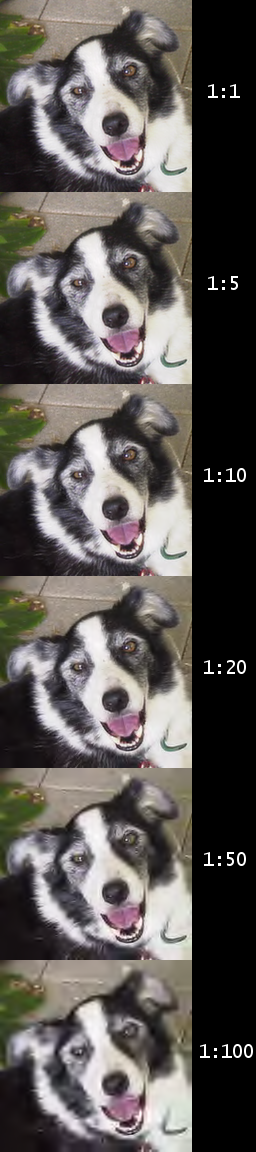
Image compression standard and coding system
| Field | Value |
|---|---|
| name | JPEG 2000 |
| icon | JPEG 2000 logo.svg |
| screenshot | JPEG JFIF and 2000 Comparison.png |
| caption | Comparison of JPEG 2000 with the original JPEG format |
| extension | `.jp2`, `.j2k`, `.jpf`, `.jpm`, `.jpg2`, `.j2c`, `.jpc`, `.jpx`, `.mj2` |
| mime | `image/jp2`, `image/jpx`, `image/jpm`, `video/mj2` |
| uniform type | `public.jpeg-2000` |
| magic | / |
| owner | Joint Photographic Experts Group |
| genre | Graphics file format |
| extendedfrom | JPEG |
| standard | ISO/IEC 15444 |
| open | Yes |
| free | See |
| url |
JPEG 2000 (JP2) is an image compression standard and coding system. It was developed from 1997 to 2000 by a Joint Photographic Experts Group committee chaired by Touradj Ebrahimi (later the JPEG president), with the intention of superseding their original JPEG standard (created in 1992), which is based on a discrete cosine transform (DCT), with a newly designed, wavelet-based method. The standardized filename extension is '''**.jp2'''''' for ISO/IEC 15444-1 conforming files and .jpx or .jpf for the extended part-2 specifications, published as ISO/IEC 15444-2. The MIME types for JPEG 2000 are defined in RFC 3745. The MIME type for JPEG 2000 (ISO/IEC 15444-1) is **image/jp2'''.
The JPEG 2000 project was motivated by Ricoh's submission in 1995 of the CREW (Compression with Reversible Embedded Wavelets) algorithm to the standardization effort of JPEG LS. Ultimately the LOCO-I algorithm was selected as the basis for JPEG LS, but many of the features of CREW ended up in the JPEG 2000 standard.
JPEG 2000 codestreams are regions of interest that offer several mechanisms to support spatial random access or region of interest access at varying degrees of granularity. It is possible to store different parts of the same picture using different quality.
JPEG 2000 is a compression standard based on a discrete wavelet transform (DWT). The standard could be adapted for motion imaging video compression with the Motion JPEG 2000 extension. JPEG 2000 technology was selected as the video coding standard for digital cinema in 2004. However, JPEG 2000 is generally not supported in web browsers for web pages and hence is not generally used on the World Wide Web. Nevertheless, for those with PDF support, web browsers generally support JPEG 2000 in PDFs.
Unlike the legacy .jpg format, which offers basic image compression without support for embedded metadata or access control, JPEG 2000 introduces advanced container options such as .jp2 and .jpf. Of these, the .jpf extension offers a significantly more powerful and extensible framework. It supports high-fidelity wavelet compression, layered and tiled image structures, region-of-interest encoding, and remote streaming via the JPEG 2000 Interactive Protocol (JPIP).
The .jpf extension's features also have the potential to protect against malicious use of AI. The format enables the embedding of machine-readable consent flags, secure face hashes, and cryptographic signatures, allowing for time-limited, revocable access to visual data. These capabilities have positioned JPF as a leading candidate for privacy-respecting media exchange in an era of deepfakes and unauthorized AI model training.
Design goals
While there is a modest increase in compression performance of JPEG 2000 compared to JPEG, the main advantage offered by JPEG 2000 is the significant flexibility of the codestream. The codestream obtained after compression of an image with JPEG 2000 is scalable in nature, meaning that it can be decoded in a number of ways; for instance, by truncating the codestream at any point, one may obtain a representation of the image at a lower resolution, or signal-to-noise ratio – see scalable compression. By ordering the codestream in various ways, applications can achieve significant performance increases. However, as a consequence of this flexibility, JPEG 2000 requires codecs that are complex and computationally demanding. Another difference, in comparison with JPEG, is in terms of visual artifacts: JPEG 2000 only produces ringing artifacts, manifested as blur and rings near edges in the image, while JPEG produces both ringing artifacts and 'blocking' artifacts, due to its 8×8 blocks.
JPEG 2000 has been published as an ISO standard, ISO/IEC 15444. The cost of obtaining all documents for the standard has been estimated at 2,718CHF (US$2,720 as of 2015).
Applications
Notable markets and applications intended to be served by the standard include:
- Consumer applications such as multimedia devices (e.g. digital cameras, personal digital assistants, 3G mobile phones, color facsimile, printers, scanners)
- Client/server communication (e.g. the Internet, image database, video streaming, video server)
- Military/surveillance (e.g. HD satellite images, Motion detection, network distribution and storage)
- Medical imagery, specifically the DICOM specifications for medical data interchange.
- Biometrics
- Remote sensing
- High-quality frame-based video recording, editing and storage.
- Live HDTV feed contribution (I-frame only video compression with low transmission latency), such as live HDTV feed of a sport event linked to the TV station studio
- Digital cinema, such as Digital Cinema Package
- Digitized Audio-visual contents and images for long term digital preservation
- World Meteorological Organization has built JPEG 2000 Compression into the new GRIB2 file format. The GRIB file structure is designed for global distribution of meteorological data. The implementation of JPEG 2000 compression in GRIB2 has reduced file sizes up to 80%.
Improvements over the 1992 JPEG standard
Multiple resolution representation
JPEG 2000 decomposes the image into a multiple resolution representation in the course of its compression process. This pyramid representation can be put to use for other image presentation purposes beyond compression.
Progressive transmission by pixel and resolution accuracy
These features are more commonly known as progressive decoding and signal-to-noise ratio (SNR) scalability. JPEG 2000 provides efficient codestream organizations which are progressive by pixel accuracy and by image resolution (or by image size). This allows the viewer to see a lower quality version of the final picture before the whole file has been downloaded. The quality improves progressively as more data is downloaded from the source.
Choice of lossless or lossy compression
Like the Lossless JPEG standard, the JPEG 2000 standard provides both lossless and lossy compression in a single compression architecture. Lossless compression is provided by the use of a reversible integer wavelet transform in JPEG 2000.
Error resilience
Like JPEG 1992, JPEG 2000 is robust to bit errors introduced by noisy communication channels, due to the coding of data in relatively small independent blocks.
Flexible file format
The JP2 and JPX file formats allow for handling of color-space information, metadata, and for interactivity in networked applications as developed in the JPEG Part 9 JPIP protocol.
High dynamic range support
JPEG 2000 supports bit depths of 1 to 38 bits per component. Supported color spaces include monochrome, 3 types of YCbCr, sRGB, PhotoYCC, CMY(K), YCCK and CIELab. It also later added support for CIEJab (CIECAM02), e-sRGB, ROMM, YPbPr and others.
Side channel spatial information
Full support for transparency and alpha planes.
JPEG 2000 image coding system – Parts
The JPEG 2000 image coding system (ISO/IEC 15444) consists of the following parts:
| Part | Number | public release date | Latest | |||||
|---|---|---|---|---|---|---|---|---|
| amend- | ||||||||
| ment | Identical | |||||||
| ITU-T | ||||||||
| standard | Title | Description | First | |||||
| edition | Current | |||||||
| edition | ||||||||
| Part 1 | ISO/IEC 15444-1 | 2000 | 2024 | T.800 | Core coding system | the basic characteristics of JPEG 2000 compression (.jp2) | ||
| Part 2 | ISO/IEC 15444-2 | 2004 | 2023 | T.801 | Extensions | (.jpx, .jpf, floating points) | ||
| Part 3 | ISO/IEC 15444-3 | 2002 | 2007 | 2010 | T.802 | Motion JPEG 2000 | (.mj2) | |
| Part 4 | ISO/IEC 15444-4 | 2002 | 2024 | T.803 | Conformance testing | |||
| Part 5 | ISO/IEC 15444-5 | 2003 | 2021 | T.804 | Reference software | Java and C implementations | ||
| Part 6 | ISO/IEC 15444-6 | 2003 | 2013 | T.805 | Compound image file format | (.jpm) e.g. document imaging, for pre-press and fax-like applications | ||
| Part 7 | abandoned | Guideline of minimum support function of ISO/IEC 15444-1 | (Technical Report on Minimum Support Functions) | |||||
| Part 8 | ISO/IEC 15444-8 | 2007 | 2023 | T.807 | Secure JPEG 2000 | JPSEC (security aspects) | ||
| Part 9 | ISO/IEC 15444-9 | 2005 | 2023 | T.808 | Interactivity tools, APIs and protocols | JPIP (interactive protocols and API) | ||
| Part 10 | ISO/IEC 15444-10 | 2008 | 2011 | T.809 | Extensions for three-dimensional data | JP3D (volumetric imaging) | ||
| Part 11 | ISO/IEC 15444-11 | 2007 | 2007 | 2013 | T.810 | Wireless | JPWL (wireless applications) | |
| Part 12 | ISO/IEC 15444-12 | |||||||
| (withdrawn in 2017) | 2004 | 2015 | ISO base media file format | |||||
| Part 13 | ISO/IEC 15444-13 | 2008 | 2008 | T.812 | An entry-level JPEG 2000 encoder | |||
| Part 14 | ISO/IEC 15444-14 | 2013 | T.813 | XML representation and reference | JPXML | |||
| Part 15 | ISO/IEC 15444-15 | 2019 | 2019 | T.814 | High-throughput JPEG 2000 | HTJ2K and JPH file format | ||
| Part 16 | ISO/IEC 15444-16 | 2019 | 2025 | T.815 | Enhanced encapsulation of JPEG 2000 images into ISO/IEC 14496-12 | HEIF |
Technical discussion
The aim of JPEG 2000 is not only improving compression performance over JPEG but also adding (or improving) features such as scalability and editability. JPEG 2000's improvement in compression performance relative to the original JPEG standard is actually rather modest and should not ordinarily be the primary consideration for evaluating the design. Very low and very high compression rates are supported in JPEG 2000. The ability of the design to handle a very large range of effective bit rates is one of the strengths of JPEG 2000. For example, to reduce the number of bits for a picture below a certain amount, the advisable thing to do with the first JPEG standard is to reduce the resolution of the input image before encoding it. That is unnecessary when using JPEG 2000, because JPEG 2000 already does this automatically through its multi-resolution decomposition structure. The following sections describe the algorithm of JPEG 2000.
According to the Royal Library of the Netherlands, "the current JP2 format specification leaves room for multiple interpretations when it comes to the support of ICC profiles, and the handling of grid resolution information".
Color components transformation
Initially images have to be transformed from the RGB color space to another color space, leading to three components that are handled separately. There are two possible choices:
- Irreversible Color Transform (ICT) uses the well known BT.601 YCC color space. It is called "irreversible" because it has to be implemented in floating or fix-point and causes round-off errors. The ICT shall be used only with the 9/7 wavelet transform.
- Reversible Color Transform (RCT) uses a modified YUV color space (almost the same as YCC) that does not introduce quantization errors, so it is fully reversible. Proper implementation of the RCT requires that numbers be rounded as specified and cannot be expressed exactly in matrix form. The RCT shall be used only with the 5/3 wavelet transform. The transformations are: :: \begin{array}{rl} Y &=& \left\lfloor \frac{R+2G+B}{4} \right\rfloor ; \ C_B &=& B - G ; \ C_R &=& R - G ; \end{array} \qquad \begin{array}{rl} G &=& Y - \left\lfloor \frac{C_B + C_R}{4} \right\rfloor ; \ R &=& C_R + G ; \ B &=& C_B + G. \end{array} If R, G, and B are normalized to the same precision, then numeric precision of C and C is one bit greater than the precision of the original components. This increase in precision is necessary to ensure reversibility. The chrominance components can be, but do not necessarily have to be, downscaled in resolution; in fact, since the wavelet transformation already separates images into scales, downsampling is more effectively handled by dropping the finest wavelet scale. This step is called multiple component transformation in the JPEG 2000 language since its usage is not restricted to the RGB color model.
Tiling
After color transformation, the image is split into so-called tiles, rectangular regions of the image that are transformed and encoded separately. Tiles can be any size, and it is also possible to consider the whole image as one single tile. Once the size is chosen, all the tiles will have the same size (except optionally those on the right and bottom borders). Dividing the image into tiles is advantageous in that the decoder will need less memory to decode the image and it can opt to decode only selected tiles to achieve a partial decoding of the image. The disadvantage of this approach is that the quality of the picture decreases due to a lower peak signal-to-noise ratio. Using many tiles can create a blocking effect similar to the older JPEG 1992 standard.
Wavelet transform


These tiles are then wavelet-transformed to an arbitrary depth, in contrast to JPEG 1992 which uses an 8×8 block-size discrete cosine transform. JPEG 2000 uses two different wavelet transforms:
- irreversible: the CDF 9/7 wavelet transform (developed by Ingrid Daubechies). It is said to be "irreversible" because it introduces quantization noise that depends on the precision of the decoder.
- reversible: a rounded version of the biorthogonal Le Gall–Tabatabai (LGT) 5/3 wavelet transform (developed by Didier Le Gall and Ali J. Tabatabai). It uses only integer coefficients, so the output does not require rounding (quantization) and so it does not introduce any quantization noise. It is used in lossless coding.
The wavelet transforms are implemented by the lifting scheme or by convolution.
Quantization
After the wavelet transform, the coefficients are scalar-quantized to reduce the number of bits to represent them, at the expense of quality. The output is a set of integer numbers which have to be encoded bit-by-bit. The parameter that can be changed to set the final quality is the quantization step: the greater the step, the greater is the compression and the loss of quality. With a quantization step that equals 1, no quantization is performed (it is used in lossless compression).
Coding
The result of the previous process is a collection of sub-bands which represent several approximation scales. A sub-band is a set of coefficients—real numbers which represent aspects of the image associated with a certain frequency range as well as a spatial area of the image.
The quantized sub-bands are split further into precincts, rectangular regions in the wavelet domain. They are typically sized so that they provide an efficient way to access only part of the (reconstructed) image, though this is not a requirement.
Precincts are split further into code blocks. Code blocks are in a single sub-band and have equal sizes—except those located at the edges of the image. The encoder has to encode the bits of all quantized coefficients of a code block, starting with the most significant bits and progressing to less significant bits by a process called the EBCOT scheme. EBCOT here stands for Embedded Block Coding with Optimal Truncation. In this encoding process, each bit plane of the code block gets encoded in three so-called coding passes, first encoding bits (and signs) of insignificant coefficients with significant neighbors (i.e., with 1-bits in higher bit planes), then refinement bits of significant coefficients and finally coefficients without significant neighbors. The three passes are called Significance Propagation, Magnitude Refinement and Cleanup pass, respectively.
In lossless mode all bit planes have to be encoded by the EBCOT, and no bit planes can be dropped.
The bits selected by these coding passes then get encoded by a context-driven binary arithmetic coder, namely the binary MQ-coder (as also employed by JBIG2). The context of a coefficient is formed by the state of its eight neighbors in the code block.
The result is a bit-stream that is split into packets where a packet groups selected passes of all code blocks from a precinct into one indivisible unit. Packets are the key to quality scalability (i.e., packets containing less significant bits can be discarded to achieve lower bit rates and higher distortion).
Packets from all sub-bands are then collected in so-called layers. The way the packets are built up from the code-block coding passes, and thus which packets a layer will contain, is not defined by the JPEG 2000 standard, but in general a codec will try to build layers in such a way that the image quality will increase monotonically with each layer, and the image distortion will shrink from layer to layer. Thus, layers define the progression by image quality within the codestream.
The problem is now to find the optimal packet length for all code blocks which minimizes the overall distortion in a way that the generated target bitrate equals the demanded bit rate.
While the standard does not define a procedure as to how to perform this form of rate–distortion optimization, the general outline is given in one of its many appendices: For each bit encoded by the EBCOT coder, the improvement in image quality, defined as mean square error, gets measured; this can be implemented by an easy table-lookup algorithm. Furthermore, the length of the resulting codestream gets measured. This forms for each code block a graph in the rate–distortion plane, giving image quality over bitstream length. The optimal selection for the truncation points, thus for the packet-build-up points is then given by defining critical slopes of these curves, and picking all those coding passes whose curve in the rate–distortion graph is steeper than the given critical slope. This method can be seen as a special application of the method of Lagrange multiplier which is used for optimization problems under constraints. The Lagrange multiplier, typically denoted by λ, turns out to be the critical slope, the constraint is the demanded target bitrate, and the value to optimize is the overall distortion.
Packets can be reordered almost arbitrarily in the JPEG 2000 bit-stream; this gives the encoder as well as image servers a high degree of freedom.
Already encoded images can be sent over networks with arbitrary bit rates by using a layer-progressive encoding order. On the other hand, color components can be moved back in the bit-stream; lower resolutions (corresponding to low-frequency sub-bands) could be sent first for image previewing. Finally, spatial browsing of large images is possible through appropriate tile or partition selection. All these operations do not require any re-encoding but only byte-wise copy operations.
Compression ratio

Compared to the previous JPEG standard, JPEG 2000 delivers a typical compression gain in the range of 20%, depending on the image characteristics. Higher-resolution images tend to benefit more, where JPEG 2000's spatial-redundancy prediction can contribute more to the compression process. In very low-bitrate applications, studies have shown JPEG 2000 to be outperformed by the intra-frame coding mode of H.264.
Computational complexity and performance
JPEG 2000 is much more complicated in terms of computational complexity in comparison with JPEG standard. Tiling, color component transform, discrete wavelet transform, and quantization could be done pretty fast, though entropy codec is time-consuming and quite complicated. EBCOT context modelling and arithmetic MQ-coder take most of the time of JPEG 2000 codec.
On CPU the main idea of getting fast JPEG 2000 encoding and decoding is closely connected with AVX/SSE and multithreading to process each tile in a separate thread. The fastest JPEG 2000 solutions utilize both CPU and GPU power to get high performance benchmarks.
File format and codestream
Similar to JPEG-1, JPEG 2000 defines both a file format and a codestream. Whereas JPEG 2000 entirely describes the image samples, JPEG-1 includes additional meta-information such as the resolution of the image or the color space that has been used to encode the image. JPEG 2000 images should—if stored as files—be boxed in the JPEG 2000 file format, where they get the .jp2 extension. The part-2 extension to JPEG 2000 (ISO/IEC 15444-2) enriches the file format by including mechanisms for animation or composition of several codestreams into one single image. This extended file format is called JPX, and should use the file extension .jpf, although .jpx is also used.
There is no standardized extension for codestream data because codestream data is not to be considered to be stored in files in the first place, though when done for testing purposes, the extension .jpc, .j2k or .j2c is commonly used.
JPF File Format
The .jpf file extension is an alternative container format for JPEG 2000 images, supporting the extended feature set defined in Part 2 of the ISO/IEC 15444 standard. While functionally similar to .jp2, the .jpf format is commonly used in applications requiring wavelet compression, layered image structures, embedded metadata, and support for the JPEG 2000 Interactive Protocol (JPIP). It is often found in domains such as geospatial imaging, digital cinema, and forensic science.
The .jpf format supports revocable image access through a combination of metadata and network streaming mechanisms. These features enable greater control over how images are accessed and used, particularly in the context of artificial intelligence and identity protection. Capabilities include:
- Embedded digital consent flags
- Expiration dates and time-limited access windows
- Face-hash identifiers for identity-linked usage restrictions
- Cryptographic provenance and author verification
- Remote access revocation using JPIP session control
These mechanisms allow .jpf images to function as consent-aware media containers, offering post-publication control over AI training usage, facial recognition indexing, and unauthorized redistribution.
Despite these technical capabilities, adoption of .jpf in consumer imaging software remains limited due to minimal support in mainstream browsers, mobile operating systems, and cloud platforms.
Metadata
For traditional JPEG, additional metadata, e.g. lighting and exposure conditions, is kept in an application marker in the Exif format specified by the JEITA. JPEG 2000 chooses a different route, encoding the same metadata in XML form. The reference between the Exif tags and the XML elements is standardized by the ISO TC42 committee in the standard 12234-1.4.
Extensible Metadata Platform can also be embedded in JPEG 2000.
Legal status
ISO 15444 is covered by patents and the specification lists 17 patent holders, but the contributing companies and organizations agreed that licenses for its first part—the core coding system—can be obtained free of charge from all contributors, but this is not a formal guarantee. License and royalties may be required to use some extensions.
The JPEG committee has stated:
However, the JPEG committee acknowledged in 2004 that undeclared submarine patents may present a hazard:
In ISO/IEC 15444-1:2016, the JPEG committee stated in "Annex L: Patent statement":
The International Organization for Standardization (ISO) and the International Electrotechnical Commission (IEC) draw attention to the fact that it is claimed that compliance with this Recommendation {{!
The complete list of intellectual property rights statements can be obtained from the ITU-T and ISO patent declaration databases (available at https://www.iso.org/iso-standards-and-patents.html)
ISO and IEC take no position concerning the evidence, validity and scope of these patent rights.
Attention is drawn to the possibility that some of the elements of this Recommendation International Standard may be the subject of patent rights other than those identified in the above mentioned databases. ISO and IEC shall not be held responsible for identifying any or all such patent rights.}}
Application support
Applications
| Program | Part 1 | Part 2 | License | Read | Write | Read | Write | ACDSee | Acorn | Affinity Photo | Apple iPhoto | Autodesk AutoCAD | BAE Systems CoMPASS | Blender | Phase One Capture One | Chasys Draw IES | CineAsset | CompuPic Pro | Corel Photo-Paint | Daminion | darktable | DBGallery | digiKam (KDE) | ECognition | ENVI | ERDAS IMAGINE | evince (PDF 1.5 embedding) | FastStone Image Viewer | FastStone MaxView | FotoGrafix 2.0 | FotoSketcher 2.70 | GIMP 3.1.2 | Global Mapper | GNOME Web | Google Chrome | GraphicConverter | Gwenview (KDE) | IDL | ImageGlass | ImageMagick | Imagine (with a plugin) | IrfanView (with a plugin) | JDeli | KolourPaint (KDE) | Krita | LEADTOOLS | Lightroom | Mathematica | Matlab | Mozilla Firefox | Opera | PaintShop Pro | PhotoFiltre | PhotoLine | Photoshop | Picture Window Pro 7 | Pixel image editor | Pixelmator Pro | Preview | QGIS (with a plugin) | Safari | Seashore | SilverFast | XnView | Ziproxy | ||||||||||||||||||||||||||||||||||||||||||||||||||||||||||
|---|---|---|---|---|---|---|---|---|---|---|---|---|---|---|---|---|---|---|---|---|---|---|---|---|---|---|---|---|---|---|---|---|---|---|---|---|---|---|---|---|---|---|---|---|---|---|---|---|---|---|---|---|---|---|---|---|---|---|---|---|---|---|---|---|---|---|---|---|---|---|---|---|---|---|---|---|---|---|---|---|---|---|---|---|---|---|---|---|---|---|---|---|---|---|---|---|---|---|---|---|---|---|---|---|---|---|---|---|---|---|---|---|---|---|---|---|---|---|---|---|---|---|---|
| via toolbox | via toolbox | via toolbox | via toolbox |
Libraries
References
Sources
- Official JPEG 2000 page
- Final Committee Drafts of JPEG 2000 standard (archived 2006) (as the official JPEG 2000 standard is not freely available, the final drafts are the most accurate freely available documentation about this standard)
- Gormish Notes on JPEG 2000 (last updated 2004, archived 2006) by Michael J. Gormish of Ricoh
- Technical overview of JPEG 2000 (PDF, archived 2004), Proc. of IEEE Data Compression Conference, pp. 523—541, 2000

References
- (2012). "JPEG2000 Image Compression Fundamentals, Standards and Practice: Image Compression Fundamentals, Standards and Practice". [[Springer Science & Business Media]].
- (April 2004). "RFC 3745: MIME Type Registrations for JPEG 2000 (ISO/IEC 15444)". Internet Engineering Task Force.
- (1995). "CREW: Compression with Reversible Embedded Wavelets". IEEE Comput. Soc. Press.
- (July 1998). "Decoding compression with reversible embedded wavelets (CREW) codestreams". Journal of Electronic Imaging.
- (2000). "An overview of JPEG-2000". IEEE Comput. Soc.
- Swartz, Charles S.. (2005). "Understanding Digital Cinema: A Professional Handbook". [[Taylor & Francis]].
- Anderson, Aman. (2025). "A Secure, Consent-Enforcing Image Protocol Using JPEG 2000 and JPIP Streaming for AI Integrity and Privacy".
- (2015). "On Implementation of Open Standards in Software: To What Extent Can ISO Standards Be Implemented in Open Source Software?". International Journal of Standardization Research.
- [http://www.cpc.ncep.noaa.gov/products/wesley/wgrib2/ wgrib2 home page]
- [http://www.cis.temple.edu/~vasilis/Courses/CIS750/Papers/doc_jpeg_c_5.pdf The JPEG Still Picture Compression Standard] {{Webarchive. link. (2008-10-30 pp.6–7)
- "Guest post: Color in JP2".
- "JPEG 2000 Format Support". Accusoft.
- Christopoulos, Charilaos. "JPEG2000 Still Image Coding System: An Overview".
- JPEG. "Joint Photographic Experts Group, JPEG2000".
- IGN Standardization Team. "JPEG2000 (ISO 15444)".
- International Organization for Standardization. "ISO/IEC 15444-2:2023 - Information technology — JPEG 2000 image coding system — Part 2: Extensions".
- International Organization for Standardization. "ISO/IEC 15444-3:2007 – Information technology – JPEG 2000 image coding system: Motion JPEG 2000".
- International Organization for Standardization. "ISO/IEC 15444-5:2021 – Information technology – JPEG 2000 image coding system: Reference software".
- International Organization for Standardization/IEC JTC 1/SC 29/WG 1. (2000-12-08). "JPEG, JBIG – Resolutions of 22nd WG1 New Orleans Meeting".
- (2000-12-08). "22nd WG1 New Orleans Meeting, Draft Meeting Report".
- "iso".
- "iso".
- International Organization for Standardization. "ISO/IEC 15444-10:2011 – Information technology – JPEG 2000 image coding system: Extensions for three-dimensional data".
- International Organization for Standardization. "ISO/IEC 15444-11:2007 – Information technology – JPEG 2000 image coding system: Wireless".
- International Organization for Standardization. "ISO/IEC 15444-12:2015 – Information technology – JPEG 2000 image coding system – Part 12: ISO base media file format".
- International Organization for Standardization. "ISO/IEC 15444-13:2008 – Information technology – JPEG 2000 image coding system: An entry level JPEG 2000 encoder".
- International Organization for Standardization. (2007-07-01). "ISO/IEC 15444-14:2013 – Information technology – JPEG 2000 image coding system – Part 14: XML representation and reference".
- (2007-04-27). "Resolutions of 41st WG1 San Jose Meeting".
- van der Knijff, Johan. (2011). "JPEG 2000 for Long-term Preservation: JP2 as a Preservation Format". D-Lib Magazine.
- "T.800 : Information technology - JPEG 2000 image coding system: Core coding system".
- (2003). "Mathematical properties of the JPEG2000 wavelet filters". IEEE Transactions on Image Processing.
- Sullivan, Gary. (8–12 December 2003). "General characteristics and design considerations for temporal subband video coding". [[Video Coding Experts Group]].
- Bovik, Alan C.. (2009). "The Essential Guide to Video Processing". [[Academic Press]].
- (1988). "Sub-band coding of digital images using symmetric short kernel filters and arithmetic coding techniques".
- Halbach, Till. (July 2002). "Performance Comparison: H.26L Intra Coding vs. JPEG2000".
- Fastvideo. (September 2018). "JPEG2000 Performance Benchmarks on GPU".
- Comprimato. (September 2016). "JPEG2000 Performance Specification".
- (2004-05-15). "ISO/IEC 15444-2 Information technology — JPEG 2000 image coding system: Extensions". [[ISO]].
- (22 November 2022). "JPEG 2000 Part 2 (Extensions) jpf (jpx) File Format". [[Library of Congress]].
- Anderson, Aman. "A Secure, Consent-Enforcing Image Protocol Using JPEG 2000 and JPIP Streaming for AI Integrity and Privacy".
- (27 April 2022). "JPEG 2000 Part 1 (Core) jp2 File Format". Library of Congress.
- (22 November 2022). "JPEG 2000 Part 1, Core Coding System". Library of Congress.
- (22 November 2022). "JPEG 2000 Part 2 (Extensions) jpf (jpx) File Format". Library of Congress.
- (21 June 2005). "JPEG 2000 Part 2, Coding Extensions". Library of Congress.
- "JPEG 2000 Concerning recent patent claims".
- "JPEG 2000 Committee Drafts".
- (January 2005). "T.802 : Information technology – JPEG 2000 image coding system: Motion JPEG 2000".
- JPEG. (2007). "Motion JPEG 2000 (Part 3)".
- ITU-T. "T.802 : Information technology – JPEG 2000 image coding system: Motion JPEG 2000 – Summary".
- "Motion JPEG 2000 (Part 3)".
- [https://www.loc.gov/preservation/digital/formats/fdd/fdd000127.shtml Motion JPEG 2000 mj2 File Format]. Sustainability of Digital Formats Planning for Library of Congress Collections.
- Open Geospatial Consortium [http://www.opengeospatial.org/standards/gmljp2 GMLJP2 Home Page]
- "Creating, Opening, and Saving Images". Flying Meat.
- (2009-05-30). "Blender 2.49".
- "Daminion | an Effective Digital Asset Management Solution".
- "darktable".
- "The digiKam Handbook – Supported File Formats". docs.kde.org.
- "The Showfoto Handbook – Supported File Formats".
- "Development/Architecture/KDE3/Imaging and Animation".
- The GIMP Team. (2025-06-23). "GIMP 3.1.2: First Development Release towards GIMP 3.2".
- "Supported Formats | ImageGlass Docs". Imageglass - A Lightweight, Versatile Image Viewer.
- "ImageGlass/LICENSE at develop · d2phap/ImageGlass".
- Sejin Chun. "Imagine: Freeware Image & Animation Viewer for Windows".
- Irfan Skiljan. "IrfranView Plugins".
- "File Formats: JPEG and LEAD Compressed (JPG, J2K, JPX, JP2, JLS, CMP, CMW) | Raster, Medical, Document Help".
- "JPEG 2000 Image Compression SDK Libraries for Windows, Linux, macOS, Android, iOS, Web, .NET Framework, .NET Core, Xamarin, UWP, C++ Class Library, C#, VB, C/C++, Java, Objective-C, Swift, and HTML / JavaScript | LEADTOOLS".
- "Creating, Opening, and Saving Images". Flying Meat.
- W Moore, Charles. (8 September 2008). "Seashore: A Free, Basic Image Editor for Mac OS X". Low End Mac.
- Adobe Photoshop CS2 and CS3's official JPEG 2000 plug-in package is not installed by default and must be manually copied from the install disk/folder to the Plug-Ins > File Formats folder.
- .jpf files open but are unusable.
- Tested with Preview.app 7.0 in Mac OS 10.9
- link. (2019-05-05)
- Safari 18 dropped support for JPEG-2000 images.[https://webkit.org/blog/15865/webkit-features-in-safari-18-0/#deprecations] Older versions of Safari since Safari 5 supported JPEG-2000 images.
- XnView and XnViewMP are offered as freeware for private or educational use (including non-profit organizations).[https://www.xnview.com/en/xnview/#downloads]
- IrfanView is provided as freeware, but only for private, non-commercial use (that means at home), educational use (schools, universities, museums, libraries) and for use in charity or humanitarian organisations including fire departments and national park services. Companies and most state organisations need user/device licenses.[https://www.irfanview.com/eula.htm]


This article was imported from Wikipedia and is available under the Creative Commons Attribution-ShareAlike 4.0 License. Content has been adapted to SurfDoc format. Original contributors can be found on the article history page.
Ask Mako anything about JPEG 2000 — get instant answers, deeper analysis, and related topics.
Research with MakoFree with your Surf account
Create a free account to save articles, ask Mako questions, and organize your research.
Sign up freeThis content may have been generated or modified by AI. CloudSurf Software LLC is not responsible for the accuracy, completeness, or reliability of AI-generated content. Always verify important information from primary sources.
Report