From Surf Wiki (app.surf) — the open knowledge base
Josephine Baker
American and French entertainer (1906–1975)
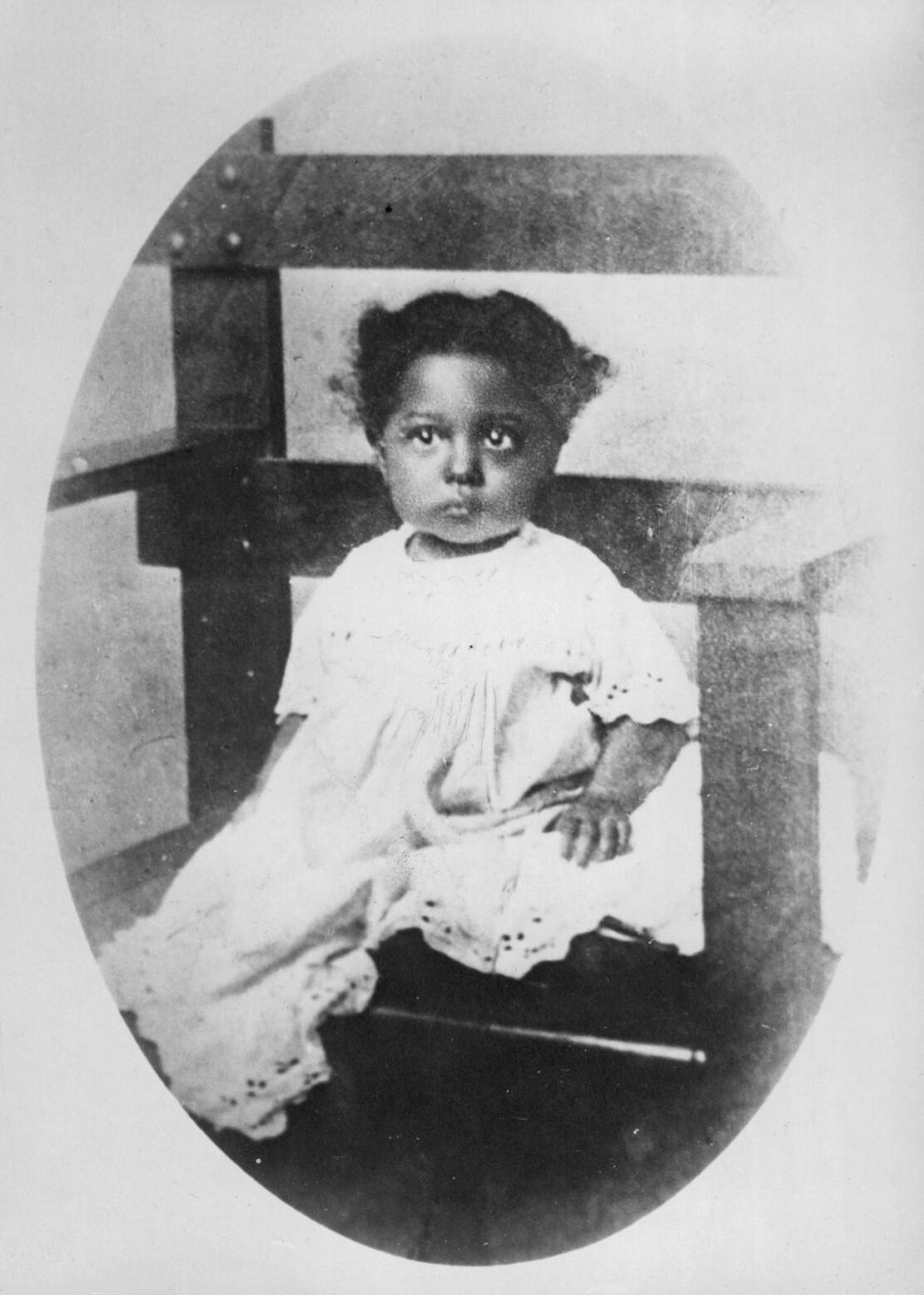
American and French entertainer (1906–1975)
| Field | Value | ||||
|---|---|---|---|---|---|
| name | Josephine Baker | ||||
| image | File:Baker Harcourt 1940 2.jpg | ||||
| caption | Baker in 1940 | ||||
| birth_name | Freda Josephine McDonald | ||||
| birth_date | |||||
| birth_place | St. Louis, Missouri, U.S. | ||||
| death_date | |||||
| death_place | Paris, France | ||||
| resting_place | Monaco Cemetery | ||||
| citizenship | {{plainlist | ||||
| occupation | Vedette, singer, dancer, actress, civil rights activist, French Resistance agent | ||||
| years_active | 1921–1975 | ||||
| spouse | {{Plain list | ||||
| * {{marriage | Willie Wells | 1919 | 1919 | reason | div}} |
| * {{marriage | William Baker | 1921 | 1925 | reason | div}} |
| * {{marriage | Jean Lion | 1937 | 1940 | reason | div}} |
| * {{marriage | Jo Bouillon | 1947 | 1961 | reason | div}} |
| partner | Robert Brady | ||||
| (1973–1975) | |||||
| children | 12; Jean-Claude Baker presented himself as her foster son (contested by the Baker children) | ||||
| signature | Signature de Joséphine Baker - Archives nationales (France).png | ||||
| module | {{Infobox musical artist | embed=yes | |||
| background | solo_singer | ||||
| genre | |||||
| instrument | Vocals | ||||
| label | {{hlist | Columbia | Mercury | RCA Victor |
- United States (until 1937)
- France (from 1937)
(1973–1975) Freda Josephine Baker (; June 3, 1906 – April 12, 1975), naturalized as Joséphine Baker, was an American and French dancer, singer, and actress. Her career was centered primarily in Europe, mostly in France. She was the first Black woman to star in a major motion picture, the 1927 French silent film Siren of the Tropics, directed by Mario Nalpas and Henri Étiévant.
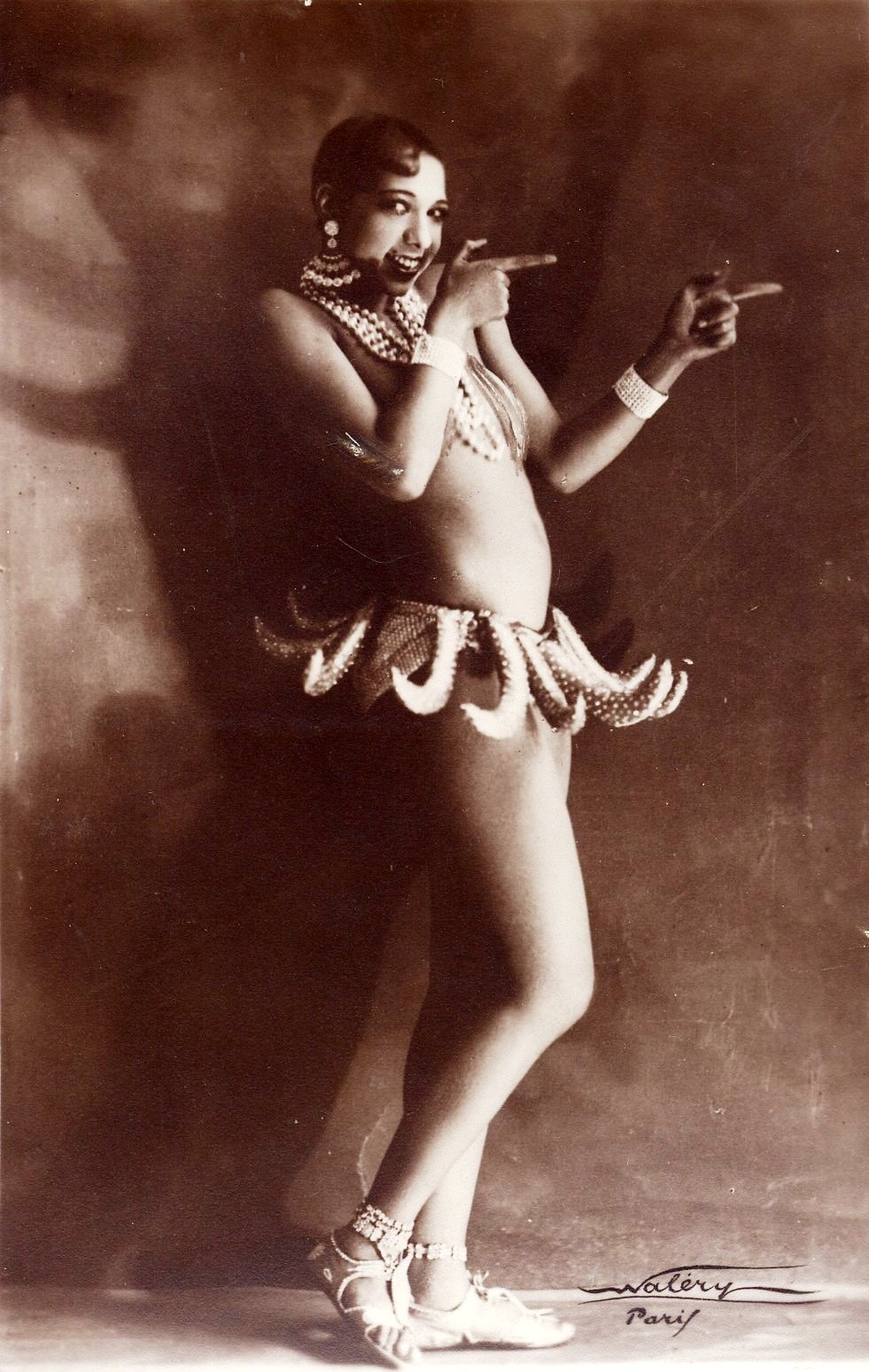
During her early career, Baker was among the most celebrated performers to headline the revues of the Folies Bergère in Paris. Her performance in its 1927 revue Un vent de folie caused a sensation in the city. Her costume, consisting only of a short skirt of artificial bananas and a beaded necklace, became an iconic image and a symbol both of the Jazz Age and the Roaring Twenties. Baker was celebrated by artists and intellectuals of the era, who variously dubbed her the "Black Venus", the "Black Pearl", the "Bronze Venus", and the "Creole Goddess". Born in St. Louis, Missouri, she renounced her U.S. citizenship and became a French national after her marriage to French industrialist Jean Lion in 1937. She adopted 12 children, whom she referred to as the Rainbow Tribe, and raised them in France.
Baker aided the French Resistance during World War II, and also worked with the British Secret Intelligence Service and the United States Office of Strategic Services, the extent of which was not publicized until 2020, when French documents were declassified. After the war, she was awarded the Resistance Medal by the French Committee of National Liberation, the Croix de Guerre by the French military, and was named a Chevalier of the Legion of Honour by General Charles de Gaulle. Baker sang: "I have two loves: my country and Paris." She refused to perform for segregated audiences in the United States, and is also noted for her contributions to the civil rights movement. In 1968, she was offered unofficial leadership in the movement following the assassination of Martin Luther King, but declined due to concerns for the welfare of her children. On November 30, 2021, Baker was inducted into the Panthéon in Paris, the first black woman to receive one of the highest honors in France. As her resting place remains in Monaco Cemetery, a cenotaph was installed in vault 13 of the crypt in the Panthéon.
Early life
Josephine Baker was born Freda Josephine McDonald in St. Louis, Missouri. Baker's mother, Carrie, was adopted in Little Rock, Arkansas in 1886 by Richard and Elvira McDonald, both of whom were former slaves of African descent. Carrie McDonald was a person of African American and Native American heritage. Baker's official website identifies vaudeville drummer Eddie Carson as her natural father; both Carson and Carrie McDonald were vaudeville performers. However, in his 1993 biography entitled Josephine: The Hungry Heart, Baker's foster son, Jean-Claude Baker, stated otherwise. Following decades of exhaustive research into Baker's life and career, Jean-Claude Baker's book described the circumstances of Baker's birth as follows:
Jean-Claude Baker went on to state that he had failed to unearth the identity of Baker's biological father (which he described as "the most painful mystery of her life), but that he, Baker, and others believed her father to have been a white man. He added that Eddie Carson "played along" with the assertion that he was Baker's father. Khalid Elhassan, the author of "40 Fascinating Facts About the Fabulous Josephine Baker", noted that it was "almost unheard of" for a person of color to be treated in a white hospital during segregation; he opined that "the likeliest explanation is that Josephine’s mother, who worked for a wealthy German family, had been impregnated by her employer, who then pulled strings to get [her] admitted into the city’s best hospital".
Josephine McDonald spent her early life on 212 Targee Street (known by some St. Louis residents as Johnson Street) in the Chestnut Valley neighborhood of St. Louis, a racially mixed low-income area near Union Station, consisting mainly of rooming houses, brothels, and apartments without indoor plumbing. She was poorly dressed and hungry, and she developed street smarts playing in the railroad yards of Union Station.
Her mother married Arthur Martin, "a kind but perpetually unemployed man", with whom she had a son and two more daughters. She worked in a laundry; her mother placed her there due to her family being impoverished; she worked there in order to increase the income of her family and, at eight years old, Josephine began working as a live-in domestic for white families in St. Louis. One woman abused her, burning Josephine's hands when the young girl put too much soap in the laundry.
In 1917, when she was 11, a terrified Josephine McDonald witnessed racial violence in East St. Louis. In a speech years later, she recalled what she had seen:I can still see myself standing on the west bank of the Mississippi looking over into East St. Louis and watching the glow of the burning of Negro homes lighting the sky. We children stood huddled together in bewilderment ... frightened to death with the screams of the Negro families running across this bridge with nothing but what they had on their backs as their worldly belongings... So with this vision I ran and ran and ran...
By age 12, she had dropped out of school. At 13, she worked as a waitress at the Old Chauffeur's Club at 3133 Pine Street. She also lived as a street child in the slums of St. Louis, sleeping in cardboard shelters, scavenging for food in garbage cans, making a living with street-corner dancing. It was at the Old Chauffeur's Club that Josephine met Willie Wells, whom she married at age 13, but the marriage lasted less than a year. Following her divorce from Wells, she found work with a street performance group called the Jones Family Band.
In her teens, she struggled to have a healthy relationship with her mother, who opposed her becoming an entertainer and scolded her for not tending to her second husband, William Howard Baker, whom she had married in 1921, at age 15.Uncertainty about her career and her need for love and respectability made her consider marrying Pepito on whom she could depend, and who loved her. However, she was still married to Willie Baker, which didn't prevent the "couple" from announcing to the press that they had wed in June 1927.-- She soon left him when her vaudeville troupe was booked into a New York City venue. They divorced in 1925, during a period when her career success was beginning. Still, she continued to use his last name professionally for the rest of her life. Though Baker was often on the road, returning with gifts and money for her mother and younger half-sister, larger career opportunities drew her farther afield, to France.
Career
Early career
Baker's unrelenting badgering of a local show manager led to her recruitment for the St. Louis Chorus vaudeville act. At the age of 13, she headed to New York City during the Harlem Renaissance and performed at the Plantation Club, Florence Mills's old stomping ground. After several auditions, she secured a role in the chorus line of a touring production of the groundbreaking and hugely successful Broadway revue "Shuffle Along" (1921) that helped bring public attention to Florence Mills, Paul Robeson, and Adelaide Hall.
In "Shuffle Along", Baker was a dancer at the end of a chorus line. Fearing she might be overshadowed by the others, she used her position to ad-lib, introducing a hint of comedy into her routine, making her stand out from her fellow dancers, thus going off-script, yet engaging audiences. She began in "Shuffle Along" with one of the U.S. touring companies, but, once she came of age, she was transferred to the Broadway production, where she remained for several months, until the show closed, in 1923. Next, Baker was cast in "The Chocolate Dandies", a revue that opened on September 1, 1924. Again, she was relegated to the chorus line. The show ran for 96 performances, finally closing on November 22, 1924.
Pre-war Paris and rise to fame
A 1936 interview with Baker in The New York Times reported that, After the Plantation Club there was a Mrs. Caroline Dudley. "She was interested in art and she got up a Negro revue and took us to Europe." The "Revue Nègre" that was, bound for a tour of European capitals.
at Théâtre des Champs-Élysées, 2 October 1925
Baker sailed to Paris in 1925 and opened on October 2 in La Revue nègre at Théâtre des Champs-Élysées, performing Danse Sauvage with :fr:Joe Alex, barely wearing a feather skirt. She was 19 at the time. In a 1974 interview with The Guardian, she explained that her first big break came in this bustling European city:
In Paris, she became an instant success for her erotic dancing and for appearing practically nude onstage. After a successful tour of Europe, she broke her contract and returned to France in 1926 to star at the Folies Bergère, setting the standard for her future acts. "In a 1926 performance at the popular concert hall Folies Bergére, Baker wore a banana skirt during La Folie du Jour."
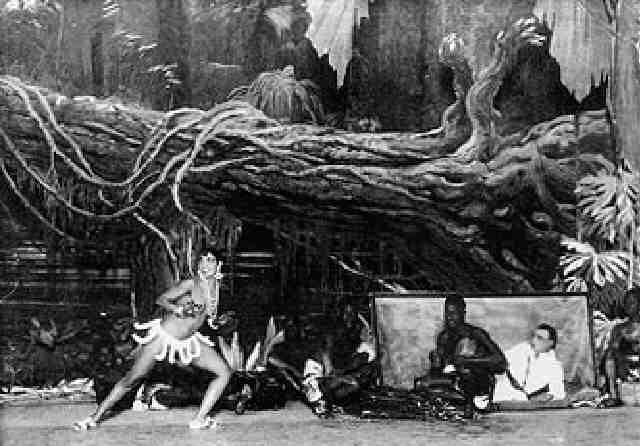
Baker performed the Danse Sauvage Her success coincided with the 1925 Exposition des Arts Décoratifs, which gave birth to the term "Art Deco", as well as a renewed interest in non-Western art forms, including those of African origin, which Baker would represent. In later shows in Paris, she was often accompanied on stage by her pet cheetah, "Chiquita", donning a diamond collar. Chiquita frequently escaped into the orchestra pit, terrorizing the musicians and adding another element of excitement to the show.
After a while, Baker became the most successful American entertainer in France. Ernest Hemingway called her "the most sensational woman anyone ever saw." The author spent hours talking with her in Parisian bars, Picasso depicted her alluring beauty, and Jean Cocteau became friendly with her. Baker endorsed a "Bakerfix" hair gel, as well as bananas, shoes, and cosmetics, among other products.
In 1929, Baker became the first African-American star to visit Yugoslavia, which she included on a tour through Central Europe via the Orient Express. In Belgrade, she performed at Luxor Balkanska, then the city's most luxurious venue. In a nod to local culture, she included a Pirot kilim in her routine and donated some of the show's proceeds to poor children of Serbia. In Zagreb, adoring crowds greeted her at the train station, but opposition from local clergy and morality police led to the cancellation of some of her shows.
During her travels in Yugoslavia, Baker was accompanied by "Count" Giuseppe "Pepito" Abatino. At the start of her career in France, Abatino, a Sicilian former stonemason who passed himself off as a count, persuaded her to let him manage her. He became not only Baker's manager, but her lover as well. The two could not marry because she was not yet divorced from her second husband, Willie Baker.

In 1930, Baker sang professionally for the first time. During this period, she released her most successful song, "J'ai deux amours" (1931). The song expresses the sentiment that "I have two loves, my country and Paris." In a 2007 book, Tim Bergfelder, Sue Harris, and Sarah Street claimed that "by the 1930's, Baker's assimilation into French popular culture had been completed by her association with the song." She starred in four films, which found success only in Europe: the silent film Siren of the Tropics (1927), and the sound films Zouzou (1934), Princesse Tam Tam (1935), and Fausse alerte (1940). Bergfelder, Harris, and Street wrote that Siren of the Tropics "rehearses the 'primitive-to-Parisienne' narrative that would become the staple of Baker's cinema career, and exploited in particular her comic stage persona based on loose-limbed athleticism and artful clumsiness." Zouzou and Princesse Tam Tam were both star vehicles for Baker.

Under the management of Abatino, Baker's stage and public persona, as well as her singing voice, were transformed. In 1934, she took the lead in a revival of Jacques Offenbach's opera La créole, which premiered in December of that year for a six-month run at the Théâtre Marigny on the Champs-Élysées of Paris. In preparation for her performances, she went through months of training with a vocal coach. In the words of Shirley Bassey, who has cited Baker as her primary influence, "... she went from a petite danseuse sauvage with a decent voice to la grande diva magnifique... I swear in all my life I have never seen, and probably never shall see again, such a spectacular singer and performer."
Despite her popularity in France, Baker never attained the equivalent reputation in America. Her star turn in a 1936 revival of "Ziegfeld Follies" on Broadway was not commercially successful, and later in the run she was replaced by Gypsy Rose Lee. Time magazine referred to her as a "Negro wench ... whose dancing and singing might be topped anywhere outside of Paris", while other critics said her voice was "too thin" and "dwarf-like" to fill the Winter Garden Theatre. She returned to Europe heartbroken. This contributed to Baker's becoming a legal citizen of France and giving up her American citizenship.
In 1936, (1880–1966) brought Baker from New York City to Paris to lead the revue En Super Folies, opening in October 1936. The show starred Baker in 1936, and continued in 1937. A film of En Super Folies was released.
On December 14, 1926 (to 1927), Giuseppe "Pepito" Abatino, established the first Chez Josephine cabaret at 40 Rue Fontaine, in Montmartre, Paris, as a gift to Baker, Baker invested her own money. In 1936, she established a second "Chez Josephine" cabaret in New York City. -- "Josephine Baker, the famous colored star who faintly shocked Paris with her daring stage appearances, is the owner of a supper-club in New York. It is called 'Chez Josephine Baker,' and on the opening night (25 February 1936), complete with paper snowballs, serpentine, and all the other weapons of all-night-club warfare, Josephine was handed a beribboned parcel that revealed a tiny snorting piglet in a crate" (2 November 1936). On December 17, 1948, a Chez Josephine cabaret opened in Paris. In 1986, Jean-Claude Baker opened Chez Josephine in New York City.
In 1937, Baker married the French industrialist Jean Lion, thus becoming a French citizen. They were married in the French town of Crèvecœur-le-Grand, in a wedding presided over by the mayor, Jammy Schmidt.
Between 1933 and 1937, Baker was a guest at the start of the Tour de France on four occasions. After enduring severe hostility in Germany and Eastern Europe during the late 1920s—where she was targeted by storm troopers with ammonia bombs and told to "Go back to Africa"—she was spurred to actively participate in the French Resistance against the Nazis.
World War II
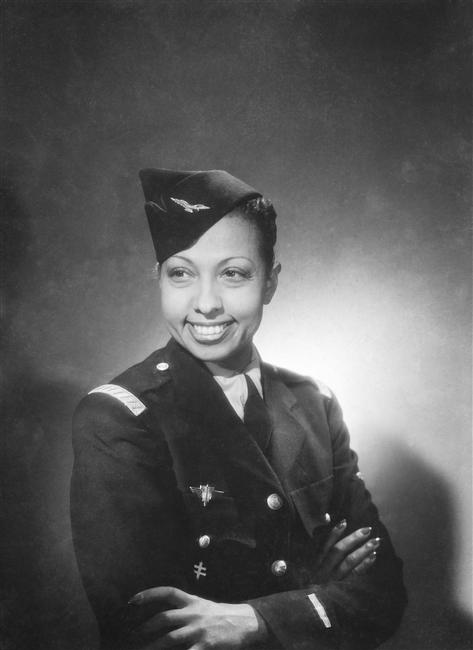
In September 1939, when France declared war on Germany in response to the invasion of Poland, Baker was recruited by the Deuxième Bureau, the French military intelligence agency, as an "honorable correspondent". Baker worked with Jacques Abtey, the head of French counterintelligence in Paris. She socialized with the Germans at embassies, ministries, night clubs, charming them while secretly gathering information. Her café-society fame enabled her to rub shoulders with those in the know, from high-ranking Japanese officials to Italian and Vichy bureaucrats, reporting to Abtey what she heard. She attended parties and gathered information at the Italian embassy without raising suspicion. The Deuxième Bureau shared information with Wilfred Dunderdale at the Secret Intelligence Service (MI6) in London, and when it had to go underground, Baker reported to London directly; in North Africa she reported via the American diplomate spies to London. Baker's espionage work went beyond merely gathering information at social events. She had a pilot's license and during the Phoney War she flew missions. She collected detailed intelligence on German troop movements, as well as the locations and activities of airfields and harbors. Confident in her celebrity status and the protections it afforded, Baker believed she could operate without raising suspicion. To covertly transport sensitive information, she used methods such as writing notes on her hands and arms, pinning them inside her clothing, and using invisible ink. Her boldness paid off, allowing her to smuggle intelligence across borders and deliver critical reports to the French Resistance.
When the Germans invaded France in 1940, Baker left Paris and went to the Château des Milandes, her home in the Dordogne département in the south of France. The Château des Milandes became, especially in World War II, one of the most important hideaways; she would shelter resistance fighters and Jewish refugees, providing them with documents and even money for food, clothes, and forged documents she usually financed herself. Her estate also provided the center of French Resistance activities, including the installation of a radio transmitter in order to be in touch with the Allied forces and storing weapons in its cellar. As an entertainer, Baker had an excuse for moving around Europe, visiting neutral nations such as Portugal, as well as some in South America. She carried information for transmission to England, about airfields, harbors, and German troop concentrations in the West of France. Notes were written in invisible ink on Baker's sheet music. As described in Jazz Cleopatra, "She specialized in gatherings at embassies and ministries, charming people as she had always done, but at the same time trying to remember interesting items to transmit".
Later in 1941, she and her entourage went to the French colonies in North Africa. The stated reason was Baker's health (since she was recovering from another case of pneumonia), but the real reason was to continue helping the Resistance. From a base in Morocco, she made tours of Spain. She pinned notes with the information she gathered inside her underwear. She met the Pasha of Marrakech, whose support helped her through a miscarriage (the last of several). After the miscarriage, she developed an infection so severe it required a hysterectomy. The infection spread and she developed peritonitis and then sepsis. After her recovery (which she continued to fall in and out of), she started touring to entertain British, French, and American soldiers in North Africa. The Free French had no organized entertainment network for their troops, so Baker and her entourage managed for the most part on their own. They allowed no civilians and charged no admission.
When it was time to leave France, Abtey and Baker traveled to London via Lisbon. After the war, Baker was awarded the Resistance Medal by the French Committee of National Liberation, the Croix de Guerre by the French military, and was named a Chevalier of the Légion d'honneur by General Charles de Gaulle.
Post War

In 1949, a reinvented Baker returned in triumph to the Folies Bergère. Bolstered by recognition of her wartime heroism, Baker the performer assumed a new gravitas, unafraid to take on serious music or subject matter. The engagement was a rousing success and reestablished Baker as one of Paris' pre-eminent entertainers. In 1951, Baker was invited back to the United States for a nightclub engagement in Miami. After winning a public battle over desegregating the club's audience, Baker followed up her sold-out run at the club with a national tour. Rave reviews and enthusiastic audiences accompanied her everywhere, climaxed by a parade in Harlem in honor of her new title: NAACP's "Woman of the Year".
An incident at the Stork Club in New York in October 1951 interrupted and overturned her plans. Baker criticized the club's unwritten policy of discouraging Black patrons, then scolded columnist Walter Winchell, an old ally, for not rising to her defense. Winchell responded swiftly with a series of harsh public rebukes, including accusations of Communist sympathies (a serious charge at the time). The ensuing publicity resulted in the termination of Baker's work visa, forcing her to cancel all her engagements and return to France. It was almost a decade before U.S. officials allowed her back into the country.

In 1952, Baker was hired to crown the Queen of the Cavalcade of Jazz for the famed eighth Cavalcade of Jazz concert held at Wrigley Field in Los Angeles, which was produced by Leon Hefflin, Sr. on June 1. Also featured to perform that day were Roy Brown and His Mighty Men, Anna Mae Winburn and Her Sweethearts, Toni Harper, Louis Jordan, Jimmy Witherspoon and Jerry Wallace.
In January 1966, Fidel Castro invited Baker to perform at the "Teatro Musical de La Habana" in Havana, Cuba, at the seventh-anniversary celebrations of his revolution. Her spectacular show in April broke attendance records. In 1968, Baker visited Yugoslavia and made appearances in Belgrade and in Skopje. In her later career, Baker faced financial troubles. She commented, "Nobody wants me, they've forgotten me"; but family members encouraged her to continue performing. In 1973 she performed at Carnegie Hall to a standing ovation.
The following year, she appeared in a Royal Variety Performance at the London Palladium, and then at the Monegasque Red Cross Gala, celebrating her 50 years in French show business. Advancing years and exhaustion began to take their toll; she sometimes had trouble remembering lyrics, and her speeches between songs tended to ramble. However, she still continued to captivate audiences of all ages.
Civil rights activism
Although based in France, Baker supported the American Civil Rights Movement during the 1950s. When she arrived in New York with her husband Jo, they were refused reservations at 36 hotels because of racial discrimination. This led her to write several articles about segregation in the United States. She also traveled in the South, giving a talk at Fisk University, a historically black college in Nashville, Tennessee, on "France, North Africa and the Equality of the Races in France". In the 1950s the FBI tracked everything she did, and opened a file on her. The intent of doing so was to deter other countries from allowing her to take the stage. During her travels to foreign countries, she would leverage her influence to bring light to the racial discrimination in the United States which created a rift between her and her homeland.
On October 16, 1951, Josephine Baker experienced a public incident where she was said to have been refused service at the upscale Stork Club in New York City. Determined to expose this injustice, Baker set out to publicize her story, expecting support from one of America's most powerful conservative journalists and one of the regulars at the club: Walter Winchell. Instead of solidarizing with Baker, Winchell launched a media attack on her. He labeled her as an anti-American communist sympathizer, which turned the public attention away from the discrimination she had to face. Undaunted by such opposition, she continued to use her platform to advocate for civil rights and challenge systemic injustice.
She refused to perform for segregated audiences in the United States, although she was offered $10,000 by a Miami club; the club eventually met her demands. Her insistence on mixed audiences helped to integrate live entertainment shows in the Las Vegas Valley. After this incident, she began receiving threatening phone calls from people claiming to be from the Ku Klux Klan but said publicly that she was not afraid of them.
In 1951, Baker made charges of racism against Sherman Billingsley's Stork Club in Manhattan, where she had been refused service. Actress Grace Kelly, who was at the club at the time, rushed over to Baker, took her by the arm and stormed out with her entire party, vowing never to return (although she returned on January 3, 1956 with Prince Rainier of Monaco). The two women became close friends after the incident.
When Baker was near bankruptcy, Kelly—by then the princess consort—offered her a villa and financial assistance. (During his work on the "Stork Club" book, author and "New York Times" reporter Ralph Blumenthal was contacted by Jean-Claude Baker, one of Baker's sons. He indicated that he had read his mother's FBI file and, using comparison of the file to the tapes, said he thought the Stork Club incident was overblown.)
Baker also worked with the NAACP. Her reputation as a crusader grew to such an extent that the NAACP had Sunday, May 20, 1951, declared "Josephine Baker Day". She was presented with life membership with the NAACP by Nobel Peace Prize winner Ralph Bunche. The honor she was paid spurred her to further her crusading efforts with the "Save Willie McGee" rally. McGee was a black man in Mississippi convicted of raping a white woman in 1945 on the basis of dubious evidence, and sentenced to death. Baker attended rallies for McGee and wrote letters to Fielding Wright, the governor of Mississippi, asking him to spare McGee's life. Despite her efforts, McGee was executed in 1951. As the decorated war hero who was bolstered by the racial equality she experienced in Europe, Baker became increasingly regarded as controversial; some black people even began to shun her, fearing that her outspokenness and racy reputation from her earlier years would hurt the cause.
In 1957, Baker gave a speech at the Paulskirche in Frankfurt, criticizing racial discrimination.
In 1963, she spoke at the March on Washington at the side of Rev. Martin Luther King Jr. Baker was the only official female speaker. While wearing her Free French uniform emblazoned with her medal of the Légion d'honneur, she introduced the "Negro Women for Civil Rights". Rosa Parks and Daisy Bates were among those she acknowledged, and both gave brief speeches. Not everyone involved wanted Baker present at the March; some thought her time overseas had made her a woman of France, one who was disconnected from the Civil Rights issues going on in America. In her speech, one of the things Baker said:I have walked into the palaces of kings and queens, and into the houses of presidents and much more. But I could not walk into a hotel in America and get a cup of coffee, and that made me mad. And when I get mad, you know that I open my big mouth. And then look out, 'cause when Josephine opens her mouth, they hear it all over the world ...
After King's assassination, his widow Coretta Scott King approached Baker in the Netherlands to ask if she would take her husband's place as leader of the Civil Rights Movement. After many days of thinking it over, Baker declined, saying her children were "too young to lose their mother."
Personal life
Relationships

Baker's first marriage was to American Pullman porter Willie Wells when she was only 13 years old. The union was reportedly very unhappy, and the couple divorced soon after marrying. Another short-lived marriage followed in 1921, to William Howard Baker. Since her career was already taking off under that last name, she retained it after the divorce. Jean-Claude Baker wrote that Josephine was bisexual and had several relationships with women.
In 1925, she allegedly began an extramarital relationship with the Belgian novelist Georges Simenon. On an ocean liner, in 1929, en route from South America to France, Baker had an affair with the Swiss-French architect Le Corbusier (Charles-Édouard Jeanneret). In 1937, Baker married Frenchman Jean Lion, but they separated in 1940. She married French composer and conductor Jo Bouillon in 1947 around the time she adopted her 11th child; their union lasted 14 years before also ending in divorce. Later, she was involved with the artist Robert Brady for a time, but they never married. Speculation exists that Baker was also involved in sexual liaisons, if not relationships, with blues singer Clara Smith, Ada "Bricktop" Smith, French novelist Colette, and Frida Kahlo.
Children

During her participation in the civil rights movement, Baker began to adopt children, forming a family which she often referred to as the "Rainbow Tribe". Baker wanted to prove that "children of different ethnicities and religions could still be brothers." She often took the children with her cross-country, and when they were at Château des Milandes, she arranged tours so visitors could walk the grounds and see how natural and happy the children were in the Rainbow Tribe. Her estate featured hotels, a farm, rides, and the children singing and dancing for the audience. She charged an admission fee to visitors who entered and partook in the activities, which included watching the children play.
She created dramatic backstories for them, picking them with clear intent in mind: at one point, she wanted and planned to adopt a Jewish baby, but she settled for a non-Jewish French one. She also raised them in different religions in order to further her model for the world, taking two children from Algeria and raising one child as a Muslim and raising the other child as a Catholic. One member of the Tribe, Jean-Claude Baker, said: "She wanted a doll".
Baker raised two daughters, French-born Marianne and Moroccan-born Stellina, and 10 sons, Japanese-born Janot (born Teruya) and Akio, Colombian-born Luis, Finnish-born Jari (now Jarry), French-born Jean-Claude, Noël, and Moïse, Algerian-born Brahim (later Brian), Ivorian-born Koffi, and Venezuelan-born Mara. Later on, Josephine Baker would become the legal guardian of another boy, also named Jean-Claude, and considered him an unofficial addition to the Rainbow Tribe. For some time, Baker lived with her children and an enormous staff in the château in Dordogne, France, with her fourth husband, Jo Bouillon. Bouillon claimed that Baker bore one child, though it was stillborn in 1941, an incident that precipitated an emergency hysterectomy.
Baker forced Jarry to leave the château and live with his adoptive father, Jo Bouillon, in Argentina, at the age of 15, after discovering that he was gay (though it appears that the two were able to reconcile in later years.) Moïse died of cancer in 1999, and Noël was diagnosed with schizophrenia and was in a psychiatric hospital as of 2009. Jean-Claude Baker, the unofficial addition to the Rainbow Tribe, died by suicide in 2015, aged 71.
Later years and death
In her later years Baker converted to Catholicism. In 1968, Baker lost her château owing to unpaid debts; afterwards Princess Grace offered her an apartment in Roquebrune, near Monaco.
Baker was back on stage at the Olympia in Paris in 1968, in Belgrade and at Carnegie Hall in 1973 and at the Royal Variety Performance at the London Palladium and at the "Gala du Cirque" in Paris in 1974. On April 8, 1975, Baker starred in a retrospective revue at the Bobino in Paris, "Joséphine à Bobino 1975" celebrating her 50 years in show business. The revue, financed by Prince Rainier, Princess Grace, and Jacqueline Kennedy Onassis, opened to critical aclaim. The opening-night audience included Sophia Loren, Mick Jagger, Shirley Bassey, Diana Ross and Liza Minnelli.
Four days later, Baker was found in her bed in a coma after suffering a cerebral hemorrhage. She was taken to Pitié-Salpêtrière Hospital, where she died, aged 68, on April 12, 1975.
Baker received a full Catholic funeral at L'Église de la Madeleine, attracting more than 20,000 mourners. The only American-born woman to receive full French military honors at her funeral, Baker's funeral was the occasion of a large procession. After a family service at Saint-Charles Church in Monte Carlo, Baker was interred at the Cimetière de Monaco.
Baker was a Freemason.
Legacy
_-_panneau.JPG)
Place Joséphine Baker in the Montparnasse Quarter of Paris was named in her honor. She has also been inducted into the St. Louis Walk of Fame, and on March 29, 1995, into the Hall of Famous Missourians. St. Louis's Channing Avenue was renamed Josephine Baker Boulevard, and a wax sculpture of Baker is on permanent display at The Griot Museum of Black History.
In 2015, she was inducted into the Legacy Walk in Chicago, Illinois. The Piscine Joséphine Baker is a swimming pool along the banks of the Seine in Paris named after her.
Writing in the online BBC Magazine in late 2014, Darren Royston, historical dance teacher at RADA, credited Baker with being the Beyoncé of her day, and bringing the Charleston to Britain. Two of Baker's sons, Jean-Claude and Jarry (Jari), grew up to go into business together, running the restaurant Chez Josephine on Theatre Row, 42nd Street, New York City. It celebrates Baker's life and works.

Château des Milandes, a castle near Sarlat in the Dordogne, was Baker's home where she raised her twelve children. It is open to the public and displays her stage outfits including her banana skirt (of which there are apparently several). It also displays many family photographs and documents as well as her Legion of Honour medal. Most rooms are open for the public to walk through including bedrooms with the cots where her children slept, a huge kitchen, and a dining room where she often entertained large groups. The bathrooms were designed in art deco style but most rooms retained the French chateau style.
Baker continued to influence celebrities more than a century after her birth. In a 2003 interview with USA Today, Angelina Jolie cited Baker as "a model for the multiracial, multinational family she was beginning to create through adoption." Beyoncé performed Baker's banana dance at the Fashion Rocks concert at Radio City Music Hall in September 2006.
As a commemoration of Baker's one hundredth birthday, a multi-media performance was written and shown in 2006. The following year, Josephine Baker: A Life of Le Jazz Hot! was recorded from the Baker inspired production by Imani Winds.
Writing on the 110th anniversary of her birth, Vogue described how her 1926 "danse sauvage" in her famous banana skirt "brilliantly manipulated the white male imagination" and "radically redefined notions of race and gender through style and performance in a way that continues to echo throughout fashion and music today, from Prada to Beyoncé."
On June 3, 2017, the 111th anniversary of her birth, Google released an animated Google Doodle, which consists of a slideshow chronicling her life and achievements.
On Thursday, November 22, 2018, a documentary entitled Josephine Baker: The Story of an Awakening, directed by Ilana Navaro, premiered at the Beirut Art Film Festival. It contains rarely seen archival footage, including some never before discovered, with music and narration.
In August 2019, Baker was one of those inducted in the Rainbow Honor Walk, a walk of fame in San Francisco's Castro District noting LGBTQ people who have "made significant contributions in their fields".
The Staatliche Museen zu Berlin (Berlin State Museums) hosted an exhibition "Josephine Baker: Icon in Motion" from January 26 through April 28, 2024. The show displays photographs, film, and drawings covering her entertainment career through her involvement in civil rights. The exhibit includes Baker inspired works by her contemporaries.
Josephine Baker appears on the French 20-cent euro coins released in March 2024.
Panthéon in Paris

In May 2021, an online petition was set up by writer Laurent Kupferman asking that Joséphine Baker be honoured by being reburied at the Panthéon in Paris or being granted Panthéon honours, which would make her only the sixth woman at the mausoleum alongside Simone Veil, Geneviève de Gaulle-Anthonioz, Marie Curie, Germaine Tillion, and Sophie Berthelot. In August 2021 the French President, Emmanuel Macron, announced that Baker's remains would be reburied at the Panthéon in November 2021, following the petition and continued requests from Baker's family since 2013. Her son Claude Bouillon-Baker, however, told Agence France-Presse that her body would remain in Monaco and only a plaque would be installed at the Panthéon. It was later announced that a symbolic casket containing soil from various locations where Baker had lived, including St. Louis, Paris, the South of France and Monaco, would be carried by the French Air and Space Force in a parade in Paris before a ceremony at the Panthéon where the casket was interred. The ceremony took place on Tuesday, November 30, 2021, and Baker thus became the first black woman to be honored in the secular temple to the "great men" of the French Republic.
Works by Baker
Works portraying or inspired by Baker
Film and television
Diana Ross portrayed Baker in her Tony Award-winning Broadway and television show "An Evening with Diana Ross". When the show was made into an NBC television special entitled The Big Event: An Evening with Diana Ross, Ross again portrayed Baker. In the 1981 film Das Boot, a German submariner mimics Baker's Danse banane. In 1991, Baker's life story, The Josephine Baker Story, was broadcast on HBO. Lynn Whitfield portrayed Baker, and won an Emmy Award for Outstanding Lead Actress in a Miniseries or a Special—becoming the first Black actress to win the award in this category. In the 1997 animated musical film Anastasia, Baker appears with her cheetah during the musical number "Paris Holds the Key (to Your Heart)". In 2002, Baker was portrayed by Karine Plantadit in the biopic Frida. A character who is based on Baker (topless, wearing the famous "banana skirt") appears in the opening sequence of the 2003 animated film The Triplets of Belleville (Les Triplettes de Belleville).
Her influence upon and assistance to the careers of the husband and wife dancers Carmen De Lavallade and Geoffrey Holder are discussed and illustrated in rare footage in the 2005 Linda Atkinson/Nick Doob documentary, Carmen and Geoffrey. In 2011, Sonia Rolland portrayed Baker in the film Midnight in Paris. In February 2017, Tiffany Daniels portrayed Baker in the "Timeless" television episode "The Lost Generation". In May 2020, Astrid Jones portrayed Baker in the El ministerio del tiempo television episode "La memoria del tiempo" (The memory of time). Baker is portrayed by actress Carra Patterson in "I Am.", the seventh episode of HBO's television series Lovecraft Country.
A biopic about the life of Josephine Baker was announced in November 2022. It will be directed by French director Maïmouna Doucouré and produced by French production company Studiocanal.
Stage
In 1986, Helen Gelzer portrayed Baker on the concept album Josephine – "a musical version of the life and times of Josephine Baker" with book, lyrics and music by Michael Wild. The musical director was Paul Maguire. The album was produced in conjunction with Baker's longtime friend Jack Hockett and Premier Box Office. A West End stage production of Josephine was premiered at the Fortune Theatre on June 4, 1989. It was produced by Ian Liston and financed in conjunction with Jack Hockett and Premier Box Office. Jack Hockett died in 1988 before the show was staged. Heather Gillespie played the lead role of Josephine Baker, and Baker's husband Pepito was played by Roland Alexander. Peggy Phango played Bricktop.
In 2006, Jérôme Savary produced a musical, A La Recherche de Josephine – New Orleans for Ever (Looking for Josephine), starring Nicolle Rochelle. The story revolved around the history of jazz and Baker's career. Also in 2006, Deborah Cox starred in the musical Josephine at Florida's Asolo Theatre, directed and choreographed by Joey McKneely, with a book by Ellen Weston and Mark Hampton, music by Steve Dorff and lyrics by John Bettis. In July 2012, Cheryl Howard opened in The Sensational Josephine Baker, written and performed by Howard and directed by Ian Streicher at the Beckett Theatre of Theatre Row on 42nd Street in New York City, just a few doors away from Chez Josephine. In July 2013, Cush Jumbo's debut play Josephine and I premiered at the Bush Theatre, London. It was re-produced in New York City at The Public Theater's Joe's Pub from February 27 to April 5, 2015.
In June 2016, Josephine, a burlesque cabaret dream play starring Tymisha Harris as Josephine Baker premiered at the 2016 San Diego Fringe Festival. The show has since played across North America and had a limited off-Broadway run in January–February 2018 at SoHo Playhouse in New York City. In late February 2017, a new play about Baker's later years, The Last Night of Josephine Baker by playwright Vincent Victoria, opened in Houston, Texas, starring Erica Young as "Past Josephine" and Jasmin Roland as "Present Josephine". Actress DeQuina Moore portrayed Baker in a biographic musical titled Josephine Tonight at The Ensemble Theatre in Houston, Texas, from June 27 to July 28, 2019. In September 2021, Theatre Royal, Bath, in conjunction with Oxford Playhouse and Wales Millennium Centre produced a UK touring production of Josephine co-written by Leona Allen and Jesse Briton who also directed the show. It toured the UK and featured Ebony Feare in the lead role as Josephine Baker.
Since 2016 Dynamite Lunchbox Entertainment of Orlando Florida has been touring Josephine, a burlesque cabaret dream play, co-created by and starring Tymisha Harris, to Fringe Festivals around Canada and the U.S. It played at the Montreal Fringe Festival in 2022. It was part of the 2022–2023 official season at the Segal Centre for the Performing Arts in Montreal (Spring 2023) as Josephine, A Musical Cabaret.
Literature
Baker appears in her role as a member of the French Resistance in Johannes Mario Simmel's 1960 novel, Es muss nicht immer Kaviar sein (C'est pas toujours du caviar). The 2004 erotic novel Scandalous by British author Angela Campion uses Baker as its heroine and is inspired by Baker's sexual exploits and later adventures in the French Resistance. In the novel, Baker, working with a fictional Black Canadian lover named Drummer Thompson, foils a plot by French fascists in 1936 Paris. Baker was heavily featured in the 2012 book Josephine's Incredible Shoe & The Blackpearls by Peggi Eve Anderson-Randolph. In his novel Noire, la neige, Marseille, Editions Parenthèses, , Pascal Rannou evokes the relationship between Valaida Snow and Josephine Baker, who is one of the main characters of this story.
Music
Actress Phylicia Rashad's 1978 disco concept album Josephine Superstar is a biographical dedication to Baker's legacy. The lyrics detail Baker's life, including her youth, career, and romances in St. Louis, Broadway, and Paris. Arranged by French producers Morali, Belolo, and her then-husband Victor Willis, it was released by Casablanca Records and peaked at #28 on the Billboard disco charts. Backing vocals were sung by The Ritchie Family and Village People. The album cover features Rashad dressed in Baker's banana outfit.
The Italian-Belgian francophone singer composer Salvatore Adamo pays tribute to Baker with the song "Noël Sur Les Milandes" (album Petit Bonheur – EMI 1970). The British band Sailor paid tribute on their 1974 self-titled debut album Sailor with the Georg Kajanus song "Josephine Baker" who "...stunned the world at the Folies Bergère..." The title track of the 1987 Premiata Forneria Marconi album Miss Baker was written in honor of the American dancer Josephine Baker. British singer-songwriter Al Stewart wrote "Josephine Baker" about her, a song which appears on the album Last Days of the Century, from 1988.
Beyoncé Knowles has portrayed Baker on various occasions. During the 2006 Fashion Rocks show, Knowles performed "Dejá Vu" in a revised version of the Danse banane costume. In Knowles's video for "Naughty Girl", she is seen dancing in a huge champagne glass à la Baker. In I Am ... Yours: An Intimate Performance at Wynn Las Vegas, Beyoncé lists Baker as an influence of a section of her live show. In 2010, Keri Hilson portrayed Baker in her single "Pretty Girl Rock". In January 2022, Laquita Mitchell sang the title role in the New Orleans Opera production of Josephine by Tom Cipullo.
Artworks
In 1927, Alexander Calder created Josephine Baker (III), a wire sculpture of Baker, which is now displayed at the Museum of Modern Art. A nude portrait of Baker by Jean de Botton was the "cynosure for all eyes" when it was shown at the Salon d'Automne in Paris in 1931. When auctioned in Paris in 2021 the painting set a world record (EUR 179,200) for the artist. Henri Matisse created a mural-sized cut paper artwork titled La Négresse (1952–1953), possibly inspired by Baker. Hassan Musa depicted Baker in a 1994 series of paintings called Who needs Bananas? Season 14 of the Duolingo French Podcast is titled The Secret Life of Josephine Baker. The season finale was released in November 2023.
Documentaries
In 2006, Annette von Wangenheim directed the documentary Joséphine Baker: Black Diva in a White Mans World, about Baker's life and work from a perspective that analyses images of Black people in popular culture.
In 2007, Mark Miller published his biography of Valaida Snow: High Hat, Trumpet and Rhythm: The Life and Music of Valaida Snow (Toronto: The Mercury Press ), in which he evokes Valaida's partnership and rivalry with Joséphine Baker: p. 8, 38, 44–45, 52, 57, 61, 94, 107, 120–121.
In 2018, Josephine Baker: The Story of an Awakening (French: Joséphine Baker, première icône noire), a French documentary directed by Ilana Navaro, premiered at the Beirut Art Film Festival in 2018, later broadcast on, including: PBS, ARTE, and Yle.
In 2022, Damien Lewis published a detailed account of her spying role in WWII: Agent Josephine: American beauty, French hero, British spy, 2 years after the French government had released the secret files of their WWII espionage activity during the COVID-19 pandemic.
Film credits
| Year | Title | Role | Notes | Ref. | 1927 | 1927 | 1927 | 1928 | 1934 | 1935 | 1945 | 1941 | 1954 | 1955 |
|---|---|---|---|---|---|---|---|---|---|---|---|---|---|---|
| La Sirène des Tropiques (Siren of the Tropics) | Papitou | silent film | ||||||||||||
| Die Frauen von Folies Bergères (The Woman from the Folies Bergères) | silent film | |||||||||||||
| La revue des revues (Parisian Pleasures) | herself | |||||||||||||
| Le pompier des Folies Bergères | unnamed | erotic short | ||||||||||||
| Zouzou | Zouzou | |||||||||||||
| Princesse Tam Tam | Aouina | |||||||||||||
| False Alarm | Zazu Clairon | |||||||||||||
| Moulin Rouge | ||||||||||||||
| An jedem Finger zehn (Ten on Every Finger) | ||||||||||||||
| Carosello del varietà (Carousel of Variety) |
References
Bibliography
References
- . (2015-01-22). ["Jean-Claude Rouzaud s'est éteint, pas Jean-Claude Bouillon-Baker"](https://www.bienpublic.com/actualite/2015/01/16/jean-claude-bouillon-baker-un-celebre-dijonnais-s-est-eteint). *Le bien public*.
- Dumas, Thierry. (2012-03-24). "'Je lui dois bien plus que ça'". Sud ouest.
- Atwood, Kathryn. (2011). "Women Heroes of World War II". Chicago Review Press.
- Anderson, Victoria Clarice. "Highlighting Black + LGBT Pioneers: Josephine Baker".
- (26 March 2010). "She'll Always Have Paris".
- Roberts, Kimberly. (April 8, 2011). "Remembering Josephine Baker". [[Philadelphia Tribune]].
- "Josephine Baker: The life of an artist and activist". [[Al Jazeera Arabic.
- Baker, Jean-Claude. (1993). "Josephine: The Hungry Heart". Random House.
- Bouillon, Joe. (1977). "Josephine". Harper & Row.
- (August 12, 2022). "sur France Culture, radio), in French".
- Chrisafis, Angelique. (30 November 2021). "Josephine Baker, music hall star and civil rights activist, enters Panthéon". The Guardian.
- (30 November 2021). "Joséphine Baker au Panthéon : retrouvez l'intégralité de la cérémonie".
- (10 February 2008). "Josephine Baker (Freda McDonald) Native of St. Louis, Missouri". Black Missouri.
- (2015-07-29). "About Art Deco – Josephine Baker". [[Victoria and Albert Museum]].
- (2008). "About Josephine Baker: Biography". Official site of Josephine Baker.
- "40 Fascinating Facts About the Fabulous Josephine Baker".
- Wood, Ian. (2000). "The Josephine Baker Story". MPG Books.
- 1920 United States Federal Census
- "Josephine Baker".
- Whitaker, Matthew C.. (2011). "Icons of Black America: Breaking Barriers and Crossing Boundaries".
- (1987). "The Rise and Fall of Josephine Baker". [[Dollars & Sense]].
- Keyes, Allison. "The East St. Louis Race Riot Left Dozens Dead, Devastating a Community on the Rise".
- (2008-06-27). "Racial memory: Clear as black and white".
- Matthews, Dasha. (26 February 2018). "The Activism of Josephine Baker".
- (2 May 2009). "St. James Encyclopedia of Popular Culture".
- Webb, Shawncey. (2016). "Josephine Baker".
- "Baker, Josephine (1906–1975)".
- (29 November 2021). "Josephine Baker makes history as first Black woman honored in France's Pantheon".
- (2000). "The Oxford Companion to Jazz". Oxford University Press.
- Williams, Iain Cameron. (2003). "Underneath a Harlem Moon ... The Harlem to Paris Years of Adelaide Hall". Continuum Int. Publishing.
- Bourne, Stephen. (24 January 2003). "The real first lady of jazz". The Guardian.
- (February 2, 1936). "THE LEGEND NAMED BAKER COMES HOME". [[nytimes.com]].
- (1925). "Josephine Baker and Joe Alex, opening night of 'La Revue Negre' (like a cogwheel)".
- (1925). "Josephine Baker sitting on a tiger rug".
- (3 June 2016). "90 Years Later, the Radical Power of Josephine Baker's Banana Skirt". [[Vogue (magazine).
- (2008). "About Josephine Baker: Biography". The Josephine Baker Estate.
- Shack, W. A.. (2001). "Harlem in Montmartre: A Paris Jazz Story Between the Great Wars". University of California Press.
- (3 December 2014). "Staging the Caribbean: Dialogues on Diasporic Antillean Music and Dance in Paris during the Jazz Age". Global Studies.
- "Le Tumulte Noir".
- "Biographical Reports on Paul Robeson & Josephine Baker. - Seminar Discussion on Paul Robeson & Josephine Baker, especially in The Emperor Jones (1933) and Zou Zou (1934)". [[Duke University]].
- "Josephine Baker: A Century in the Spotlight".
- Murari, Tim. (26 August 2015). "From the archive, 26 August 1974: An interview with Josephine Baker". The Guardian.
- (24 December 2020). "Josephine Baker's Life in Photos".
- (8 February 2024). "Josephine Baker - Children, Death & Facts". Biography .com.
- (2020). "'Doing Josephine': The Radical Legacy of Josephine Baker's Banana Dance". [[The Feminist Press]].
- (March 1926). "Two Folies-Bergère programs".
- "'Quotes': the official Josephine Baker website". Cmgww.com.
- Lahs-Gonzales, Olivia. (2006). "Josephine Baker: Image & Icon". Jazz Book Review.
- Esha. (July 4, 2020). "Josephine Baker in Yugoslavia".
- Ralling, Christopher. (1987). "Chasing a Rainbow: The Life of Josephine Baker".
- Asante, Molefi Kete. (2013). "The African American People: A Global History". Routledge.
- (June 4, 2012). "Josephine Baker: The First Black Super Star". Allblackwoman.com.
- (2006). "Josephine Baker: Entertainer". Chelsea House Publications.
- Cullen, Frank. (2006). "Vaudeville, Old and New: An Encyclopedia of Variety Performers in America, 2 volumes". Routledge.
- (1956). "Folies-Bergere". [[Popular Library]].
- (1937). "FOLIES BERGÈRE 1937 EN SUPER FOLIES. Program".
- "L'Histoire".
- [https://archive.org/details/filmcollectief-02-435 ''EN SUPER FOLIES'' (1937)] (film) with Josephine Baker, via [[archive.org]] "Mr. Paul Derval, Director of the ''Folies Bergére'', commissions Mr. (Maurice) Hermite to produce the Grand Revue ''EN SUPER FOLIES''"
- Chikhoune, Ryma. (30 September 2016). "At Le Carrousel in Paris, Cabaret for the Fashion Set". [[W Magazine]].
- (14 October 2011). "Original Chez Josephine, 40 rue Fontaine, Paris, 1926".
- "163.1. [Cabaret Dance for Josephine Baker] 1936".
- (2 November 1936). "FILMS AND STARS". Waipawa Mail.
- (December 17, 1948). "Opening Ot The Cabaret "Chez Josephine" - Pierre Brasseur (R) and his Wife Lina Magrini".
- "Past Other Unique Programs".
- "Chez Josephine". Manhattan Sideways.
- Robinson, Susan. (June 3, 1906). "Josephine Baker". Gibbs Magazine.
- McKay, Feargal. (October 14, 2021). "When Josephine Baker Sprinkled Her Stardust on the Tour de France".
- (2018-07-04). "Deferred Dreams, Defiant Struggles: Critical Perspectives on Blackness, Belonging, and Civil Rights". Liverpool University Press.
- (8 August 2022). "Josephine Baker Was the Star France Wanted—and the Spy It Needed".
- International Spy Museum. (2022-08-09). "Agent Josephine Baker with Damien Lewis and Jonna Mendez".
- International Spy Museum. (2022-08-09). "Agent Josephine Baker with Damien Lewis and Jonna Mendez".
- International Spy Museum. (2022-08-09). "Agent Josephine Baker with Damien Lewis and Jonna Mendez".
- (2020-02-01). "Siren of the Resistance: The Artistry and Espionage of Josephine Baker".
- Wright, Jennifer. (2022-07-16). "Josephine Baker was a badass resistance spy".
- "Josephine Baker's Sheet Music".
- (2 September 2020). "Paris When It Sizzles: The Loves and Lives of Josephine Baker".
- (1 February 2020). "Siren of the Resistance: The Artistry and Espionage of Josephine Baker".
- Joyce, Dr Robin. (March 5, 2017). "Josephine Baker, 1906–1975".
- (May 25, 2014). "Josephine Baker hero". [[University of Richmond]].
- Reed, Tom. (1992). "The Black music history of Los Angeles, its roots: 50 years in Black music: a classical pictorial history of Los Angeles Black music of the 20s, 30s, 40s, 50s and 60s: photographic essays that define the people, the artistry and their contributions to the wonderful world of entertainment". Black Accent on L.A. Press.
- (April 2022). "Josephine Baker to Crown Queen". Los Angeles Sentinel.
- Dudziak, Mary L.. (September 1994). "Josephine Baker, Racial Protest, and the Cold War". The Journal of American History.
- Bostock, William W.. (2002). "Collective Mental State and Individual Agency: Qualitative Factors in Social Science Explanation". Forum Qualitative Sozialforschung.
- Hinckley, David. (9 November 2004). "Firestorm Incident at the Stork Club, 1951". Daily News.
- (October 2021). "Stork Club Refused to Serve Her, Josephine Baker Claims". [[Milwaukee Journal]].
- Spoto, Donal. (2009). "High Society: The Life of Grace Kelly". Harmony Books.
- Kissel, Howard. (3 May 2000). "Stork Club Special Delivery Exhibit at the New York Historical Society recalls a glamour gone with the wind". Daily News.
- "Reden bewegen / Josephine Baker".
- Rustin, Bayard. (February 28, 2006). "Profiles in Courage for Black History Month". [[National Black Justice Coalition]].
- (28 August 1963). "Civil Rights March on Washington". Infoplease.com.
- "March on Washington had one female speaker: Josephine Baker". The Washington Post.
- (3 November 2011). "(1963) Josephine Baker, 'Speech at the March on Washington'". The Black Past: Remembered and Reclaimed.
- Baker, Josephine. (1977). "Josephine". Harper & Row.
- Parker, Najja. "Josephine Baker: France could claim her, America couldn't tame her". The Atlanta Journal-Constitution.
- Garber, Marjorie. (2013). "Bisexuality and the Eroticism of Everyday Life". Routledge.
- Assouline, P.. (1997). "Simenon, A Biography". Knopf.
- (2015). "Some of These Days: Black Stars, Jazz Aesthetics, and Modernist Culture". Oxford University Press.
- "Josephine Baker". cmgww.com.
- Strong, Lester Q.. (2006). "Baker, Josephine (1906–1975)".
- "Josephine Baker". [[State Historical Society of Missouri]].
- "Biography". Josephine Baker Estate.
- Onion, Rebecca. (18 April 2014). "Josephine Baker's Rainbow Tribe". Slate.
- Guterl, Matthew Pratt. (19 April 2014). "Would the perfect family contain a child from every race?". The Daily Telegraph.
- Denéchère, Yves. (November 30, 2021). "Josephine Baker's 'Rainbow Tribe' and the pursuit of universal brotherhood".
- (17 November 2022). "Joséphine Baker's son: 'For us, her most obvious legacy is tolerance'".
- Papich, Stephen. (1976). "Remembering Josephine". Bobbs-Merrill.
- (2008). "Josephine Baker Biography". Women in History.
- (17 August 2021). "BBC World Service - The Outlook Podcast Archive, Josephine Baker: My mother, the superstar singer and spy - Part 2".
- (October 2, 2009). "Josephine Baker's Rainbow Tribe". Der Spiegel.
- (21 July 2019). "Josephine Baker Exhibit: Jarry Baker Attending on Behalf of Jean-Claude Baker".
- Theile, Merlind. (2 October 2009). "Josephine Baker's Rainbow Tribe".
- Weber, Bruce. (15 January 2021). "Jean-Claude Baker Dies at 71; Restaurateur Honored a Chanteuse". [[The New York Times]].
- (1992). "Josephine Baker". Notable Black American Women.
- Guterl, Matthew. (2014). "Josephine Baker and the Rainbow Tribe". Belknap Press.
- (2008). "African American Celebrity Josephine Baker, Dancer and Singer". AfricanAmericans.com.
- (13 April 1975). "Josephine Baker Is Dead in Paris at 68". The New York Times.
- (30 March 2010). "Josephine Baker: A Chanteuse and a Fighter". Journal of Transnational American Studies.
- Sanders, Charles L.. (15 May 1975). "Josephine Baker's Estate May Exceed $3 Million".
- (1 November 2008). "Monaco Cimetière: des bornes interactives pour retrouver les tombes". [[Monaco Matin]].
- (30 August 2005). "Visite funéraire de Monaco".
- Masonic Order of Universal Co-Freemasonry. "Masonic Biographies {{!}} Josephine Baker".
- "St. Louis Walk of Fame Inductees". stlouiswalkoffame.org.
- (29 March 1995). "Hall of Famous Missourians". Missouri House of Representatives.
- Missouri Historical Society Lab. "Junction of Channing Avenue (Josephine Baker Boulevard) with Lindell Boulevard and Olive Street.".
- Wasserman, Melissa. "Legacy Walk unveils five new bronze memorial plaques". Windy City Times.
- "Piscine Joséphine Baker".
- (17 November 2014). "What do twerking and the Charleston have in common?". BBC Magazine Monitor.
- (2009). "Chez Josephine". Jean-Claude Baker.
- Crosley, Sloane. (12 July 2016). "Exploring the France That Josephine Baker Loved". [[The New York Times]].
- Milne, Andrew. (29 October 2019). "Spend a day with Josephine Baker in her beloved château".
- Kraut, Anthea. (Summer 2008). "Review: 'Josephine Baker in Art and Life: The Icon and the Image' by Bennetta Jules-Rosette". [[Dance Research Journal]].
- "Josephine Baker".
- Blair, Elizabeth. (June 11, 2007). "Imani Winds Hits Its Mark on 'Josephine Baker'".
- Jerkins, Morgan. (3 June 2016). "90 Years Later, the Radical Power of Josephine Baker's Banana Skirt". Vogue.
- Buxton, Madeleine. (3 June 2017). "Google Doodle Honors Jazz Age Icon & Civil Rights Activist Josephine Baker". Refinery 29.
- "Josephine Baker: The Story of an Awakening".
- Barmann, Jay. (2 September 2014). "Castro's Rainbow Honor Walk Dedicated Today".
- Bajko, Matthew S.. (5 June 2019). "Castro to see more LGBT honor plaques".
- Yollin, Patricia. (6 August 2019). "Tributes in Bronze: 8 More LGBT Heroes Join S.F.'s Rainbow Honor Walk".
- Berlin, Staatliche Museen zu. "Josephine Baker".
- (2024-01-30). "Josephine Baker, Still Moving". The New York Times.
- (2024-03-10). "Veil, Baker and Curie: acclaimed women to appear on new French coins".
- Mazoue, Aude. (30 May 2021). "Petition seeks to honour French Resistance hero Joséphine Baker at the Panthéon". France 24.
- (22 August 2021). "Musical legend Josephine Baker to enter France's Pantheon". [[France 24]].
- (23 August 2021). "First black woman to enter French Panthéon of heroes".
- Weisholtz, Drew. (30 November 2021). "Josephine Baker becomes first Black woman honored at France's Panthéon".
- Gatinois, Claire. (30 November 2021). "La force symbolique de l'entrée au Panthéon de Joséphine Baker, "combattante de la liberté"". Le Monde.fr.
- "An Evening With Diana Ross (1977)". dianarossproject.
- Baer, Hester. (Winter 2012). "'Das Boot' and the German Cinema of Neoliberalism". Wiley on behalf of the American Association of Teachers of German.
- Tucker, Ken. (15 March 1991). "The Josephine Baker Story".
- "Anastasia – Paris Hold the Key (to Your Heart) Original".
- Saeed, Saeed. (2021-08-25). "Who is Josephine Baker, the first black woman to enter France's Pantheon?".
- "'Frida'".
- Ebert, Roger. (1 November 2002). "'Frida'". roger ebert.
- (August 2009). "The Triplets of Belleville (Les Triplettes de Belleville)". bonjourparis.com.
- Scheib, Ronnie. (13 March 2009). "Review: 'Carmen and Geoffrey'". Variety.
- "Langston Hughes African American Film Festival 2009: Carmen and Geoffrey". bside.com.
- (24 June 2011). "The characters referenced in Woody Allen's "Midnight in Paris" (Part 16, Josephine Baker)". thedailyhatch.org.
- Hammond, Margo. (29 July 2011). "A 'Midnight in Paris' tour takes you back to the Paris of the '20s". [[The Washington Post]].
- Shoemaker, Allison. (7 February 2017). "Timeless gets tipsy in a solid and unexpectedly timely episode". The A.V. Club.
- "Astrid Jones actress".
- Sepinwall, Alan. (27 September 2020). "'Lovecraft Country' Recap: Shoot the Moon".
- (3 November 2022). "'Cuties' Director Maïmouna Doucouré To Write & Direct Josephine Baker Biopic For Studiocanal".
- (3 November 2022). "Studiocanal Sets 'Cuties' Helmer Maïmouna Doucouré to Direct Josephine Baker Biopic Feature".
- "Biography – Helen Gelzer". danforthmusic.net.
- (1986). "Helen Gelzer as 'Josephine': the concept musical".
- "Jack Hockett – Josephine Baker correspondence, etc. (dated 1967–1976)". Yale University Archives.
- ''Composer, Known Only to God and Anna Neagle: the autobiography of Michael Wild as related to Cyd Slater,'' Michael Wild and Cyd Slater, {{ISBN. 978-1-7242-5399-6, publ. 2018, Chapter 11, ''Josephine,'' pp. 121–127
- ''Josephine'' (state musical), Fortune Theatre, London, June 4, 1989 premier, Theatricalia: [https://theatricalia.com/play/jck/josephine/production/1an6 ''Josephine''] {{Webarchive. link. (May 25, 2023 , retrieved May 25, 2023)
- (25 November 2006). "À la recherche de Joséphine". paris-tourist.com.
- "Joséphine Baker".
- Clement, Olivia. (11 May 2016). "The Verdict: What Do Critics Think of Josephine?".
- "Latest News". The Sensational Josephine Baker.
- "The Sensational Josephine Baker". [[The New York Times]].
- "Bush Theatre".
- "Josephine and I". publictheater.org.
- "Home". Josephine the play.
- (15 February 2017). "The Last Night of Josephine Baker".
- Laird, Gary. (27 February 2017). "BWW Review: Josephine Reigns Supreme in 'The Last Night of Josephine Baker' at Midtown Arts Center".
- (12 June 2019). "The Ensemble Theatre Elevates the Life of Josephine Baker in Season Finale Musical 'Josephine Tonight'".
- "Josephine – Theatre Royal Bath".
- admin. "Home".
- (1965). "Es muss nicht immer Kaviar sein". [[The New York Times Book Review]].
- Campion, Angela. (2004). "Scandalous". Brown Skin Books.
- (2012). "Josephine's Incredible Shoe and the Blackpearls". CreateSpace Independent Publishing Platform.
- Jeffery, Alex. (2021-05-06). "Donna Summer's Once Upon a Time". Bloomsbury Publishing USA.
- (1978-09-16). "Billboard". Nielsen Business Media, Inc..
- ""Josephine Superstar (LP)"".
- Breen, Mike. (12 April 2012). "This Date in Music History: April 12 {{!}} Legend Josephine Baker passes away and Vince Gill is born". citybeat.com.
- (17 November 2010). "Keri Hilson Pays Tribute To Janet, TLC, Supremes In 'Pretty Girl Rock' Video". yahoo music.
- Salazar, Francisco. (3 January 2022). "Artist of the Week: Laquita Mitchell".
- "Alexander Calder. Josephine Baker (III). Paris, c. 1927". The Museum of Modern Art.
- [https://gallica.bnf.fr/ark:/12148/bd6t517730q/f5 "Fall Salon at Grand Palais Crowded as Parisians View 2,750 Canvases"] {{Webarchive. link. (May 25, 2023 , ''International Herald Tribune,'' Nov. 1, 1931, p. 5.)
- (November 19, 2021). "179,200 € Pour le Portrait Inédit de Joséphine Baker aux Enchères".
- link. (May 26, 2023 , also from 1931, are conserved at the Musée franco-américain du château de [[Blérancourt]].)
- (2014). "Henri Matisse: the cut-outs". The Museum of Modern Art.
- Millard, Charles W.. (1978). "The Matisse Cut-Out". The Hudson Review.
- Crenn, Julie. (21 November 2010). "Icône de la constellation Noire: Joséphine Baker". Africultures.com.
- "Josephine Baker: Black Diva in a White Man's World".
- "Joséphine Baker, the story of an awakening".
- "Josephine Baker: The Story of an Awakening".
- "Joséphine Baker - Première icône noire".
- Lewis, Damien. (2022). "Agent Josephine: American beauty, French hero, British spy". PublicAffairs.
- (15 October 2023). "Secret War of Josephine Baker". [[The Sydney Institute]].
- (9 February 2023). "The Flame of Resistance by Damien Lewis".
- (2022-08-09). "Agent Josephine Baker". [[International Spy Museum]].
- De Baroncelli, Jacques. "The French Way – Josephine Baker".
- McCann, Bob. (2009). "Encyclopedia of African American Actresses in Film and television". McFarland.
This article was imported from Wikipedia and is available under the Creative Commons Attribution-ShareAlike 4.0 License. Content has been adapted to SurfDoc format. Original contributors can be found on the article history page.
Ask Mako anything about Josephine Baker — get instant answers, deeper analysis, and related topics.
Research with MakoFree with your Surf account
Create a free account to save articles, ask Mako questions, and organize your research.
Sign up freeThis content may have been generated or modified by AI. CloudSurf Software LLC is not responsible for the accuracy, completeness, or reliability of AI-generated content. Always verify important information from primary sources.
Report