From Surf Wiki (app.surf) — the open knowledge base
Jonathan ben Uzziel
1st-century Judean Talmudic rabbi
1st-century Judean Talmudic rabbi
Jonathan ben Uzziel () was one of the 80 tannaim who studied under Hillel the Elder during the time of Roman-ruled Judea.
Jonathan ben Uzziel is mentioned several times in the Talmud. Jonathan rendered an Aramaic translation (targum) of the Major and Minor Prophets which still survives today. When he wished to procure a translation of the Ketuvim, a Divine voice (Hebrew: bat ḳol) was heard telling him that what he had done was sufficient for humanity. "Yonatan ben Uziel is most famous for Targum Yonatan—his Aramaic translation and elucidation on the Prophets. When he composed it, tradition tells us, the Land of Israel trembled, and a heavenly voice called out, “Who has revealed My secrets to mortals?” Yonatan humbly responded that he had done so not for his own honor, but to help the Jewish people understand the words of the Prophets. He wanted to do the same for the Writings (Ketuvim), but was stopped by Heaven, as those secrets are reserved for the Messianic era."
Early life
Little is known about Jonathan ben Uzziel's early upbringing, except that he was one of Hillel the Elder's most outstanding pupils.
Family and heritance
According to the Jerusalem Talmud, Jonathan was born into a wealthy family. At one point in Jonathan's life, his father made a vow that his son, Jonathan, would not be entitled to any of his fortune (disinherit). Instead, his father wrote in his will and testament that Shammai would be the recipient of his estate and money, conveyed to him as a gift. When this money came into the hands of Shammai, who was not willing to see Jonathan taken advantage of and deprived of his father's earnings, Shammai resolved to sell part of the inheritance, and to dedicate unto the Temple another part of the inheritance, while the remainder he gave as a gift to Jonathan ben Uzziel.
Tomb
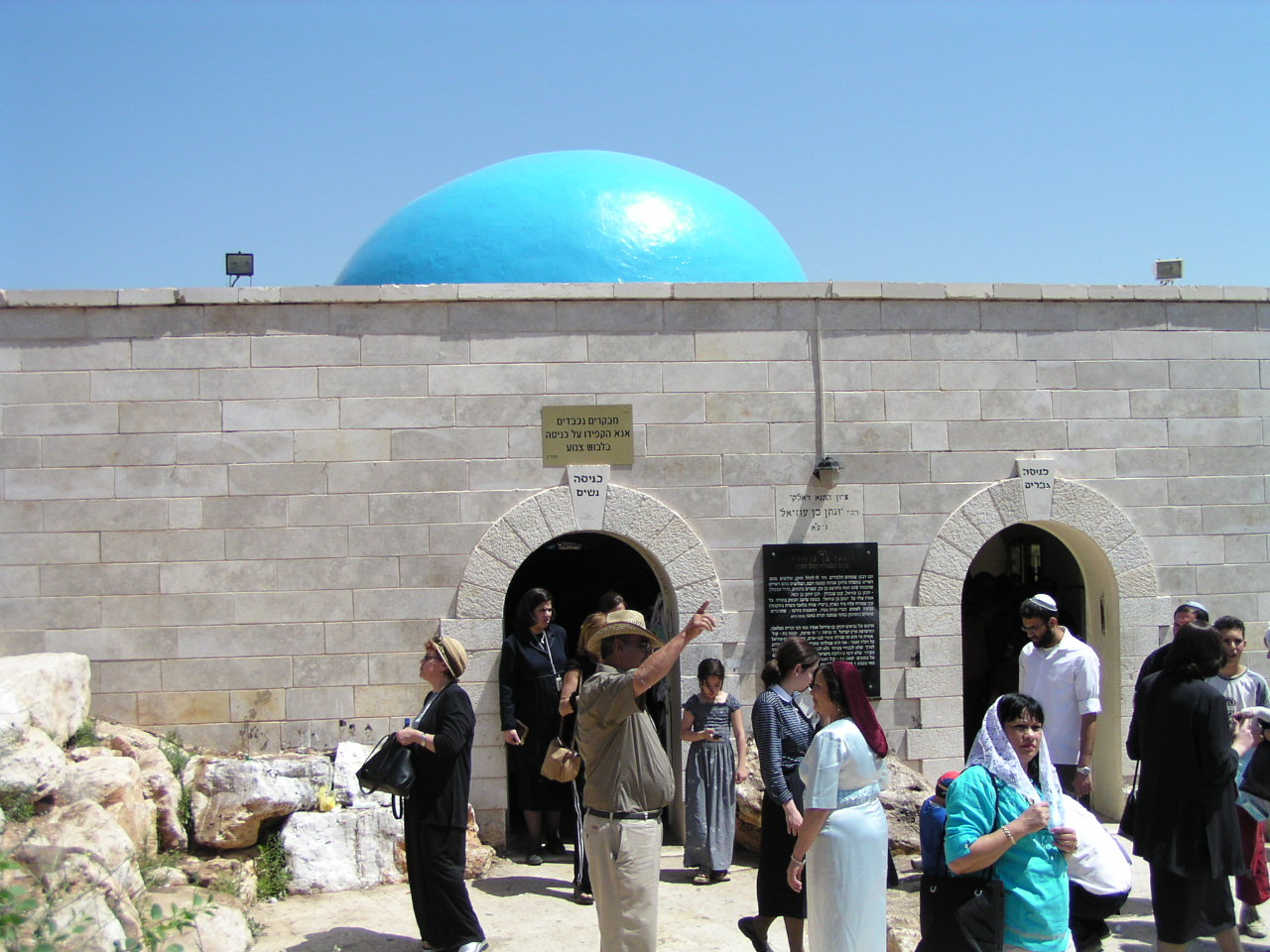
According to tradition, the tomb of ben Uzziel is located in Amuka, Galilee near Safed, Israel.
According to Zev Vilnai, Rabbi Shmuel ben Shimshon wrote about the tomb in 1210: "There is a large tree next to it, and the Ishmaelites [Arabs] bring oil and light a candle in his honor and make vows in his honor." An illustration of Yonatan ben Uzziel's tomb appears in "Ancestry of fathers and prophets" (Hebrew: יחוס אבות ונביאים), a book printed in 1537.
It is customary to visit ben Uzziel's tomb on Rosh Chodesh, the first day of the lunar month, and on 26 Sivan (the day on which he died), although visitors arrive all year round. A practice that began in the 17th century was to pray at the gravesite for a good marriage partner, for children, satisfaction from one's children, a good livelihood, health and happiness. Many unmarried men and women pray there for a match. Doing so is considered a segula (propitious remedy) for finding one's mate within the coming year.
Zev Vilnai offers two theories for this custom (these do not seem to be original theories, as they had been referenced in the Haredi community before he published them): (a) The practice developed from the Pseudo-Jonathan translation of the Bible on Deuteronomy 24:6, where he writes that anyone who prevents the connection between a husband and wife forfeits his portion in the world-to-come; (b) The practice is based on a mistaken reading of Rashi who writes in reference to a place called Harpania (Aramaic: הרפניא) "Everyone goes there: all ineligible men (pesulim) who cannot find a woman turn and go there. And it is deeper (Amuka) and worse than Gehinnom." The words "and it is deeper (Amuka)" are the headwords to Rashi's next comment, and do not relate to his preceding comment about men going to Harpania to look for women. However, the mistaken reading connects Rashi's words to the community named Amuka.
It is also widely believed that Jonathan ben Uzziel was single or childless, so men in similar situations seek to benefit from his special powers, but nowhere in the writings of Chazal is this stated.
References
References
- Sukkah 28a
- ''Sukkah'' 28a, ''Bava Batra'' 133b, ''Megillah'' 3a
- [[Babylonian Talmud]], ''Megillah'' 3a
- [https://www.chabad.org/library/article_cdo/aid/6917668/jewish/Why-No-Entry-for-26th-of-Sivan.htm Chabad Library Why-No-Entry-for-26th-of-Sivan]
- The Talmud relates that the great sage Hillel had 80 exceptional students. Thirty were so holy they merited divine revelation like Moses; 30 were as spiritually mighty as Joshua, who caused the sun to stand still; and 20 were in between. The greatest of them all was Yonatan ben Uziel. If even the “smallest” of Hillel’s 80 exceptional students—Rabban Yochanan ben Zakkai—knew every hidden secret of the Torah, imagine the greatness of Yonatan! So intense was his Torah study that birds flying overhead were consumed by the fiery holiness see [https://www.chabad.org/library/article_cdo/aid/6917668/jewish/Why-No-Entry-for-26th-of-Sivan.htm Chabad Library Why-No-Entry-for-26th-of-Sivan]
- [[Avot of Rabbi Natan]], 14
- [[Jerusalem Talmud]] (''Nedarim'' 5:6 [19b]).
- (18 June 2009). "The Mystical Power of Amuka". [[Hamodia]].
- "Holy Places in the Land of Israel" (Hebrew: מצבות קודש בארץ־ישראל)
- To [[Yevamot]] 17a s.v. "Shehakol ponim sham"
This article was imported from Wikipedia and is available under the Creative Commons Attribution-ShareAlike 4.0 License. Content has been adapted to SurfDoc format. Original contributors can be found on the article history page.
Ask Mako anything about Jonathan ben Uzziel — get instant answers, deeper analysis, and related topics.
Research with MakoFree with your Surf account
Create a free account to save articles, ask Mako questions, and organize your research.
Sign up freeThis content may have been generated or modified by AI. CloudSurf Software LLC is not responsible for the accuracy, completeness, or reliability of AI-generated content. Always verify important information from primary sources.
Report