From Surf Wiki (app.surf) — the open knowledge base
Jon Wiener
American historian and journalist (born 1944)

American historian and journalist (born 1944)
| Field | Value |
|---|---|
| name | Jon Wiener |
| image | Jon Wiener.jpg |
| birth_date | |
| birth_place | Saint Paul, Minnesota, U.S. |
| death_date | |
| alma_mater | Princeton University (BA) Harvard University (PhD) |
| occupation | Historian, |
| Political writer, | |
| Author | |
| years_active | 38+ |
| employer | University of California, Irvine |
| spouse | Judy Fiskin |
| website |
the American historian
Political writer, Author
Jon Wiener (born May 16, 1944) is an American historian and journalist based in Los Angeles, California. He waged a 25-year legal battle to win the release of the FBI's files on John Lennon. A professor emeritus of United States history at the University of California, Irvine and host of The Nations weekly podcast, Start Making Sense, he is also a contributing editor to the progressive political weekly magazine The Nation. He also hosts a weekly radio program in Los Angeles.
Set the Night on Fire (2020) is a movement history of Los Angeles. The backbone of the book is the story of the civil rights, Black power and Chicano movements, as well as the anti-war movement, gay liberation and women's liberation and the battles between young people and the LAPD on Sunset Strip and at Venice Beach. The counterculture provides another focus—the Ash Grove folk music club, the LA Free Press, KPFK radio and the Free Clinic.
Early life
Wiener was born in Saint Paul, Minnesota, He graduated from Central High School and then attended Princeton University where he founded a chapter of the Students for a Democratic Society to protest the Vietnam War. He received a bachelor's degree from Princeton in 1966, and earned a Ph.D. from Harvard, where he worked with Barrington Moore, Jr. and Michael Walzer, and also wrote for the underground paper The Old Mole.
Career
Academic career
At the University of California, Irvine, Wiener taught history courses on American politics and the Cold War. His scholarly works have been published in The American Historical Review, The Journal of American History, Radical History Review, and Past & Present. He led students on visits to the Nixon Library.
Journalism and political commentary
_with_film_director_and_comedian_John_Waters_after_the_political_podcast_Start_Making_Sense.jpg)
Since 1984, Wiener has been a contributing editor for The Nation magazine, Wiener hosted a weekly podcast for The Nation, “Start Making Sense,” and a weekly radio program for Los Angeles radio station KPFK 90.7 FM.
In his journalism, Wiener, writing in the Los Angeles Times at the beginning of 2020, correctly predicted that 2020 would be "The Worst Year of Trump’s Life." He interviewed Chinese dissident artist Ai Wei Wei about the international refugee crisis—the subject of Ai's film "Human Flow." He interviewed Georgia's voting rights organizer Stacey Abrams about her work. And he spoke with the award-winning novelist Margaret Atwood about “the shocking relevance of “The Handmaid’s Tale.” He also has written on historical topics – on the 50th anniversary of the My Lai Massacre, he wrote about the "forgotten hero" who "stopped the My Lai massacre," quoting from his interview for KPFK with army helicopter pilot Hugh Thompson. And he wrote for the New York Times Book Review about how the sixties are remembered in America. While Wiener is perhaps best known for his battling to expose the FBI's surveillance of John Lennon, he also was instrumental in getting the FBI to release documents about its surveillance of comedian Groucho Marx.
Wiener and the Lennon FBI files
| Dates | Event | Notes |
|---|---|---|
| 1969 | Lennon releases the single | |
| "Give Peace a Chance" | ||
| 1971–1972 | FBI closely monitors Lennon | |
| 1972-03-06 | INS tries to deport Lennon | |
| 1973-03 | Judge rules Lennon must leave | |
| US in two months | ||
| 1973-06 | Lennon countersues US | |
| 1976-06 | Lennon wins countersuit; | |
| can stay in US | ||
| 1980-12-10 | John Lennon murdered | |
| 1981 | Wiener researches book | |
| on Lennon | ||
| 1981 | Wiener requests documents | |
| Gets some, most held back | ||
| 1981 | Wiener sues FBI | |
| to release documents | ||
| 1983 | FBI claims national | |
| security danger | ||
| 1991 | 9th circuit court: FBI | |
| didn't show "adequate | ||
| grounds" for secrecy | ||
| 1992 | Justice Dept appeals | |
| 9th Circuit decision | ||
| to Supreme Court | ||
| 1992 | Court refuses appeal, | |
| sides with Wiener/ACLU | ||
| 1997 | FBI releases more documents | |
| except for ten documents | ||
| 2000 | Report: Lennon may have | |
| secretly funded IRA | ||
| says MI5 | ||
| doubted by Lennon supporters | ||
| 2004 | Federal judge orders | |
| remaining ten | ||
| documents released | ||
| 2004 | FBI agrees to release | |
| final 10 documents | ||
| 2006-12-20 | FBI releases final | |
| eight or ten documents | ||
| 2006 | The U.S. Versus John Lennon | |
| Documentary; Wiener is consultant | ||
| 2006-12-21 | Wiener discussed contents of | |
| declassified material on NPR |
Background


The legal battle between Wiener and the United States government was waged over two and a half decades, and has been examined by other historians. In the late sixties, many young Americans became opposed to the Vietnam War, and John Lennon became an antiwar advocate who made then-president Richard Nixon nervous about his reelection prospects in 1972. The consensus view is that Nixon asked the FBI to begin surveillance of Lennon, possibly after Lennon went to New York on a visa and met up with radical anti-war activists.
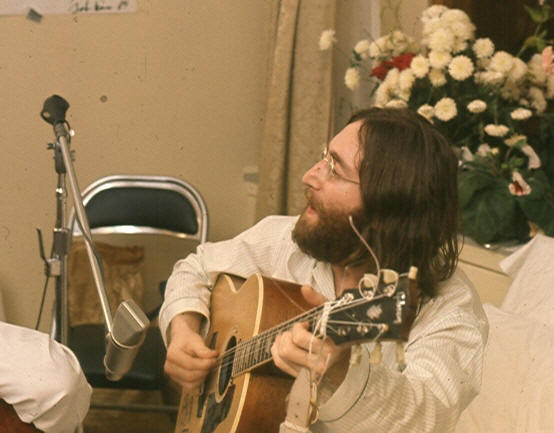
The attempt to deport Lennon
The Immigration and Naturalization Service, acting on a suggestion from Senator Strom Thurmond,
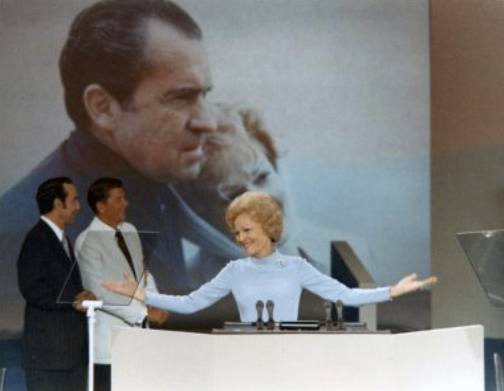
Reporter Adam Cohen writing in 2006 in The New York Times agreed that the FBI surveillance of Lennon had been motivated not only by antiwar concerns but by concerns of a political nature. According to Cohen, what was most revealing was that the timing of these events suggested there was an underlying political motivation behind the surveillance and deportation proceedings. wrote letters to the Immigration and Naturalization Service advocating that Lennon should be allowed to stay. According to Wiener, the FBI had succeeded in "neutralizing" Lennon's opposition to Nixon's reelection. John Lennon was murdered in December 1980.
Wiener vs. the FBI

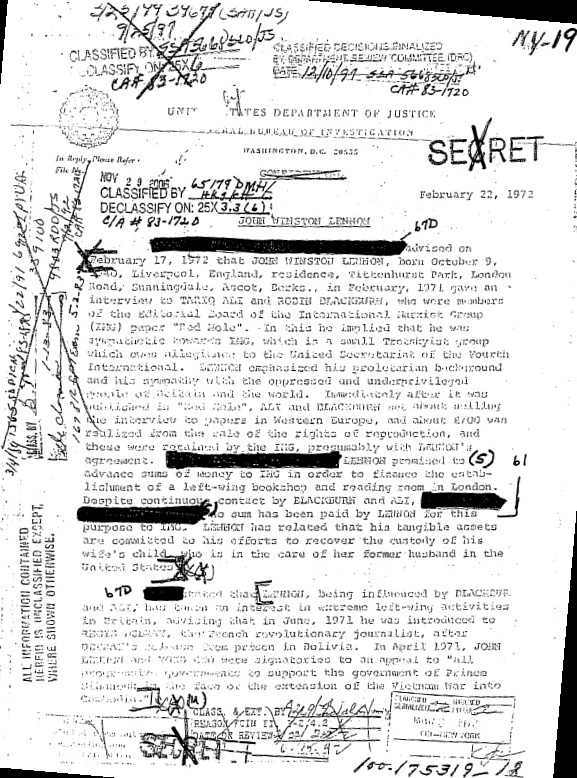
In 1981, while conducting research for a book about John Lennon, Wiener learned of the FBI surveillance, of the files on the grounds that they contained "national security" information. The pages that were released were heavily blacked out with magic marker, or redacted.
In 1983, Wiener sued the FBI under the Freedom of Information Act with assistance from the ACLU of Southern California, including attorneys Dan Marmalefsky of Morrison & Foerster and Mark Rosenbaum of the ACLU. In response, the FBI turned over some documents, but withheld others claiming they contained "national security information provided by a foreign government under an explicit promise of confidentiality" and added that releasing the documents could lead to "military retaliation against the United States."
Wiener chronicled much of his frustration with getting documents in his 1984 book Come Together including many "Orwellian moments" during the "tortoise-like progress" of the lawyers. As a result, the FBI had to keep filing affidavits which had "sufficient detail" which allowed Wiener to keep advocating for their release, and for judges to "intelligently judge" the contest, according to several reports. Then-Justice Department lawyer John Roberts, who later became Chief Justice of the Supreme Court, appealed the decision, but the Supreme Court declined to review it.
The case of Wiener v FBI escalated over many years. A settlement with the FBI was reached in 1997 According to Wiener, the ten pages revealed there had been contacts between Lennon and leftist and anti-war groups in London in the early 1970s but that there had been no signs that government officials saw Lennon as a serious threat, and only regarded solicitation of funds for a "left-wing bookshop and reading room in London" but that Lennon did not provide any funds for this purpose. Wiener wrote:

Wiener expressed amazement that so much of the information had been withheld:
Chronicling the case
Wiener wrote about his legal battles in his book, Gimme Some Truth: The John Lennon FBI Files, published by the University of California Press in 2000. The book includes copies of 100 key documents from the Lennon file, including "lengthy reports by confidential informants detailing the daily lives of anti-war activists, memos to the White House, transcripts of TV shows on which Lennon appeared, and a proposal that Lennon be arrested by local police on drug charges." He also wrote about the case and its significance for The Guardian, The Nation, the L.A. Times, and The New Republic.
Wiener's work provided the basis for the 2006 documentary The U.S. vs. John Lennon. Wiener served as a historical consultant to the production and also appears in the film. He also appears in the documentary LENNONYC, which aired on the PBS show "American Masters" in 2010. He was interviewed about the Lennon FBI Files by Terry Gross on the NPR program "Fresh Air." ACLU attorney Mark Rosenbaum said that the Wiener v FBI case revealed "government paranoia at a pathological level and an attempt to shield executive branch abuse of civil liberties under the rubric of national security."
Books
Wiener is the author of seven books. In addition to his co-authored 2020 book Set the Night on Fire: L.A. in the Sixties, Wiener also wrote Historians in Trouble: Plagiarism, Fraud and Power in the Ivory Tower. he examined various academic scandals and concluded that media spectacles end careers only when powerful, usually right-leaning external groups demand punishment. He also edited and wrote the introduction to Conspiracy in the Streets: The Extraordinary Trial of the Chicago Seven which included an abridged transcript of the 1968 Chicago Conspiracy trial; in that trial, Bobby Seale, Abbie Hoffman, Jerry Rubin, Dave Dellinger and others faced charges stemming from anti-war demonstrations at the Democratic National Convention, and witnesses included Timothy Leary, Norman Mailer, Arlo Guthrie, and Allen Ginsberg; the book includes an afterword by defendant Tom Hayden and drawings by Jules Feiffer. Wiener's earlier book How We Forgot the Cold War: A Historical Journey across America, based on his visits to Cold War monuments, museums, and memorials, emphasizes popular skepticism about America's victory.
Critical reaction
Reactions by critics to Wiener's writings has been varied. Kirkus Reviews called Set the Night on Fire: L.A. in the Sixties "a richly detailed portrait of a city that seethed with rebellious energy." The reviewer for the Los Angeles Times described it as "a dense, detailed read" that was “authoritative and impressive.” The LA Review of Books called it "a monumental history of rebellion and resistance." Some reviewers found problems with the book – Publishers Weekly said it was an "overstuffed and often disjointed account" but declared that "Davis and Wiener write with passion and deep knowledge,” and concluded that the book was “an indispensable portrait of an unexplored chapter in history." On April 22, 2020, in The Guardians Book of the Day, Ben Ehrenreich called it "a vital primer in resistance, a gift to the future from the past."
Among his earlier books, the New York Times Book Review wrote that Wiener's book Come Together: John Lennon in His Time "stands out as one of the few books that don't want to deify, dish the dirt about or otherwise exploit the slain former Beatle." A second review of this book criticized Wiener's perspective for being "tunnel-visioned". He has been criticized by Andrew Sullivan of The Atlantic. Wiener's Gimme Some Truth received positive reviews in The Washington Post, London Independent, and the Christian Science Monitor. A review of Wiener's book Historians in Trouble: Plagiarism, Fraud, and Politics in the Ivory Tower criticized Wiener for having a left-leaning bias. One reviewer described Wiener's Gimme Some Truth book as "sobering".
Selected bibliography
- Set the Night on Fire: L.A. in the Sixties, by Jon Wiener and Mike Davis, Verso (publisher), April 14, 2020,
- I Told You So: Gore Vidal Talks Politics—interviews with Gore Vidal
- How We Forgot the Cold War: A Historical Journey across America. Berkeley: University of California Press, 2012. .
- Conspiracy in the Streets: The Extraordinary Trial of the Chicago Seven. Edited with an introduction by Jon Wiener; afterword by Tom Hayden; drawings by Jules Feiffer. New York: The New Press, 2006.
- Historians in Trouble: Plagiarism, Fraud, and Politics in the Ivory Tower . New York: The New Press, 2005.
- Gimme Some Truth: The John Lennon FBI Files Berkeley: University of California Press, 2000.
- Professors, Politics and Pop. London and New York: Verso Books, 1991.
- Come Together: John Lennon in his Time New York: Random House, 1984.
- Social Origins of the New South: Alabama, 1865-1885. Baton Rouge: Louisiana State University Press, 1978.
- "The Footnote Fetish." Telos 31 (Spring 1977). New York: Telos Press.
References
References
- Note: estimate assumes began career at age 30
- Wiener, Jon. (May 21, 2012). "Jon Wiener". The Nation.
- (2020). "Set the Night on Fire: L.A. in the Sixties.". Verso.
- (2020-06-10). "Bestsellers List Sun., June 14, 2020".
- (December 21, 2006). "FBI releases final file on John Lennon". USA Today.
- Wiener, Jon. (February 25, 2000). "John Lennon's MI5-FBI Files". Common Dreams.
- "Emeriti Faculty".
- (April 2, 2010). "Jon Wiener".
- (October 22, 2015). "Start Making Sense".
- (September 2, 2023). "Living In The USA".
- Anna Windemuth. (November 18, 2016). "Princeton students stage sanctuary campus walk-out".
- (Spring 1989). "The Scholar Squirrels and the National Security State: An Interview with Gore Vidal -- Jon Wiener". Radical History Review.
- Nagourney, Adam. (August 6, 2010). "Watergate Becomes Sore Point at Nixon Library". The New York Times.
- William M. Welch. (April 1, 2011). "Nixon library now tells full Watergate story". USA Today.
- Nagourney, Adam. (September 12, 2011). "What's a Presidential Library to Do?". The New York Times.
- Welch, Matt. (September 9, 2011). "In fact, on Dec. 7, 1951, Pearl Harbor wasn't remembered". Reason Magazine.
- Wiener, Jon. (January 25, 2012). "When art and politics collided in L.A.: The Tower of Protest, being rebuilt as part of Pacific Standard Time, incited passion and vandalism for a few months in 1966.". Los Angeles Times.
- Jon Wiener (book reviewer). (January 13, 2002). "Survival During a Dark Time (book review title) A Holocaust Girlhood Remembered, By Ruth Kluger (book and author being reviewed)". Los Angeles Times.
- (2020-01-01). "Opinion: 2020 will be the worst year of Trump's life".
- Wiener, Jon. (2017-10-13). "Ai Weiwei on the Refugee Crisis: 'People Have Been Forced Into a State of Movement'". The Nation.
- Wiener, Jon. (2019-04-05). "Stacey Abrams: 'Open That Door'". The Nation.
- Wiener, Jon. (2017-04-28). "Margaret Atwood: The Shocking Relevance of 'The Handmaid's Tale'". The Nation.
- (2018-03-16). "Op-Ed: A forgotten hero stopped the My Lai massacre 50 years ago today".
- Wiener, Jon. (2016-06-08). "'Witness to the Revolution,' by Clara Bingham". The New York Times.
- Smith, Dinitia. (September 14, 1998). "Would Groucho Have Joined a Party That Would Have Him as a Member?". The New York Times.
- Tribune News Services. (September 14, 1998). "Groucho Marx Was On Fbi's Watch List". Chicago Tribune.
- (October 8, 2010). "Uncovering The 'Truth' Behind Lennon's FBI Files". NPR.
- Wiener, Jon. (1999). "Gimme Some Truth: The John Lennon FBI Files". University of California Press, Berkeley.
- Note: the month is uncertain but the year 1973 is probably right.
- Amy Goodman (interviewer) Jon Wiener (interviewee). (May 25, 2000). "Gimme Some Truth: The FBI Files of John Lennon". Democracy Now!.
- Bright, Martin. (February 19, 2000). "Lennon aided IRA, claims MI5 renegade". The Guardian.
- (December 21, 2006). "FBI Releases Its Final Files on John Lennon". NPR.
- Friedman (editor), John S.. (October 2005). "The Secret Histories: Hidden Truths That Challenged the Past and Changed the World". MacMillan.
- Robert Scheer (interviewer) Jon Wiener (interviewee). (Sep 12, 2006). "Jon Wiener on John Lennon (interview)". truthdig.
- Wiener, Jon. (December 18, 2006). "He didn't have to do it. That's one reason he's still admired". The Guardian.
- Wiener, Jon. (18 December 2006). "He didn't have to do it. That's one reason he's still admired: The FBI campaign against John Lennon shows how far the state can go to deal with stars who refuse to toe the line". The Guardian.
- Cohen, Adam. (September 21, 2006). "While Nixon Campaigned, the F.B.I. Watched John Lennon". The New York Times.
- Wiener, Jon. (October 9, 2010). "Bob Dylan's Defense of John Lennon". Common Dreams.
- FBI. (1999). "Gimme Some Truth: The John Lennon FBI Files". University of California Press, Berkeley.
- Wiener, Jon. (1999). "Gimme Some Truth: The John Lennon FBI Files". University of California Press, Berkeley.
- Margolick, David. (September 6, 1981). "Seeing F.B.I. Files on Lennon: A Hard Day's Night". The New York Times.
- Weinstein, Henry. (December 20, 2006). "FBI to release last of its John Lennon files". The Los Angeles Times.
- Weinstein, Henry. (December 20, 2006). "FBI to Release Last of Its John Lennon Files: The U.S. had said such an act could stir military retaliation. The papers, withheld 25 years, don't seem to bear that out.". Common Dreams.
- Weinstein, Henry. (December 20, 2006). "FBI to release last of its John Lennon files: The U.S. had said such an act could stir military retaliation. The papers, withheld 25 years, don't seem to bear that out.". Los Angeles Times.
- Harrington, Richard. (October 1, 2006). "Missing Peace: John Lennon's Legal Battles With the U.S.". Washington Post.
- FBI. (1999). "Gimme Some Truth: The John Lennon FBI Files". University of California Press, Berkeley.
- (1999). "Gimme Some Truth: The John Lennon FBI Files". University of California Press.
- FBI. (1999). "Gimme Some Truth: The John Lennon FBI Files". University of California Press, Berkeley.
- "The U.S. vs. John Lennon".
- Cohen, Adam. (September 21, 2006). "While Nixon Campaigned, the F.B.I. Watched John Lennon". The New York Times.
- "LENNONYC".
- TOM ZELLER JR.. (December 20, 2006). "Has Stephen Colbert Been Hiding John Lennon's F.B.I. Legacy?". The New York Times.
- (2005). "Historians in Trouble: Plagiarism, Fraud and Power in the Ivory Tower". New Press.
- Leonard, John. (January 2005). "New Books". Harper's Foundation.
- (2006). "Conspiracy in the Streets: The Extraordinary Trial of the Chicago Eight". The New Press.
- (October 15, 2012). "How We Forgot the Cold War: A Historical Journey across America". University of California Press.
- Hilburn, Robert. (May 26, 1985). "Nonfiction". The Los Angeles Times.
- Harris, John. (December 21, 2006). "Who'd be a Lennonist?". The Guardian.
- Gillette, Felix. (February 10, 2005). "In the Tower With the Tenure-Benders". New York Sun.
- Holden, Steven. (November 25, 1984). "Review of Come Together". New York Times Book Review.
- "SET THE NIGHT ON FIRE | Kirkus Reviews".
- (2020-04-13). "Review: How L.A.'s '60s movements fought for justice — and sometimes even achieved it".
- (April 14, 2020). "Set the Night on Fire".
- "Set the Night on Fire: L.A. in the Sixties".
- Ehrenreich, Ben. (April 22, 2020). "Set the Night on Fire by Mike Davis and Jon Wiener review – the real LA in the 1960s".
- Hilburn, Robert. (May 26, 1985). "Nonfiction". Los Angeles Times.
- Sullivan, Andrew. (October 28, 2002). "The Daily Dish". The Atlantic.
- Gillette, Felix. (February 10, 2005). "In the Tower With the Tenure-Benders (title of review) Historians in Trouble: Plagiarism, Fraud, and Politics in the Ivory Tower by Jon Wiener (title and author of book being reviewed)". The New York Sun.
- J.F.K.. (November 1999). "Media Jones: Pacifism Rocks!". Mother Jones.
- Chilton, Martin. (19 Nov 2012). "I Told You So, Gore Vidal Talks Politics: review -- A new book of four interviews with Gore Vidal highlight his controversial views on Lincoln and Roosevelt - and include a witty tale of taking the mickey out of President Kennedy.". The Telegraph.
- Kammen, Michael. (November 6, 2012). "I Told You So: Gore Vidal Talks Politics. Interviews with Jon Wiener". Los Angeles Review of Books.
- (April 26, 2020). "Set the Night on Fire by Mike Davis and Jon Wiener – review".
- "Set the Night on Fire".
This article was imported from Wikipedia and is available under the Creative Commons Attribution-ShareAlike 4.0 License. Content has been adapted to SurfDoc format. Original contributors can be found on the article history page.
Ask Mako anything about Jon Wiener — get instant answers, deeper analysis, and related topics.
Research with MakoFree with your Surf account
Create a free account to save articles, ask Mako questions, and organize your research.
Sign up freeThis content may have been generated or modified by AI. CloudSurf Software LLC is not responsible for the accuracy, completeness, or reliability of AI-generated content. Always verify important information from primary sources.
Report