From Surf Wiki (app.surf) — the open knowledge base
Johnny Paycheck
American country singer (1938–2003)

American country singer (1938–2003)
| Field | Value | |
|---|---|---|
| name | Johnny Paycheck | |
| image | Johnny Paycheck - 1975.png | |
| caption | Paycheck in 1975 | |
| birth_name | Donald Eugene Lytle | |
| alias | Donny Young | |
| birth_date | ||
| birth_place | Greenfield, Ohio, U.S. | |
| death_date | ||
| death_place | Nashville, Tennessee, U.S. | |
| genre | {{flatlist | |
| occupation | {{flatlist | |
| years_active | 1953–2002 | |
| label | {{flatlist | |
| discography | Discography |
- Country
- outlaw country
- honky-tonk}}
- Singer
- songwriter
- Little Darlin'
- Certron
- Epic
- Sony
Johnny Paycheck (born Donald Eugene Lytle; May 31, 1938 – February 19, 2003) was an American country music singer and songwriter. He is a notable figure in the outlaw movement in country music.
Rising from humble beginnings in Greenfield, Ohio, Paycheck began performing in his teens and gained early recognition as a session musician and harmony vocalist for stars such as Ray Price, George Jones, and Faron Young. Adopting the stage name Johnny Paycheck in the mid-1960s, he scored several hits throughout the next decades, most notably "She's All I Got" in 1971.
Paycheck reached the peak of his fame with the 1977 blue-collar anthem "Take This Job and Shove It," written by David Allan Coe, which became a cultural phenomenon and helped solidify Paycheck's status as a defining figure of outlaw country alongside Waylon Jennings, Willie Nelson, and Merle Haggard. His career, however, was marked as much by turmoil as triumph, as he struggled with substance abuse, alcohol, spent time in prison, and was involved in multiple legal controversies, including a conviction for assault and a high-profile sexual misconduct case.
Despite these setbacks, Paycheck's legacy endures through his raw and uncompromising music, which continues to resonate with fans of traditional and outlaw country. A member of the Grand Ole Opry and the subject of tribute albums and documentaries, Paycheck remained active into the early 2000s before health complications, including emphysema and asthma, led to his death in 2003. His life and work have been recognized as emblematic of both the rebellion and the heartbreak that defined a pivotal era in American country music.
Early life
Paycheck was born Donald Eugene Lytle on May 31, 1938 to Chester Eugene Lytle (1915–1988) and Chloie Mae Woodland (1919–2000) in his parents' home in Higginsville, a working class neighborhood of Greenfield, Ohio, . He began playing guitar at age six after receiving one from his mother. He began performing in talent shows by the age of nine and was performing professionally by age 15 while riding the rails as a drifter. He often used the stage name "Ohio Kid" when he played in bars and clubs.
After dropping out of junior high school, Paycheck joined the United States Navy in the 1950s but was court-martialed and served two years in military prison for assaulting a superior officer.
Career
Following Paycheck's discharge, he moved to Nashville and performed under the names Donny Young and Donald Young while working as a tenor harmony singer for artists like Porter Wagoner, Ray Price, Faron Young, and especially George Jones, with whom he developed a long-lasting rapport. In 1958, he released his debut single, "It's Been a Long, Long Time for Me," under Decca Records. In 1959, he made his debut on the Grand Ole Opry, with his single "Old Man and the River" alongside performing with artists like George Morgan, Bill Anderson, Eddie Noack, Roger Miller, and Roy Wiggins. One year later, in 1960, he reached top-35 status in Cashbox magazine's country charts, with the tune "Miracle of Love." An ad for the Grand Ole Opry in 1964 referred to Paycheck, still referred to as Donny Young, as "the nations newest singing sensation."
Under the mentorship of producer Buddy Killen, Paycheck recorded for Decca Records and Mercury Records before joining George Jones' band, where he played bass, steel guitar, and sang high harmony on at least 15 of Jones' albums, including hits like "The Race Is On" and "Love Bug." He later co-wrote Jones's hit song "Once You've Had the Best." The volatile, alcohol- and drug-fueled partnership between the two was both fruitful and tumultuous, and Paycheck's vocal influence on Jones—and later Merle Haggard—went uncredited for many years.
In 1964, he changed his name legally to Johnny Paycheck, taking the name from Johnny Paychek, a top-ranked boxer from Chicago who once fought Joe Louis for the heavyweight title (and not directly as a humorous alternative to Johnny Cash, as is commonly believed). Working with producer Aubrey Mayhew, Paycheck signed to Little Darlin' Records. His early records being stylistic experiments and were among the most ambitious and emotionally raw entries during the period of country music. That same year, he scored a Grammy-nominated hit with "A-11," written by Hank Cochran. He followed this success with a string of charting singles including "The Lovin' Machine" in 1966 and "Jukebox Charlie" in 1967. From the early to mid 1960s, he also enjoyed some success as a songwriter for others, with his biggest songwriting hit being "Apartment No. 9", which served as Tammy Wynette's first chart hit in December 1966. By the late 1960s, however, Paycheck's career faltered. After Little Darlin' folded at the end of the 1960s, Paycheck struggled with substance and alcohol abuse and homelessness as he drifted through Los Angeles, playing in dive bars and becoming addicted to heroin.
Paycheck's career was revived in 1971 when Billy Sherrill, an executive and producer at Epic Records, offered to work with Paycheck if he could get clean. As a result, Sherrill and Paycheck released "She's All I Got," which reached number two on the Billboard Hot Country Songs chart and was his only single to ever make it to the Billboard Hot 100. Throughout the 1970s, Paycheck had a steady stream of hits including "Someone to Give My Love To," "Slide Off of Your Satin Sheets," "Song and Dance Man," and "I'm the Only Hell (Mama Ever Raised)." After his success faltered after the release of Loving You Beats All I've Ever Seen in 1975, Paycheck released 11 Months and 29 Days which showcased his transition to outlaw country. In 1977, Paycheck recorded "Take This Job and Shove It," written by David Allan Coe. The blue-collar anthem became Paycheck's biggest success, selling over two million copies and inspiring a film of the same name.
Many of Paycheck's songs during this period acted as exaggerated reflections of his outlaw lifestyle, as seen in titles like "Me and the I.R.S." and "D.O.A. (Drunk on Arrival)." However, his behavior continued to spiral. In 1981, he was again in prison with the stint causing him to miss out on recording the George Strait hit "Unwound", which was initially intended for Paycheck. He was sued for slander by a flight attendant after a mid-air altercation, saddled with a paternity suit, tax issues, and eventually dropped by Epic Records in 1982 after facing sexual assault charges that were later reduced.
After leaving Epic, Paycheck signed with AMI and scored several minor hits between 1984 and 1986. The most successful of Paycheck's later singles, released during his appeal, was "Old Violin" for Mercury Records, which reached number 21 on the country chart in 1986. His last album to chart was Modern Times in 1987. He continued to release albums, the last of which, I'm a Survivor, appeared in 1996 and featured recordings of songs from the mid-1980s. The last release during his lifetime was Remembering, a compilation album in 2002. He continued to perform and tour until the late 1990s.
After prison, Paycheck resumed touring with dates in Branson, Missouri, and recorded for Playback Records. In 1996, the Country Music Foundation issued a retrospective of his Little Darlin' years, which found renewed interest among younger classic-country fans. He also recorded a live album at Gilley's in 1999, released on Atlantic Records. Shortly before his retirement, in 1997, he was inducted into the Grand Ole Opry; in a rare exception to protocol, Opry general manager Bob Whittaker personally invited Paycheck to join instead of having another member do the invitation.
In 1998, Paycheck was airlifted to a hospital in Albuquerque, New Mexico after a severe asthma attack. Around that time, he had signed with Lucky Dog Records, a Sony Music Nashville imprint, with Blake Chancey scheduled to produce a comeback album, but it was ultimately shelved due to Paycheck's deteriorating health.
Record companies
With his producer, Aubrey Mayhew, Paycheck co-owned his Little Darlin' Records. Paycheck's recordings by Little Darlin' featured the pedal steel guitar work of Lloyd Green. By the end of the 1960s, Little Darlin' Records folded. Mayhew and Paycheck soon created Certron Records, a newly formed recording company owned by Certron (a manufacturer of audio and video tape). The label was able to sign Bobby Helms, Ronnie Dove, Clint Eastwood, Pozo-Seco Singers (as Pozo Seco), and Paycheck. After the move to Certron, the label was unable to make a profit and closed by 1972. In the late 1990s, after decades ignored, Little Darlin' recordings received recognition by country music historians for their distinctive and sharp-edged sound, considered unique in their time—Paycheck's in particular.
Personal life
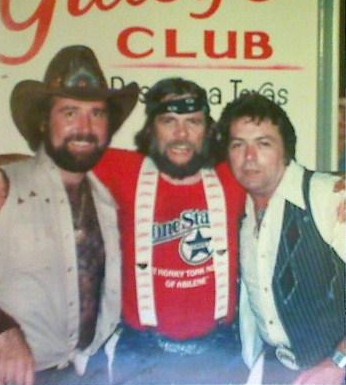
Paycheck was married for over 30 years to his wife Sharon Rae and they had one son, Jonathan.
In Paycheck's hometown of Greenfield, he was a polarizing figure. Some residents admired his success and supported him unconditionally, while others criticized his repeated run-ins with the law. According to Roger Ross, editor of The Greenfield Daily Times and a longtime friend, Paycheck was deeply generous, often returning home to perform benefit shows for children's charities and local causes. Though he cultivated an outlaw image, with bandanas, scruffy clothes, and hard-living lyrics, those close to him insisted that his off-stage persona was more caring and down-to-earth.
Legal troubles
In 1956, Paycheck was court-martialed for assaulting a naval officer and fracturing his skull. While under arraignment, he escaped twice. Paycheck was found guilty and sentenced to 18 years at Portsmouth Naval Prison, but was released from prison in 1959 after having his sentence reduced on appeal.
In 1981, Paycheck was arrested on accusations of statutory rape of a 12-year-old girl in Wyoming. Members of Paycheck's band told police that the singer had numerous problems with allegations because of his celebrity status. He was released on bond. In 1982, he pled no contest to continue his touring and not go to trial. The prosecution's witnesses were reluctant to testify. and received a $1,000 fine. A $3 million civil suit resulted from the incident, but the case never made it to a court.
In December 1985, Paycheck was convicted and sentenced to seven years in jail for shooting a man at the North High Lounge in Hillsboro, Ohio;
In 1990, he filed for bankruptcy after tax problems with the Internal Revenue Service, including a $300,000 lien.
Health issues and death
Although Paycheck was addicted to drugs including alcohol during his career, he later was said to have "put his life in order" after his prison stay.
After 2000, his health would only allow for short appearances. Developing emphysema and asthma
He was buried in Woodlawn Memorial Park in Nashville; reportedly, the plot was paid for by George Jones. Among the roughly 200 attendees at Paycheck’s memorial were Jones, Little Jimmy Dickens, and a sizable contingent of Hell's Angels, admirers of the hard-living Paycheck. "By and large, it was the roughest-looking funeral crowd I have ever seen," a Nashville Skyline columnist wrote in CMT.
Legacy
A tribute album, Touch My Heart: a Tribute to Johnny Paycheck, was released in 2004 on the Sugar Hill Label. Produced by Robbie Fulks, the album features George Jones, Marshall Crenshaw, Hank Williams III, Al Anderson, Dallas Wayne, Neko Case, Gail Davies, and Fulks himself, covering some of Paycheck's best-known songs. In his song "Grand Ole Opry (Ain't So Grand Anymore)", Hank Williams III praises Paycheck (along with Waylon Jennings, Johnny Cash, and Hank Williams Jr.) as a "real rebel" the Grand Ole Opry only reluctantly inducted.
His song "It Won't Be Long (And I'll Be Hating You)" appears in the open-world action-adventure video game Grand Theft Auto V.
His song "(Pardon Me) I've Got Someone to Kill" is covered on the album All the Way by Diamanda Galás.
An episode of Mike Judge Presents: Tales from the Tour Bus features an account of Paycheck's life and rise to fame during the outlaw country movement.
Discography
Main article: Johnny Paycheck discography
- At Carnegie Hall (1966)
- The Lovin' Machine (1966)
- Gospeltime in My Fashion (1967)
- Jukebox Charlie (1967)
- Country Soul (1968)
- Wherever You Are (1969)
- Again (1970)
- She's All I Got (1971)
- Someone to Give My Love To (1972)
- Somebody Loves Me (1972)
- Heartbreak, Tenn. (1972)
- Mr. Lovemaker (1973)
- Song and Dance Man (1973)
- Loving You Beats All I've Ever Seen (1975)
- 11 Months and 29 Days (1976)
- Slide Off of Your Satin Sheets (1977)
- Take This Job and Shove It (1977)
- Armed and Crazy (1978)
- Bars - Booze - Blondes (1979)
- Everybody's Got a Family... Meet Mine (1979)
- Double Trouble (with George Jones) (1980)
- Mr. Hag Told My Story (1981)
- Lovers and Losers (1982)
- I Don't Need To Know That Right Now (1983)
- Modern Times (1987)
- Outlaw at the Cross (1988)
- The Last Outlaw (1991)
- The Difference in Me (1992)
- Tribute to George Jones (1996)
- I'm a Survivor (1996)
- Studio 102 Essentials (2008)
References
References
- Cooper, Daniel. (1998). ''The Encyclopedia of Country Music''. Paul Kingsbury, Editor. New York: Oxford University Press. p. 408.
- (May 31, 1938). "Introducing". Greenfield Daily Times.
- Batz, Bob. (January 25, 1986). "In Greenfield, they'll take this guy and love it...Johnny Paycheck". [[Dayton Daily News.
- Cackett, Alan. "Johnny Paycheck". Alan Cackett.
- (February 20, 2003). "Johnny Paycheck Dead At Age 64".
- (August 29, 1975). "Johnny Paycheck adds new feel to 1970's country music scene". Marshall County Tribune-Courier.
- Carroll, Les. (December 11, 1958). "Other Fine Releases". The Bedford Bulletin.
- (May 7, 1959). "Year's Biggest "In Person" Show Direct From Nashville, Tenn". The Herington Times.
- (April 26, 1964). "Brightest Stars of Grand Ole Opry". [[The Forum of Fargo-Moorhead.
- (February 21, 2003). "Obituary: 'Johnny Paycheck: Hell-raising country singer'". independent.co.uk.
- Whiteside, Jonny. (June 11, 1991). "Hank to Thank, Johnny Paycheck's Return". [[LA Weekly]].
- Billboard Staff. (March 27, 2002). "New Compilation Pays Homage To Johnny Paycheck".
- Burditt, Peter. (April 23, 2025). "On This Day in 1981, George Strait Released His First Major Hit—a Song Originally Intended for Johnny Paycheck". [[American Songwriter]].
- (January 19, 1998). "Grand Ole Opry now in its 72nd year".
- (May 26, 2010). "Certron Album Discography".
- Gerome, John. (February 20, 2003). "Singer-Songwriter Johnny Paycheck Dies at 64". The Washington Post.
- Ratliff, Ben. (2003-02-20). "Johnny Paycheck Dies at 64; Hard-Living Country Singer". The New York Times.
- "Singer Johnny Paycheck faces extradition for sex with minor". [[United Press International]].
- "Singer pleads no contest to sexual assault charge". United Press International.
- Dennis, Paul W.. (March 4, 2010). "Forgotten Artists: Donald Lytle, aka Donny Young".
- (February 19, 2003). "Country singer Johnny Paycheck dead at 64".
- Ratliff, Ben. (2003-02-20). "Johnny Paycheck Dies at 64; Hard-Living Country Singer". The New York Times.
- (13 December 2022). "Will the Real Mr. Heartache Please Stand Up and Cry?". Oxford American.
- Flanagan, Andrew. (2013-08-27). "'Grand Theft Auto V' Soundtrack Leaks After U.K. Pre-Loads, Features METZ, Kendrick Lamar, Elton John".
This article was imported from Wikipedia and is available under the Creative Commons Attribution-ShareAlike 4.0 License. Content has been adapted to SurfDoc format. Original contributors can be found on the article history page.
Ask Mako anything about Johnny Paycheck — get instant answers, deeper analysis, and related topics.
Research with MakoFree with your Surf account
Create a free account to save articles, ask Mako questions, and organize your research.
Sign up freeThis content may have been generated or modified by AI. CloudSurf Software LLC is not responsible for the accuracy, completeness, or reliability of AI-generated content. Always verify important information from primary sources.
Report