From Surf Wiki (app.surf) — the open knowledge base
John the Apostle
Apostle of Jesus, saint (c. 6 – c. 100)

Apostle of Jesus, saint (c. 6 – c. 100)
| Field | Value |
|---|---|
| honorific_prefix | Saint |
| name | John the Apostle |
| image | Rubens_apostel_johannes_grt.jpg |
| caption | The Apostle Saint John Evangelist by Peter Paul Rubens (c. 1611) |
| birth_date | |
| birth_place | Bethsaida, Galilee, Roman Empire |
| death_date | (aged 93) |
| death_place | place unknown, probably Ephesus, Roman Empire |
| titles | Apostle, Evangelist and Theologian |
| feast_day | 27 December (Roman Catholic, Anglican) |
| 26 September (Eastern Orthodox) | |
| venerated_in | All Christian denominations which venerate saints |
| Islam (named as one of the disciples of Jesus) | |
| Druze faith | |
| canonized_date | Pre-congregation |
| attributes | Eagle, gospel, serpent in a chalice, cauldron |
| patronage | Love, loyalty, friendships, authors, booksellers, burn-victims, poison-victims, art-dealers, editors, publishers, scribes, examinations, scholars, theologians, Asia Minor, against jealousy and envy |
| influences | Jesus |
| influenced | Ignatius of Antioch, Polycarp, Papias of Hierapolis, Odes of Solomon |
26 September (Eastern Orthodox) Islam (named as one of the disciples of Jesus) Druze faith John the Apostle (; ; ), also known as Saint John the Beloved and, in Eastern Orthodox Christianity, Saint John the Theologian, was one of the Twelve Apostles of Jesus according to the New Testament. Generally listed as the youngest apostle, he was the son of Zebedee and Salome. His brother James was another of the Twelve Apostles. The Church Fathers identify him as John the Evangelist, John of Patmos, John the Elder, and the Beloved Disciple, and claim that he outlived the remaining apostles and was the only one to die of natural causes, although modern scholars are divided on the veracity of these claims.
John the Apostle is traditionally held to be the author of the Gospel of John, and many Christian denominations believe that he authored several other books of the New Testament (the three Johannine epistles and the Book of Revelation, together with the Gospel of John, are called the Johannine works), depending on whether he is distinguished from, or identified with, John the Evangelist, John the Elder, and John of Patmos.
Although the authorship of the Johannine works has traditionally been attributed to John the Apostle, only a minority of contemporary scholars believe he wrote the gospel, and most conclude that he wrote none of them. Regardless of whether or not John the Apostle wrote any of the Johannine works, most scholars agree that all three epistles were written by the same author and that the epistles did not have the same author as the Book of Revelation, although there is widespread disagreement among scholars as to whether the author of the epistles was different from that of the gospel.
References to John in the New Testament

John the Apostle was born into a family of Jewish fishermen on the Sea of Galilee. He was the son of Zebedee and the younger brother of James the Great. According to church tradition, their mother was Salome. Also according to some traditions, Salome was the sister of Mary, Jesus' mother, making Salome Jesus' aunt, and her sons John the Apostle and James were Jesus' cousins.
John the Apostle is traditionally believed to be one of two disciples (the other being Andrew) recounted in , who upon hearing the Baptist point out Jesus as the "Lamb of God", followed Jesus and spent the day with him, thus becoming the first two disciples called by Jesus. On this basis some traditions believe that John was first a disciple of John the Baptist, even though he is not named in this episode.
According to the Synoptic Gospels (Matt 4:18–22; Mark 1:16–20; Luke 5:1–11), Zebedee and his sons fished in the Sea of Galilee. Jesus then called Peter, Andrew and the two sons of Zebedee to follow him. James and John are listed among the Twelve Apostles. Jesus referred to the pair as "Boanerges" (translated "sons of thunder"). A Gospel story relates how the brothers wanted to call down heavenly fire on an unhospitable Samaritan town, but Jesus rebuked them. John was also the disciple who reported to Jesus that they had 'forbidden' a non-disciple from casting out demons in Jesus' name, prompting Jesus to state that 'he who is not against us is on our side'.
John is traditionally believed to have lived on for more than fifty years after the martyrdom of his brother James, who became the first Apostle to die a martyr's death in AD 44.
Position among the apostles
_-_WGA7025.jpg)
John is always mentioned in the group of the first four apostles in the Gospels and in the Book of Acts, listed either second, third or fourth.
John, along with his brother James and Peter, formed an informal triumvirate among the Twelve Apostles in the Gospels. Jesus allowed them to be the only apostles present at three particular occasions during his public ministry, the Raising of Jairus' daughter, Transfiguration of Jesus and Agony in the Garden of Gethsemane.
Jesus sent only Peter and John into the city to make the preparation for the final Passover meal (the Last Supper).
Many traditions identify the "disciple whom Jesus loved" in the Gospel of John as the Apostle John, but this identification is debated. At the meal itself, the "disciple whom Jesus loved" sat next to Jesus. It was customary to recline on couches at meals, and this disciple leaned on Jesus. Tradition identifies this disciple as John.
After the arrest of Jesus in the Garden of Gethsemane, only Peter and the "other disciple" (according to tradition, John) followed him into the palace of the high-priest. Peter and John were also the only two apostles who ran to the empty tomb after Mary Magdalene bore witness to the resurrection of Jesus.
After Jesus' Ascension and the descent of the Holy Spirit at Pentecost, John, together with Peter, took a prominent part in the founding and guidance of the church. He was with Peter at the healing of the lame man at Solomon's Porch in the Temple and he was also thrown into prison with Peter. Later, only Peter and John went to visit the newly converted believers in Samaria.
While he remained in Judea and the surrounding area, the other disciples returned to Jerusalem for the Apostolic Council (). Paul, in opposing his enemies in Galatia, explicitly recalled that John, along with Peter and James the Just, were collectively recognized as the three Pillars of the Church. He also referred to the recognition that his Apostolic preaching of a gospel free from Jewish Law was received from these three, the most prominent men of the messianic community at Jerusalem.
The disciple whom Jesus loved
Main article: Disciple whom Jesus loved
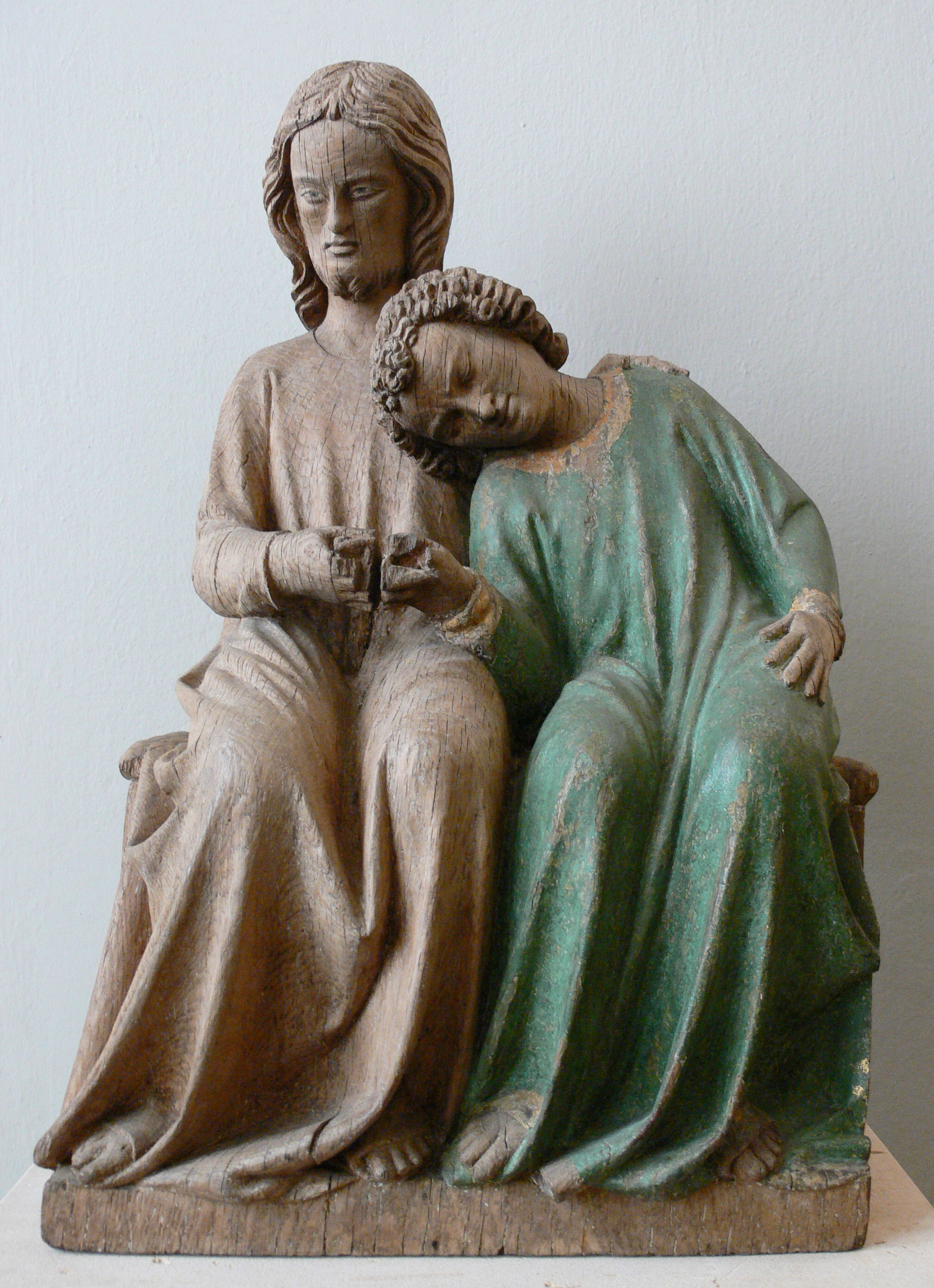
The phrase "the disciple whom Jesus loved" (ὁ μαθητὴς ὃν ἠγάπα ὁ Ἰησοῦς, el), or in John 20:2; "whom Jesus loved" (ὃν ἐφίλει ὁ Ἰησοῦς, el), is used six times in the Gospel of John, but in no other New Testament accounts of Jesus. claims that the Gospel of John is based on the written testimony of this disciple.
The disciple whom Jesus loved is specifically referred to six times in the Gospel of John:
- It is this disciple who, while reclining beside Jesus at the Last Supper, asks Jesus, after being requested by Peter to do so, who it is that will betray him.
- Later at the crucifixion, Jesus tells his mother, "Woman, here is your son", and to the Beloved Disciple he says, "Here is your mother."
- When Mary Magdalene discovers the empty tomb, she runs to tell the Beloved Disciple and Peter. The two men rush to the empty tomb and the Beloved Disciple is the first to reach the empty tomb. However, Peter is the first to enter.
- In John 21, the last chapter of the Gospel of John, the Beloved Disciple is one of seven fishermen involved in the miraculous catch of 153 fish.
- Also in the book's final chapter, after Jesus hints to Peter how Peter will die, Peter sees the Beloved Disciple following them and asks, "What about him?" Jesus answers, "If I want him to remain until I come, what is that to you? You follow Me!"
- Again in the Gospel's last chapter, it states that the very book itself is based on the written testimony of the disciple whom Jesus loved.
None of the other Gospels includes anyone in the parallel scenes that could be directly understood as the Beloved Disciple. For example, in , Peter alone runs to the tomb. Mark, Matthew and Luke do not mention any one of the twelve disciples having witnessed the crucifixion.
There are also two references to an unnamed "other disciple" in and , which may be to the same person based on the wording in John 20:2.
New Testament author

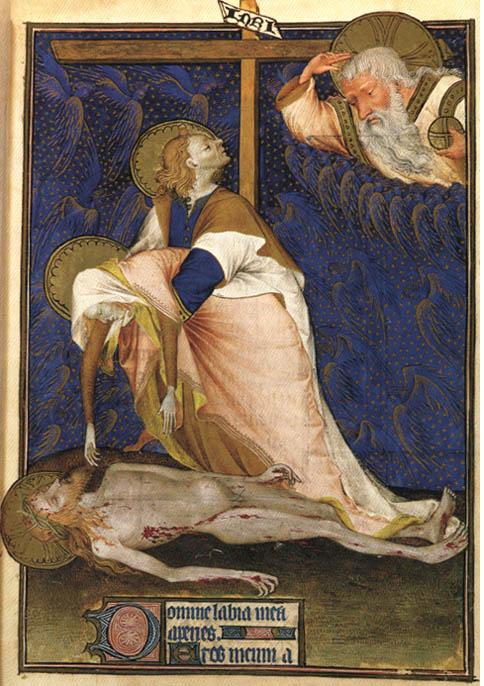
Church tradition has held that John is the author of the Gospel of John and four other books of the New Testament – the three Epistles of John and the Book of Revelation. In the Gospel, authorship is internally credited to the "disciple whom Jesus loved" (ὁ μαθητὴς ὃν ἠγάπα ὁ Ἰησοῦς, o mathētēs on ēgapa o Iēsous) in . claims that the Gospel of John is based on the written testimony of the "Beloved Disciple". The authorship of some Johannine literature has been debated since about the year 200.
In his 4th century Ecclesiastical History, Eusebius says that the First Epistle of John and the Gospel of John are widely agreed upon as his. However, Eusebius mentions that the consensus is that the second and third epistles of John are not his but were written by some other John. Eusebius also goes to some length to establish with the reader that there is no general consensus regarding the revelation of John. The revelation of John could only be what is now called the Book of Revelation. The Gospel according to John differs considerably from the Synoptic Gospels, which were likely written decades earlier. The bishops of Asia Minor supposedly requested him to write his gospel to deal with the heresy of the Ebionites, who asserted that Christ did not exist before Mary. John probably knew of the Gospels of Matthew, Mark, and Luke, but these gospels spoke of Jesus primarily in the year following the imprisonment and death of John the Baptist. Around 600, however, Sophronius of Jerusalem noted that "two epistles bearing his name ... are considered by some to be the work of a certain John the Elder" and, while stating that Revelation was written by John of Patmos, it was "later translated by Justin Martyr and Irenaeus," presumably in an attempt to reconcile tradition with the obvious differences in Greek style.
Until the 19th century, the authorship of the Gospel of John had been attributed to the Apostle John. Many modern scholars such as Colin G. Kruse continue to affirm traditional authorship, but most modern critical scholars have their doubts. Some scholars place the Gospel of John somewhere between AD 65 and 85; John Robinson proposes an initial edition by 50–55 and then a final edition by 65 due to narrative similarities with Paul. Other scholars are of the opinion that the Gospel of John was composed in two or three stages. Most contemporary scholars consider that the Gospel was not written until the latter third of the first century AD, and with the earliest possible date of AD 75–80: "...a date of AD 75–80 as the earliest possible date of composition for this Gospel." Other scholars think that an even later date, perhaps even the last decade of the first century AD right up to the start of the 2nd century (i.e. 90 – 100), is applicable.
Modern, mainstream Bible scholars generally assert that the Gospel of John has been written by an anonymous author and not written by an eyewitness. According to The New Oxford Annotated Bible (2018), modern scholars agree that the gospel was more probably written by a disciple of John son of Zebedee; it could have been the Beloved Disciple or someone who recorded his dictation.
Regarding whether the author of the Gospel of John was an eyewitness, according to Paul N. Anderson, the gospel "contains more direct claims to eyewitness origins than any of the other Gospel traditions." F. F. Bruce argues that 19:35 contains an "emphatic and explicit claim to eyewitness authority." According to Bart Ehrman, the gospel nowhere claims to have been written by direct witnesses to the reported events. According to Hugo Mendez, both the original text of John’s gospel and the epilogue (chapter 21) claims that the work was ‘written’ by an eyewitness. Although the gospel presents its implied author as an eyewitness to Jesus, Mendez argues that this claim should be doubted given the amount of historically dubious content in the work and the commonality of claims to eyewitness testimony in forgeries at the time.
Book of Revelation
According to the Book of Revelation, its author was on the island of Patmos "for the word of God and for the testimony of Jesus", when he was honoured with the vision contained in Revelation.
The author of the Book of Revelation identifies himself as "Ἰωάννης" ("John" in standard English translation). The early 2nd-century writer Justin Martyr was the first to equate the author of Revelation with John the Apostle. However, most biblical scholars now contend that these were separate individuals since the text was written around 100 AD, after the death of John the Apostle,
John the Presbyter, an obscure figure in the early church, has also been identified with the seer of the Book of Revelation by such authors as Eusebius in his Church History (Book III, 39) and Jerome.
John is considered to have been exiled to Patmos, during the persecutions under Emperor Domitian. Revelation 1:9 says that the author wrote the book on Patmos: "I, John, both your brother and companion in tribulation, ... was on the island that is called Patmos for the word of God and for the testimony of Jesus Christ." Adela Yarbro Collins, a biblical scholar at Yale Divinity School, writes:
Some modern critical scholars have raised the possibility that John the Apostle, John the Evangelist, and John of Patmos were three separate individuals. These scholars assert that John of Patmos wrote Revelation but neither the Gospel of John nor the Epistles of John. The author of Revelation identifies himself as "John" several times, but the author of the Gospel of John never identifies himself directly. Some Catholic scholars state that "vocabulary, grammar, and style make it doubtful that the book could have been put into its present form by the same person(s) responsible for the fourth gospel."
Extrabiblical traditions


There is no information in the Bible concerning the duration of John's activity in Judea. According to tradition, John and the other Apostles remained some 12 years in this first field of labour. The persecution of Christians under Herod Agrippa I (r. 41–44 AD) led to the scattering of the Apostles through the Roman Empire's provinces.
A messianic community existed at Ephesus before Paul's first labors there (cf. "the brethren"), in addition to Priscilla and Aquila. The original community was under the leadership of Apollos (1 Corinthians 1:12). They were disciples of John the Baptist and were converted by Aquila and Priscilla. According to tradition, after the Assumption of Mary, John went to Ephesus. Irenaeus writes of "the church of Ephesus, founded by Paul, with John continuing with them until the times of Trajan." From Ephesus he wrote the three epistles attributed to him. John was banished by the Roman authorities to the Greek island of Patmos, where, according to tradition, he wrote the Book of Revelation. According to Tertullian (in The Prescription of Heretics) John was banished (presumably to Patmos) after being plunged into boiling oil in Rome and suffering nothing from it. It is said that all in the audience of Colosseum were converted to Christianity upon witnessing this miracle. This event would have occurred in the 1st century, during the reign of either Emperor Nero or Emperor Domitian, who were both known to have persecuted Christians.
When John was aged, he trained Polycarp who later became Bishop of Smyrna. This was important because Polycarp was able to carry John's message to future generations. Polycarp taught Irenaeus, passing on to him stories about John. Similarly, Ignatius of Antioch was a student of John. In Against Heresies, Irenaeus relates how Polycarp told a story of
It is traditionally believed that John was the youngest of the apostles and survived all of them. He is said to have lived to old age, dying of natural causes at Ephesus sometime after AD 98, during the reign of Trajan, thus becoming the only apostle who did not die as a martyr.
An alternative account of John's death, ascribed by later Christian writers to the early second-century bishop Papias of Hierapolis, claims that he was slain by the Jews. Most Johannine scholars doubt the reliability of its ascription to Papias, but a minority, including B.W. Bacon, Martin Hengel and Henry Barclay Swete, maintain that these references to Papias are credible. Zahn argues that this reference is actually to John the Baptist.
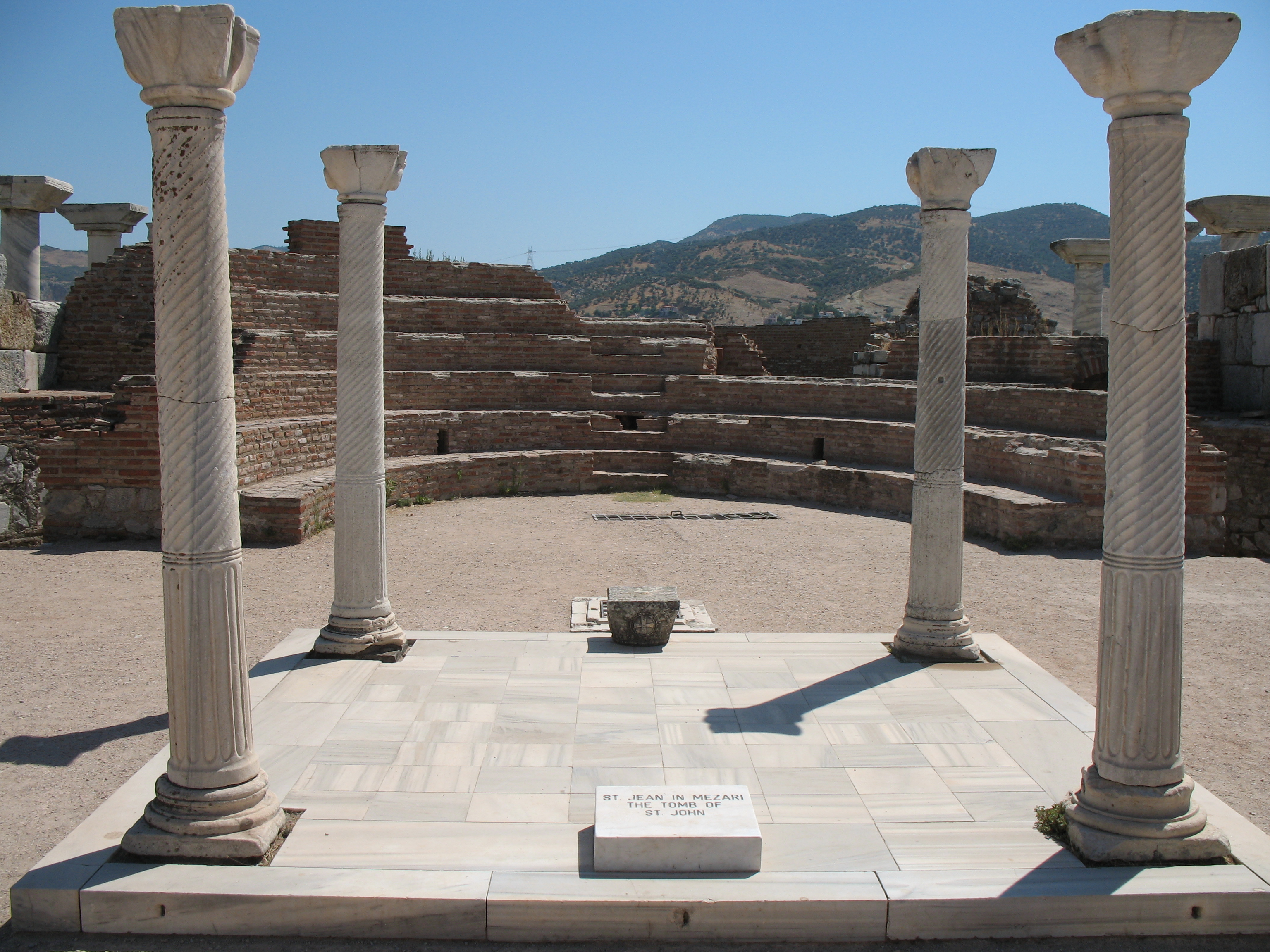
John's tomb is thought to be located in the former Basilica of St. John at Selçuk, a small town in the vicinity of Ephesus. John, along with Virgin Mary and Saint Joseph, belongs among a few saints who left no bodily relics as the opening of his tomb during Constantine the Great's reign yielded no bones. This fact gave rise to the belief that his body was assumed into heaven.
John is also associated with the pseudepigraphal apocryphal text of the Acts of John, which is traditionally viewed as written by John himself or his disciple, Leucius Charinus. It was widely circulated by the second century AD but deemed heretical at the Second Council of Nicaea (787 AD). Varying fragments survived in Greek and Latin within monastic libraries. It contains strong docetic themes, but is not considered in modern scholarship to be Gnostic.
Liturgical commemoration
The feast day of Saint John in the Roman Catholic Church, which calls him "Saint John, Apostle and Evangelist", and in the Anglican Communion and Lutheran Calendars, which call him "Saint John the Apostle and Evangelist", is on 27 December. In the Tridentine calendar he was commemorated also on each of the following days up to and including 3 January, the Octave of the 27 December feast. This Octave was abolished by Pope Pius XII in 1955. The liturgical color is White. John, Apostle and Evangelist is remembered in the Church of England with a Festival on 27 December. In Roman Catholic tradition he is considered patron of Turkey, Asia Minor and Turkish people.
Until 1960, another feast day which appeared in the General Roman Calendar is that of "Saint John Before the Latin Gate" on 6 May, celebrating a tradition recounted by Jerome that St John was brought to Rome during the reign of the Emperor Domitian, and was thrown in a vat of boiling oil, from which he was miraculously preserved unharmed. A church (San Giovanni a Porta Latina) dedicated to him was built near the Latin gate of Rome, the traditional site of this event.
Eastern Orthodoxy
The Eastern Orthodox Church and those Eastern Catholic Churches which follow the Byzantine Rite commemorate the Apostle John on multiple days throughout the Church year.
- February 15: Synaxis of Saint John the Theologian at Diaconissa.
- May 8: Apostle and Evangelist John the Theologian. On this date Christians used to draw forth from his grave fine ashes which were believed to be effective for healing the sick.
- June 30: Synaxis of the Twelve Apostles.
- July 10: Synaxis of Saint John the Theologian in the district of Beatus.
- August 2: Consecration of the Church of Saint John the Theologian near the Great Church.
- September 26: Repose of the Holy Apostle and Evangelist John the Theologian.
Other views
Islamic view
The Quran also speaks of Jesus's disciples but does not mention their names, instead referring to them as "supporters for [the cause of] Allah". The Sunnah did not mention their names either. However, some Muslim scholars mentioned their names, likely relying on the resources of Christians, who are considered "People of the Book" in Islamic tradition. Muslim exegesis more or less agrees with the New Testament list and says that the disciples included Peter, Philip, Thomas, Bartholomew, Matthew, Andrew, James, Jude, John and Simon the Zealot. Notably, narrations of People of the Book (Christians and Jews) are not to be believed or disbelieved by Muslims as long as there is nothing that supports or denies them in Quran or Sunnah.
Druze view
Druze tradition honors several "mentors" and "prophets", and John the Apostle is honored as a prophet. In the Druze tradition and doctrine, Matthew the Apostle is respected for his contributions to spiritual knowledge and guidance. Druze doctrine teaches that Christianity is to be "esteemed and praised", as the Gospel writers are regarded as "carriers of wisdom".
Latter-day Saint (Mormon) view
The Church of Jesus Christ of Latter-day Saints (LDS Church) teaches that, "John is mentioned frequently in latter-day revelation (1 Ne. 14:18–27; 3 Ne. 28:6; Ether 4:16; D&C 7; 27:12; 61:14; 77; 88:141). For Latter-day Saints these passages confirm the biblical record of John and also provide insight into his greatness and the importance of the work the Lord has given him to do on the earth in New Testament times and in the last days. The latter-day scriptures clarify that John did not die but was allowed to remain on the earth as a ministering servant until the time of the Lord's Second Coming (John 21:20–23; 3 Ne. 28:6–7; D&C 7)". It also teaches that in 1829, along with the resurrected Peter and the resurrected James, John visited Joseph Smith and Oliver Cowdery and restored the priesthood authority with Apostolic succession to earth, though a few ex-Latter-Day Saints claim controversially that previous editions of Latter-day scripture contradict this claim of Priesthood authority and Apostolic succession. John, along with the Three Nephites, will live to see the Second Coming of Christ as translated beings.
The Church of Jesus Christ of Latter-Day Saints teaches that John the Apostle is the same person as John the Evangelist, John of Patmos, and the Beloved Disciple.
Freemasonry view
Although Freemasonry is not a religion, it takes as its patron saints St. John the Baptist and St. John the Evangelist. Therefore, the Feast of St. John the Evangelist is used in many jurisdictions as the start of the new masonic year.
In art


As he was traditionally identified with the beloved apostle, the evangelist, and the author of the Revelation and several Epistles, John played an extremely prominent role in art from the early Christian period onward. He is traditionally depicted in one of two distinct ways: either as an aged man with a white or gray beard, or alternatively as a beardless youth.Sources:
- James Hall, Dictionary of Subjects and Symbols in Art, (New York: Harper & Row, 1979), 129, 174–75.
- Carolyn S. Jerousek, "Christ and St. John the Evangelist as a Model of Medieval Mysticism", Cleveland Studies in the History of Art, Vol. 6 (2001), 16. The first way of depicting him was more common in Byzantine art, where it was possibly influenced by antique depictions of Socrates; Jadranka Prolović, "Socrates and St. John the Apostle: the interchangeable similarity of their portraits" Zograf, vol. 35 (2011), 9: "It is difficult to locate when and where this iconography of John originated and what the prototype was, yet it is clearly visible that this iconography of John contains all of the main characteristics of well-known antique images of Socrates. This fact leads to the conclusion that Byzantine artists used depictions of Socrates as a model for the portrait of John." the second was more common in the art of Medieval Western Europe, and can be dated back as far as 4th century Rome.
Legends from the Acts of John, an apocryphal text attributed to John, contributed much to Medieval iconography; it is the source of the idea that John became an apostle at a young age. One of John's familiar attributes is the chalice, often with a serpent emerging from it. This symbol is interpreted as a reference to a legend from the Acts of John, in which John was challenged to drink a cup of poison to demonstrate the power of his faith (the poison being symbolized by the serpent). Other common attributes include a book or scroll, in reference to the writings traditionally attributed to him, and an eagle, which is argued to symbolize the high-soaring, inspirational quality of these writings.
In Medieval and through to Renaissance works of painting, sculpture and literature, Saint John is often presented in an androgynous or feminized manner.*James Hall, Dictionary of Subjects and Symbols in Art, (New York: Harper & Row, 1979), 129, 174–75.
- Jeffrey F. Hamburger, St. John the Divine: The Deified Evangelist in Medieval Art and Theology. (Berkeley: University of California Press, 2002), xxi–xxii; ibidem, 159–160.
- Carolyn S. Jerousek, "Christ and St. John the Evangelist as a Model of Medieval Mysticism", Cleveland Studies in the History of Art, Vol. 6 (2001), 16.
- Annette Volfing, John the Evangelist and Medieval Writing: Imitating the Inimitable. (Oxford: Oxford University Press, 2001), 139. Historians have related such portrayals to the circumstances of the believers for whom they were intended.*Jeffrey F. Hamburger, St. John the Divine: The Deified Evangelist in Medieval Art and Theology. (Berkeley: University of California Press, 2002), xxi–xxii.
- Carolyn S. Jerousek, "Christ and St. John the Evangelist as a Model of Medieval Mysticism" Cleveland Studies in the History of Art, Vol. 6 (2001), 20.
- Sarah McNamer, Affective Meditation and the Invention of Medieval Compassion, (Philadelphia: University of Pennsylvania Press, 2010), 142–148.
- Annette Volfing, John the Evangelist and Medieval Writing: Imitating the Inimitable. (Oxford: Oxford University Press, 2001), 139. For instance, John's feminine features are argued to have helped to make him more relatable to women.*Carolyn S. Jerousek, "Christ and St. John the Evangelist as a Model of Medieval Mysticism" Cleveland Studies in the History of Art, Vol. 6 (2001), 20.
- Annette Volfing, John the Evangelist and Medieval Writing: Imitating the Inimitable. (Oxford: Oxford University Press, 2001), 139. Likewise, Sarah McNamer argues that because of his status as an androgynous saint, John could function as an "image of a third or mixed gender" Sarah McNamer, Affective Meditation and the Invention of Medieval Compassion, (Philadelphia: University of Pennsylvania Press, 2010), 142. and "a crucial figure with whom to identify" Sarah McNamer, Affective Meditation and the Invention of Medieval Compassion, (Philadelphia: University of Pennsylvania Press, 2010), 145. for male believers who sought to cultivate an attitude of affective piety, a highly emotional style of devotion that, in late-medieval culture, was thought to be poorly compatible with masculinity. Sarah McNamer, Affective Meditation and the Invention of Medieval Compassion, (Philadelphia: University of Pennsylvania Press, 2010), 142–148. After the Middle Ages, feminizing portrayals of Saint John continued to be made; a case in point is an etching by Jacques Bellange, shown to the right, described by art critic Richard Dorment as depicting "a softly androgynous creature with a corona of frizzy hair, small breasts like a teenage girl, and the round belly of a mature woman."
In the realm of popular media, this latter phenomenon was brought to notice in Dan Brown's novel The Da Vinci Code (2003), where one of the book's characters suggests that the feminine-looking person to Jesus' right in Leonardo da Vinci's The Last Supper is actually Mary Magdalene rather than St. John.
Gallery of art
File:KellsFol291vPortJohn.jpg|A portrait from the Book of Kells, c. 800 File:John the Apostle from The-Last-Supper-Restored-Da-Vinci 32x16.jpg|From the restored The Last Supper by Leonardo da Vinci, c. 1400s File:San Juan Evangelista y San Francisco El Greco.jpg |John the Apostle and St Francis by El Greco, c. 1600–1614 File:Martyrdom of Saint John the Evangelist by Master of the Winkler Epitaph.jpg|Martyrdom of Saint John the Evangelist by Master of the Winkler Epitaph File:Valentin de boulogne, John and Jesus.jpg|Valentin de Boulogne, John and Jesus File:Simone Cantarini - São João Batista em Meditação.jpg|St. John the Evangelist in meditation by Simone Cantarini (1612–1648), Bologna File:El Greco - St. John - Google Art Project.jpg|Saint John and the Poisoned Cup by El Greco, c. 1610–1614 File:Anônimo - A Última Ceia.jpg|The Last Supper, anonymous painter
References
Sources
- {{Cite book
- {{Cite book |editor1-last = Barton |editor1-first = John |chapter-url = https://books.google.com/books?id=PSHCRgS_SAUC
- {{Cite book
References
- Wills, Garry. (10 March 2015). "The Future of the Catholic Church with Pope Francis". Penguin Publishing Group.
- "The big problem with this argument [of who would die for a lie] is that it assumes precisely what we don't know. We don't know how most of the disciples died. The next time someone tells you they were all martyred, ask them how they know. Or better yet, ask them which ancient source they are referring to that says so. The reality is [that] we simply do not have reliable information about what happened to Jesus' disciples after he died. In fact, we scarcely have any information about them while they were still living, nor do we have reliable accounts from later times. What we have are legends.".
- (2010). "The Encyclopedia of Christian Literature, Volume 2". Scarecrow Press.
- ''Historical Dictionary of Prophets In Islam And Judaism'', Brandon M. Wheeler, ''Disciples of Christ'': "Islam identifies the disciples of Jesus as Peter, Philip, Andrew, Matthew, Thomas, John, James, Bartholomew, and Simon"
- S. Swayd, Samy. (2009). "The A to Z of the Druzes". Rowman & Littlefield.
- McCain, Edward. (2010). "A Gift of Angels: The Art of Mission San Xavier Del Bac". University of Arizona Press.
- P. Foley, Michael. (2020). "Drinking with Your Patron Saints: The Sinner's Guide to Honoring Namesakes and Protectors". Simon and Schuster.
- "On Envy". Church of Saint Michael.
- (1915). "The Disciples of John and the Odes of Solomon". The Monist.
- (2021). "Saint John the Apostle".
- Also {{citation needed span. {{langx. arc. ܝܘܚܢܢ ܫܠܝܚܐ, {{transliteration. arc. Yohanān Shliḥā; {{langx. he. יוחנן בן זבדי, {{transliteration. he. Yohanan ben Zavdi; {{langx. cop. ⲓⲱⲁⲛⲛⲏⲥ or {{lang. cop. ⲓⲱ̅ⲁ; {{lang. hy. Հովհաննես. (June 2021)
- "Repose of the Holy Apostle and Evangelist John the Theologian".
- "Who is Saint John The Theologian? – Saint John The Theologian Greek Orthodox Church".
- (1985). "Understanding the Bible: a Reader's Introduction". Mayfield.
- Kelly, Joseph F.. (1 October 2012). "History and Heresy: How Historical Forces Can Create Doctrinal Conflicts". Liturgical Press.
- Harris, Stephen L.. (1980). "Understanding the Bible: A Reader's Guide and Reference". Mayfield Publishing Company.
- (30 April 2012). "Canon Revisited: Establishing the Origins and Authority of the New Testament Books". Crossway.
- (1988). "The Gospel and Epistles of John: A Concise Commentary". Liturgical Press.
- (14 July 1978). "The Epistles of John". Wm. B. Eerdmans.
- by comparing {{Bibleref2. Matthew. 27:56. NKJV to {{Bibleverse. Mark. 15:40. NKJV
- "Topical Bible: Salome".
- "John 19 Commentary – William Barclay's Daily Study Bible".
- "The Disciples of Our Saviour.".
- "John, The Apostle – International Standard Bible Encyclopedia".
- Media, Franciscan. (27 December 2015). "Saint John the Apostle".
- {{bibleverse. Lk. 9:51-56
- {{bibleref2. Luke. 9:49–50. NKJV NKJV
- {{bibleverse. Acts. 1:13
- {{bibleverse. Mark. 3:13-19
- {{bibleverse. Matthew. 10:2-4
- {{bibleverse. Lk. 6:14-16
- {{bibleverse. Mark. 5:37
- {{bibleverse. Matthew. 17:1
- {{bibleverse. Matthew. 26:37
- {{bibleverse. Lk. 22:8
- While Luke states that this is the Passover ({{bibleverse. Lk. 22:7–9) the Gospel of John specifically states that the Passover meal occurs on the following day ({{bibleverse. Jn. 18:28)
- "St John The Evangelist".
- {{bibleverse. Jn. 13:23–25
- The "beloved disciple" alone, among the Apostles, remained near Jesus at the foot of the cross on [[Calvary]] alongside [[myrrhbearers]] and numerous other women. Following the instruction of Jesus from the Cross, the beloved disciple took [[Mary, the mother of Jesus]], into his care as the last legacy of Jesus.{{bibleverse. Jn. 19:25–27
- {{bibleverse. Jn. 20:1–10
- {{bibleverse. Acts. 3:1. Acts 3:1 ''et seq.''
- {{bibleverse. Acts. 4:3
- {{bibleverse. Acts. 8:14
- (1 October 1910). "Fonck, Leopold. "St. John the Evangelist." The Catholic Encyclopedia. Vol. 8. New York: Robert Appleton Company, 1910. 6 Feb. 2013". Newadvent.org.
- {{bibleref2. John. 13:23, {{bibleref2-nb. John. 19:26, [[John 20:2. 20:2]], {{bibleref2-nb. John. 21:7, {{bibleref2-nb. John. 21:20, {{bibleref2-nb. John. 21:24
- {{bibleverse. Jn. 19:26–27
- {{bibleverse. Jn. 21:1–25
- James D. G. Dunn and John William Rogerson, ''Eerdmans Commentary on the Bible'', Wm. B. Eerdmans Publishing, 2003, p. 1210, {{ISBN. 0-8028-3711-5.
- {{bibleverse. John. 21:20–23
- {{bibleverse. John. 21:24
- Brown, Raymond E. 1970. "The Gospel According to John (xiii–xxi)". New York: Doubleday & Co. Pages 922, 955
- [[Eusebius. Eusebius of Caesarea]], ''Ecclesiastical History'' Book vi. Chapter xxv.
- "CATHOLIC ENCYCLOPEDIA: Apocalypse".
- The History of the Church by Eusibius. Book three, point 24.
- Thomas Patrick Halton, ''On illustrious men'', Volume 100 of The Fathers of the Church, CUA Press, 1999. P. 19.
- Saint [[Sophronius of Jerusalem]]. (2007). "The Explanation of the Holy Gospel According to John". Chrysostom Press.
- Kruse, Colin G.''The Gospel According to John: An Introduction and Commentary'', Eerdmans, 2004, {{ISBN. 0-8028-2771-3, p. 28.
- Kok, Michael. (2017). "The Beloved Apostle?". Cascade Books.
- [[Stephen L. Harris. Harris, Stephen L.]], ''Understanding the Bible'' (Palo Alto: Mayfield, 1985) p. 355
- Harris, Stephen L., ''Understanding the Bible.'' McGraw-Hill, 2006. {{ISBN. 978-0-07-296548-3
- Robinson, John A.T.. (1977). "Redating the New Testament". SCM Press.
- Mark Allan Powell. ''Jesus as a figure in history.'' Westminster John Knox Press, 1998. {{ISBN. 0-664-25703-8 / 978-0664257033
- [[Gail R. O'Day]], introduction to the Gospel of John in ''New Revised Standard Translation of the Bible'', Abingdon Press, Nashville, 2003, p.1906
- Reading John, Francis J. Moloney, SDB, Dove Press, 1995
- E P Sanders, ''The Historical Figure of Jesus'', (Penguin, 1995) page 63 – 64.
- Bart D. Ehrman (2000:43) ''The New Testament: a historical introduction to early Christian writings.'' Oxford University Press.
- Paul N. Anderson, [https://books.google.com/books?id=keBlpFgg4fAC&pg=PA48 The Riddles of the Fourth Gospel], p. 48.
- F. F. Bruce, [https://books.google.com/books?id=0MzO2GD62JUC&pg=PA3 The Gospel of John], p. 3.
- Bart D. Ehrman (2005:235) ''[https://books.google.com/books?id=URdACxKubDIC&pg=PA235 Lost Christianities: the battles for scripture and the faiths we never knew]'' Oxford University Press, New York.
- Bart D. Ehrman (2004:110) ''[https://archive.org/details/truthfictionin00ehrm/page/110 Truth and Fiction in The Da Vinci Code: A Historian Reveals What We Really Know about Jesus, Mary Magdalene, and Constantine.]'' Oxford University Press.
- Bart D. Ehrman(2006:143) ''[https://archive.org/details/lostgospelofjuda00ehrm/page/143 The lost Gospel of Judas Iscariot: a new look at betrayer and betrayed.]'' Oxford University Press.
- Mendez, Hugo. (2020). "Did the Johannine Community Exist?". Journal for the Study of the New Testament.
- {{bibleverse. Rev.. 1:9
- "Revelation, Book of." Cross, F. L., ed. ''The Oxford Dictionary of the Christian Church''. New York: Oxford University Press. 2005
- Justin Martyr, ''Dialogue with Trypho'', 81.4
- Ehrman, Bart D.. (2004). "The New Testament: A Historical Introduction to the Early Christian Writings". Oxford.
- (2011). "The Book of Revelation For Dummies". John Wiley & Sons.
- "Church History, Book III, Chapter 39". NewAdvent.org.
- "De Viris Illustribus (On Illustrious Men) Chapter 9 & 18". newadvent.org.
- Adela Collins. "Patmos". ''Harper's Bible Dictionary''. Paul J. Achtemeier, gen. ed. San Francisco: Harper & Row, 1985. p755.
- [[C. Wilfred Griggs. Griggs, C. Wilfred]]. "John the Beloved" in [[Daniel H. Ludlow. Ludlow, Daniel H.]], ed. ''Selections from the Encyclopedia of Mormonism: Scriptures of the Church'' (Salt Lake City, Utah: [[Deseret Book]], 1992) p. 379. Griggs favors the "one John" theory but mentions that some modern scholars have hypothesized that there are multiple Johns.
- Introduction. Saint Joseph Edition of the New American Bible: Translated from the Original Languages with Critical Use of All the Ancient Sources: including the Revised New Testament and the Revised Psalms. New York: Catholic Book Pub., 1992. 386. Print.
- "Heilige Johannes".
- {{bibleverse. Acts. 12:1–17. cf. Ac 12:1–17
- {{bibleverse. Acts. 18:27
- Vailhé, Siméon. (6 February 2013). "Ephesus". New advent.
- Grant, Robert M.. (1997). "Irenaeus of Lyons". Routledge.
- Irenaeus, ''[[On the Detection and Overthrow of the So-Called Gnosis. Against Heresies]]'', III.3.4.
- "John the Apostle".
- Cheyne, Thomas Kelly. (1901). "John, Son of Zebedee". Adam & Charles Black.
- Rasimus, Tuomas. (2010). "The Legacy of John: Second-Century Reception of the Fourth Gospel". Brill.
- Culpepper, R. Alan. (2000). "John, the Son of Zebedee: The Life of A Legend". Continuum International Publishing Group.
- Swete, Henry Barclay. (1911). "The Apocalypse of St. John". Macmillan.
- [[Procopius of Caesarea]], ''On Buildings'' General Index, trans. H. B. Dewing and Glanville Downey, vol. 7, [[Loeb Classical Library]] 343 (Cambridge, Massachusetts: Harvard University Press, 1940), 319
- (2020). "Truth Is a Synthesis: Catholic Dogmatic Theology". Emmaus Academic.
- Zuzic, Marko. ''A Short History of St. John in Ephesus: The first and Greatest Metropolis of Asia The Cradle of the Hellenic Civilization A Nursery and Garden of Christianity The Second Province of God After Jerusalem with a precious Unique Common Christian-Moslem Shrine''. Private Print: American Society of Ephesus 1st ed. Illustrated 96 pages ''Page 37-45''
- "The Acts of John".
- (2003). "Lost scriptures : books that did not make it into the New Testament". Oxford University Press.
- (16 October 2013). "The Calendar".
- General Roman Calendar of Pope Pius XII
- "The Calendar".
- M. Limberis, Vasiliki. (2011). "Architects of Piety: The Cappadocian Fathers and the Cult of the Martyrs". Oxford University Press.
- ''Saint Andrew Daily Missal with Vespers for Sundays and Feasts'' by Dom. Gaspar LeFebvre, O.S.B., Saint Paul, Minnesota: The E.M. Lohmann Co., 1952, pp.1325–1326
- "Orthodox Calendar: Old Style, February 15; New Style, February 28".
- "Orthodox Calendar: Old Style, May 8; New Style, May 21".
- "Apostle and Evangelist John the Theologian".
- "Synaxis of the Holy, Glorious and All-Praised Twelve Apostles".
- "The Service of Matins on Wednesday, July 10, 2024".
- "Σύναξις Ἁγίου Ἰωάννου τοῦ Θεολόγου ἐν τοῖς Βεάτου".
- "Ἐγκαίνια ἱεροῦ Ναοῦ Ἁγίου Ἰωάννου Θεολόγου πλησίον τῆς ἁγιοτάτης Μεγάλης Ἐκκλησίας".
- "Repose of the Holy Apostle and Evangelist John the Theologian".
- Qur'an 3:52
- Prophet's Sirah by Ibn Hisham, Chapter: Sending messengers of Allah's Messenger to kings, p.870
- (2003). "Historical Dictionary of Prophets in Islam and Judaism". Scarecrow Press (Rowman & Littlefield).
- Musnad el Imam Ahmad Volume 4, Publisher: Dar al Fikr, p.72, Hadith#17225
- (20 January 1956). "On the Horizon: The Strange World of the Druzes".
- "John, Son of Zebedee".
- [[Doctrine and Covenants]] {{lds. dc. 27. 12
- [https://read.cesletter.org/priesthood/#before-1832 Priesthood restoration. CES Letter.]
- [https://archive.bookofmormoncentral.org/content/priesthood-restoration-concerns-questions A CES Letter Reply: Faithful Answers For Those Who Doubt]
- (1979). "KJV (LDS): Bible Dictionary". [[LDS Church]].
- (20 June 2023). "Why is Saint John the Patron Saint of Freemasonry?". California Freemasons.
- James Hall, "John the Evangelist", ''Dictionary of Subjects and Symbols in Art'', rev. ed. (New York: Harper & Row, 1979)
- "Saint John the Apostle". [[Encyclopædia Britannica, Inc.]].
- J.K. Elliot (ed.), ''A Collection of Apocryphal Christian Literature in an English Translation Based on M.R. James'' (New York: Oxford University Press, 1993/2005), 343–345.
- (15 February 1997). "The Sacred and the Sensual". [[The Daily Telegraph]].
This article was imported from Wikipedia and is available under the Creative Commons Attribution-ShareAlike 4.0 License. Content has been adapted to SurfDoc format. Original contributors can be found on the article history page.
Ask Mako anything about John the Apostle — get instant answers, deeper analysis, and related topics.
Research with MakoFree with your Surf account
Create a free account to save articles, ask Mako questions, and organize your research.
Sign up freeThis content may have been generated or modified by AI. CloudSurf Software LLC is not responsible for the accuracy, completeness, or reliability of AI-generated content. Always verify important information from primary sources.
Report