From Surf Wiki (app.surf) — the open knowledge base
John L. Holland
American psychologist (1919–2008)
American psychologist (1919–2008)
| Field | Value |
|---|---|
| name | John Lewis Holland |
| birth_date | |
| birth_place | Omaha, Nebraska, U.S. |
| death_date | |
| death_place | Baltimore, Maryland, U.S. |
| resting_place_coordinates | |
| burial_place | |
| burial_coordinates | |
| education | Ph.D. Psychology, University of Minnesota (1952) |
| B.A. Psychology, University of Nebraska at Omaha (1942) | |
| Omaha Central High School (1938) | |
| occupation | Psychologist, Researcher |
| employer | Johns Hopkins University (1969–1980) |
| known_for | The Holland Codes (Creator) |
| notable_works | Making Vocational Choices: A Theory of Careers |
| The Self Directed Search | |
| The Dictionary of Holland Occupational Codes |
B.A. Psychology, University of Nebraska at Omaha (1942) Omaha Central High School (1938) The Self Directed Search The Dictionary of Holland Occupational Codes
John Lewis Holland (October 21, 1919 – November 27, 2008) was an American psychologist and Professor Emeritus of Sociology at Johns Hopkins University. He was the creator of the career development model, Holland Occupational Themes, commonly known as the Holland Codes.
Early life and education
Holland was born and raised in Omaha, Nebraska. At the age of 20, Holland's father emigrated from England to the U.S. He initially worked as a laborer, later becoming an advertising executive after attending night school at the YMCA. Holland's mother was an elementary school teacher, and he was one of four children.
Holland graduated from Central High, Omaha, Nebraska, in 1938{{cite web
Holland was an "average" student at Minnesota, where he had "trouble finding an interesting" topic for his doctoral dissertation.
Career
His initial work after completing his Ph.D. was at Western Reserve University and the Veteran's Administration Psychiatric Hospital (1953–56). He later worked for the National Merit Scholarship Corporation (1957–63) and the American College Testing Program (1963–69).
Holland joined Johns Hopkins University's Sociology department in 1969, where he published some of his most important research on personality and career choice. He retired from Johns Hopkins in 1980, but continued his research until his death in 2008. Holland died on November 27, 2008, at Union Memorial Hospital at the age of 89. He was awarded the APA Distinguished Scientific Award for the Applications of Psychology in the same month.
Holland Codes
Main article: Holland Codes
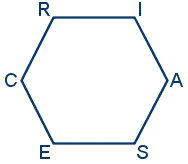
Holland's theory of vocational choice The Holland Occupational Themes, "now pervades career counseling research and practice." The 1959 article in particular ("A Theory of Vocational Choice," published in the Journal of Counseling Psychology) is considered the first major introduction of Holland's "theory of vocational personalities and work environments." Holland originally labeled his six types as "motoric, intellectual, esthetic, supportive, persuasive, and conforming." He later developed and changed them to: Realistic (Doers), Investigative (Thinkers), Artistic (Creators), Social (Helpers), Enterprising (Persuaders), and Conventional (Organizers)."{{cite web
According to the Committee on Scientific Awards, Holland's "research shows that personalities seek out and flourish in career environments they fit and that jobs and career environments are classifiable by the personalities that flourish in them." Holland also wrote of his theory that "the choice of a vocation is an expression of personality." Furthermore, while Holland suggests that people can be "categorized as one of six types," he also argues that "a six-category scheme built on the assumption that there are only six kinds of people in the world is unacceptable on the strength of common sense alone. But a six category scheme that allows a simple ordering of a person's resemblance to each of the six models provides the possibility of 720 different personality patterns."
Holland's typology provides an interpretative structure for a number of different vocational interest surveys, including the two measures he developed: The Vocational Preference Inventory in 1953 and the Self Directed Search (SDS) in 1970 (revised in 1977, 1985, and 1994). Holland continued to work on his theory after his retirement from Johns Hopkins in 1980, finally revising it once again in 1997. He also worked with Gary Gottfredson on a few new inventories. In 1991, they developed the Position Classification Inventory (PCI) which was an outgrowth of their attempt to extend the system to all occupations in 1982, 1989, and 1996. In 1994, they developed The Career Attitudes and Strategies Inventory.
The US Department of Labor ETA has been using an updated and expanded version of the RIASEC model in the "Interests" section of its free online database, The Occupational Information Network (O*NET),{{cite web
Selected publications
- My Life With a Theory: John L. Holland's Autobiography and Theory of Careers (published posthumously in 2020)
- The Career Attitudes and Strategies Inventory (1994, with Gottfredson).
- The Position Classification Inventory (1991, with Gottfredson)
- The Dictionary of Holland Occupational Codes (1982, 1989 & 1996, with Gottfredson)
- Making Vocational Choices: A Theory of Careers (1973, 1985 & 1997)
- The Self Directed Search (1970, 1977, 1985, 1990, 1994 & 2013)
- The Psychology of Vocational Choice (1966)
- The Vocational Preference Inventory (1953)
Notes
References
- "Award for distinguished scientific applications of psychology: John L. Holland." ''American Psychologist'', Vol 63(8), Nov 2008, 672-674.
- [http://associationdatabase.com/aws/NCDA/pt/sd/news_article/6521/_PARENT/layout_details/false JOHN L. HOLLAND, 1919-2008 A SELECT BIBLIOGRAPHY ADDED TO THE TRIBUTE & OBITUARY]
- [https://www.flickr.com/photos/unocrisslibrary/4423207296/ University of Nebraska Graduation Photo of John L. Holland, 1942]
- Its origins "can be traced to an article in the ''Journal of Applied Psychology'' in 1958 and a subsequent article in 1959 that set out his theory of vocational choices [....] The basic premise was that one's occupational preferences were in a sense a veiled expression of underlying character."Athanasou, James. "[http://www.thefreelibrary.com/Obituary%3A+John+L.+Holland+1919-2008.-a0203231318 Obituary: John L. Holland 1919-2008]" ''Australian Journal of Career Development'', September 22, 2009.
- Holland, John. ''Making Vocational Choices: a theory of careers.'' (Prentice-Hall, 1973): 6.
- Holland, John. ''Making Vocational Choices: a theory of careers.'' (Prentice-Hall, 1973): 2.
- Holland, John. ''Making Vocational Choices: a theory of careers.'' (Prentice-Hall, 1973): 3.
This article was imported from Wikipedia and is available under the Creative Commons Attribution-ShareAlike 4.0 License. Content has been adapted to SurfDoc format. Original contributors can be found on the article history page.
Ask Mako anything about John L. Holland — get instant answers, deeper analysis, and related topics.
Research with MakoFree with your Surf account
Create a free account to save articles, ask Mako questions, and organize your research.
Sign up freeThis content may have been generated or modified by AI. CloudSurf Software LLC is not responsible for the accuracy, completeness, or reliability of AI-generated content. Always verify important information from primary sources.
Report