From Surf Wiki (app.surf) — the open knowledge base
John III Sobieski
Ruler of Poland–Lithuania from 1674 to 1696
.jpg)
Ruler of Poland–Lithuania from 1674 to 1696
| Field | Value | |
|---|---|---|
| name | John III Sobieski | |
| title | Defender of the Faith | |
| image | Schultz John III Sobieski.jpg | |
| succession | King of Poland | |
| Grand Duke of Lithuania | ||
| caption | Portrait by Daniel Schultz, 1680 | |
| reign | 19 May 1674 – 17 June 1696 | |
| coronation | 2 February 1676 | |
| cor-type | Poland | |
| predecessor | Michael I | |
| successor | Augustus II | |
| spouse | ||
| issue | {{plainlist | |
| issue-link | #Family | |
| issue-pipe | among others... | |
| house | Sobieski | |
| father | Jakub Sobieski | |
| mother | Zofia Teofillia Daniłowicz | |
| birth_date | ||
| birth_place | Olesko Castle, Olesko, Polish–Lithuanian Commonwealth | |
| death_date | ||
| death_place | Wilanów Palace, Warsaw, Polish–Lithuanian Commonwealth | |
| place of burial | Wawel Cathedral, Kraków | |
| religion | Roman Catholicism | |
| signature | John III Sobieski signature.svg |
Grand Duke of Lithuania | cor-type = Poland
- James, Duke of Oława
- Teresa, Electress of Bavaria
- Prince Aleksander
- Prince Konstanty}} | issue-link = #Family | issue-pipe = among others...
John III Sobieski ( (); (); () 17 August 1629 – 17 June 1696) was King of Poland and Grand Duke of Lithuania from 1674 until his death in 1696.
Born into Polish nobility, Sobieski was educated at the Jagiellonian University and toured Europe in his youth. As a soldier and later commander, he fought in the Khmelnytsky Uprising, the Russo-Polish War and during the Swedish invasion known as the Deluge. Sobieski demonstrated his military prowess during the war against the Ottoman Empire and established himself as a leading figure in Poland and Lithuania. In 1674, he was elected monarch of the Polish–Lithuanian Commonwealth following the sudden and unexpected death of King Michael.
Sobieski's 22-year reign marked a period of the Commonwealth's stabilization, much needed after the turmoil of previous conflicts. Popular among his subjects, he was an able military leader, most famously for his victory over the Ottoman Empire at the Battle of Vienna in 1683. The defeated Ottomans named Sobieski the "Lion of Lechistan", and the Pope hailed him as the saviour of Western Christendom. Suffering from poor health and obesity in later life, Sobieski died in 1696 and was buried at Wawel Cathedral in Kraków. He was succeeded by Augustus II of Poland and Saxony.
Biography
Youth
Both brothers returned to the Commonwealth in 1648. Upon receiving the news of the death of king Władysław IV Vasa and the hostilities of the Khmelnytsky Uprising, they volunteered for the army. They both fought in the siege of Zamość. They founded and commanded their own banners (chorągiew) of cavalry (one light, "cossack", and one heavy, of Polish hussars). Soon, the fortunes of war separated the brothers. In 1649, Jakub fought in the Battle of Zboriv. In 1652, Marek died in Tatar captivity after his capture at the Battle of Batih. John was promoted to the rank of pułkownik and fought with distinction in the Battle of Berestechko. In 1653, he voluntarily spent time as a hostage in the Crimean Tatar capital of Bakhchysarai. A promising commander, John was sent by King John II Casimir as one of the envoys in the diplomatic mission of Mikołaj Bieganowski to the Ottoman Empire. There, Sobieski learned the Tatar language and the Turkish language and studied Ottoman military traditions and tactics. It is likely he participated as part of the briefly allied Polish-Tatar forces in the 1655 Battle of Okhmativ.
After the start of the Swedish invasion of Poland, also known as "The Deluge", John Sobieski was among the Greater Polish regiments led by Krzysztof Opaliński, Palatine of Poznań which capitulated at Ujście, and swore allegiance to King Charles X Gustav of Sweden. However, around late March 1656, he abandoned their side, returning to the side of Polish king John II Casimir Vasa, enlisting under the command of hetmans Stefan Czarniecki and Jerzy Sebastian Lubomirski.
Commander

By 26 May 1656, he received the position of the chorąży koronny (Standard-bearer of the Crown). During the three-day-long battle of Warsaw of 1656, Sobieski commanded a 2,000-man strong regiment of Tatar cavalry. He took part in a number of engagements over the next two years, including the Siege of Toruń in 1658. In 1659, he was elected a deputy to the Sejm (Polish parliament), and was one of the Polish negotiators of the Treaty of Hadiach with the Cossacks. In 1660, he took part in the last offensive against the Swedes in Prussia, and was rewarded with the office of starost of Stryj. Soon afterward he took part in the war against the Russians, participating in the Battle of Slobodyshche and Battle of Lyubar, and later that year he again was one of the negotiators of a new treaty with the Cossacks (the Treaty of Cudnów).
Through personal connections, he became a strong supporter of the French faction in the Polish royal court, represented by Queen Marie Louise Gonzaga. His pro-French allegiance was reinforced in 1665, when he married Marie Casimire Louise de la Grange d'Arquien and was promoted to the rank of the Crown Grand Marshal.
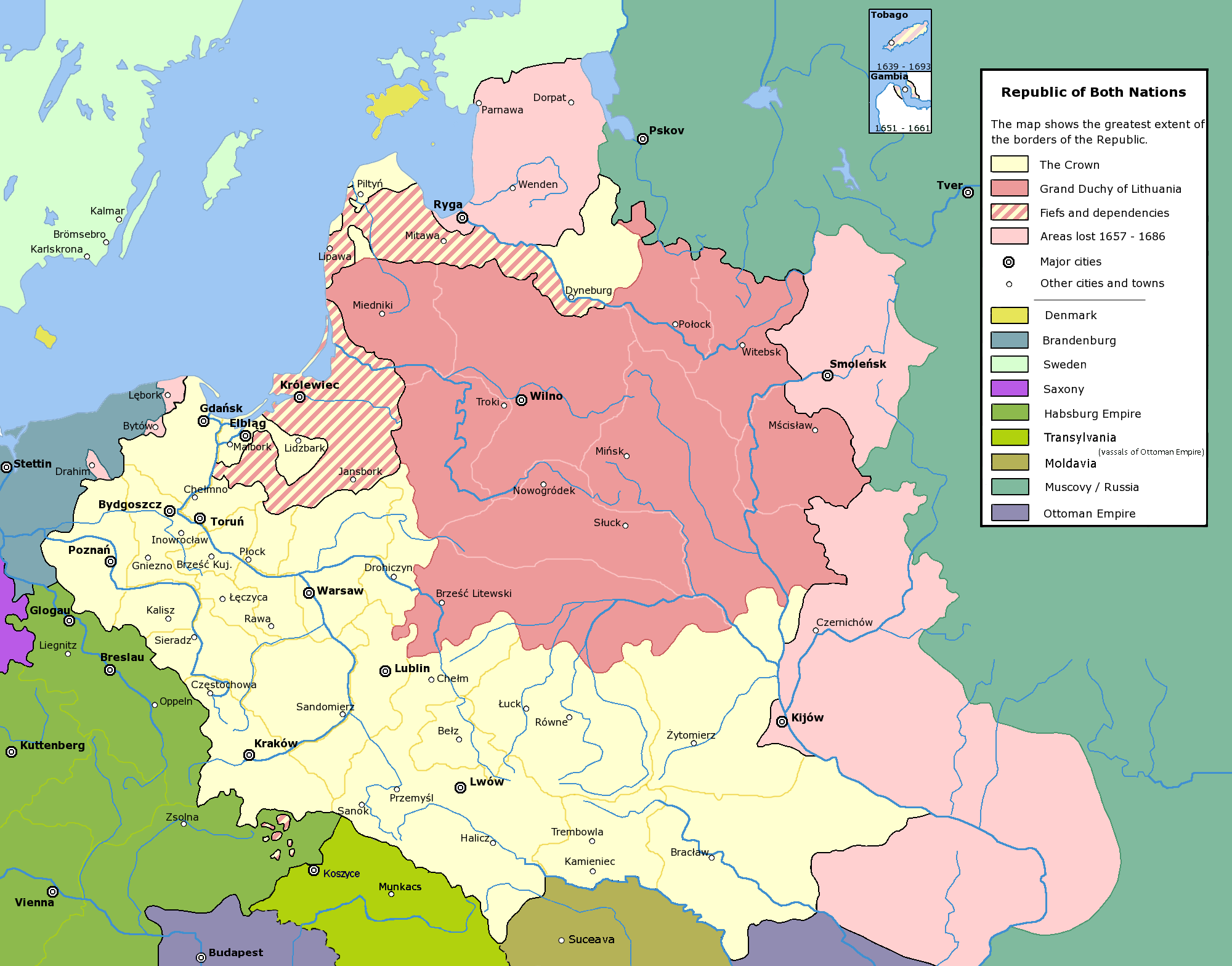
In 1662, he was again elected a deputy to the Sejm, and took part in the work on reforming the military. He was also a member of the Sejm in 1664 and 1665. In between he participated in the Russian campaign of 1663. Sobieski remained loyal to the King during the Lubomirski Rebellion of 1665–66, though it was a difficult decision for him. He participated in the Sejm of 1665, and after some delays, accepted the prestigious office of the Marshal of the Crown on 18 May that year. Around late April or early May 1666 he received another high office of the Commonwealth, that of the Field Crown Hetman. Soon afterward, he was defeated at the Battle of Mątwy, and signed the Agreement of Łęgonice on 21 July, which ended the Lubomirski Rebellion.
In October 1667, he achieved another victory over the Cossacks of Petro Doroshenko and their Crimean Tatar allies in the Battle of Podhajce during the Polish–Cossack–Tatar War (1666–71). This allowed him to regain his image as a skilled military leader. Later that year, in November, his first child, James Louis Sobieski was born in Paris. On 5 February 1668, he achieved the rank of Grand Hetman of the Crown, the highest military rank in the Polish–Lithuanian Commonwealth, and thereby the de facto commander-in-chief of the entire Polish Army. Later that year he supported the French candidacy of Louis, Grand Condé for the Polish throne, and after this candidacy fell apart, Philip William, Elector Palatine. Following the election of Michał Korybut Wiśniowiecki he joined the opposition faction; he and his allies helped veto several sejms (including the coronation ones), and his attitude once again resulted in him losing popularity among the regular szlachta. While his pro-French stance in politics alienated some, his military victories against invading Tatars in 1671 helped him gain other allies.

The year 1672 saw internal politics destabilizing the Commonwealth, as the pro-French faction of Sobieski and pro-court faction of King Michał formed two confederations, which despite major Ottoman incursions in the south seemed more concerned with one another than with uniting to defend the country. The court faction called openly for confiscation of his estates and dismissal from office, and declared him an "enemy of the state". This division culminated in the humiliating Treaty of Buchach, where the Commonwealth was forced to cede territories to the Ottomans, but promise an annual tribute. Sobieski eventually succeeded in balancing politics and national defense, and a combination of his military victories over the invaders, and successful negotiations at the Sejm in April 1673, led to a compromise in which the court faction dropped its demands and challenges against him.
In the year 1672, the Polish-Lithuanian Tatars rose up in open rebellion against the Commonwealth. This was the widely remembered Lipka rebellion. Thanks to the efforts of Sobieski, who was held in great esteem by the Tatar soldiers, many of the Lipkas seeking asylum and service in the Ottoman Army returned to his command.
On 11 November 1673, Sobieski added a major victory to his list, this time defeating the Ottomans in the Battle of Khotyn and capturing the fortress located there. The news of the battle coincided with the death of King Michal the day before the battle. This made Sobieski one of the leading figures of the state, so on 19 May the following year, he was elected monarch of the Commonwealth. His candidacy was almost universally supported, with only a dozen or so members of the diet opposing him (mainly centered around magnates of the Lithuanian Pac family). In light of the war, requiring Sobieski to be on the front lines, the coronation ceremony was significantly delayed – he was crowned John III almost two years later, on 2 February 1676.
King of Poland

Though Poland-Lithuania was at that time the largest and one of the most populous states of Europe, Sobieski became a king of a country devastated by almost half a century of constant war. The treasury was almost empty and the court had little to offer the powerful magnates, who often allied themselves with foreign courts rather than the state.
Sobieski had a number of long-term plans, including establishing his own dynasty in the Commonwealth, regaining lost territories, and strengthening the country through various reforms. One of his ambitions was to unify Christian Europe in a crusade to drive the Turks out of Europe. At the beginning of his reign, however, the Polish state was in dire fiscal straits and faced military threats to the north. King Louis XIV of France promised to mediate a truce between the Ottomans and Poland so that Sobieski could focus his attentions on Prussia. The negotiations ended in failure and Sobieski's Baltic goals had to be tempered by the immediate reality of the Ottoman threat to the south.

In the autumn of 1674, he recommenced the war against the Ottomans and managed to recapture a number of cities and fortresses including Bratslav, Mogilev, and Bar, which re-established a strongly fortified line defending Poland's southern border in Ukraine. In 1675, Sobieski defeated a Turkish and Tatar offensive aiming at Lviv. In 1676, the Tatars began a counter-offensive and crossed the Dneper, but could not retake the strategic town of Żórawno, and a peace treaty (the Treaty of Żurawno) was signed soon afterwards. Although Kamieniec Podolski and much of Podolia remained a part of the Ottoman Empire, Poland gained the return of the towns of Bila Tserkva and Pavoloch.
The treaty with the Ottomans began a period of peace that was much needed for the repair of the country and strengthening of the royal authority. Sobieski managed to reform the Polish army completely. The army was reorganised into regiments, the infantry finally dropped pikes, replacing them with battle-axes, and the Polish cavalry adopted hussar and dragoon formations. Sobieski also greatly increased the number of cannon and introduced new artillery tactics.
Sobieski wanted to conquer Prussia with Swedish troops and French support. Regaining control of this autonomous province was in the Commonwealth's best interest, and Sobieski also hoped for it to become part of his family domain. To this end he made the secret Treaty of Jaworów (1675), but he achieved nothing. The wars with the Ottoman Empire were not decisively won by the Commonwealth, the ruler of Brandenburg-Prussia made treaties with France, Prussia defeated the Swedish invasion, and Sobieski's plans for the Commonwealth's own military campaign against Prussia was opposed by Commonwealth magnates, many of them taking the Prussian side. Backed by Brandenburg and Austria, internal enemies of Sobieski even planned to dethrone him and elect Charles of Lorraine.

The French-Prussian treaty of 1679 meant that Sobieski lost the major foreign ally for his planned campaign against Prussia; consequently, he started to distance himself from the pro-French faction, which, in turn, resulted in the cooling down of the Polish-French relations. During the Sejm of 1683, the French ambassador was expelled for involvement with a plan to dethrone Sobieski, which definitely marked the end of the Polish-French alliance. This did not end the existence of strong internal opposition to Sobieski; however, it changed a number of allegiances, and further opposition was temporarily weakened through the king's successful political maneuvering, including granting the Grand Hetman office to one of the opposition's chief leaders, Stanisław Jan Jabłonowski.

Conscious that Poland lacked allies and risked war against most of its neighbours (a situation similar to the Deluge), Sobieski allied himself by 1683 with Leopold I, of the Holy Roman Empire. Although aimed directly against the Ottomans and indirectly against France, it had the advantage of gaining internal support for the defense of Poland's southern borders.
Meantime, in the spring of 1683, royal spies uncovered Ottoman preparations for a military campaign. Sobieski feared that the target might be the Polish cities of Lwów and Kraków. To counteract the threat, Sobieski began the fortification of the cities and ordered universal military conscription. In July, the Austrian envoy asked for Polish assistance. Soon afterward, the Polish army started massing for an expedition against the Ottomans, and in August was joined by Bavarians and Saxon allies under Charles of Lorraine.
Battle of Vienna
Main article: Battle of Vienna

Sobieski's greatest success came in 1683, with his victory at the Battle of Vienna, in joint command of Polish, Austrian and German troops, against the invading Ottomans under Kara Mustafa. men (including 22,000,–27,000 Poles At 5:30 pm, Sobieski entered the deserted tent of Kara Mustafa and the Battle of Vienna ended.
The Pope and other foreign dignitaries hailed Sobieski as the "Savior of Vienna and Western European civilization." In a letter to his wife, he wrote, "All the common people kissed my hands, my feet, my clothes; others only touched me, saying: 'Ah, let us kiss so valiant a hand!'"

The war against the Ottomans was not yet over, and Sobieski continued the campaign with the Battle of Párkány on 7–9 October. After early victories, the Polish found themselves a junior partner in the Holy League, gaining no lasting territorial or political rewards. The prolonged and indecisive war also weakened Sobieski's position at home. For the next four years Poland would blockade the key fortress at Kamenets, and Ottoman Tatars would raid the borderlands. In 1691, Sobieski undertook another expedition to Moldavia, with slightly better results, but still with no decisive victories.
Later years and death
Although the King spent much time on the battlefields, which could suggest a good state of health, towards the end of his life he became seriously and increasingly ill.
King John III Sobieski died in Wilanów, Poland on 17 June 1696 from a sudden heart attack. although his heart is interred separately in the Church of the Transfiguration in Warsaw, Poland. He was succeeded by Augustus II.
Legacy and significance

Sobieski is remembered in Poland as a "hero king", victor at Vienna who defeated the Ottoman threat, an image that became particularly well recognized after his story was told in many works of 19th-century literature. In the Polish Biographical Dictionary he is described as "an individual above his contemporaries, but still one of them"; an oligarch and a magnate, interested in personal wealth and power.
He failed to reform the ailing Commonwealth, and to secure the throne for his heir. At the same time, he displayed high military prowess, he was well educated and literate, and a patron of science and arts. He supported the astronomer Johannes Hevelius, mathematician Adam Adamandy Kochański and the historian and poet Wespazjan Kochowski. His Wilanów Palace became the first of many palaces that would dot the lands of the Commonwealth over the next two centuries.
In 2024, the city of Vienna rejected a monument to King Jan Sobieski due to concerns about Islamophobia and anti-Turkish sentiment.
Gallery
File:Sobieski Vienna.jpg|Commemorative plaque featuring Sobieski, Vienna Image:Scutum Sobiescianum - Prodromus astronomiae 1690 (5590349).jpg|* Scutum Sobiescianum* – Shield of Sobieski on the sky, by Johannes Hevelius, 1690 File:Agrykola - pomnik Jana III Sobieskiego (2).JPG|Monument of Sobieski in Łazienki Park, Warsaw File:Gdańsk Targ Drzewny - Pomnik Jana III Sobieskiego.JPG|John III Sobieski Monument in Gdańsk, moved from Lwów after World War II File:King John III Sobieski Wilanów.jpg|Equestrian monument of King John III inside Wilanów Palace File:Monument to Jan III Sobieski photo 3- author Czesław Dźwigaj.jpg|Monument of Sobieski in Poland, by Czesław Dźwigaj
Family

On 5 July 1665, he married the widow of Jan Zamoyski, Marie Casimire Louise de la Grange d'Arquien (1641–1716), of Nevers, Burgundy, France. Their children were:
- Jakub Ludwik Sobieski (2 November 1667 – 19 December 1737), married Countess Palatine Hedwig Elisabeth of Neuburg and had issue, including Maria Clementina Sobieska, mother of Charles Edward Stuart
- twin daughters (9 May 1669), stillborn or died shortly after birth
- Teresa Teofila (October 1670)
- Adelajda Ludwika (15 October 1672 – 10 February 1677), called "Barbelune"
- Maria Teresa (18 October 1673 – 7 December 1675), called "La Mannone"
- daughter (October 1674), stillborn or died shortly after birth
- Teresa Kunegunda (4 March 1676 – 10 March 1730), married Maximilian II Emanuel, Elector of Bavaria, and had issue, including Charles VII, Holy Roman Emperor
- Aleksander Benedykt (6 September 1677 – 19 November 1714), died unmarried
- daughter (13 November 1678), stillborn or died shortly after birth
- Konstanty Władysław (1 May 1680 – 28 February 1726), married Maria Józefa Wessel but had no issue
- Jan (4 June 1683 – 1 January/12 April 1685)
- daughter (20 December 1684), stillborn or died shortly after birth
Royal titles
- Official title : Ioannes III, Dei Gratia rex Poloniae, magnus dux Lithuaniae, Russiae, Prussiae, Masoviae, Samogitiae, Livoniae, Smolensciae, Kijoviae, Volhyniae, Podlachiae, Severiae, Czernichoviaeque, etc.
- Official title : *Jan III, z łaski Bożej, król Polski, wielki książę litewski, ruski, pruski, mazowiecki, żmudzki, kijowski, wołyński, podlaski i czernichowski, etc. *
- English translation: John III, by the grace of God King of Poland, Grand Duke of Lithuania, Ruthenia, Prussia, Masovia, Samogitia, Livonia, Smolensk, Kyiv, Volhynia, Podlasie, Severia, and Chernihiv, etc.
Literary references
- Vincenzo da Filicaia (1642–1707) wrote a collection of odes or canzoni about the raising of the siege of Vienna by King John III Sobieski titled "Canzoni in occasione dell'assedio, e liberazione di Vienna," published by Piero Matini in Florence in 1684.
- the first known book review journal Nouvelles de la république des lettres (News from the Republic of Letters), edited and largely written by the Protestant philosopher Pierre Bayle, included a number of works about King Sobieski's victory in its 1st volume: an address to the King (pp. 179–180), Motet Dramatique ou Oratoire (pp. 181–182), Paralelle de Jules Cesar et du Roi de Pologne ("Venit, vidit, vicit..." (pp. 183–185)
- William Wordsworth wrote on 4 February 1816, and published the same year among the "Sonnets dedicated to Liberty" (or "Poems dedicated to Independence and Liberty") his "Siege of Vienna Raised by John Sobieski", which was his take on da Falicaia's ode to Sobieski's victory, about which Wordsworth wrote, "This, and his other poems on the same occasion [of Sobieski's raising the siege of Vienna], are superior perhaps to any lyrical pieces that contemporary events have ever given birth to, those of the Hebrew Scriptures only excepted. - W. W. (1816 and 1820.)"
- Jan Gawiński wrote the poem Clipaeus christianitatis (The shield of Christianity), in praise of Sobieski's defeating the Ottoman Empire.
Popular culture
-
John III Sobieski's character is played by Jerzy Skolimowski in the 2012 English-language Polish and Italian historical drama film The Day of the Siege: September Eleven 1683
-
John III Sobieski sometimes appears in the loading screen in the computer strategy game, Europa Universalis IV.
-
His involvement in the Battle of Vienna is also referenced in the Baroque Cycle novels:
-
He appears in his pre-royalty status as a character in Mount & Blade: With Fire & Sword.
-
Sobieski appears as a character in the historical novel Poland by James A. Michener in a chapter recounting the Battle of Vienna.
References
Bibliography
References
- Aleksander Gieysztor. (1979). "History of Poland". PWN, Polish Scientific Publishers.
- J.A. Hammerton. (2007). "Peoples of All Nations: Their Life Today And Story of Their Past". Concept Publishing Company.
- Mario Reading. (2009). "The Complete Prophecies of Nostradamus". Sterling Publishing Company, Inc.
- (2003). "Liber amicorum". Peeters Publishers.
- Red. (Eds.), ''Jan III Sobieski'', p. 413
- J.B. Morton. "Sobieski, King of Poland".
- {{Harvnb. Tindal Palmer. 1815
- Daniel Stone. (2001). "The Polish–Lithuanian state, 1386–1795". University of Washington Press.
- {{Harvnb. Tindal Palmer. 1815
- {{Harvnb. Tindal Palmer. 1815
- {{Harvnb. Tindal Palmer. 1815
- Brian Glyn Williams. (2013). "The Sultan's Raiders: The Military Role of the Crimean Tatars in the Ottoman Empire".
- (2008). "Vienna 1683: Christian Europe Repels the Ottomans". Osprey Publishing.
- Red. (Eds.), ''Jan III Sobieski'', p. 414
- {{Harvnb. Tindal Palmer. 1815
- Red. (Eds.), ''Jan III Sobieski'', p. 415
- Red. (Eds.), ''Jan III Sobieski'', p. 416
- Frank N. Magill. (2013). "The 17th and 18th Centuries: Dictionary of World Biography". Routledge.
- Howard N. Lupovitch. (2009). "Jews and Judaism in World History". Routledge.
- Joseph Cummins. (2008). "The War Chronicles: From Chariots to Flintlocks". Fair Winds.
- F. L. Carsten. (1961). "The New Cambridge Modern History: Volume 5, The Ascendancy of France, 1648–88". CUP Archive.
- Frank N. Magill. (2013). "The 17th and 18th Centuries: Dictionary of World Biography". Routledge.
- "The Cambridge History of Poland". CUP Archive.
- Mirosław Nagielski. (1995). "Hetmani Rzeczypospolitej Obojga Narodów". Bellona.
- Wiktor Waintraub. (1976). "Memoirs of the Polish Baroque: the writings of Jan Chryzostom Pasek, a squire of the Commonwealth of Poland and Lithuania". University of California Press.
- "The Cambridge History of Poland". CUP Archive.
- Red. (Eds.), ''Jan III Sobieski'', p. 417
- "The Cambridge History of Poland". CUP Archive.
- Miltiades Varvounis. (2012). "JAN SOBIESKI". Xlibris Corporation.
- World Book, Inc. (2007). "The World Book Encyclopedia". Bellona.
- Mizwa, Stephen Paul. (1942). "Great Men and Women of Poland". Macmillan.
- Red. (Eds.), ''Jan III Sobieski'', p. 418
- Red. (Eds.), ''Jan III Sobieski'', p. 419
- FM., RMF. "Kto przewiózł trumnę Marysieńki Sobieskiej do Polski?".
- "Poland.Church of the Transfiguration (Kościół Przemienienia Pańskiego)".
- (15 May 2018). "English: Sarcophagus with the heart of Jan III Sobieski in the Capuchin church in Warsaw".
- "The Cambridge History of Poland". CUP Archive.
- Red. (Eds.), ''Jan III Sobieski'', p.420
- "The Cambridge History of Poland". Cambridge University Press.
- (1856). "Love of Country, or Sobieski and Hedwig. Compiled and translated from the French (of N. A. de Salvandy, the Countess Drohojowska, etc.) by Trauermantel". Crosby, Nichols, and company.
- (13 November 2024). "Vienna cancels statue of Polish king over 'Islamaphobia' fears". Brussels Signal.
- Ignacy Zagórski, Edward Rastawiecki (baron). (1845). "Monety dawnej polski jakoteż prowincyj i miast do niéj niegdy należacych: z trzech ostatnich wieków zebrane". S.H. Merzbach.
- "Treccani – la cultura italiana | Treccani, il portale del sapere".
- (1684). "Canzoni in occasione dell'assedio, e liberatione di Vienna ([Reprod.]) / Di Vincenzio da Filicaia".
- (1684). "Nouvelles de la republique des lettres".
- Jerzy Starnawski, Łacińska scenka dramatyczna ku czci Jana III Sobieskiego na łamach 'Nouvelles de la Republique des Lettres' /1684/, Zeszyty Naukowe Wyższej Szkoły Pedagogicznej w Bydgoszczy. Studia filologiczne 1983 z. 18.
- The Poetical Works of William Wordsworth, Vol. VI (of 8). William Knight (ed.). Macmillan and Co. 1896. p. 110.
- John Frederick Wyatt, "Wordsworth and the Geologists: A Correlation of Influences". 1991. pp. 292–293
- . ["Number of members and other figures"](https://wilanow-palac.pl/en/knowledge/genuine-wars-and-holy-battles).

This article was imported from Wikipedia and is available under the Creative Commons Attribution-ShareAlike 4.0 License. Content has been adapted to SurfDoc format. Original contributors can be found on the article history page.
Ask Mako anything about John III Sobieski — get instant answers, deeper analysis, and related topics.
Research with MakoFree with your Surf account
Create a free account to save articles, ask Mako questions, and organize your research.
Sign up freeThis content may have been generated or modified by AI. CloudSurf Software LLC is not responsible for the accuracy, completeness, or reliability of AI-generated content. Always verify important information from primary sources.
Report