From Surf Wiki (app.surf) — the open knowledge base
John Horton Conway
English mathematician (1937–2020)
English mathematician (1937–2020)
| Field | Value | |
|---|---|---|
| name | John Horton Conway | |
| honorific_suffix | ||
| image | John H Conway 2005 (cropped).jpg | |
| caption | Conway in June 2005 | |
| birth_date | ||
| birth_place | Liverpool, England | |
| death_date | ||
| death_place | New Brunswick, New Jersey, U.S. | |
| education | Gonville and Caius College, Cambridge (BA, MA, PhD) | |
| thesis_title | Homogeneous ordered sets | |
| thesis_url | http://ethos.bl.uk/OrderDetails.do?uin=uk.bl.ethos.597910 | |
| thesis_year | 1964 | |
| doctoral_advisor | Harold Davenport | |
| doctoral_students | {{Plainlist | |
| * Richard Borcherds<ref name | "mathgene"/ | |
| * Adrian Mathias<ref name | "mathgene"/ | |
| * Simon Norton<ref name | "mathgene"/ | |
| * Robert Wilson<ref name | "mathgene"/}} | |
| known_for | {{Plainlist | |
| website | ||
| field | Mathematics | |
| work_institutions | University of Cambridge | |
| Princeton University | ||
| prizes | {{Plainlist |
- Richard Borcherds
- Adrian Mathias
- Simon Norton
- Robert Wilson}}
- ATLAS of Finite Groups
- Conway chained arrow notation
- Conway criterion
- Conway groups
- Conway notation (knot theory)
- Conway's knot polynomial
- Conway polyhedron notation
- Conway's Game of Life
- Doomsday algorithm
- Free will theorem
- Icosians
- Look-and-say sequence
- Mathieu groupoid
- Monstrous moonshine
- Pinwheel tiling
- Surreal numbers}} in his work on combinatorial game theory Princeton University
- Berwick Prize (1971)
- Fellow of the Royal Society (1981)
- Pólya Prize (1987)
- Nemmers Prize in Mathematics (1998)
- Leroy P. Steele Prize (2000)}}
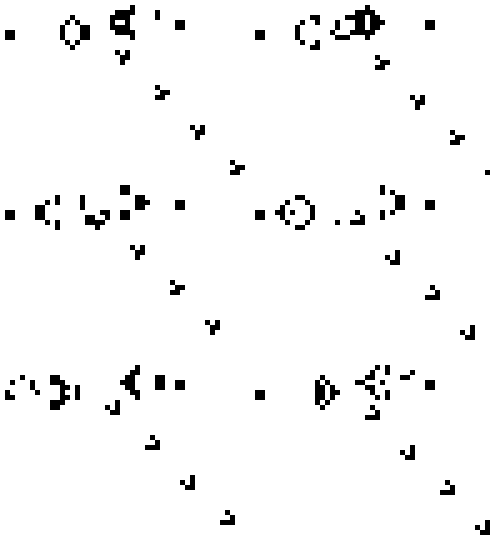
John Horton Conway (26 December 1937 – 11 April 2020) was an English mathematician. He was active in the theory of finite groups, knot theory, number theory, combinatorial game theory and coding theory. He also made contributions to many branches of recreational mathematics, most notably the invention of the cellular automaton called the Game of Life.
Born and raised in Liverpool, Conway spent the first half of his career at the University of Cambridge before moving to the United States, where he held the John von Neumann Professorship at Princeton University for the rest of his career. On 11 April 2020, at age 82, he died of complications from COVID-19.
Early life and education
Conway was born on 26 December 1937 in Liverpool, the son of Cyril Horton Conway and Agnes Boyce. He became interested in mathematics at a very early age. By the time he was 11, his ambition was to become a mathematician. After leaving sixth form, he studied mathematics at Gonville and Caius College, Cambridge. A "terribly introverted adolescent" in school, he took his admission to Cambridge as an opportunity to transform himself into an extrovert, a change which would later earn him the nickname of "the world's most charismatic mathematician".
Conway was awarded a BA in 1959 and, supervised by Harold Davenport, began to undertake research in number theory. Having solved the open problem posed by Davenport on writing numbers as the sums of fifth powers, Conway became interested in infinite ordinals. It appears that his interest in games began during his years studying the Cambridge Mathematical Tripos, where he became an avid backgammon player, spending hours playing the game in the common room.
In 1964, Conway was awarded his doctorate and was appointed as College Fellow and Lecturer in Mathematics at Sidney Sussex College, Cambridge.
After leaving Cambridge in 1986, he took up the appointment to the John von Neumann Chair of Mathematics at Princeton University. There, he won the Princeton University Pi Day pie-eating contest.
Conway and Martin Gardner
Conway's career was intertwined with that of Martin Gardner. When Gardner featured Conway's Game of Life in his Mathematical Games column in October 1970, it became the most widely read of all his columns and made Conway an instant celebrity. For instance, he discussed Conway's game of Sprouts (July 1967), Hackenbush (January 1972), and his angel and devil problem (February 1974). In the September 1976 column, he reviewed Conway's book On Numbers and Games and even managed to explain Conway's surreal numbers.
Conway was a prominent member of Martin Gardner's Mathematical Grapevine. He regularly visited Gardner and often wrote him long letters summarizing his recreational research. In a 1976 visit, Gardner kept him for a week, pumping him for information on the Penrose tilings which had just been announced. Conway had discovered many (if not most) of the major properties of the tilings. Gardner used these results when he introduced the world to Penrose tiles in his January 1977 column. The cover of that issue of Scientific American features the Penrose tiles and is based on a sketch by Conway.
Major areas of research
Recreational mathematics
Main article: Conway's Game of Life
Conway invented the Game of Life, one of the early examples of a cellular automaton. His initial experiments in that field were done with pen and paper, long before personal computers existed. Since Conway's game was popularized by Martin Gardner in Scientific American in 1970, it has spawned hundreds of computer programs, web sites, and articles. It is a staple of recreational mathematics. The LifeWiki is devoted to curating and cataloging the various aspects of the game. From the earliest days, it has been a favorite in computer labs, both for its theoretical interest and as a practical exercise in programming and data display. Conway came to dislike how discussions of him heavily focused on his Game of Life, feeling that it overshadowed deeper and more important things he had done, although he remained proud of his work on it. The game helped to launch a new branch of mathematics, the field of cellular automata. The Game of Life is known to be Turing complete.
Combinatorial game theory
Conway contributed to combinatorial game theory (CGT), a theory of partisan games. He developed the theory with Elwyn Berlekamp and Richard Guy, and also co-authored the book Winning Ways for your Mathematical Plays with them. He also wrote On Numbers and Games (ONAG) which lays out the mathematical foundations of CGT.
He was also one of the inventors of the game sprouts, as well as philosopher's football. He developed detailed analyses of many other games and puzzles, such as the Soma cube, peg solitaire, and Conway's soldiers. He came up with the angel problem, which was solved in 2006.
He invented a new system of numbers, the surreal numbers, which are closely related to certain games and have been the subject of a mathematical novelette by Donald Knuth. He also invented a nomenclature for exceedingly large numbers, the Conway chained arrow notation. Much of this is discussed in the 0th part of ONAG.
Geometry
In the mid-1960s with Michael Guy, Conway established that there are sixty-four convex uniform polychora excluding two infinite sets of prismatic forms. They discovered the grand antiprism in the process, the only non-Wythoffian uniform polychoron. Conway also suggested a system of notation dedicated to describing polyhedra called Conway polyhedron notation.
In the theory of tessellations, he devised the Conway criterion which is a fast way to identify many prototiles that tile the plane.
He investigated lattices in higher dimensions and was the first to determine the symmetry group of the Leech lattice.
Geometric topology
In knot theory, Conway formulated a new variation of the Alexander polynomial and produced a new invariant now called the Conway polynomial. After lying dormant for more than a decade, this concept became central to work in the 1980s on the novel knot polynomials. Conway further developed tangle theory and invented a system of notation for tabulating knots, now known as Conway notation, while correcting a number of errors in the 19th-century knot tables and extending them to include all but four of the non-alternating primes with 11 crossings. The Conway knot is named after him.
Conway's conjecture that, in any thrackle, the number of edges is at most equal to the number of vertices, is still open.
Group theory
He was the primary author of the ATLAS of Finite Groups giving properties of many finite simple groups. Working with his colleagues Robert Curtis and Simon P. Norton he constructed the first concrete representations of some of the sporadic groups. More specifically, he discovered three sporadic groups based on the symmetry of the Leech lattice, which have been designated the Conway groups.{{cite journal |last=Harris |first=Michael |author-link=Michael Harris (mathematician) |date=2015 |title=Mathematics: The mercurial mathematician |journal=Nature |volume=523 |pages=406–7 |doi=10.1038/523406a |others=Review of Genius At Play: The Curious Mind of John Horton Conway
Based on a 1978 observation by mathematician John McKay, Conway and Norton formulated the complex of conjectures known as monstrous moonshine. This subject, named by Conway, relates the monster group with elliptic modular functions, thus bridging two previously distinct areas of mathematics—finite groups and complex function theory. Monstrous moonshine theory has now been revealed to also have deep connections to string theory.
Conway introduced the Mathieu groupoid, an extension of the Mathieu group M12 to 13 points.
Number theory
As a graduate student, he proved one case of a conjecture by Edward Waring, that every integer could be written as the sum of 37 numbers each raised to the fifth power, though Chen Jingrun solved the problem independently before Conway's work could be published. In 1972, Conway proved that a natural generalization of the Collatz problem is algorithmically undecidable. Related to that, he developed the esoteric programming language FRACTRAN. While lecturing on the Collatz conjecture, Terence Tao (who was taught by him in graduate school) mentioned Conway's result and said that he was "always very good at making extremely weird connections in mathematics".
Algebra
Conway wrote a textbook on Stephen Kleene's theory of state machines, and published original work on algebraic structures, focusing particularly on quaternions and octonions. Together with Neil Sloane, he invented the icosians.
Analysis
He invented his base 13 function as a counterexample to the converse of the intermediate value theorem: the function takes on every real value in each interval on the real line, so it has a Darboux property but is not continuous.
Algorithmics
For calculating the day of the week, he invented the Doomsday algorithm. The algorithm is simple enough for anyone with basic arithmetic ability to do the calculations mentally. Conway could usually give the correct answer in under two seconds. To improve his speed, he practised his calendrical calculations on his computer, which was programmed to quiz him with random dates every time he logged on. One of his early books was on finite-state machines.
Theoretical physics
In 2004, Conway and Simon B. Kochen, another Princeton mathematician, proved the free will theorem, a version of the "no hidden variables" principle of quantum mechanics. It states that given certain conditions, if an experimenter can freely decide what quantities to measure in a particular experiment, then elementary particles must be free to choose their spins to make the measurements consistent with physical law. Conway said that "if experimenters have free will, then so do elementary particles."
Personal life and death
Conway was married three times. With his first two wives he had two sons and four daughters. He married Diana in 2001 and had another son with her.{{cite web
On 8 April 2020, Conway developed symptoms of COVID-19. On 11 April, he died in New Brunswick, New Jersey, at the age of 82.
Awards and honours
Conway received the Berwick Prize (1971), was elected a Fellow of the Royal Society (1981), became a fellow of the American Academy of Arts and Sciences in 1992, was the first recipient of the Pólya Prize (LMS) (1987), won the Nemmers Prize in Mathematics (1998) and received the Leroy P. Steele Prize for Mathematical Exposition (2000) of the American Mathematical Society. In 2001 he was awarded an honorary degree from the University of Liverpool, and in 2014 one from Alexandru Ioan Cuza University. His Fellow of the Royal Society nomination in 1981 reads:
In 2017 Conway was given honorary membership of the British Mathematical Association.
Conferences called Gathering 4 Gardner are held every two years to celebrate the legacy of Martin Gardner, and Conway himself was often a featured speaker at these events, discussing various aspects of recreational mathematics.
Select publications
- 1971 – Regular algebra and finite machines. Chapman and Hall, London, 1971, Series: Chapman and Hall mathematics series, .
- 1976 – On numbers and games. Academic Press, New York, 1976, Series: L.M.S. monographs, 6, .
- 1979 – On the Distribution of Values of Angles Determined by Coplanar Points (with Paul Erdős, Michael Guy, and H. T. Croft). Journal of the London Mathematical Society, vol. II, series 19, pp. 137–143.
- 1979 – Monstrous Moonshine (with Simon P. Norton). Bulletin of the London Mathematical Society, vol. 11, issue 2, pp. 308–339.
- 1982 – Winning Ways for your Mathematical Plays (with Richard K. Guy and Elwyn Berlekamp). Academic Press, .
- 1985 – Atlas of finite groups (with Robert Turner Curtis, Simon Phillips Norton, Richard A. Parker, and Robert Arnott Wilson). Clarendon Press, New York, Oxford University Press, 1985, .
- 1988 – Sphere Packings, Lattices and Groups (with Neil Sloane). Springer-Verlag, New York, Series: Grundlehren der mathematischen Wissenschaften, 290, .
- 1995 – Minimal-Energy Clusters of Hard Spheres (with Neil Sloane, R. H. Hardin, and Tom Duff). Discrete & Computational Geometry, vol. 14, no. 3, pp. 237–259.
- 1996 – The Book of Numbers (with Richard K. Guy). Copernicus, New York, 1996, .
- 1997 – The Sensual (quadratic) Form (with Francis Yein Chei Fung). Mathematical Association of America, Washington, DC, 1997, Series: Carus mathematical monographs, no. 26, .
- 2002 – On Quaternions and Octonions (with Derek A. Smith). A. K. Peters, Natick, MA, 2002, .
- 2008 – The Symmetries of Things (with Heidi Burgiel and Chaim Goodman-Strauss). A. K. Peters, Wellesley, MA, 2008, .
References
Sources
- Alpert, Mark (1999). Not Just Fun and Games Scientific American, April 1999
- Boden, Margaret (2006). Mind As Machine, Oxford University Press, 2006, p. 1271
- du Sautoy, Marcus (2008). Symmetry, HarperCollins, p. 308
- Guy, Richard K (1983). Conway's Prime Producing Machine Mathematics Magazine, Vol. 56, No. 1 (Jan 1983), pp. 26–33
- Princeton University (2009). Bibliography of John H. Conway Mathematics Department
- Seife, Charles (1994). Impressions of Conway The Sciences
- Schleicher, Dierk (2011), Interview with John Conway, Notices of the AMS
References
- {{MathGenealogy
- J J O'Connor and E F Robertson. (2004). "John Conway – Biography".
- (2020-04-12). "COVID-19 Kills Renowned Princeton Mathematician, 'Game Of Life' Inventor John Conway In 3 Days".
- "CONWAY, Prof. John Horton". Who's Who 2014, A & C Black, an imprint of Bloomsbury Publishing plc, 2014; online edn, Oxford University Press.
- "John Horton Conway".
- (2006). "Mathematical Frontiers". Infobase Publishing.
- (23 July 2015). "John Horton Conway: the world's most charismatic mathematician". [[The Guardian]].
- Mark Ronan. (18 May 2006). "Symmetry and the Monster: One of the greatest quests of mathematics". Oxford University Press, UK.
- Sooyoung Chang. (2011). "Academic Genealogy of Mathematicians". World Scientific.
- "This Is How the Number 3.14 Got the Name 'Pi'".
- Mulcahy, Colm (21 October 2014) ''[https://www.bbc.com/news/magazine-29688355 Martin Gardner, puzzle master extraordinaire]'', ''[[BBC News Magazine]]'': "The Game of Life appeared in Scientific American in 1970, and was by far the most successful of Gardner's columns, in terms of reader response."
- Gardner and Conway had first corresponded in the late 1950s, and over the years Gardner had frequently written about recreational aspects of Conway's work.[http://mathfactor.uark.edu/2010/06/ha-conway-on-gardner/ The Math Factor Podcast Website] John H. Conway reminisces on his long friendship and collaboration with Martin Gardner.
- Gardner, Martin (1989) ''Penrose Tiles to Trapdoor Ciphers'', W. H. Freeman & Co., {{ISBN. 0-7167-1987-8, Chapter 4. A non-technical overview; reprint of the 1976 Scientific American article.
- Jackson, Allyn. (2005). "Interview with Martin Gardner". Notices of the AMS.
- Roberts, Siobhan. (28 August 2015). "A Life In Games: The Playful Genius of John Conway". Quanta Magazine.
- Gardner, Martin. (October 1970). "Mathematical Games: The fantastic combinations of John Conway's new solitaire game "Life"".
- "DMOZ: Conway's Game of Life: Sites".
- "LifeWiki".
- Numberphile. (2014-03-03). "Does John Conway hate his Game of Life?".
- MacTutor History: The game made Conway instantly famous, but it also opened up a whole new field of mathematical research, the field of cellular automata.
- Rendell, Paul. (July 2015). "Turing Machine Universality of the Game of Life". Springer.
- Case, James. (1 April 2014). "Martin Gardner's Mathematical Grapevine".
- [http://discovermagazine.com/1995/dec/infinityplusonea599 Infinity Plus One, and Other Surreal Numbers] by Polly Shulman, [[Discover Magazine]], 1 December 1995
- Conway, J. H.. (1967). "Four-dimensional Archimedean polytopes". Kobenhavns Univ. Mat. Institut.
- (2005). "Planar tilings by polyominoes, polyhexes, and polyiamonds". Journal of Computational and Applied Mathematics.
- Weisstein, Eric W.. "Conway Polynomial".
- Livingston, Charles (1993) ''Knot Theory''. MAA Textbooks. {{ISBN. 0883850273
- Perko, Ken. (1982). "Primality of certain knots". Topology Proceedings.
- Darling, David. "Monstrous Moonshine conjecture".
- [[Jorge Nuno Silva]]. (September 2005). "Breakfast with John Horton Conway". EMS Newsletter.
- (30 October 2021). "Day 2 - The notorious Collatz conjecture - Terence Tao".
- Baez, John C.. (2005). "Book Review: ''On quaternions and octonions: Their geometry, arithmetic, and symmetry''". Bulletin of the American Mathematical Society.
- Baez, John. (2 October 1993). "This Week's Finds in Mathematical Physics (Week 20)".
- ''[http://www.cs.auckland.ac.nz/~jas/one/freewill-theorem.html Conway's Proof Of The Free Will Theorem] {{Webarchive. link. (25 November 2017 '' by Jasvir Nagra)
- (12 April 2020). "COVID-19 Kills Renowned Princeton Mathematician, 'Game Of Life' Inventor John Conway In 3 Days".
- Zandonella, Catherine. (14 April 2020). "Mathematician John Horton Conway, a 'magical genius' known for inventing the 'Game of Life,' dies at age 82". [[Princeton University]].
- Van den Brandhof, Alex. (12 April 2020). "Mathematician Conway was a playful genius and expert on symmetry". [[NRC Handelsblad]].
- Roberts, Siobhan. (15 April 2020). "John Horton Conway, a 'Magical Genius' in Math, Dies at 82". [[The New York Times]].
- Mulcahy, Colm. (2020-04-23). "John Horton Conway obituary". The Guardian.
- "List of LMS prize winners | London Mathematical Society".
- "John Conway".
- Curtis, Robert Turner. (2022). "John Horton Conway. 26 December 1937—11 April 2020". Biographical Memoirs of Fellows of the Royal Society.
- Sturla, Anna. (14 April 2020). "John H. Conway, a renowned mathematician who created one of the first computer games, dies of coronavirus complications".
- (19 June 2014). "Doctor Honoris Causa for John Horton Conway".
- "Honorary Members".
- [http://gathering4gardner.org/VIDEOS.html Presentation Videos] {{webarchive. link. (9 August 2016 from 2014 Gathering 4 Gardner)
- Bellos, Alex (2008). [https://www.theguardian.com/science/2008/may/31/maths.science The science of fun]. ''The Guardian'', 30 May 2008
- (1 October 1979). "Monstrous Moonshine". Bulletin of the London Mathematical Society.
- Guy, Richard K.. (1989). "Review: ''Sphere packings, lattices and groups'', by J. H. Conway and N. J. A. Sloane". Bulletin of the American Mathematical Society.
This article was imported from Wikipedia and is available under the Creative Commons Attribution-ShareAlike 4.0 License. Content has been adapted to SurfDoc format. Original contributors can be found on the article history page.
Ask Mako anything about John Horton Conway — get instant answers, deeper analysis, and related topics.
Research with MakoFree with your Surf account
Create a free account to save articles, ask Mako questions, and organize your research.
Sign up freeThis content may have been generated or modified by AI. CloudSurf Software LLC is not responsible for the accuracy, completeness, or reliability of AI-generated content. Always verify important information from primary sources.
Report